

Crypto and the Idea of Trustless Societies
 Michael Willson
What Does “Trustless” Mean in the World of Crypto?
In crypto, “trustless” doesn’t mean untrustworthy. It describes a digital environment where people can interact, trade, and verify transactions without depending on a central authority. In traditional finance, users must trust banks, brokers, and governments to maintain accurate records and enforce rules. In a trustless system, the rules are programmed into code and validated through consensus across a decentralized network.
This simple but powerful concept forms the backbone of blockchain innovation. The idea of a trustless society suggests that coordination, trade, and verification can occur transparently—where code, not corporations, guarantees fairness.

To understand how artificial intelligence and blockchain engineering make these systems reliable, a strong foundation in data-driven automation is essential. You can start with a Crypto certification to explore how algorithms and consensus models are changing financial and social systems.
How Does Blockchain Create a Trustless Environment?
Blockchain achieves trustlessness through a combination of cryptography, distributed consensus, and transparency. It replaces the need for intermediaries with verifiable, tamper-resistant records. Each transaction is recorded across thousands of nodes, ensuring no single entity can manipulate data.
Here’s how it works:
- Consensus Mechanisms: Systems like Proof of Work or Proof of Stake ensure all participants agree on a single version of truth.
- Cryptography: Public and private keys verify ownership and prevent forgery.
- Transparency: Anyone can view blockchain data, making tampering instantly visible.
- Automation through Smart Contracts: Predefined rules execute transactions when conditions are met, removing the need for third-party enforcement.
Together, these components make trust programmable, not personal.
The Importance of a Trustless Crypto Society
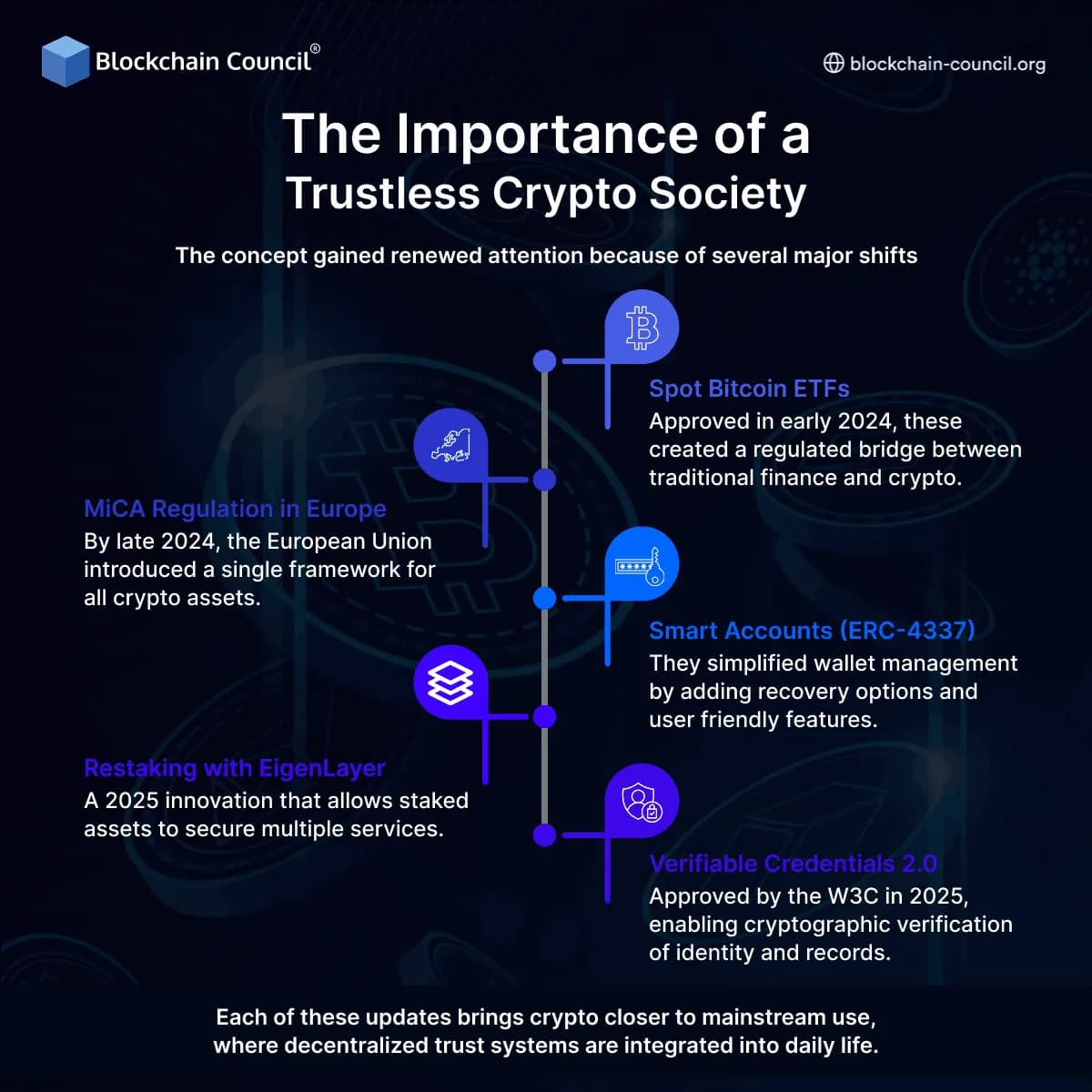
The concept gained renewed attention because of several major shifts:
- Spot Bitcoin ETFs: Approved in early 2024, these created a regulated bridge between traditional finance and crypto.
- MiCA Regulation in Europe: By late 2024, the European Union introduced a single framework for all crypto assets.
- Smart Accounts (ERC-4337): They simplified wallet management by adding recovery options and user-friendly features.
- Restaking with EigenLayer: A 2025 innovation that allows staked assets to secure multiple services.
- Verifiable Credentials 2.0: Approved by the W3C in 2025, enabling cryptographic verification of identity and records.
Each of these updates brings crypto closer to mainstream use, where decentralized trust systems are integrated into daily life.
What Does a Trustless Society Look Like in Practice?
A trustless society is not a world without trust—it’s a world where trust shifts from institutions to systems. Everyday experiences already reflect this transformation:
- Money and Payments: People store and transfer value using digital wallets instead of banks.
- Investing: Smart contracts manage portfolios transparently.
- Identity: Digital credentials let users prove qualifications without revealing personal details.
- Governance: Online communities use decentralized voting for decision-making.
- Social Media: Platforms like Farcaster give users ownership of their profiles and followers.
These examples show that trustless systems are reshaping not only finance but also social structures and governance.
How Do Crypto Systems Build Trust Without Middlemen?
Trustless environments rely on mathematics and transparency rather than authority.
- Every transaction is verified publicly.
- Every rule is encoded in software.
- Every outcome is visible to the network.
That transparency builds confidence naturally. Participants can independently audit behavior instead of relying on statements from institutions.
To understand how data science supports this kind of trust infrastructure, professionals can pursue the Data Science Certification, which explains how models analyze and verify large data sets.
What Are the Core Components of a Trustless Economy?
The structure of a decentralized economy depends on a few core technologies:
- Smart Contracts: These execute automatically when preset conditions are met.
- Decentralized Identity: Users own their credentials and can prove them securely.
- Non-Custodial Wallets: Investors hold their private keys instead of third parties.
- Oracles: They connect real-world data to blockchain applications.
- Restaking Protocols: They expand network security by using the same stake across multiple layers.
Each innovation contributes to self-sustaining systems where reliability doesn’t depend on trust in a middleman.
How Do Regulation and Innovation Interact?
Global regulators are trying to balance innovation with consumer safety.
- In the United States, financial authorities focus on preventing fraud and improving transparency.
- In Europe, MiCA provides uniform laws for crypto companies, promoting innovation under clear guidelines.
- In Asia, countries like Singapore and South Korea are experimenting with flexible sandboxes for DeFi projects.
The rise of crypto ETFs, regulatory clarity, and digital identity standards indicates that decentralization is not about escaping oversight but about creating verifiable transparency.
How Are Smart Accounts Making Trustless Systems Easier to Use?
A major hurdle in crypto adoption was wallet complexity. Forgetting a seed phrase could mean losing everything. Smart accounts, introduced through Ethereum’s ERC-4337 standard, fix that.
Key features include:
- Password recovery through social or multi-signature backups.
- Gas fee abstraction so users can pay in stablecoins instead of ETH.
- Session keys for temporary permissions.
- Spending limits and automation controls.
These features make crypto more accessible while maintaining decentralization.
How Does Restaking Strengthen Shared Security?
Restaking is one of 2025’s biggest breakthroughs. It allows the same staked cryptocurrency to secure multiple networks, services, or applications.
Benefits include:
- More efficient use of capital.
- Greater network security.
- Incentives for validators to support multiple ecosystems.
However, restaking also introduces risks if the same collateral secures too many systems. Developers are actively designing slashing and insurance mechanisms to prevent cascading failures.
Understanding how autonomous systems handle these trade-offs aligns well with the agentic ai certification, which explores how agents make decisions under complex, rule-driven environments.
How Do Verifiable Credentials Reinvent Digital Identity?
A crucial part of trustless societies is portable, privacy-preserving identity. Verifiable credentials (VCs) allow users to prove facts—like age, education, or creditworthiness—without revealing unnecessary personal data.
For example:
- A student can show proof of graduation without sharing their transcript.
- An employee can confirm work authorization without exposing other details.
These systems depend on decentralized identifiers (DIDs), which are owned by users instead of corporations. It’s a shift toward personal empowerment, one that mirrors how blockchain gives people control over money.
How Do DAOs Represent the Governance Layer of Trustless Societies?
Decentralized autonomous organizations (DAOs) operate on transparent rules stored in smart contracts. They use on-chain voting and community proposals to make collective decisions.
MakerDAO’s 2024-2025 restructuring—known as the “Endgame” plan—shows how governance can evolve without traditional hierarchies. Token holders decide upgrades, financial parameters, and treasury allocations.
This model demonstrates how communities can coordinate large-scale projects transparently. It’s not perfect, but it offers a blueprint for decentralized management in business, charity, and even government.
How Is AI Supporting Crypto’s Trustless Vision?
AI plays a growing role in improving blockchain systems. Algorithms help:
- Detect fraud and suspicious activity.
- Optimize smart contract execution.
- Automate market-making and portfolio rebalancing.
- Translate complex blockchain data into simple insights for users.
To stay competitive in this evolving field, professionals can pursue AI certs to strengthen their understanding of machine learning applications in decentralized systems.
How Are Decentralized Identities Shaping Governance?
Decentralized identities are critical to future e-governance and voting systems. They can verify citizenship or eligibility without central databases.
Projects like Estonia’s digital ID system and blockchain-based voting pilots in universities show how verifiable identity enhances transparency. Citizens could eventually participate in secure online elections verified cryptographically.
The potential of decentralized governance goes far beyond money—it’s about creating open, accountable communities.
What Role Does Blockchain Play in Redefining Social Trust?
In traditional systems, institutions mediate trust. In blockchain-based environments, that trust is distributed.
- Transparency: Every action is recorded and verifiable.
- Auditability: Anyone can check compliance or spending.
- Resilience: No single authority can erase history.
The social impact is enormous. Blockchain-based communities can fund projects, support creators, or distribute aid without intermediaries.
Learners interested in mastering these applications can explore blockchain technology courses to see how decentralized architecture enables fairness in digital systems.
How Does Crypto Create Economic Empowerment?
Crypto’s most significant impact is financial inclusion. Billions of people without access to banks can now transact globally with only a smartphone.
Benefits include:
- Direct peer-to-peer payments.
- Instant cross-border transfers.
- Asset ownership through tokenization.
- Access to global capital without middlemen.
For developing economies, this represents an unprecedented opportunity to leapfrog outdated infrastructure.
Professionals exploring long-term strategies can enhance their understanding with tech certifications that combine digital finance, AI, and blockchain innovation.
How Are Institutions Responding to the Trustless Movement?
Institutions are adapting rather than resisting. Many now integrate blockchain into operations or offer hybrid models that blend decentralization with compliance.
Banks use private blockchain for settlements, while corporations tokenize assets to improve liquidity. Governments test digital currencies that maintain sovereignty but adopt cryptographic security.
This convergence suggests that “trustless” doesn’t mean eliminating institutions—it means redesigning them around transparency and shared rules.
How Are ETFs and Regulation Helping Adoption?
The approval of Bitcoin ETFs legitimized crypto for mainstream investors. Institutional money adds liquidity and stability, which benefits all participants.
Similarly, the MiCA regulation gives European investors confidence that stablecoins and exchanges operate under strict guidelines. Regulation provides a path for responsible growth rather than suppression.
These shifts indicate that decentralization can work within legal frameworks, not outside them.
What Are the Challenges of Building a Trustless World?
The vision is compelling, but it comes with obstacles:
- Complex User Experience: Wallets and seed phrases can be confusing.
- Regulatory Ambiguity: Different countries interpret crypto laws differently.
- Scalability: Public blockchains must handle global traffic efficiently.
- Security: Smart contract bugs can still lead to loss of funds.
- Public Perception: Misunderstanding of “trustless” can create fear.
Each challenge is being addressed through education, design innovation, and clearer policies.
How Does Crypto Interact with AI in Financial Systems?
AI and blockchain increasingly intersect in predictive analytics, fraud detection, and automated trading.
An AI trading course helps investors understand algorithmic strategies that analyze patterns and optimize performance.
Likewise, portfolio managers use AI to forecast returns and blockchain to verify results publicly. The synergy of these tools makes markets smarter and more accountable.
What Ethical Considerations Come with Trustless Systems?
Ethics remains crucial. A trustless society still requires moral principles. Code can enforce fairness, but it cannot define values.
Developers must decide how much control to automate, how to prevent bias, and how to balance privacy with compliance. As decentralized identity and AI grow, these decisions will shape the moral framework of future economies.
Learning ethics, data handling, and automation principles is part of the Marketing and Business Certification, which focuses on responsible leadership in digital ecosystems.
How Do Proof-of-Personhood and Privacy Conflict?
Some projects use biometrics to prove uniqueness online, but this raises serious privacy issues. Collecting personal data contradicts decentralization’s goal of anonymity and autonomy.
Authorities in Spain, Hong Kong, and the EU have challenged projects that store biometric information, forcing teams to redesign their systems. The debate continues between identity verification and personal freedom.
How Can Professionals Build Careers in This Space?
As crypto integrates into more sectors, the demand for qualified experts is skyrocketing. Professionals can focus on areas like blockchain auditing, data analysis, policy consulting, or Web3 education.
Those interested in financial engineering can pursue the AI powered investment course to understand how intelligent systems manage decentralized assets.
The trustless economy will rely on skilled builders who understand both code and community.
How Is AI Helping Secure Trustless Networks?
AI enhances blockchain security by analyzing behavior patterns and identifying potential exploits before they occur. Machine learning models can predict attack vectors, detect anomalies, and strengthen network defenses.
For crypto exchanges and DeFi apps, these predictive layers are essential for preventing fraud and safeguarding user funds.
How Do Crypto and Trustless Systems Affect Society Beyond Finance?
Beyond money, the principles of trustless design can apply to healthcare, education, supply chains, and voting.
- Healthcare: Patients control their records using verifiable credentials.
- Education: Diplomas are issued on-chain to prevent forgery.
- Supply Chains: Every product movement is traceable from origin to sale.
- Voting: Citizens verify election integrity through transparent audit trails.
Each use case shows how the trustless model strengthens accountability and inclusion.
What Will the Future of Trustless Societies Look Like?
The next few years will focus on integration, not isolation. Expect to see:
- Governments adopting decentralized identity frameworks.
- Enterprises using on-chain auditing to verify ESG performance.
- Cross-chain protocols connecting previously separate ecosystems.
- Quantum-resistant encryption securing long-term data.
AI and blockchain will converge into systems that run continuously and autonomously, creating a foundation for transparent global cooperation.
Conclusion: Why Trustless Systems Represent the Future of Human Coordination
The idea of trustless societies is about freedom, accountability, and innovation. By removing unnecessary intermediaries, blockchain and AI together redefine how people exchange value, prove identity, and collaborate globally.
Trustless doesn’t mean lawless—it means verifiable. It replaces blind faith in authority with open, inspectable systems.
As technology matures, every individual—not just institutions—will have the power to participate in secure, transparent, and equitable markets. This movement toward trustless design represents one of the most significant social and economic evolutions of our time.
Related Articles
View All
Cryptocurrency
The Future of Crypto: Regulation, Institutional Adoption & Digital Assets
Explore the Future of Crypto, from regulation and spot ETFs to stablecoin payments, CBDCs, and tokenised assets. A clear, up-to-date guide for beginners and professionals.

Cryptocurrency
Beyond Bitcoin: DeFi, Stablecoins, NFTs & the Expanding Crypto Ecosystem
Go Beyond Bitcoin and explore DeFi, stablecoins, NFTs, DAOs, tokenisation, and Web3. A clear guide to how the expanding crypto ecosystem works and how its parts connect.

Cryptocurrency
Understanding the Crypto Market: Prices, Volatility & What Moves Crypto
Understanding the Crypto Market made simple. Learn how crypto prices are set, what market cap and liquidity mean, why volatility happens, and which factors move prices.
Trending Articles
AWS Career Roadmap
A step-by-step guide to building a successful career in Amazon Web Services cloud computing.

Top 5 DeFi Platforms
Explore the leading decentralized finance platforms and what makes each one unique in the evolving DeFi landscape.
How to Install Claude Code
Learn how to install Claude Code on macOS, Linux, and Windows using the native installer, plus verification, authentication, and troubleshooting tips.