

Top Crypto Compliance Frameworks Worldwide: What Global Crypto Firms Must Know
 Suyash Raizada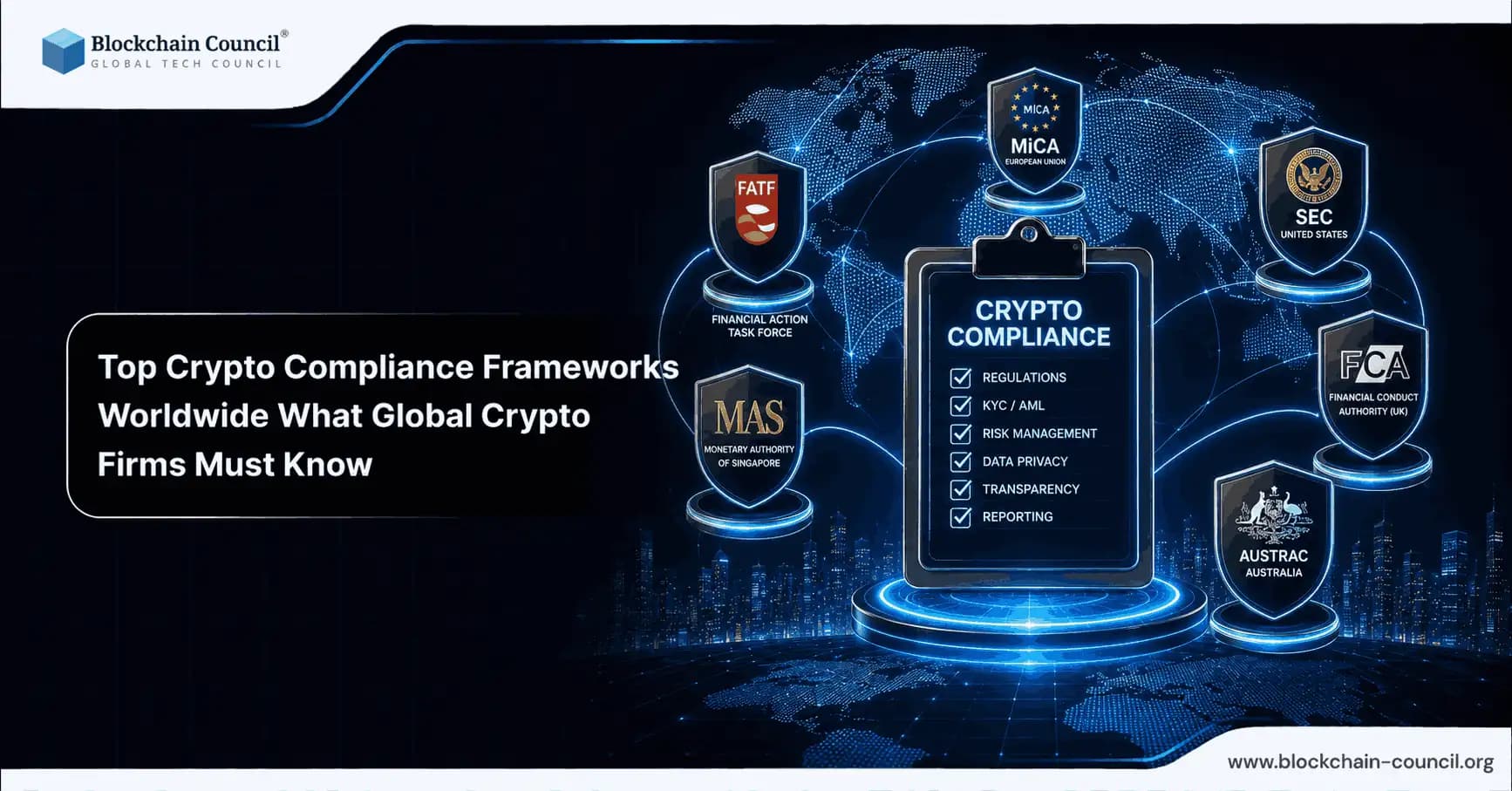
Top Crypto Compliance Frameworks Worldwide are evolving quickly as regulators respond to AML, CFT, sanctions, and consumer protection risks across the crypto ecosystem. The regulatory landscape remains fragmented: the Atlantic Council reports that only 28 of 75 tracked economies have comprehensive rules spanning taxation, AML-CFT, consumer protection, and licensing simultaneously. Yet harmonization is accelerating, with many jurisdictions aligning to Financial Action Task Force (FATF) expectations, including the Travel Rule, stronger KYC requirements, and more rigorous transaction monitoring. Explore the top global crypto compliance frameworks covering AML, KYC, FATF Travel Rule, sanctions screening, and transaction monitoring by building expertise through a Cyber Security Expert, automating compliance analysis and blockchain monitoring using a Python certification, and strengthening compliance-driven crypto operations with a Digital marketing course.
This guide breaks down the most influential global frameworks, the core components they share, and what crypto businesses should implement to operate across borders with lower regulatory risk.

Why Crypto Compliance Frameworks Matter
Compliance frameworks define how crypto companies design onboarding, custody, trading, stablecoin issuance, and cross-border transfers. They also determine which products can launch in which markets, since many global firms must satisfy the strictest applicable requirements across multiple jurisdictions.
Key conditions shaping the current environment include:
Fragmentation: Comprehensive regulatory coverage remains limited, even among major economies.
Convergence around AML standards: FATF-driven requirements are increasingly treated as a minimum baseline.
Rising scrutiny of DeFi and privacy tools: Only a small share of jurisdictions have explicit DeFi guidance, but regulatory attention is growing.
Parallel CBDC development: The Atlantic Council notes over 90% of tracked jurisdictions have active CBDC projects, which may influence oversight expectations for crypto more broadly.
Tier 1: Global Baseline Standards Shaping Crypto Compliance
FATF Recommendations and the Travel Rule
Across top crypto compliance frameworks, FATF Recommendations function as the common denominator for AML-CFT controls. The most operationally significant requirement for crypto businesses is the Travel Rule (FATF Recommendation 16), which requires the transmission of originator and beneficiary information alongside certain transfers.
Implementation differs by jurisdiction, but several major markets treat it as mandatory. Industry solutions continue to mature through Travel Rule protocols such as TRISA and Notabene, while blockchain analytics providers support attribution and risk assessment.
KYC and CDD Expectations
Most regulatory regimes now require:
Customer identification and verification aligned to risk level.
Enhanced due diligence for higher-risk customers, including sanctions exposure, PEP risk, and unusual activity patterns.
Beneficial ownership checks where relevant, particularly for corporate and institutional accounts.
Ongoing monitoring rather than one-time onboarding checks.
For teams building or scaling compliance capability, structured training across AML, sanctions, and governance roles helps ensure consistent execution. Blockchain Council programs such as the Certified Cryptocurrency Expert, Certified Blockchain Professional, and Certified Web3 Professional provide relevant foundational knowledge for compliance and technical teams alike.
Tier 2: Regional and Jurisdiction-Leading Frameworks
European Union: MiCA as a Comprehensive Operating Model
The European Union Markets in Crypto-Assets Regulation (MiCA), implemented in 2023, is widely regarded as one of the most comprehensive frameworks for Crypto-Asset Service Providers (CASPs). MiCA establishes a clear operating perimeter for exchanges, custodians, and other service providers, with strong emphasis on consumer protection and market integrity.
Core compliance themes under MiCA include:
Licensing and authorization obligations for CASPs operating within the EU.
Enhanced KYC and due diligence documentation requirements.
Transaction monitoring and suspicious activity reporting aligned with FATF standards.
Travel Rule alignment for relevant transfers.
For global crypto firms, MiCA frequently serves as a reference point for building policies that can be adapted across multiple jurisdictions, particularly when constructing a unified compliance program.
United States: Enforcement-Led, Multi-Agency Reality
The United States presents a complex regulatory environment because there is no single, unified crypto statute covering all aspects of market activity. Firms must navigate a multi-regulator structure that typically involves the SEC for securities-related questions, FinCEN for AML obligations under Bank Secrecy Act requirements, and OFAC for sanctions compliance. This structure creates practical uncertainty, particularly where asset classification and product design overlap.
For compliance teams operating in the US market, this approach reinforces the need for:
Robust sanctions screening covering addresses, counterparties, and indirect exposure pathways.
Evidence-based risk assessments that can be explained clearly to regulators and auditors.
Clear recordkeeping and escalation workflows aligned to BSA-style monitoring expectations.
UAE: VARA and ADGM as a High-Clarity Model
The UAE has emerged as a key example of a fast-maturing compliance environment. Dubai's Virtual Asset Regulatory Authority (VARA) provides a specialized licensing framework, while Abu Dhabi Global Market (ADGM) through the Financial Services Regulatory Authority has adopted Travel Rule expectations and issued additional guidance to reduce anonymous counterparty risk.
The region has demonstrated significant scale, with reports citing over $30 billion in crypto transaction volume between July 2023 and June 2024, alongside major institutional signals such as a $2 billion investment in Binance by MGX in March 2025. This level of activity reflects the scale at which regulators expect mature compliance controls to be in place.
Singapore: MAS Licensing with Strong AML Alignment
Singapore is recognized for its licensing-centered approach under the Monetary Authority of Singapore (MAS), paired with active engagement mechanisms including sandbox-style initiatives. The regime emphasizes FATF alignment, including Travel Rule implementation, and expects regulated entities to maintain robust AML frameworks and risk governance structures.
Hong Kong: SFC and AMLO Licensing Expectations for VASPs
Hong Kong continues to refine its structured compliance approach through the Securities and Futures Commission (SFC) and the Anti-Money Laundering and Counter-Terrorist Financing Ordinance (AMLO). For virtual asset trading platforms, the focus remains on licensing, investor protection, and AML controls consistent with global standards.
Australia: ASIC Oversight with Structured Experimentation
Australia combines regulatory oversight with structured experimentation. A sandbox approach and active government engagement with blockchain firms support innovation while maintaining compliance boundaries. For crypto companies, sandboxes can reduce time-to-learning on new product designs, but they do not remove the need for core AML and consumer protection safeguards.
Switzerland: FINMA Guidance and Predictable Rulemaking
Switzerland is frequently cited for regulatory clarity, particularly around tokenization and ICO guidance under FINMA, and for its established ecosystem in Zug - often referred to as Crypto Valley. For compliance leaders, Switzerland demonstrates how regulatory certainty can support responsible growth, particularly when paired with strong governance and transparent disclosures.
What These Frameworks Have in Common: Core Compliance Building Blocks
Despite jurisdictional divergence, top crypto compliance frameworks converge on a shared set of operational controls that firms can build toward regardless of their primary market.
1) Licensing and Governance
Defined scope of regulated activities and registration triggers per jurisdiction.
Fit-and-proper expectations for leadership and control functions.
Written policies covering AML, sanctions, custody, market abuse, complaints handling, and incident response.
2) Transaction Monitoring Beyond Basic Screening
Modern crypto compliance increasingly blends exposure scoring with behavioral analytics. Practical indicators include structuring patterns, obfuscation signals linked to mixers or tumblers, and abnormal velocity analysis. A central principle is explainable risk scoring - compliance teams need to demonstrate clearly which factors drove specific decisions when questioned by regulators or auditors.
3) Blockchain Analytics and Forensic Readiness
Analytics providers support real-time screening across chains, historical datasets of risk entities, and investigatory tooling. Increasing regulatory expectations across multiple regions mean that blockchain analytics is shifting from a supplementary capability to a core compliance requirement, particularly for firms handling significant transaction volumes or operating across high-risk corridors.
4) Stablecoin-Specific Controls
Stablecoins are increasingly subject to distinct treatment, often focused on:
Reserve backing and independent verification for prudential confidence.
Issuance and redemption controls alongside operational resilience requirements.
Redemption rights and clear disclosure obligations for holders.
Geographic restrictions that vary by territory and product type.
Persistent Challenges for Global Crypto Compliance
Implementation Gaps and Unequal Capability
Both emerging and advanced economies still lag on comprehensive regulation and enforcement capability. Even where rules exist, practical enforcement can be constrained by limited regulatory expertise and tooling, particularly for real-time transaction monitoring across novel asset types.
DeFi Oversight Remains Early-Stage
Scrutiny of DeFi and privacy-enhancing technologies is increasing, yet only a small minority of jurisdictions have issued explicit DeFi guidance. Compliance teams should anticipate more regulatory attention on DEX interfaces, liquidity pools, and questions of accountability for smart contract builders and operators as this area develops.
Cross-Border Compliance Execution Remains Difficult
Travel Rule expectations are widespread, but execution quality varies considerably across markets. As protocols consolidate, firms operating across 10 to 20 markets will still encounter differing local thresholds, reporting formats, and privacy constraints that require jurisdiction-specific adjustments.
Practical Checklist: Building a Program That Works Across Top Frameworks
Map your regulated activities by jurisdiction and document licensing triggers for each product line.
Adopt a risk-based AML program with clear customer risk scoring, enhanced due diligence playbooks, and defined review cadences.
Implement Travel Rule workflows and test interoperability with major counterparties before scaling operations.
Deploy blockchain analytics for real-time screening, cross-chain tracing, and investigation support.
Build sanctions controls that account for indirect exposure, not only direct address matches.
Create audit-ready evidence through explainable alerts, decision logs, and consistent recordkeeping practices.
Learn how global crypto firms implement compliance frameworks to manage regulatory risk, prevent fraud, and maintain secure digital asset operations by mastering crypto governance through a Cryptocurrency Expert, developing compliance automation systems using a Node JS Course, and scaling trusted blockchain businesses using an AI powered marketing course.
Conclusion
Top crypto compliance frameworks reflect a maturing regulatory environment where FATF-aligned AML controls are becoming a baseline expectation, while regional leaders such as the EU under MiCA and jurisdictions like the UAE, Singapore, and Hong Kong define operational standards through licensing and monitoring requirements. The direction is consistent: stronger KYC, more rigorous cross-border information sharing, deeper blockchain analytics integration, and increasing scrutiny of DeFi and privacy technologies.
For crypto businesses, the advantage will go to firms that treat compliance as core infrastructure rather than a reactive obligation. That means building scalable governance, investing in monitoring technology, and maintaining the ability to evidence decisions to regulators and banking partners across multiple jurisdictions.
FAQs
1. What are crypto compliance frameworks?
Crypto compliance frameworks are rules and controls that guide how crypto businesses operate legally. They cover areas like AML, KYC, sanctions, licensing, and transaction monitoring. These frameworks help reduce regulatory and financial crime risks.
2. Why do crypto compliance frameworks matter?
They help crypto firms understand what they can offer in different markets. Strong frameworks protect users, reduce illegal activity, and improve trust with regulators. Ignoring them is a bold strategy for attracting fines.
3. What is FATF’s role in crypto compliance?
FATF sets global AML and counter-terrorist financing standards for crypto firms. Many countries use FATF guidance as a baseline for local rules. Its recommendations strongly influence Travel Rule and KYC requirements.
4. What is the Travel Rule in crypto?
The Travel Rule requires crypto firms to share sender and receiver information for certain transfers. It helps authorities track suspicious activity and reduce anonymous fund movement. Implementation varies across jurisdictions.
5. Why is KYC important for crypto businesses?
KYC helps firms verify customer identities before providing services. It supports fraud prevention, sanctions screening, and risk-based monitoring. Strong KYC reduces the chance of serving high-risk or illegal actors.
6. What is customer due diligence in crypto?
Customer due diligence means checking customer identity, ownership, risk level, and transaction behavior. Higher-risk users may require enhanced due diligence. Ongoing monitoring is also needed after onboarding.
7. What is MiCA in the European Union?
MiCA is the EU’s major regulatory framework for crypto-asset service providers. It sets rules for licensing, consumer protection, market integrity, and compliance. Many global firms use MiCA as a reference model.
8. How does the United States regulate crypto compliance?
The US uses a multi-agency approach involving regulators such as FinCEN, OFAC, and the SEC. Firms must manage AML, sanctions, securities, and reporting obligations. This creates complexity, because apparently one regulator was too simple.
9. What is the UAE’s approach to crypto regulation?
The UAE has built specialized crypto frameworks through authorities such as VARA and ADGM. These regimes focus on licensing, Travel Rule alignment, and reducing anonymous counterparty risk. The country is becoming a major crypto compliance hub.
10. How does Singapore regulate crypto businesses?
Singapore uses a licensing-focused model led by the Monetary Authority of Singapore. It emphasizes AML controls, governance, and FATF-aligned standards. Firms operating there need strong risk management and compliance systems.
11. What is Hong Kong’s crypto compliance approach?
Hong Kong regulates virtual asset platforms through licensing and AML-focused requirements. Its framework emphasizes investor protection, transaction monitoring, and operational controls. This supports a more structured crypto market.
12. How does Australia support crypto compliance?
Australia combines regulatory oversight with sandbox-style experimentation. This allows firms to test blockchain products while staying within compliance boundaries. Core AML and consumer protection obligations still apply.
13. Why is Switzerland important in crypto regulation?
Switzerland is known for clear guidance around tokenization, ICOs, and crypto business operations. FINMA provides predictable regulatory expectations. This clarity has helped support responsible growth in Crypto Valley.
14. What are the common parts of crypto compliance frameworks?
Most frameworks include licensing, governance, KYC, AML monitoring, sanctions screening, and recordkeeping. Many also require transaction monitoring and suspicious activity reporting. These controls form the basic compliance toolkit.
15. Why is blockchain analytics important for compliance?
Blockchain analytics helps firms screen wallet addresses, trace funds, and detect risky transaction patterns. It supports investigations and real-time monitoring across networks. Regulators increasingly expect this capability.
16. What are stablecoin-specific compliance controls?
Stablecoin controls often focus on reserve backing, redemption rights, disclosures, and operational resilience. Regulators want confidence that stablecoins can be redeemed safely. Weak controls can create market and consumer risks.
17. Why is DeFi compliance challenging?
DeFi often operates through smart contracts, decentralized interfaces, and liquidity pools without clear intermediaries. This makes accountability and monitoring harder. Regulators are paying closer attention, because ambiguity is everyone’s favorite loophole.
18. What makes cross-border crypto compliance difficult?
Different countries have different thresholds, reporting formats, privacy rules, and licensing requirements. A firm operating globally must adjust controls for each market. This makes compliance execution complex and expensive.
19. How can crypto firms build a strong compliance program?
They should map regulated activities, apply risk-based AML controls, implement Travel Rule workflows, and use blockchain analytics. Firms should also maintain audit-ready records and train staff regularly. Strong documentation makes regulatory reviews easier.
20. What is the main takeaway about global crypto compliance?
Crypto compliance is becoming stricter, more technical, and more globally connected. Firms that treat compliance as core infrastructure will be better prepared. Strong governance, monitoring, and evidence-based decisions are now essential.
Related Articles
View All
Cryptocurrency
Crypto Compliance and Asset Recovery: Why KYC, AML, and Forensics Matter
KYC, AML, and blockchain forensics now drive crypto compliance and asset recovery by linking wallets, monitoring risk, and supporting investigations.

Cryptocurrency
Top Crypto Asset Recovery Tools Used in Blockchain Investigations
Explore the top crypto asset recovery tools used in blockchain investigations, from Chainalysis and TRM Labs to Recovery CAT and stablecoin freezes.

Cryptocurrency
Rug Pull vs Exit Scam: Key Differences Crypto Investors Must Understand
Understand rug pull vs exit scam differences, how each works, key warning signs, real examples, and due diligence steps for safer crypto investing.
Trending Articles
The Role of Blockchain in Ethical AI Development
How blockchain technology is being used to promote transparency and accountability in artificial intelligence systems.
AWS Career Roadmap
A step-by-step guide to building a successful career in Amazon Web Services cloud computing.
How to Install Claude Code
Learn how to install Claude Code on macOS, Linux, and Windows using the native installer, plus verification, authentication, and troubleshooting tips.