

Digital Asset Custody Explained: Hot vs Cold Storage, MPC, and Institutional Best Practices
 Suyash Raizada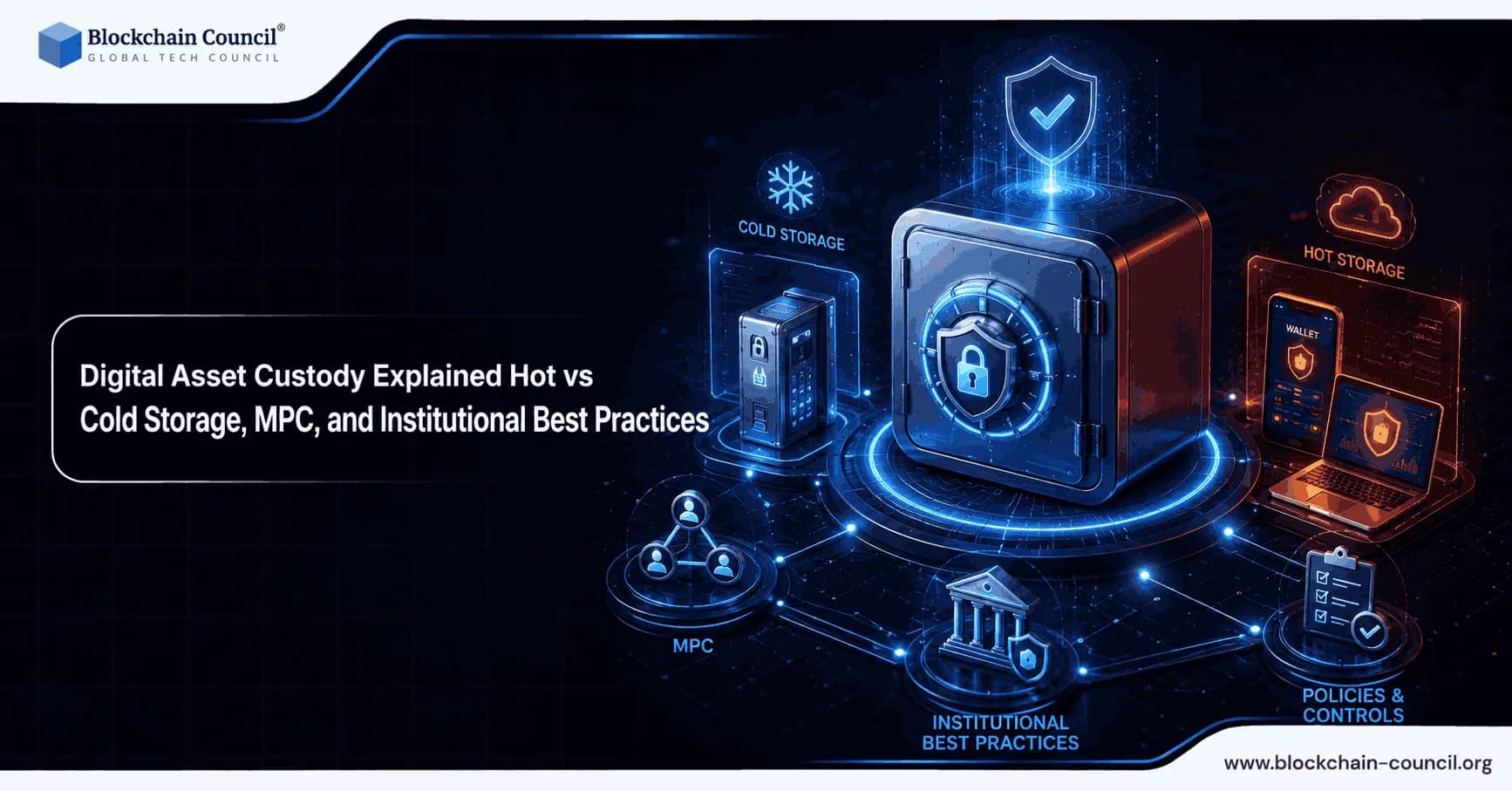
Digital asset custody is the discipline of securely storing and managing cryptocurrencies and other blockchain-based assets by protecting the private keys that control them. Because blockchains are decentralized, there is no central password recovery authority. If keys are stolen, assets can be drained. If keys are lost, assets may become permanently unrecoverable. That reality has made digital asset custody a core capability for exchanges, fintech platforms, funds, and enterprises that hold crypto on behalf of users or carry it on corporate balance sheets. Understand digital asset custody models including hot wallets, cold storage, MPC security, and institutional-grade protection strategies by building expertise through a Cryptocurrency Expert, analyzing wallet security systems using a Python certification, and applying crypto security best practices with a Digital marketing course.
This guide explains hot vs cold storage, modern approaches like multi-party computation (MPC), and institutional best practices that reduce operational and security risk while meeting compliance expectations.

What Is Digital Asset Custody?
At its core, digital asset custody is key management plus governance. A custody design defines:
Where keys live (online, offline, or split across multiple components)
Who can approve transactions (individuals, teams, or automated policies)
How approvals are audited (logs, policy controls, attestations)
How incidents are handled (revocation, rotation, and recovery plans)
Custodial vs Non-Custodial Models
Digital asset custody is typically discussed in two broad models:
Custodial: A third party, such as an exchange or qualified custodian, controls private keys. This enables account recovery workflows and institutional features like policy enforcement, but it introduces counterparty risk and creates attractive targets for attackers.
Non-custodial: The user or organization retains direct control of keys. This aligns with self-sovereignty principles and many DeFi use cases, but increases the burden of secure key handling, backups, and recovery planning.
For professionals building custody workflows, pairing custody design with strong cybersecurity and governance is essential. Relevant learning paths often combine blockchain security fundamentals with operational controls, drawing on programs such as a Certified Blockchain Security Professional certification and a Certified Cryptocurrency Expert certification.
Hot Wallets vs Cold Storage: What Is the Difference?
The most widely understood distinction in digital asset custody is hot vs cold storage:
Hot wallets store keys on internet-connected systems for fast transactions.
Cold storage keeps keys offline (air-gapped) to reduce remote attack exposure.
Hot Wallets: Speed and Accessibility, With Higher Exposure
Hot wallets are designed for availability. They are used for active trading, market making, DeFi interactions, staking operations, and customer withdrawals that need to be processed quickly.
Key characteristics of hot wallets:
Always online, typically on servers or devices connected to the internet.
Instant transaction capability, often integrated into apps, exchanges, and APIs.
Operational convenience, but increased risk from malware, phishing, supply chain vulnerabilities, and remote exploitation.
Industry practice commonly points to tiered treasury strategies where approximately 5-10% of assets remain in hot wallets for liquidity, with the remainder held in colder tiers. This approach aims to balance customer experience with security. Hot wallet breaches have historically contributed to significant losses across the industry, and improved monitoring combined with modern controls has helped reduce incident rates over time.
Practical takeaway: Hot wallets should be treated as an operational buffer, not a vault.
Cold Storage: The Security Baseline for Reserves
Cold storage keeps private keys offline using approaches such as hardware devices, air-gapped computers, or offline signing environments. Because signing keys are never exposed to the internet, cold storage is the accepted security standard for long-term holdings and institutional reserves.
Why cold storage is favored for reserves:
Resistant to remote compromise, since attackers cannot reach the signing environment over the network.
Widely expected by regulators and risk teams, who typically require that most client funds remain in cold storage.
Reduced dependency on exchange solvency when implemented with proper asset segregation and governance.
A typical institutional cold withdrawal flow works as follows:
A withdrawal is initiated and validated against policy rules.
If the hot wallet has insufficient liquidity, the request is queued.
Authorized operators access a secure offline environment, sign the transaction using cold credentials, and record approvals.
The signed transaction is transferred to an online machine and broadcast to the network.
Cold storage does introduce operational constraints. Processing takes longer, and physical security becomes critical. Organizations must plan for secure backups, device loss scenarios, and controlled access to signing locations.
Warm Wallets and Tiered Custody: Bridging Operations and Security
Many institutions use a tiered custody architecture rather than a simple hot or cold choice. A common structure is:
Operational tier (hot): roughly 5-10% for day-to-day liquidity and automated withdrawals
Reserve tier (cold): roughly 90-95% for long-term custody and capital protection
Some programs introduce a warm tier, which is more accessible than cold storage but more restricted than hot. Warm designs typically include limited connectivity, stricter policy checks, and time-based or human-based approvals before transactions are authorized.
MPC and Multisig: Modern Control Planes for Institutional Custody
Institutions increasingly rely on advanced cryptographic and governance techniques to reduce single points of failure and improve operational flexibility.
Multi-Party Computation (MPC)
MPC is a technique where the private key is never held as a single complete secret in one location. Instead, it is split into shards distributed across multiple parties, devices, or secure components. A valid signature is produced only when the required components participate, without ever reconstructing the full key.
Why MPC is widely adopted for digital asset custody:
Reduces single points of compromise, since no one system holds the complete key.
Supports flexible deployment across hot, warm, and cold operational models.
Enables strong policy controls tied to roles, devices, geographies, time windows, and transaction thresholds.
Most leading custodians now use MPC in some form, reporting meaningful reductions in breach risk compared to legacy hot wallet designs. Some vendors combine MPC with secure hardware and trusted execution environments to reduce signing latency while preserving strong isolation.
Multisignature (Multisig)
Multisig requires multiple approvals to authorize a transaction, such as 2-of-3 or 3-of-5 signers. It is a powerful governance tool for treasury controls and separation of duties.
Common institutional patterns include:
Role-based approvals, for example requiring both operations and compliance sign-off
Threshold approvals that increase signer requirements for higher-value transfers
Emergency procedures to rotate signers after personnel changes or device loss
MPC and multisig can be combined with monitoring, fraud detection, and Know Your Transaction (KYT) tooling to strengthen end-to-end custody operations.
Institutional Best Practices for Digital Asset Custody
Custody at institutional scale is as much about process as cryptography. The following best practices appear consistently across mature custody programs.
1) Implement a Tiered Treasury Strategy
Keep most assets in cold storage for capital protection.
Limit hot wallet balances to operational requirements.
Rebalance using automated treasury management with strict controls and full auditability.
2) Enforce Least Privilege and Separation of Duties
Use role-based access control so no single operator can both initiate and approve high-risk transfers.
Require multi-approval for administrative actions, not only on-chain transactions.
Segment environments for signing, monitoring, and broadcasting.
3) Apply Continuous Monitoring and Anomaly Detection
Monitor withdrawal patterns, destination addresses, and velocity changes.
Use allowlists, blocklists, and risk scoring for counterparties and addresses.
Log every action for post-incident investigation and audit readiness.
4) Build for Compliance and Audit
Custody providers and platforms commonly operate under frameworks that require KYC/AML controls and transaction monitoring. Regulators increasingly expect evidence of asset segregation, access controls, and incident response maturity. Travel Rule obligations and other reporting requirements also affect how transfers and counterparties are handled.
5) Plan Recovery, Key Rotation, and Physical Security
Maintain secure backups for cold storage with tested recovery drills.
Document key rotation procedures for staff turnover and compromise scenarios.
Harden physical access to offline signing locations with tamper-evident controls and strict custody logs.
Teams often pair these operational controls with structured staff training, drawing on certifications focused on blockchain security, cryptocurrency fundamentals, and enterprise risk management for digital assets.
Real-World Custody Patterns: What Leading Platforms Do
In practice, exchanges and custodians frequently use a hybrid architecture:
Exchanges hold a small portion of assets in hot wallets for withdrawals and trading, keeping the majority in cold storage as reserves. After major industry failures, many platforms significantly increased their cold storage ratios.
Qualified custodians serve institutions such as ETF issuers and corporates, using MPC-based wallets, policy engines, and audited controls to manage large balances with strong governance.
Fintech platforms often adopt MPC to distribute signing authority across devices and operators, requiring additional human approvals for higher-value movements.
Historical incidents have repeatedly demonstrated that compromised hot wallet environments can lead to catastrophic losses, while well-designed offline storage meaningfully limits exposure. The prevailing industry approach is straightforward: use hot wallets for operational convenience, and protect reserves with cold or MPC-hybrid controls.
Future Outlook: Where Digital Asset Custody Is Heading
Digital asset custody is developing rapidly as institutional participation grows and compliance expectations rise. Key trends include:
MPC-first architectures becoming the institutional default, with policies spanning hot, warm, and cold workflows.
Faster cold-equivalent signing through secure hardware integrations, aiming to reduce processing delays without increasing exposure.
AI-driven risk controls for anomaly detection and transaction screening.
Post-quantum preparedness as cryptographic research and standards mature, particularly for long-duration custody arrangements.
Conclusion
Digital asset custody is fundamentally about minimizing both the probability and the impact of key compromise while keeping operations reliable. Hot wallets deliver speed but increase online exposure. Cold storage minimizes remote attack risk but introduces operational friction and physical security requirements. Modern institutions increasingly rely on tiered architectures combined with MPC and strong governance to balance liquidity, security, and compliance.
For professionals and enterprises, the strongest results come from treating custody as an integrated system: cryptography, access control, monitoring, incident response, and trained teams working together. Building that capability is now a baseline requirement for any organization serious about managing digital assets at scale. Learn how institutional investors secure digital assets using MPC, hardware wallets, multi-signature systems, and compliance-focused custody frameworks by mastering blockchain security through a Cyber Security Expert, developing secure wallet integrations using a Node JS Course, and scaling trusted crypto services using an AI powered marketing course.
FAQs
1. What is digital asset custody?
Digital asset custody is the secure storage and management of cryptocurrencies and blockchain-based assets. It mainly focuses on protecting private keys, which control access to digital assets. Strong custody systems combine key management, access controls, approvals, monitoring, and recovery planning.
2. Why is digital asset custody important?
Digital asset custody is important because lost or stolen private keys can lead to permanent asset loss. Unlike traditional banking, blockchain systems usually do not offer simple password recovery. This makes secure key storage and governance essential for individuals, exchanges, funds, and enterprises.
3. What is the difference between custodial and non-custodial custody?
Custodial custody means a third party, such as an exchange or qualified custodian, controls the private keys. Non-custodial custody means the user or organization controls the keys directly. Custodial models offer convenience, while non-custodial models place full responsibility on the owner, because apparently freedom comes with homework.
4. What are hot wallets?
Hot wallets are wallets connected to the internet and used for fast transactions. They are common in exchanges, apps, trading platforms, and customer withdrawal systems. Their main advantage is speed, but their online exposure creates higher security risk.
5. What is cold storage?
Cold storage keeps private keys offline using hardware devices, air-gapped computers, or offline signing systems. It is commonly used for long-term holdings and institutional reserves. Since the keys are not exposed to the internet, cold storage reduces remote hacking risk.
6. What is the main difference between hot wallets and cold storage?
Hot wallets prioritize accessibility and fast transfers, while cold storage prioritizes security and long-term protection. Hot wallets are useful for daily liquidity, but cold storage is better for reserves. A balanced custody strategy usually uses both.
7. Why are hot wallets risky?
Hot wallets are risky because they operate on internet-connected systems. This exposes them to malware, phishing, remote exploits, supply chain attacks, and compromised credentials. They should be treated as an operational buffer, not a vault.
8. Why do institutions prefer cold storage for reserves?
Institutions prefer cold storage because it protects large asset balances from remote compromise. Regulators and risk teams often expect most client funds to be held offline. Cold storage also supports stronger physical controls, approval workflows, and audit trails.
9. What is a tiered custody strategy?
A tiered custody strategy divides assets across hot, warm, and cold storage based on operational needs. Hot wallets hold a small amount for liquidity, while cold storage protects most reserves. This approach balances speed, security, and business continuity.
10. What are warm wallets?
Warm wallets sit between hot wallets and cold storage. They may have limited connectivity and stricter approval rules than hot wallets. They are useful when organizations need faster access than cold storage but stronger controls than standard online wallets.
11. What is Multi-Party Computation in custody?
Multi-Party Computation, or MPC, splits signing authority into multiple key shares instead of storing one complete private key. A transaction can be signed only when the required shares participate. This reduces single points of failure and improves institutional security.
12. Why is MPC popular for institutional custody?
MPC is popular because it combines strong security with operational flexibility. It can support hot, warm, and cold workflows while enforcing policies based on roles, devices, locations, and transaction limits. It also avoids keeping one complete private key in a single vulnerable place.
13. What is multisig custody?
Multisig custody requires multiple approvals before a transaction can be executed. For example, a 2-of-3 setup needs two approved signatures from three possible signers. This improves governance and reduces the risk of one person moving funds alone.
14. How are MPC and multisig different?
MPC splits the private key into cryptographic shares, while multisig uses multiple separate keys to approve a transaction. Both reduce single-person control and improve transaction security. Institutions may use either approach, or combine them with monitoring and approval policies.
15. What is the least privilege in digital asset custody?
Least privilege means each person or system receives only the access needed to perform its role. No single operator should be able to initiate and approve high-risk transfers alone. This limits insider risk and accidental misuse, which is useful because humans remain creatively fallible.
16. Why is continuous monitoring important in custody?
Continuous monitoring helps detect unusual withdrawals, suspicious destination addresses, and abnormal transaction patterns. It supports faster response to fraud, compromise, or operational errors. Monitoring also creates useful evidence for audits and incident investigations.
17. What compliance controls are important for digital asset custody?
Important controls include KYC, AML, transaction monitoring, audit logs, asset segregation, access reviews, and incident response plans. Custody providers must show that assets are protected and operations are traceable. Compliance is not glamorous, but neither is explaining missing funds to regulators.
18. Why is recovery planning important in custody?
Recovery planning prepares organizations for device loss, staff turnover, key compromise, or physical access failures. It includes secure backups, key rotation procedures, tested drills, and emergency access controls. Without recovery planning, even a secure custody system can become a very expensive locked box.
19. What custody patterns do exchanges and custodians use?
Exchanges usually keep a small portion of assets in hot wallets for withdrawals and trading. Most reserves are kept in cold storage or MPC-based systems with stronger approval controls. Qualified custodians often use policy engines, audited controls, and institutional-grade monitoring.
20. What is the future of digital asset custody?
Digital asset custody is moving toward MPC-first architectures, AI-driven risk monitoring, faster secure signing, and stronger compliance controls. Institutions will continue combining cryptography, governance, monitoring, and recovery planning. The future belongs to custody systems that are secure, auditable, and practical at scale.
Related Articles
View All
Cryptocurrency
Crypto Asset Protection: Best Practices to Secure Your Digital Wealth
Learn practical crypto asset protection steps for wallets, keys, MFA, multi-sig, legal structures, estate planning, records, and incident response.

Cryptocurrency
Hot Wallet vs Cold Wallet: Which Crypto Storage Option Is Safer?
Cold wallets are safer for long-term crypto storage, while hot wallets are better for trading, DeFi, and payments. Learn which setup fits your risk.

Cryptocurrency
Hot Wallet vs Cold Wallet Security: Which Is Safer for Crypto Storage?
Cold wallets are safer for long-term crypto storage, while hot wallets fit active use. Learn the risks, trade-offs, and best hybrid model.
Trending Articles
AWS Career Roadmap
A step-by-step guide to building a successful career in Amazon Web Services cloud computing.

Can DeFi 2.0 Bridge the Gap Between Traditional and Decentralized Finance?
The next generation of DeFi protocols aims to connect traditional banking with decentralized finance ecosystems.
Claude AI Tools for Productivity
Discover Claude AI tools for productivity to streamline tasks, manage workflows, and improve efficiency.