

Claude Safety & Ethics
 Suyash Raizada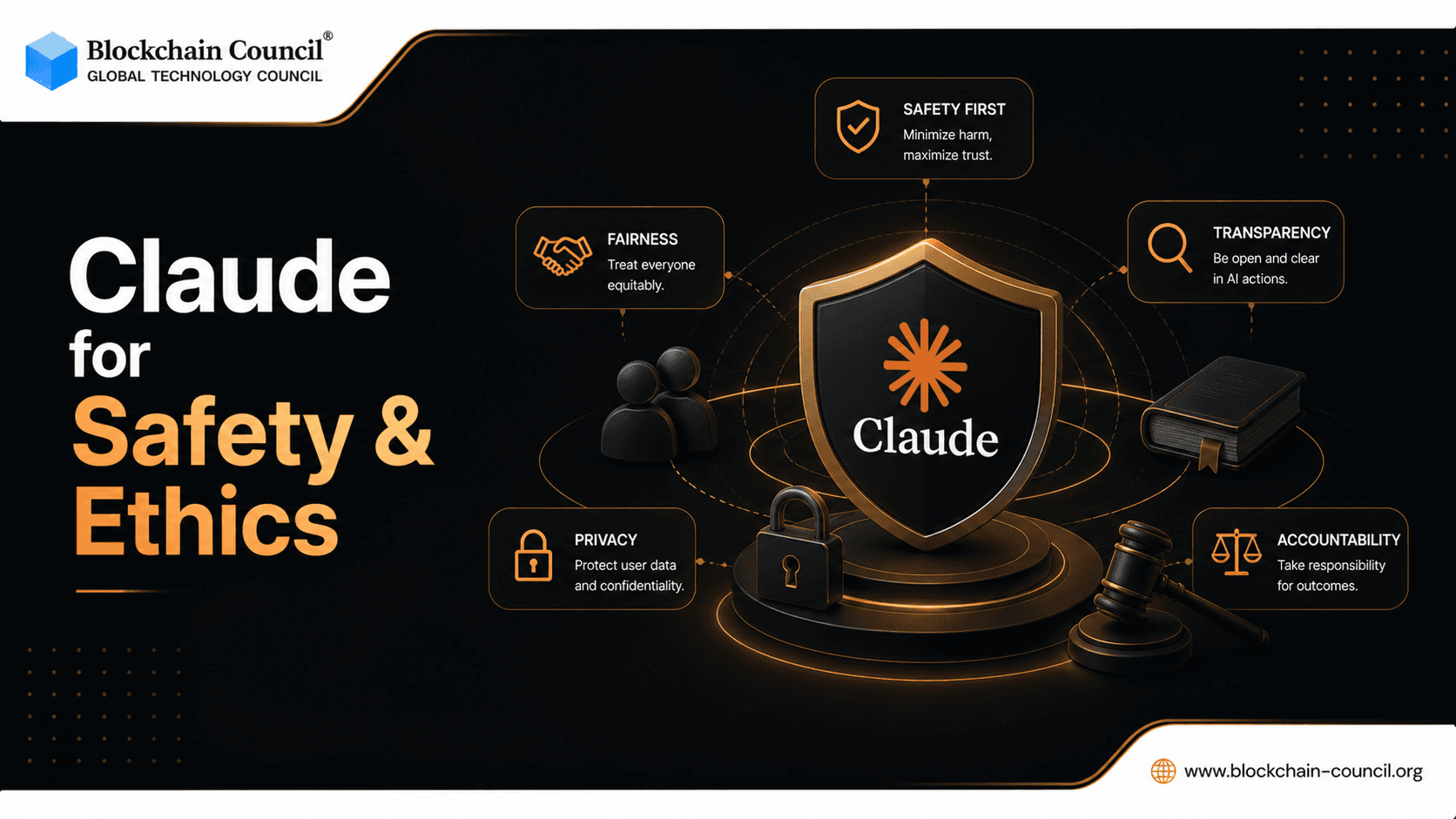
As AI becomes more powerful, one question matters more than ever - can we trust it?
From generating content to making decisions, AI systems influence millions of users daily. This makes safety, ethics, and alignment critical.

This is where Claude AI stands out. Built with a strong focus on responsible AI, Claude is designed to be helpful, honest, and safe.
What is AI Safety & Ethics?
AI safety refers to ensuring that artificial intelligence systems:
Do not cause harm
Provide reliable outputs
Follow ethical guidelines
AI ethics focuses on:
Fairness
Transparency
Accountability
Together, they ensure AI is trustworthy and aligned with human values.
Constitutional AI Principles
One of the key innovations behind Claude is Constitutional AI, developed by Anthropic.
What is Constitutional AI?
It is a framework where AI is trained using a set of guiding principles (a “constitution”) instead of relying only on human feedback.
Key Benefits:
More consistent behavior
Reduced harmful outputs
Better alignment with ethical standards
Why It Matters:
It ensures that Claude:
Follows rules independently
Makes safer decisions
Maintains reliability at scale
Bias Handling in Claude
Bias in AI is a major concern.
What is AI Bias?
Bias occurs when AI produces:
Unfair results
Skewed perspectives
Discriminatory outputs
How Claude Handles Bias:
Balanced training data
Continuous evaluation
Ethical safeguards
Goal:
To provide fair and neutral responses across different contexts.
Safe Outputs: Preventing Harmful Content
Claude is designed to prioritize safety in every response.
Safety Mechanisms:
Content filtering
Harm prevention systems
Context-aware moderation
What It Avoids:
Harmful instructions
Unsafe content
Misleading information
Result:
More reliable and responsible AI interactions.
AI Alignment: Matching Human Values
AI alignment ensures that AI systems behave according to human expectations.
What Alignment Means:
Acting in users’ best interest
Avoiding harmful actions
Providing truthful outputs
Claude’s Approach:
Constitutional principles
Safety training
Continuous improvement
Limitations & Restrictions
No AI system is perfect - and Claude is no exception.
Key Limitations:
May lack real-time data
Can make mistakes
Requires human verification
Restrictions:
Avoids unsafe or unethical tasks
Limits harmful outputs
Follows strict safety guidelines
Why This is Important:
These limitations ensure:
User safety
Ethical usage
Responsible AI deployment
Why Claude is a Leader in Safe AI
Compared to many AI systems, Anthropic focuses heavily on:
Safety-first design
Ethical frameworks
Advanced alignment
Continuous improvements
This makes Claude one of the most trustworthy AI systems available today.
AI Learning Path: Understanding Ethical AI
To fully understand AI safety:
Step 1: Basics
AI fundamentals
Ethics principles
Step 2: Intermediate
Bias understanding
Safety mechanisms
Step 3: Advanced
AI alignment
Responsible AI development
A structured approach like the Certified Claude AI Expert Program helps you:
Understand AI ethics deeply
Apply safe AI practices
Build responsible systems
Tech Certifications for Future AI Careers
Recommended
Business Certifications for Growth
Top Certifications
Career Opportunities
AI Ethics Specialist
Responsible AI Consultant
Policy Advisor
AI Researcher
Conclusion
As AI continues to evolve, safety and ethics will define its future.
Claude sets a strong example by combining:
Advanced technology
Ethical principles
Responsible design
The goal is not just powerful AI - but AI we can trust.
FAQs
1. What is Claude AI safety?
It refers to measures ensuring safe and ethical AI outputs.
2. What is Constitutional AI?
A framework where AI follows predefined ethical principles.
3. Who developed Claude AI?
It was developed by Anthropic.
4. How does Claude handle bias?
Through balanced training and continuous evaluation.
5. Is Claude safe to use?
Yes, it is designed with strong safety measures.
6. What is AI alignment?
Ensuring AI behaves according to human values.
7. Can AI be biased?
Yes, but systems like Claude work to reduce it.
8. What are safe outputs?
Responses that avoid harm and misinformation.
9. Does Claude have limitations?
Yes, like all AI systems.
10. Can Claude make mistakes?
Yes, human verification is important.
11. What is AI ethics?
Principles guiding responsible AI use.
12. Why is AI safety important?
To prevent harm and ensure trust.
13. Can Claude generate harmful content?
It is designed to avoid such outputs.
14. What industries use ethical AI?
Tech, healthcare, finance, and more.
15. What is bias in AI?
Unfair or skewed outputs.
16. How can I learn AI ethics?
Through courses and certifications.
17. Is AI regulated?
Yes, regulations are evolving.
18. What is responsible AI?
AI designed with safety and ethics in mind.
19. Can AI replace human judgment?
No, it should support decision-making.
20. What is the future of AI safety?
Stronger regulations and better alignment.
Related Articles
View All
Claude Ai
Claude Fable 5 Restored: Anthropic Brings Back Its Most Powerful AI Model With Tighter Safety Guardrails
Anthropic has reportedly restored Claude Fable 5 with enhanced safety guardrails, balancing advanced reasoning capabilities with stronger oversight for enterprise and developer use. This article examines the reported changes, potential impact, and what they could mean for AI deployment.

Claude Ai
Claude Fable 5 vs ChatGPT: Coding, Reasoning, Cost, and Safety Compared
Claude Fable 5 beats ChatGPT on hard coding and reasoning, while ChatGPT remains cheaper, easier to access, and stronger for long-context workflows.

Claude Ai
Claude Fable 5 Responsible AI: Security, Ethics, and Governance
Explore Claude Fable 5 Responsible AI considerations, including security guardrails, ethical risks, governance controls, and enterprise best practices.
Trending Articles

Can DeFi 2.0 Bridge the Gap Between Traditional and Decentralized Finance?
The next generation of DeFi protocols aims to connect traditional banking with decentralized finance ecosystems.
Claude AI Tools for Productivity
Discover Claude AI tools for productivity to streamline tasks, manage workflows, and improve efficiency.
Blockchain in Supply Chain Provenance Tracking
Supply chains are under pressure to prove not just efficiency, but also authenticity, sustainability, and fairness. Customers want to know if their coffee really is fair trade, if the diamonds are con