

Top 10 AI Use Cases in Blockchain You Must Know (2026 Guide)
 Suyash Raizada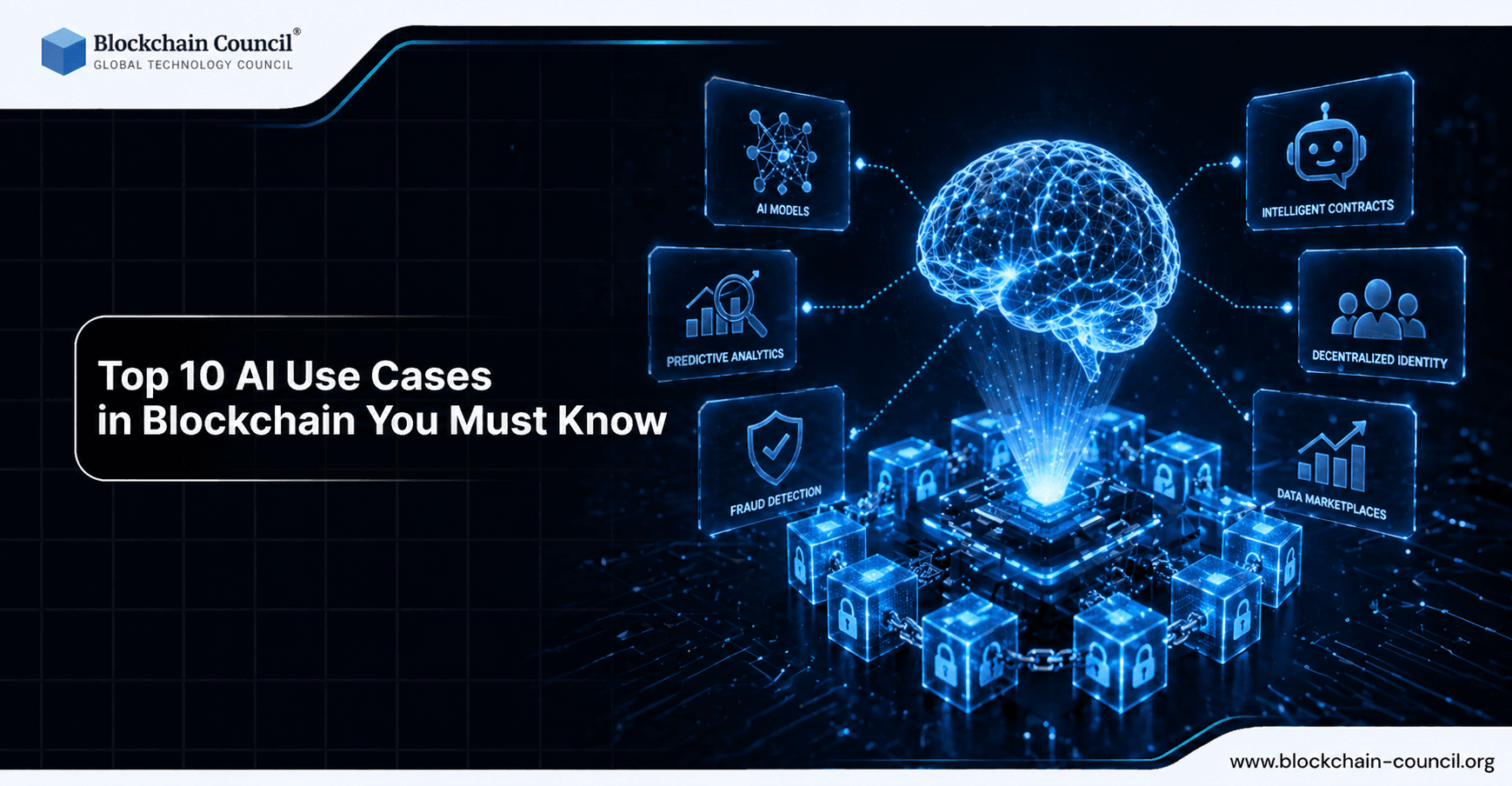
AI use cases in blockchain have moved from experimental pilots to production-grade systems that improve security, automate operations, and unlock new data-driven business models. By combining AI capabilities like real-time anomaly detection and predictive modeling with blockchain features like immutability and transparent audit trails, organizations can build systems that are both intelligent and verifiable. This convergence is especially relevant in 2026 as decentralized finance (DeFi), tokenization, and Web3 applications demand stronger trust, faster automation, and scalable governance.
Curious about real-world AI use cases in blockchain? Build your expertise with a Blockchain Course, understand models through a machine learning course, and connect insights to growth via a Digital marketing course.

Below are the top 10 AI applications in blockchain that teams are adopting today, along with practical examples and implementation considerations for professionals.
Why AI and Blockchain Work Together
AI excels at learning patterns from large datasets, scoring risk, and generating predictions. Blockchain excels at maintaining a tamper-resistant history of transactions and events. Together, they enable:
Continuous monitoring of transactions, smart contracts, and user behavior with explainable audit trails.
Automation via smart contracts triggered by AI-driven risk scores or forecasts.
Data integrity for training and validating models, particularly when provenance matters.
New markets such as tokenized real-world assets (RWAs) that require reliable valuation and compliance controls.
Top 10 AI Use Cases in Blockchain
1. Enhanced Security and Fraud Detection
Security is the most mature area for AI use cases in blockchain. Machine learning models analyze transaction graphs, wallet clusters, and behavior signals to flag anomalies in real time. Graph AI is particularly effective for tracing money laundering patterns across addresses and chains.
What AI does: anomaly detection, graph analytics, risk scoring, entity resolution.
What blockchain adds: immutable evidence trails for investigation and compliance.
Example: Elliptic, working with academic and industry partners, trained models on hundreds of millions of transactions and reported a significant improvement in money laundering detection precision, reaching 27% from a low baseline.
Pro tip: For production deployments, prioritize model governance - including false positive management and drift monitoring - and build privacy safeguards into any pipeline that enriches on-chain data with off-chain signals.
2. Smart Contract Optimization and Automated Auditing
Smart contracts concentrate value and risk, making them a prime target for AI-driven auditing. Automated vulnerability scanning is increasingly used to detect common issues like reentrancy flaws, access-control weaknesses, and unsafe external calls.
What AI does: code pattern detection, vulnerability classification, test generation, and continuous post-deployment monitoring.
What blockchain adds: deterministic execution and on-chain traceability of contract behavior.
Professionals building secure Web3 systems often combine training across blockchain security, smart contract development, and AI to address both code and model risk effectively.
3. Supply Chain Management and Traceability
Supply chains require both foresight and proof. AI forecasts demand, predicts delays, and optimizes inventory. Blockchain preserves provenance records, handoffs, and certifications so stakeholders can verify product origin and handling conditions.
What AI does: demand forecasting, disruption prediction, route optimization.
What blockchain adds: end-to-end traceability and tamper-resistant provenance records.
Example: Enterprise traceability networks, including well-known food safety implementations, combine predictive analytics with verifiable tracking to reduce shortages and improve recall response times.
4. Predictive Analytics and Market Forecasting
Crypto markets move quickly, and AI models can process historical prices, liquidity signals, and social sentiment to forecast trends and detect manipulative patterns such as pump-and-dump activity. This is among the most visible AI applications in blockchain that users encounter daily through analytics dashboards and trading tools.
What AI does: time-series forecasting, sentiment analysis, anomaly detection on order flow.
What blockchain adds: transparent on-chain data for backtesting and attribution.
Extreme liquidation events have reached the billion-dollar range in single episodes. Automated detection can reduce exposure by flagging abnormal momentum and liquidity risk earlier than traditional rule-based systems.
5. Tokenization of Real-World Assets (RWAs)
Tokenization has accelerated as institutions explore fractional ownership of assets including real estate, commodities, invoices, and collectibles. AI improves valuation accuracy by incorporating market trends, asset condition signals, and comparable transaction data, while blockchain enables transparent ownership records, transfers, and settlement.
What AI does: valuation modeling, fraud detection in documentation, credit and liquidity risk scoring.
What blockchain adds: programmable ownership, continuous transferability, and auditable history.
Implementation note: RWA systems typically require robust identity frameworks, compliance workflows, and oracle design. AI can assist across all three areas, but governance and data quality remain decisive factors.
6. Decentralized Identity Verification and Privacy-Preserving Access
Identity is a foundational layer for exchanges, enterprise networks, and regulated DeFi. AI-based biometrics - such as facial recognition or liveness detection - can be combined with decentralized identifiers and verifiable credentials stored or referenced via blockchain. Smart contracts can then enforce access policies without exposing raw biometric data.
What AI does: biometric matching, liveness detection, risk-based authentication.
What blockchain adds: decentralized control, verifiable credentials, and auditability.
Teams building identity infrastructure should consider training that spans cybersecurity, blockchain architecture, and AI governance to address privacy, algorithmic bias, and regulatory constraints in parallel.
7. Energy-Efficient Mining and Infrastructure Optimization
Mining and blockchain infrastructure operations can be optimized using AI models that account for real-time hash rates, electricity costs, device performance, and thermal constraints. This supports automated resource allocation and can reduce both operating costs and environmental impact.
What AI does: dynamic workload scheduling, predictive maintenance, cost optimization.
What blockchain adds: measurable performance data and transparent accounting for incentive mechanisms.
Optimizations tend to be most material in regions with variable energy pricing and tighter regulatory scrutiny on energy consumption.
8. Smarter DAOs and Governance Support
Decentralized Autonomous Organizations (DAOs) face persistent challenges around participation rates, proposal overload, and governance attacks. AI agents can summarize proposals, detect collusion patterns, and model likely outcomes based on prior voting behavior. Used carefully, this can improve decision quality without removing human accountability.
What AI does: proposal classification, recommendation systems, voter behavior analysis.
What blockchain adds: transparent voting records and enforceable governance rules.
Best practice: Keep AI advisory rather than authoritative. Publish model assumptions and provide explainability for any governance recommendations surfaced to participants.
9. Automated Trading, Risk Assessment, and DeFi Security
Algorithmic trading and DeFi risk tooling increasingly rely on AI for volatility prediction, portfolio rebalancing, and protocol risk scoring. AI can evaluate tokenomics scenarios, stress-test liquidity pools, and flag exploit conditions earlier than rule-based monitoring tools.
What AI does: volatility forecasting, liquidation risk scoring, strategy optimization.
What blockchain adds: transparent position data and on-chain market signals for real-time monitoring.
Compliance teams also use AI to monitor peer-to-peer transactions and respond to investigations rapidly. Public reporting from major exchanges indicates tens of thousands of law enforcement requests handled annually, with asset freezes linked to cybercrime investigations.
10. Personalized Recommendations and Customer Intelligence in Web3
DeFi and Web3 platforms compete heavily on user experience, and AI can tailor recommendations based on wallet behavior, transaction history, and protocol usage patterns. Blockchain provides reliable interaction logs and makes it easier to verify which actions occurred and when.
What AI does: user segmentation, churn prediction, personalized product routing.
What blockchain adds: transparent user journeys and cross-protocol attribution.
Responsible personalization can improve onboarding and reduce user errors. Poor implementation can expose sensitive behavioral patterns, which makes privacy-by-design a requirement rather than an afterthought.
Implementation Challenges to Plan For
As real-world blockchain AI deployments scale, teams consistently encounter a set of shared constraints:
Explainability: compliance and incident response workflows often require interpretable model outputs, not black-box scores.
Privacy: linking identities to wallet addresses can introduce significant data protection risks, particularly under GDPR and similar frameworks.
Data quality: on-chain data is reliable by design, but training labels and contextual signals typically come from off-chain sources of varying quality.
Compute costs: advanced models can be expensive to train and operate at scale, which requires careful architecture decisions early in the design process.
From DeFi to security, AI use cases are expanding fast-start with an AI Course, build tools using a Python certification, and understand user adoption with a Digital marketing course.
Where AI Use Cases in Blockchain Are Headed
The most impactful AI use cases in blockchain share a common characteristic: they convert raw on-chain activity into actionable intelligence while preserving the benefits of tamper-resistant records and programmable execution. Near-term growth areas include AI-driven smart contract auditing, graph analytics for DeFi fraud prevention, and RWA tokenization supported by robust valuation and compliance tooling. Longer term, decentralized AI agents and AI-assisted governance systems may help Web3 networks scale without compromising transparency.
For professionals, the fastest path to meaningful impact is building competence across both domains - blockchain architecture and security on one side, and AI model lifecycle management and governance on the other. Structured learning paths that span blockchain, AI, cybersecurity, and smart contract development provide the foundation needed for job-aligned skill development in this field.
FAQs
1. What are the top AI use cases in blockchain for 2026?
Key use cases include fraud detection, smart contract optimization, predictive analytics, and decentralized AI marketplaces. AI also powers identity verification, trading automation, and risk management. These applications improve efficiency and trust in blockchain systems.
2. How does AI improve fraud detection in blockchain networks?
AI analyzes transaction patterns to identify anomalies and suspicious behavior. It can detect fraud, scams, and money laundering in real time. This enhances security in cryptocurrency and DeFi platforms.
3. What role does AI play in smart contract automation?
AI enables smart contracts to make data-driven decisions based on real-time inputs. It can automate complex workflows and reduce manual intervention. This improves contract efficiency and adaptability.
4. How is AI used in blockchain-based identity verification?
AI processes biometric and behavioral data for accurate identity validation. Combined with blockchain, it ensures secure and tamper-proof identity records. This is widely used in KYC and digital identity systems.
5. Can AI help optimize blockchain network performance?
Yes, AI predicts network congestion and optimizes resource allocation. It improves transaction speed and reduces latency. This helps blockchain systems scale more effectively.
6. What is the role of AI in decentralized finance (DeFi)?
AI is used for risk analysis, automated trading, and credit scoring in DeFi platforms. It helps users make data-driven financial decisions. This increases efficiency and reduces human error.
7. How does AI enhance blockchain data analytics?
AI processes large volumes of blockchain data to identify trends and insights. It helps detect anomalies and predict future behaviors. This supports better decision-making for developers and businesses.
8. What are AI-powered decentralized applications (dApps)?
AI-powered dApps integrate machine learning models into blockchain-based applications. They offer intelligent features such as recommendations and automation. These dApps provide more personalized and efficient user experiences.
9. How does AI contribute to blockchain security beyond fraud detection?
AI can detect vulnerabilities, monitor network activity, and predict potential attacks. It continuously learns from new threats. This creates a proactive and adaptive security system.
10. What is a decentralized AI marketplace on blockchain?
A decentralized AI marketplace allows users to buy, sell, and share AI models securely. Blockchain ensures transparency and ownership of data and models. This promotes collaboration and innovation.
11. How is AI used in crypto trading on blockchain platforms?
AI algorithms analyze market data and execute trades automatically. They identify patterns and predict price movements. This helps traders maximize profits and minimize risks.
12. Can AI improve blockchain consensus mechanisms?
AI can optimize consensus algorithms by predicting node behavior and network conditions. It reduces energy consumption and improves efficiency. This is useful in proof-of-stake and hybrid systems.
13. What industries benefit from AI use cases in blockchain?
Industries such as finance, healthcare, supply chain, and cybersecurity benefit greatly. AI and blockchain improve transparency, automation, and data accuracy. This leads to more efficient operations across sectors.
14. How does AI help in supply chain management using blockchain?
AI analyzes supply chain data to predict demand and detect inefficiencies. Blockchain ensures transparent and traceable records. Together, they improve logistics and reduce fraud.
15. What are the challenges of implementing AI in blockchain?
Challenges include high computational costs, integration complexity, and data privacy concerns. Blockchain’s immutability can limit AI model updates. Proper system design is needed to overcome these issues.
16. How does AI support predictive analytics in blockchain?
AI models analyze historical blockchain data to forecast trends and behaviors. This helps in risk assessment and decision-making. Predictive analytics is widely used in finance and trading.
17. What tools are used to build AI-powered blockchain solutions?
Common tools include TensorFlow and PyTorch for AI, and Ethereum, Hyperledger, or Solana for blockchain. APIs and integration frameworks connect both technologies. These tools enable efficient development.
18. How can developers start building AI use cases in blockchain?
Developers should learn the basics of machine learning and blockchain first. Building small projects and using open-source tools helps gain experience. Understanding real-world use cases is essential.
19. What is the future of AI in blockchain applications?
The future includes autonomous systems, smarter dApps, and decentralized AI ecosystems. AI will make blockchain more efficient and intelligent. This integration will drive innovation across industries.
20. Why is AI important for the evolution of blockchain technology?
AI adds intelligence and automation to blockchain systems. It helps analyze data, improve security, and optimize performance. This makes blockchain more scalable, efficient, and practical for real-world use.
Related Articles
View All
Blockchain
Top Blockchain Use Cases in Banks and Financial Services
Explore the top blockchain use cases in banks, from payments and trade finance to tokenization, settlement, lending, KYC, and digital asset services.

Blockchain
Blockchain in Banks: Use Cases, Benefits, Risks, and the AI Connection
Explore how blockchain in banks is reshaping payments, trade finance, tokenized deposits, KYC, AML, and AI-driven risk workflows.

Blockchain
Blockchain Train Technology: Rail Use Cases, Benefits, and Limits
Blockchain train technology is moving from pilots to practical rail use cases in freight, ticketing, asset records, IoT security, and audit trails.
Trending Articles
The Role of Blockchain in Ethical AI Development
How blockchain technology is being used to promote transparency and accountability in artificial intelligence systems.
AWS Career Roadmap
A step-by-step guide to building a successful career in Amazon Web Services cloud computing.
How Blockchain Secures AI Data
Understand how blockchain technology is being applied to protect the integrity and security of AI training data.