

Blockchain in Banking and Finance: Use Cases, Benefits, and Future Trends

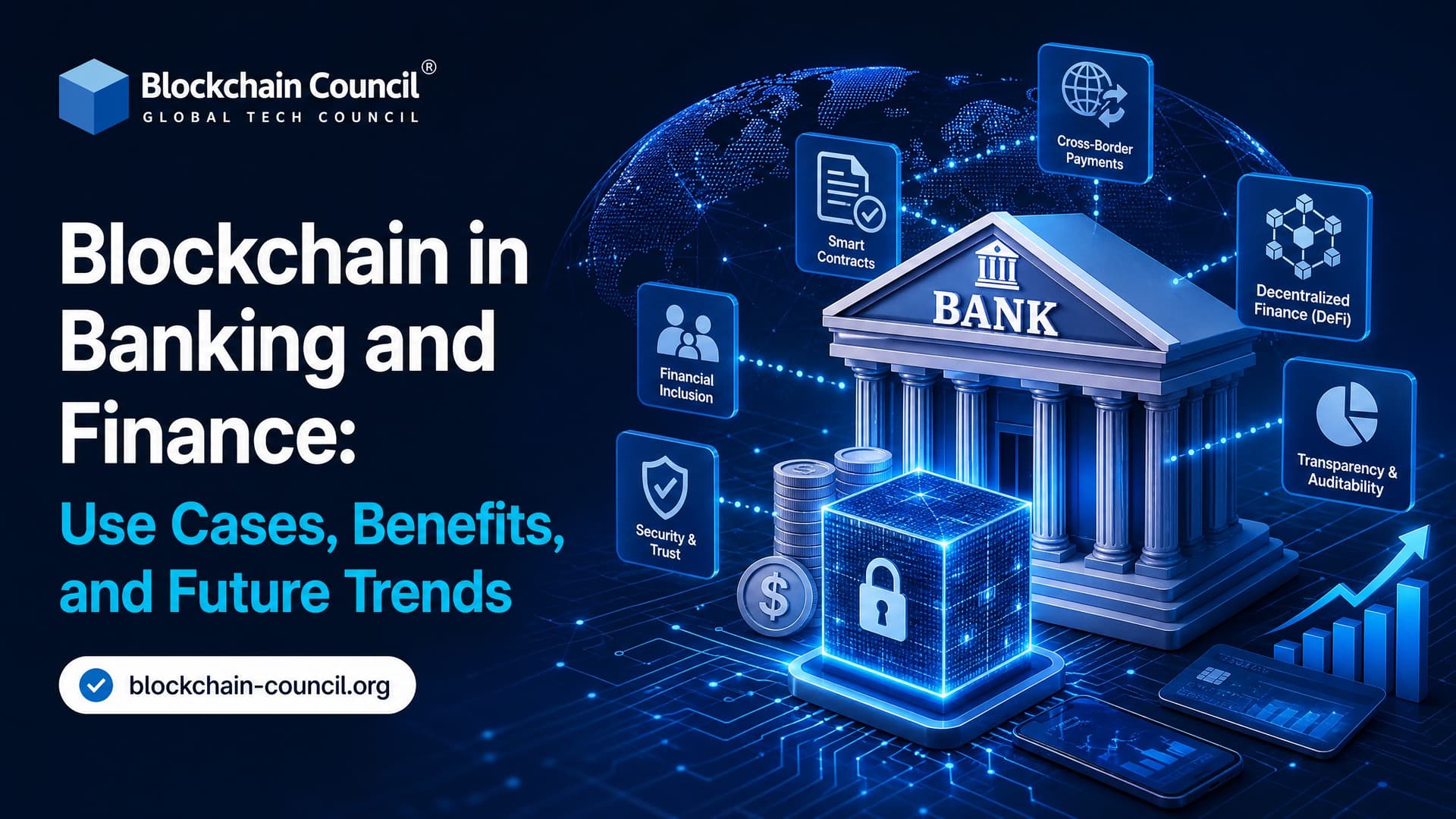
Blockchain in banking and finance has moved beyond lab pilots. The strongest production activity now sits in cross border payments, tokenization, digital asset custody, securities settlement, trade finance, and compliance workflows. Banks no longer treat distributed ledger technology as a side project. They use it to rebuild parts of market infrastructure where shared data, settlement certainty, and auditability matter.
That does not mean every banking problem needs a blockchain. Many do not. A single-bank internal ledger is often faster and cheaper with a conventional database. Blockchain earns its place when several parties need to coordinate around the same transaction record without fully trusting one operator.

Why Blockchain Matters in Banking and Finance
Financial services run on ledgers. Banks, custodians, brokers, clearing houses, payment networks, and regulators all keep records of who owns what, who owes whom, and when obligations settle. The problem is that these records sit in separate systems. That creates reconciliation work, settlement delays, manual exceptions, and operational risk.
Blockchain gives approved participants a shared record that can be updated through agreed rules. In public networks, those rules are enforced through open consensus. In permissioned banking networks, governance is usually handled by known institutions. Either way, the core idea is the same: reduce duplicate records and make transaction history harder to alter.
Research from IBM and OMFIF has highlighted the potential for distributed ledgers to cut reconciliation costs in securities clearing and settlement. The Federal Reserve Bank of Chicago has also described blockchain as a likely source of financial market innovation because it supports immutable records, digital asset representations, and automated contract execution.
Real-World Use Cases of Blockchain in Banking and Finance
Cross Border Payments and Remittances
Cross border payments are the clearest near-term use case. Traditional correspondent banking can involve multiple intermediaries, cut-off times, foreign exchange spreads, and limited transparency on fees. Blockchain-based payment networks can move tokenized value between parties with faster status updates and fewer handoffs.
OMFIF research has found that banking executives often rank faster international payments as the highest-return blockchain use case. That tracks with what practitioners see in the field. Payment operations teams care less about ideology and more about whether a transfer can settle faster, with fewer failed investigations.
Stablecoins, tokenized deposits, and central bank digital currencies are all part of this story. They are not the same instrument. A regulated bank deposit token has a different risk profile from an offshore stablecoin. Still, all three point toward programmable money and faster settlement rails.
Capital Markets and Securities Settlement
Capital markets remain a major area for blockchain adoption. Use cases include digital issuance, trading, clearing, settlement, asset servicing, collateral mobility, and custody. A tokenized bond, for example, can carry ownership records and payment logic on a shared ledger.
The Deutsche Bundesbank and Deutsche Börse have demonstrated delivery versus payment settlement using digital coins and securities in a distributed ledger prototype, as documented in IBM and OMFIF research. That matters because delivery versus payment is the heart of safe securities settlement: cash and asset ownership must change hands together, or not at all.
Settlement compression is attractive. Moving from T+2 style settlement cycles to minutes can reduce counterparty exposure and capital tied up in post-trade processes. But instant settlement is not always desirable. Some market participants rely on netting, liquidity buffers, and operational windows. The better target is configurable settlement, not blind speed.
Tokenization of Real World Assets
Tokenization turns ownership rights in assets such as real estate, funds, commodities, bonds, or equities into digital tokens. These tokens can be transferred, divided, and programmed under defined rules. Ripple's 2025 analysis of institutional digital asset activity points to tokenization infrastructure, custody, trading, and payments as top areas of bank interest.
The strongest case for tokenization is not that everything becomes a token. That is noise. The real value comes when tokenization improves liquidity, makes fractional ownership practical, reduces settlement friction, or creates better collateral workflows.
For example, a tokenized money market fund share can potentially be used as collateral outside conventional market hours. That is useful. A tokenized collectible with no legal clarity around ownership is not the same thing.
Lending, Collateral, and Credit Workflows
Blockchain can support lending by recording collateral, automating repayment logic, and improving visibility across syndicates or multiparty credit arrangements. Smart contracts can encode repayment schedules, margin calls, and collateral release conditions.
In decentralized finance, lending protocols already show how on-chain collateral and algorithmic interest rates can work without a traditional loan officer. These systems are useful laboratories, but they are not a full replacement for regulated credit markets. Most DeFi lending is overcollateralized, which limits its usefulness for ordinary borrowers.
For banks, the more practical path is selective automation. Use smart contracts for well-defined events, such as collateral movements or covenant checks, while keeping credit judgment, dispute handling, and regulatory oversight inside controlled processes.
Trade Finance and Supply Chain Finance
Trade finance is paperwork-heavy. Letters of credit, bills of lading, invoices, insurance documents, and shipment data often move through disconnected channels. Blockchain can give importers, exporters, banks, insurers, and logistics providers a shared view of documents and events.
Infosys and other enterprise technology firms have described blockchain use cases in commodities trade finance, receivables financing, and electronic document exchange. When shipment status, document approval, and financing terms are synchronized, banks can make faster funding decisions and reduce fraud linked to duplicate or forged documents.
This is one area where the technology only works if the business network joins. A perfect ledger with one participant is just an expensive database.
Digital Asset Custody and Investment Services
Banks are increasingly building or partnering for digital asset custody, trading infrastructure, staking support, and tokenized asset services. Institutional clients need controls that retail crypto wallets do not provide: segregation of duties, key recovery processes, policy approvals, audit logs, insurance considerations, and regulatory reporting.
Custody is harder than it looks. In a test environment, a developer can send an ERC-20 token in seconds. In production, you need wallet whitelisting, transaction simulation, hardware security modules, withdrawal approval rules, and incident playbooks. Anyone who has seen an ethers.js CALL_EXCEPTION because a smart contract reverted during a token transfer knows the small details matter. In OpenZeppelin Contracts 4.x, a common failed test still reads ERC20: transfer amount exceeds balance. In banking custody, that kind of issue becomes an operations incident if pre-funding and balance checks are weak.
Identity, KYC, and Compliance
Know your customer and anti money laundering processes are expensive because institutions repeatedly collect and verify similar data. Blockchain-based identity systems can use verifiable credentials so a customer proves a status, such as KYC completion or accredited investor eligibility, without exposing every underlying document each time.
This is not about putting passports on a public chain. Do not do that. The better model is privacy-preserving proof, selective disclosure, and clear governance over issuers, verifiers, and revocation.
Benefits of Blockchain for Financial Institutions
- Lower operational cost: Shared ledgers reduce reconciliation, exception handling, and duplicate record keeping.
- Faster settlement: Payments and securities transfers can settle in minutes for suitable use cases.
- Better auditability: Immutable transaction history improves reporting, supervision, and dispute resolution.
- Improved data integrity: Standardized records reduce mismatches between banks, custodians, and counterparties.
- Security gains: Cryptography and consensus make unauthorized record changes difficult, although endpoint security still matters.
- Programmable workflows: Smart contracts can automate asset servicing, collateral triggers, and compliance checks.
Key Challenges Banks Must Manage
Blockchain is not a shortcut around regulation, risk management, or integration work. The hard parts are often outside the chain.
- Legacy integration: Core banking systems, payment hubs, and risk engines were not built for real-time token settlement.
- Regulatory uncertainty: Digital asset classification, custody rules, stablecoin regulation, and cross border compliance still vary by jurisdiction.
- Scalability and privacy: Public chains may expose too much transaction metadata, while permissioned chains require strong governance.
- Interoperability: Tokenized assets lose value if they are trapped in isolated networks.
- Operational risk: Smart contract bugs, key mismanagement, and poor access controls can create losses quickly.
Future Trends in Blockchain Banking
DeFi and Traditional Finance Will Partly Converge
Decentralized finance will keep influencing banking architecture, especially in lending, liquidity pools, collateral management, and market making. Regulated institutions will not copy DeFi wholesale. They will borrow the useful parts: transparent collateral, programmable settlement, automated controls, and composable financial logic.
Programmable Money Will Become Normal
Tokenized deposits, regulated stablecoins, and central bank digital currencies are moving from theory to structured experimentation. Chainlink, Consensys, IBM, and central bank research all point to a future where digital money can interact with smart contracts, identity systems, and tokenized assets.
Real World Asset Tokenization Will Grow
Expect more tokenized funds, bonds, private credit instruments, real estate interests, and commodities. The winners will be products with legal clarity, credible custody, clear redemption rights, and real distribution. Tokenization without enforceable rights is just a database entry with marketing attached.
AI, Privacy Tech, and Blockchain Will Combine
Artificial intelligence can improve fraud monitoring, transaction screening, and credit analytics. Advanced cryptography, including zero knowledge proofs and secure multiparty computation, can reduce unnecessary data exposure. Blockchain can provide the shared transaction layer. The combination is powerful, but only if governance is clear.
What Professionals Should Learn Next
If you work in banking, payments, compliance, or financial technology, focus on practical architecture rather than slogans. Learn how token standards work, how custody models are designed, how smart contracts fail, and how settlement rules interact with regulation.
For structured learning, Blockchain Council offers relevant learning paths such as Certified Blockchain Expert™, Certified Blockchain Developer™, Certified Blockchain Architect™, and Certified Smart Contract Developer™. If your work touches fraud detection, compliance analytics, or risk modeling, pairing blockchain training with an AI-focused certification can also help.
Final Takeaway
Blockchain in banking and finance is becoming practical infrastructure for payments, capital markets, tokenization, custody, lending, trade finance, and compliance. The best projects solve multiparty coordination problems where shared records and programmable settlement create measurable value. Start by mapping one workflow with heavy reconciliation, delayed settlement, or repeated verification. Then test whether a shared ledger actually reduces friction. That is where the real business case begins.
Related Articles
View All
Blockchain
Blockchain in Banks: Use Cases, Benefits, Risks, and the AI Connection
Explore how blockchain in banks is reshaping payments, trade finance, tokenized deposits, KYC, AML, and AI-driven risk workflows.

Blockchain
Blockchain Train Technology: Rail Use Cases, Benefits, and Limits
Blockchain train technology is moving from pilots to practical rail use cases in freight, ticketing, asset records, IoT security, and audit trails.

Blockchain
Why Blockchain Matters: Benefits, Use Cases, and Business Impact
Why blockchain matters for business: trust, transparency, automation, faster settlement, and real use cases in finance, healthcare, supply chains, and identity.
Trending Articles
The Role of Blockchain in Ethical AI Development
How blockchain technology is being used to promote transparency and accountability in artificial intelligence systems.
Claude AI Tools for Productivity
Discover Claude AI tools for productivity to streamline tasks, manage workflows, and improve efficiency.
Blockchain in Supply Chain Provenance Tracking
Supply chains are under pressure to prove not just efficiency, but also authenticity, sustainability, and fairness. Customers want to know if their coffee really is fair trade, if the diamonds are con