

Blockchain in Banks: Use Cases, Benefits, Risks, and the AI Connection

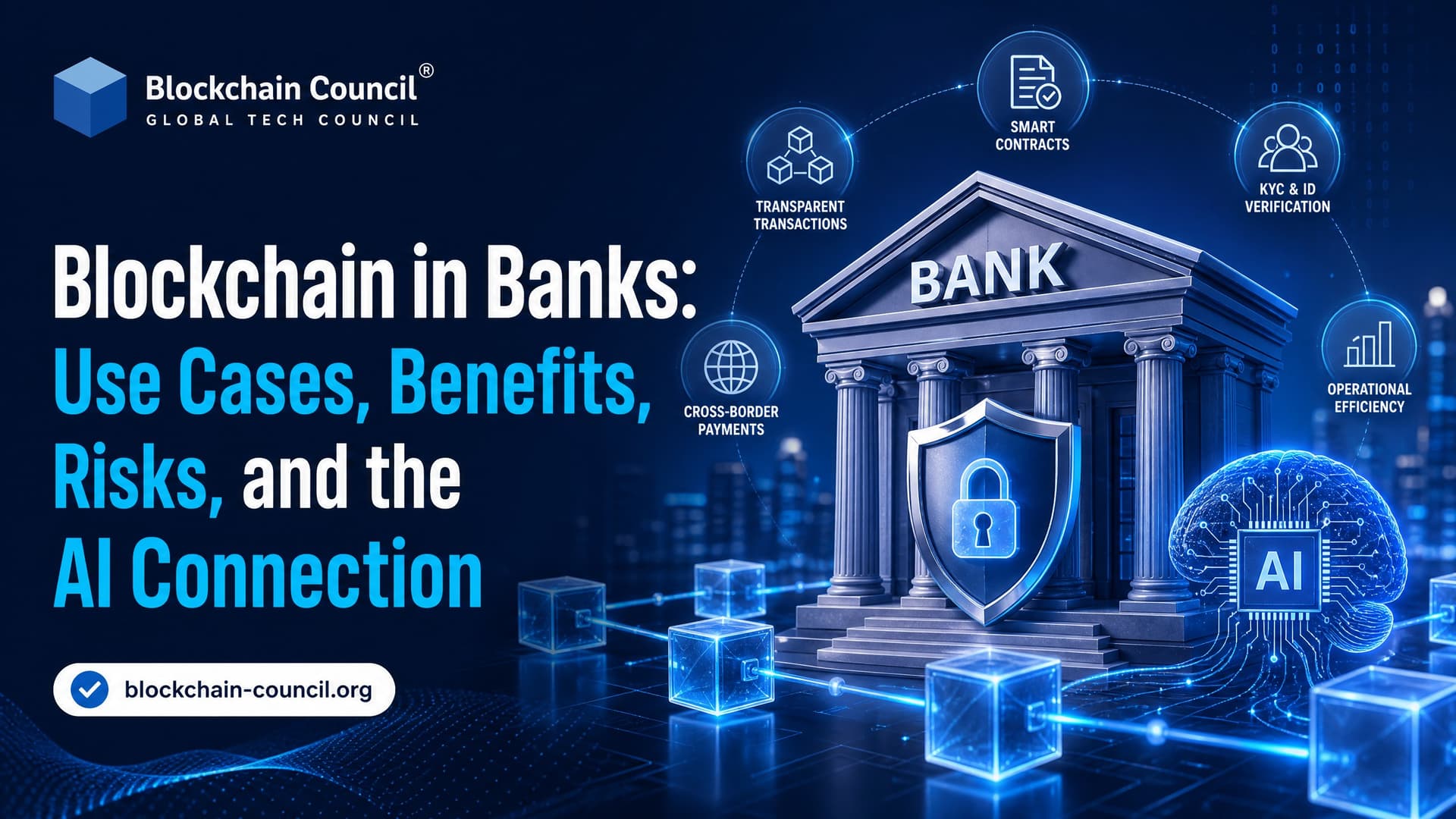
Blockchain in Banks is no longer a lab experiment. Large financial institutions now use distributed ledger technology for cross-border payments, trade finance, tokenized deposits, digital asset custody, and compliance workflows. The pattern is clear. Banks are not replacing every core system with blockchain. They apply it where shared records, settlement finality, and auditability solve real operational pain.
The shift is measurable. A widely cited global blockchain survey found that over 95 percent of participating banks planned some level of investment in blockchain or distributed ledger technology. The same survey reported that 68 percent believed they could lose competitive advantage without it, while 84 percent expected blockchain in banking and finance to become mainstream.

Why Banks Are Using Blockchain
Banks run on trust, records, and reconciliation. That sounds simple until you see how many parties touch one international payment or trade finance transaction. Correspondent banks, clearing systems, compliance teams, messaging networks, and back-office staff all keep their own records. Mismatches create delays.
Blockchain helps when several organizations need a shared version of transaction history without giving one party total control. In banking, that usually means permissioned ledgers, strict identity controls, and agreed governance rules.
Most banks prefer private or consortium blockchains for regulated use cases. R3 Corda and JPMorgan's Quorum are widely cited examples in financial services. Public chains still matter, especially for digital assets and tokenized securities, but banks treat them carefully because of privacy, compliance, and operational risk.
Major Use Cases of Blockchain in Banks
1. Cross-Border Payments and Settlement
Cross-border payments remain the strongest near-term use case. Traditional international transfers can involve multiple intermediaries, time zone delays, manual checks, and settlement uncertainty. Blockchain-based systems can cut reconciliation work and support near real-time settlement between approved participants.
A Juniper Research estimate suggests that blockchain deployments could save banks up to 27 billion dollars in cross-border settlement costs by 2030, reducing costs by more than 11 percent. That is not a small process improvement. It is a serious cost target.
HSBC has reported cutting certain transaction processing times from 5 to 10 days down to less than 24 hours using blockchain-based solutions. That kind of gain matters most in high-value trade, treasury, and correspondent banking, where trapped liquidity is expensive.
2. Trade Finance
Trade finance is paperwork-heavy. Letters of credit, invoices, bills of lading, customs documents, insurance certificates, and shipment updates often move across disconnected systems. Blockchain gives banks, exporters, importers, and logistics partners a shared record of document status and transaction events.
The we.trade consortium, created by European banks including Deutsche Bank, HSBC, and Rabobank, showed how banks could digitize trade finance workflows. The larger lesson holds even when individual platforms come and go: trade finance works better when parties can verify documents and conditions from a common ledger.
3. Tokenized Deposits and Digital Assets
Tokenized deposits are becoming one of the most serious banking applications. A tokenized deposit is a blockchain-based representation of a bank deposit, not an unbacked crypto token. Large US banks, including JPMorgan, Citi, Bank of America, and Wells Fargo, have been linked to plans for a tokenized deposit network connected to conventional payment infrastructure and managed through The Clearing House.
This matters because tokenized deposits could let banks move regulated money on blockchain rails while keeping deposit relationships, compliance checks, and banking supervision intact.
Tokenization also extends to real-world assets. Goldman Sachs has explored tokenizing real assets as digital financial instruments. Tokenized bonds, fund units, and other securities can reduce issuance friction, improve settlement speed, and support programmable servicing. Keep the cautious view. Tokenization is worth doing when it improves distribution, settlement, or lifecycle management. Tokenizing an asset just for branding is usually a poor use of budget.
4. Crypto Custody and Collateral Services
Some banks are adding custody services for cryptoassets and tokenized securities where regulation allows. Custody is not just wallet storage. It includes key management, segregation of assets, reporting, transaction approval controls, insurance considerations, and audit trails.
If you have ever managed a production wallet system, you know the operational risk is not theoretical. One wrong signing policy, one exposed private key, or one poorly tested recovery process can create losses fast. Banks bring discipline here, but they also inherit new technical risks.
5. KYC, AML, and Regulatory Reporting
KYC and AML are expensive because banks repeatedly verify the same customers across different institutions and jurisdictions. Blockchain can support shared identity attestations and compliance records while preserving permissioned access. Instead of every bank rebuilding the same file from scratch, verified data can be reused under agreed rules.
This is where banks with blockchain and AI becomes a practical strategy. Blockchain can provide tamper-resistant records. AI can help with document verification, entity matching, anomaly detection, sanctions screening, and transaction monitoring. The combination is strongest when AI decisions are traceable and the underlying data has a clear audit history.
How Banks With Blockchain and AI Are Changing Risk Workflows
AI needs reliable data. Blockchain can improve data lineage by recording who submitted data, when it changed, and which transaction or identity event it relates to. That helps model governance teams, especially in regulated environments.
Common banking applications include:
- KYC onboarding: AI reads documents and flags inconsistencies, while blockchain stores verification attestations.
- AML monitoring: Machine learning models score suspicious patterns across transaction histories, with blockchain improving auditability.
- Credit analytics: AI models assess risk using approved data sources, while blockchain records consent, data provenance, and updates.
- Smart contract workflows: Loan disbursement, collateral checks, and settlement events can be automated with programmable rules.
Be blunt about the trade-off. AI does not fix bad compliance data. Blockchain does not make a weak risk model accurate. Together, they work only when banks design clear data permissions, model controls, and exception handling.
What Developers and Banking Teams Should Know
If you build blockchain systems for banks, you have to think differently than you would for a consumer DeFi app. Privacy, role-based access, audit logs, disaster recovery, and regulator access are first-class requirements.
A small technical detail trips many beginners: deployment settings matter. On Ethereum-compatible networks, using the wrong chain ID can send a transaction to the wrong network or fail signature validation. Ethereum mainnet uses chain ID 1. In Solidity 0.8.x, arithmetic overflow reverts by default, which changed how many older SafeMath examples behave. In token workflows, approval logic is another common failure point. Developers often hit errors such as execution reverted: ERC20InsufficientAllowance when a contract tries to transfer tokens without the required allowance.
For bank-grade systems, those are not minor bugs. They turn into failed settlements, broken reconciliation, or compliance exceptions.
Challenges Slowing Adoption
Blockchain in banks still faces real constraints. The technology is useful, but it is not magic infrastructure.
- Regulatory uncertainty: Digital assets, tokenized securities, custody obligations, and data-sharing rules vary by jurisdiction.
- Legacy systems: Many banks still depend on decades-old core banking platforms. Integration is slow and expensive.
- Interoperability: Banks need blockchain networks to talk to payment rails, core ledgers, reporting systems, and other chains.
- Scalability: High-volume payments require predictable throughput, finality, and service-level controls.
- Governance: Consortium chains need rules for upgrades, participant onboarding, dispute handling, and liability.
- Security: Smart contract bugs, key custody failures, and access-control mistakes can be severe.
This is why most serious banks start with targeted deployments. They do not migrate every account ledger at once. They pick expensive, multi-party processes where blockchain cuts friction enough to justify the change.
Future Outlook for Blockchain in Banking
Payments will likely stay the lead use case over the next few years. Trade finance, tokenized deposits, digital securities, and compliance data sharing will keep expanding as regulations get clearer.
Expect banks to run a mixed architecture:
- Permissioned ledgers for interbank settlement and regulated workflows.
- Public chains where market access and asset distribution matter.
- AI systems for fraud detection, credit risk, KYC review, and operational monitoring.
- APIs connecting blockchain networks to existing banking, payment, and reporting infrastructure.
The winning model is not blockchain replacing banks. It is banks using blockchain as shared financial infrastructure, with AI improving analysis and decision-making around that infrastructure.
Skills Professionals Should Build Next
If you work in banking, compliance, fintech, or software development, focus on the practical stack: distributed ledger design, tokenization, smart contracts, digital identity, AI risk analytics, and regulatory controls. You do not need to become a protocol researcher to contribute. You do need to know where blockchain helps and where a normal database is better.
For structured learning, consider Blockchain Council programs such as Certified Blockchain Expert™, Certified Blockchain Developer™, Certified Smart Contract Developer™, and Certified AI Expert™. Each covers a different slice of blockchain architecture, smart contract development, and AI applications in financial services.
Start with one banking workflow. Map every participant, record, approval, and reconciliation step. Then ask a hard question: does a shared ledger cut cost, risk, or settlement time enough to justify production deployment? If the answer is yes, you have a real blockchain use case, not a slide deck.
Related Articles
View All
Blockchain
Top Blockchain Use Cases in Banks and Financial Services
Explore the top blockchain use cases in banks, from payments and trade finance to tokenization, settlement, lending, KYC, and digital asset services.

Blockchain
Blockchain Train Technology: Rail Use Cases, Benefits, and Limits
Blockchain train technology is moving from pilots to practical rail use cases in freight, ticketing, asset records, IoT security, and audit trails.

Blockchain
Blockchain in Banking and Finance: Use Cases, Benefits, and Future Trends
Explore blockchain in banking and finance, including payments, tokenization, custody, lending, trade finance, compliance, benefits, and future trends.
Trending Articles
The Role of Blockchain in Ethical AI Development
How blockchain technology is being used to promote transparency and accountability in artificial intelligence systems.
What is AWS? A Beginner's Guide to Cloud Computing
Everything you need to know about Amazon Web Services, cloud computing fundamentals, and career opportunities.

Can DeFi 2.0 Bridge the Gap Between Traditional and Decentralized Finance?
The next generation of DeFi protocols aims to connect traditional banking with decentralized finance ecosystems.