

Technical Skills for Blockchain Product Managers

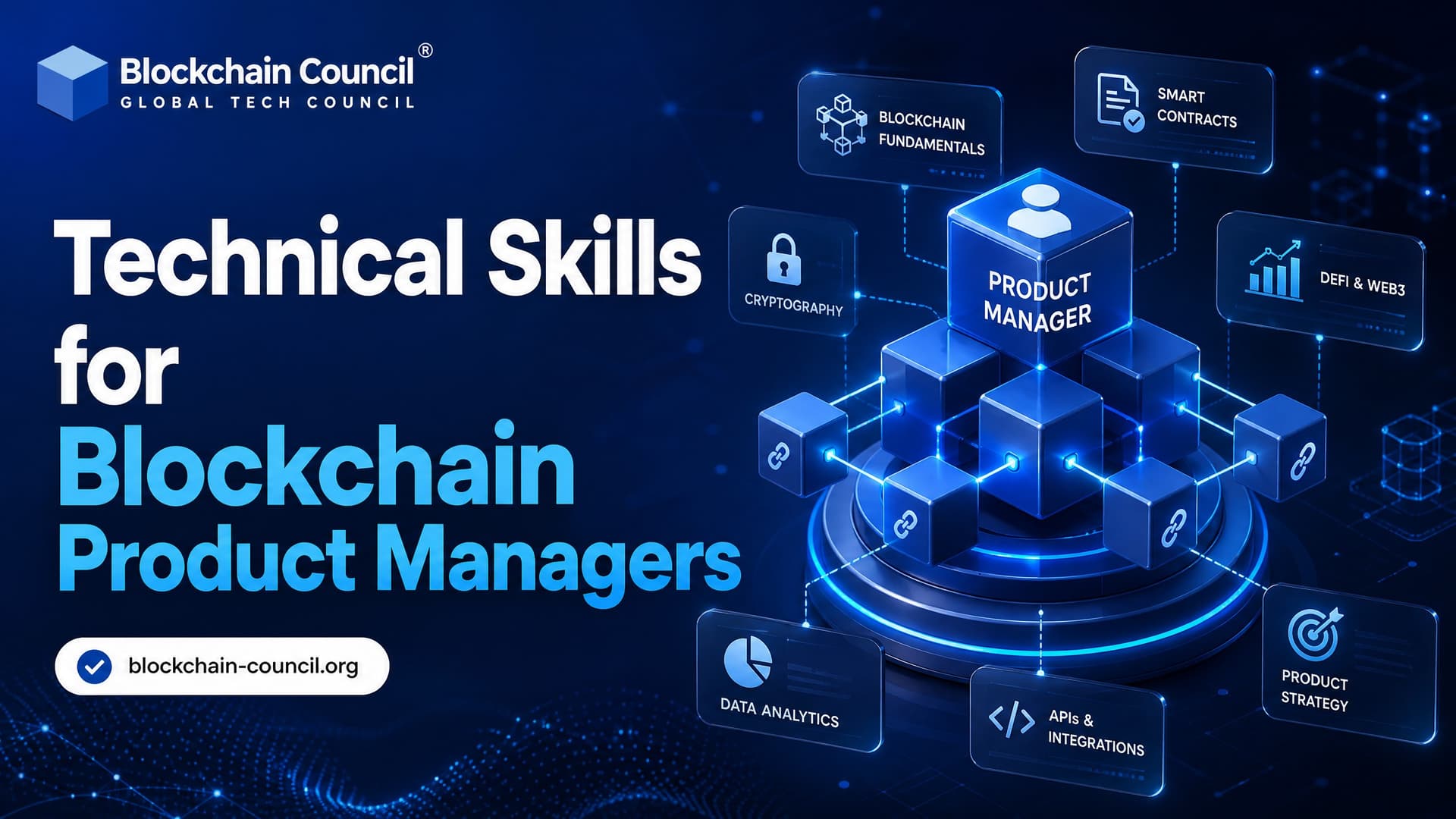
Technical skills for blockchain product managers are no longer a nice extra. If you manage a wallet, DeFi app, NFT marketplace, exchange feature, or enterprise blockchain product, you need enough depth in smart contracts, wallets, and Web3 architecture to make good trade-offs before engineering has already committed to a design.
You do not need to be the strongest Solidity developer in the room. You do need to understand what can break, what cannot be changed after deployment, and why a five-click wallet flow can kill conversion even when the contract code is correct.

Why Blockchain Product Managers Need Technical Depth
Traditional product management skills still matter: discovery, prioritization, stakeholder alignment, analytics, pricing, and user research. Blockchain adds a second layer. Your product decisions may affect token economics, custody risk, gas costs, governance rights, and regulatory exposure.
Job descriptions for Web3 product managers now commonly ask for knowledge of smart contracts, consensus mechanisms, wallets, DeFi, NFTs, compliance, and major chains such as Ethereum, Solana, and Polygon. Reviews of hundreds of crypto product roles show wallet, DeFi, trading, AI, compliance, and fintech skills appearing again and again. That matches what teams see in practice.
The short version: you cannot manage what you cannot reason about.
Smart Contract Literacy for Product Managers
What smart contracts do in the product
Smart contracts are programs stored and executed on a blockchain. They enforce rules for transfers, minting, staking, swaps, governance votes, permissions, rewards, and asset ownership. In many dApps, the smart contract is the product's core back end.
That changes the product manager's job. A pricing rule in a Web2 application can often be changed with a database migration and a deployment pipeline. A pricing rule embedded in an immutable contract may require an upgrade path, a governance vote, user migration, or a new contract address that breaks integrations.
Be blunt with yourself here. If the product depends on an on-chain rule, write the requirement like a legal contract and a test case had a child. Ambiguity gets expensive.
Languages, platforms, and standards you should recognize
You do not need to write production contracts daily, but you should recognize the common stack:
- Solidity 0.8.x for Ethereum and EVM-compatible chains such as Polygon, Arbitrum, Optimism, and BNB Smart Chain.
- Rust for Solana programs and some other ecosystems.
- ERC-20 for fungible tokens.
- ERC-721 and ERC-1155 for NFTs and multi-token designs.
- EIP-1559 fee mechanics on Ethereum, where users deal with base fees and priority fees.
- Ethereum mainnet chain ID 1, which matters when wallets ask users to switch networks.
A useful practitioner detail: many beginners get confused when a transaction fails in testing with execution reverted. For a PM, that message is not noise. It usually means a contract requirement was not met, such as insufficient allowance, the wrong caller, a paused contract, or a require statement failing. Ask the engineer which condition reverted and whether the UI can prevent that action before the user pays gas.
Upgradeability and audits
One of the most important technical skills for blockchain product managers is knowing when immutability helps and when it hurts. Immutable contracts build trust, but they also lock in bugs. Upgradeable contracts, such as proxy-based designs using ERC-1967 patterns, allow fixes but introduce admin-key and governance risks.
Take a clear position in planning: for financial contracts, audit time is not a buffer to cut at the end. It is part of the build. Security reviews, threat modeling, test coverage, and staged deployment should be on the roadmap from day one.
Smart contract PMs should be able to ask:
- What functions can move user funds?
- Who has admin permissions?
- Can the contract be paused?
- What happens if an oracle is delayed or manipulated?
- How do users exit if an upgrade fails?
- Are gas costs acceptable for the target chain and user segment?
If you want structured depth here, Blockchain Council's Certified Smart Contract Developer™ and Certified Blockchain Developer™ are natural learning paths to explore.
Wallet Skills Every Blockchain PM Should Have
Wallets are not just login screens
A crypto wallet stores or controls private keys, derives public addresses, signs transactions, signs messages, and connects users to dApps through providers. MetaMask, Coinbase Wallet, Phantom, Ledger, and Safe serve different user groups and risk models.
For the user, the wallet is often the product experience. If your dApp asks for the wrong network, displays an unreadable signature request, or fails after the user signs, trust drops fast.
Wallet usage is no longer niche. Industry estimates in late 2024 placed monthly active crypto wallet addresses around 220 million, though the number of real individuals was likely closer to 30 to 60 million, since users often hold multiple wallets and bots inflate activity. Other estimates put global crypto ownership above 560 million people in 2024, rising toward 741 million in 2025. Consensys has also reported growing participation in Web3 wallets, DeFi, blockchain games, and staking.
Custodial, non-custodial, and smart contract wallets
Product choices around wallets affect UX, compliance, and liability.
- Custodial wallets: A platform controls keys for the user. This can simplify onboarding, but it adds custody obligations, KYC, operational security, and regulatory pressure.
- Non-custodial wallets: Users control keys. This supports self-custody but creates recovery problems. Lost seed phrase, lost funds.
- Externally owned accounts: The standard user accounts controlled by private keys, common in MetaMask-style flows.
- Smart contract wallets: Wallets controlled by contract logic, often supporting multisig, spending limits, social recovery, batching, and account abstraction patterns.
Mobile matters too. Several market reports suggest most crypto users prefer mobile wallets, and many wallet providers now support biometric authentication, multi-chain assets, NFT display, staking, and multi-factor controls. Do not assume your desktop extension flow is enough for a global consumer product.
Wallet connection flows you should understand
A product manager should be able to map the wallet flow step by step:
- User selects Connect Wallet.
- The dApp detects a provider, such as an injected Ethereum provider in the browser.
- The wallet asks the user to approve account access.
- The app checks network, address, balances, and permissions.
- The user signs a message or sends a transaction.
- The app waits for confirmation and updates state from chain data or an indexer.
One practical gotcha: in ethers.js v6, several patterns changed from v5. For example, ethers.utils.parseEther became ethers.parseEther. That kind of library change sounds small, but it can slow a sprint when frontend, wallet, and contract teams are debugging the same transaction flow.
Blockchain Council's Certified Web3 Expert™ can be a useful next step if your work is closer to dApp strategy, wallet UX, or Web3 product design.
Web3 Architecture Product Managers Must Understand
The core stack
Most dApps use a stack like this:
- Blockchain network: Stores transactions, contract state, and asset ownership.
- Nodes and RPC providers: Let applications read chain data and broadcast transactions through JSON-RPC APIs.
- Smart contracts: Hold on-chain business logic.
- Frontend: Usually React, Vue, or mobile UI code that interacts with wallets and contracts.
- Indexers: Off-chain services that read events and make data queryable for dashboards, feeds, notifications, and analytics.
- Oracles: Bring external data on-chain, such as prices, randomness, or real-world events.
- Back-end services: Handle caching, compliance workflows, alerts, customer support tools, and integrations that do not belong on-chain.
Ethereum frontends do not call a contract the way a Web2 app calls a normal REST endpoint. They usually call a node through an RPC provider, and the node reads state or submits a signed transaction. Reads are often free. State-changing writes require gas and finality time.
On-chain versus off-chain decisions
Good Web3 product architecture is mostly about deciding where logic and data should live. Put too much on-chain and users pay for every interaction. Put too little on-chain and the product may lose transparency or composability.
Use this rule of thumb:
- Put ownership, settlement, and critical permissions on-chain.
- Keep private user data, heavy computation, search, recommendations, and most analytics off-chain.
- Index on-chain events for speed, but treat the chain as the source of truth.
- Design failure states before launch, especially for oracle delays, RPC outages, stuck transactions, and bridge failures.
Cross-chain features need extra caution. Bridges and relays can improve reach and liquidity, but they add security assumptions. A bridge compromise can turn a product incident into a treasury-level loss. If you cannot explain the trust model to a customer or compliance lead, the design is not ready.
How These Skills Change Product Work
Technical skills for blockchain product managers show up in daily work, not just architecture meetings. You will use them when you:
- Write requirements for mint limits, staking rewards, swap fees, governance thresholds, or withdrawal queues.
- Prioritize audit findings against launch pressure.
- Review wallet drop-off during signature and transaction steps.
- Define analytics events from smart contract logs.
- Plan chain support based on liquidity, fees, finality, wallets, and user geography.
- Work with legal teams on custody, token distribution, KYC, sanctions screening, and user disclosures.
Chainalysis has reported crypto activity rising sharply from late 2023 into early 2024, reaching levels above the 2021 bull market period. TRM Labs has also pointed to accelerating retail activity in 2025. Whether markets are hot or quiet, teams still need PMs who can separate useful infrastructure from overhyped architecture.
A Practical Learning Path for Blockchain PMs
If you are building your skill plan, do it in this order:
- Learn blockchain fundamentals: Consensus, blocks, transactions, gas, finality, and common token standards. Blockchain Council's Certified Blockchain Expert™ fits this stage.
- Study smart contract behavior: Read simple Solidity contracts, understand events, reverts, access control, upgrades, and audits.
- Use wallets hands-on: Connect MetaMask or another wallet to a testnet dApp, switch networks, sign messages, approve token allowances, and inspect transactions.
- Map a full dApp architecture: Frontend, wallet, RPC provider, contracts, indexer, oracle, monitoring, and admin controls.
- Learn architecture trade-offs: For deeper system design, consider Blockchain Council's Certified Blockchain Architect™.
Build one small thing next: a testnet ERC-20 token dashboard that connects a wallet, reads balances, sends a transaction, and displays events from an indexer. It is simple. It will teach you more than ten abstract strategy decks.
Related Articles
View All
Blockchain
Non-Technical Skills for Blockchain Product Managers: Communication, Strategy, and Leadership
Learn the key non-technical skills blockchain product managers need, including communication, strategy, leadership, community work, and risk management.

Blockchain
Product Discovery for Blockchain Products: A Step-by-Step Guide for Web3 Product Managers
A practical Web3 product discovery guide covering wallet behavior, token validation, governance, security, metrics, and testnet pilots.

Blockchain
Tokenomics for Product Managers: Designing Sustainable Blockchain Products
A practical guide to tokenomics for product managers, covering utility, supply, incentives, governance, compliance, and sustainable Web3 product design.
Trending Articles
The Role of Blockchain in Ethical AI Development
How blockchain technology is being used to promote transparency and accountability in artificial intelligence systems.

Top 5 DeFi Platforms
Explore the leading decentralized finance platforms and what makes each one unique in the evolving DeFi landscape.

Can DeFi 2.0 Bridge the Gap Between Traditional and Decentralized Finance?
The next generation of DeFi protocols aims to connect traditional banking with decentralized finance ecosystems.