

Non-Technical Skills for Blockchain Product Managers: Communication, Strategy, and Leadership

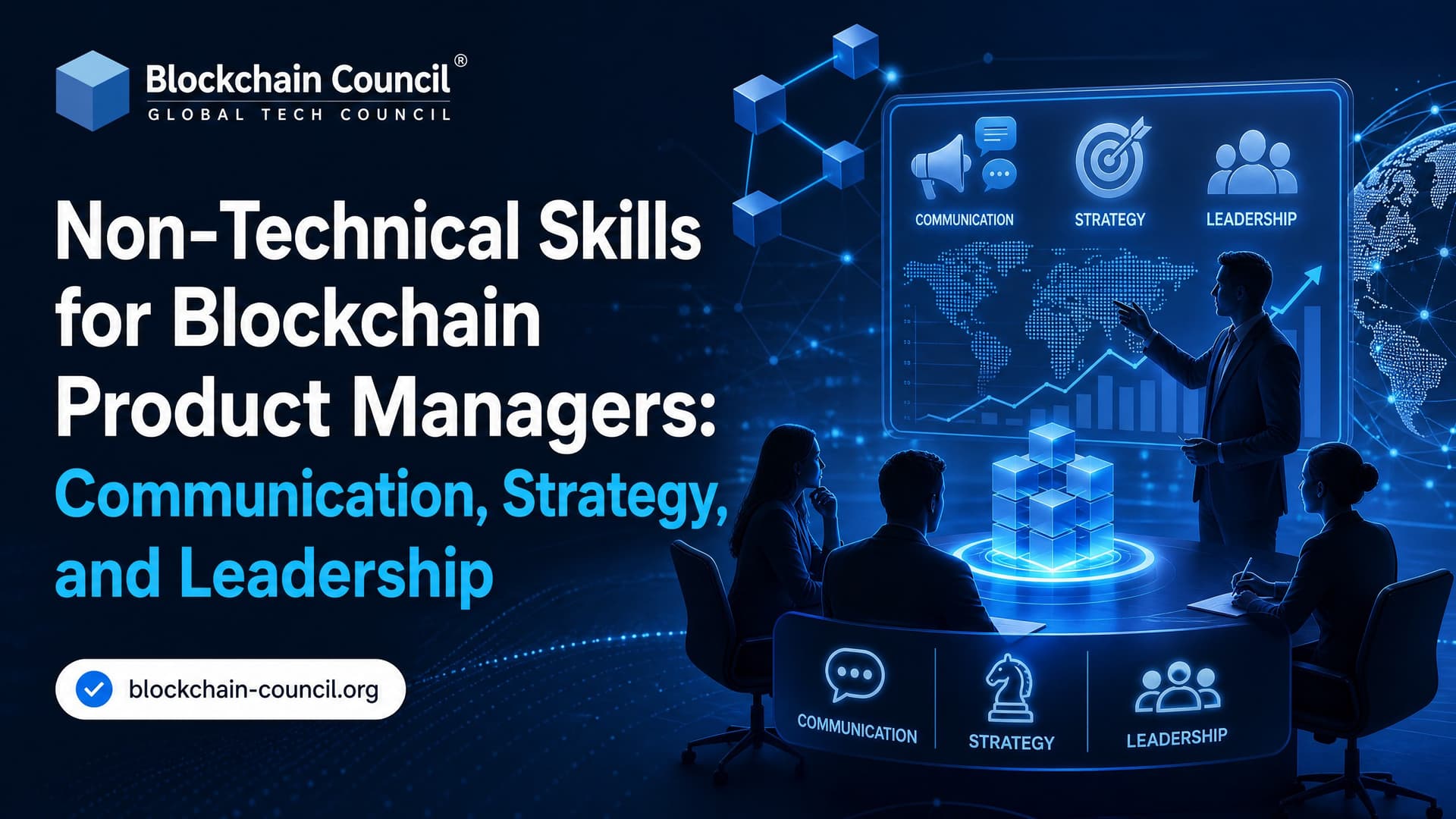
Non-technical skills for blockchain product managers now decide whether a product earns trust, ships safely, and survives market pressure. You still need blockchain literacy, of course. But the PM who can explain a token design to legal, turn on-chain data into roadmap choices, and calm a Discord during an incident is often the person who keeps the product alive.
Blockchain product management sits between engineering, business, compliance, design, and community. That is a crowded room. The best PMs do not try to sound like protocol engineers. They translate, prioritize, and lead decisions when the answer is not obvious.

Why Non-Technical Skills Matter in Blockchain Product Management
A blockchain product manager is not just a backlog owner. The role is closer to strategic operator. You connect blockchain capabilities with business goals, user needs, market timing, and regulatory limits.
Product managers usually work across development, operations, sales, and marketing. In blockchain, add smart contract engineers, auditors, token economists, DAO contributors, exchange partners, regulators, and public communities. It gets noisy fast.
That is why three non-technical skill groups matter most:
- Communication: Turn technical, legal, and economic complexity into clear decisions.
- Strategy: Choose use cases where blockchain adds real value, not just novelty.
- Leadership: Coordinate teams, manage risk, and guide communities through uncertainty.
To be blunt, blockchain is often overused. A shared database is still the better answer for many internal workflows. A good PM has the confidence to say that before engineering spends three months building a smart contract nobody needed.
Communication: The Core Skill That Keeps Blockchain Teams Aligned
Translate Between Technical and Business Teams
Blockchain PMs spend a surprising amount of time translating. Executives may ask, "Can we launch this token next quarter?" Engineers may answer with gas limits, bridge risk, oracle dependencies, and audit timelines. Your job is to turn that into a decision the business can act on.
Say the team is building on Ethereum. You should understand enough about EIP-1559 gas mechanics, wallet signing, and smart contract immutability to ask sensible questions. You do not need to write every Solidity 0.8.x contract yourself. But if a developer says a deployment failed with ProviderError: execution reverted in Hardhat, you should know that this is not "a frontend bug" by default. It might be a constructor condition, an access control issue, or a failed dependency in the deployment script.
Good communication shows up in small deliverables:
- Clear product requirement documents that define wallet flows, transaction states, and error handling.
- User stories that include failed transactions, rejected signatures, and network switching.
- Executive updates that separate technical blockers from market or compliance decisions.
- Launch notes that explain risks without burying users in protocol jargon.
The PM who writes "connect wallet" as one feature has probably not tested enough wallets. MetaMask, WalletConnect, hardware wallets, mobile deep links, and wrong-chain states all create different user paths. Spell them out.
Communicate With Communities, Not Just Customers
Web3 products often have communities before they have stable revenue. Web3 PMs may rely more heavily on community engagement than conventional product-market fit signals, especially when user tracking is limited.
This changes the communication job. You are not only explaining features to users. You may be discussing governance proposals, token incentives, protocol fees, creator royalties, or audit results in public channels.
Strong external communication includes:
- Posting roadmap changes in plain language on Discord, Telegram, X, or governance forums.
- Explaining why a feature was delayed, especially when security review is the reason.
- Sharing on-chain metrics such as wallet activity, transaction volume, total value locked, or NFT floor price trends with context.
- Responding to criticism without sounding defensive.
Do not outsource all of this to marketing. Community members can usually tell when the PM is absent. If users are voting on a governance proposal, they deserve to hear the product reasoning from someone close to the roadmap.
Strategy: Choosing the Right Blockchain Use Cases
Separate Real Utility From Hype
Strategic thinking is where many blockchain products fail early. A team starts with "we need a token" instead of "what user problem requires decentralization, programmable incentives, or transparent settlement?" That order matters.
Blockchain makes sense when the product benefits from characteristics such as:
- Shared state across parties that do not fully trust each other.
- Transparent audit trails for transactions or asset history.
- Programmable ownership, payments, or access rights.
- Open participation through wallets, smart contracts, or governance.
It is a poor fit when users need high privacy, instant reversibility, low operational complexity, or when all participants already trust one central operator. Say that early. It saves budget and credibility.
For enterprise blockchain products, strategy often means choosing a narrow use case first. Supply chain traceability, invoice settlement, digital credentials, and tokenized assets all require different stakeholder maps. A PM should identify who needs to write data, who needs to verify it, who pays for infrastructure, and who carries legal risk.
Use Metrics That Fit Web3 Behavior
Traditional SaaS metrics still matter: activation, retention, revenue, support cost, and customer acquisition. But blockchain product managers also need fluency in on-chain indicators.
Depending on the product, useful metrics may include:
- Wallet activity: New wallets, returning wallets, and active signing behavior.
- Transaction rates: Successful transactions, failed transactions, and average confirmation time.
- Total value locked: Common in DeFi, but dangerous if used without quality checks.
- Gas costs: Especially important for products on Ethereum mainnet, chain ID 1.
- Governance participation: Proposal views, votes, quorum, and delegate activity.
Be careful with vanity numbers. A spike in wallets can be airdrop farming. High TVL can disappear when incentives end. NFT floor prices can move because of thin liquidity. The PM's strategic job is to ask, "What behavior proves durable value?"
Build Regulatory Awareness Into Product Strategy
Regulation is not a final checklist item. It affects product design from the first roadmap discussion. Crypto product managers need working awareness of KYC, AML, consumer protection, securities concerns, sanctions screening, and data privacy.
You are not expected to act as legal counsel. You are expected to know when legal review is needed and how to turn legal constraints into product flows. If identity checks are required for a market, that changes onboarding. If token distribution creates regulatory exposure, that changes launch strategy. If users are in multiple jurisdictions, that changes support and communications.
This is also where Blockchain Council learning paths can help. Professionals moving into this role can use programs such as Certified Blockchain Expert™ for conceptual depth and Certified Web3 Expert™ for ecosystem context.
Leadership: Guiding Teams Through Uncertainty
Lead Cross-Functional Decisions
Blockchain product work has more trade-offs than most PM roles. Security slows speed. Compliance limits growth tactics. Decentralization can reduce control. User experience may suffer when users must approve multiple wallet signatures.
Your leadership is tested when priorities collide. A growth team may want a fast token incentive campaign. Security may warn that the reward contract needs another audit pass. Legal may ask for jurisdiction exclusions. Engineering may want to deploy behind a proxy contract so bugs can be patched later, while the community may object to admin control.
A strong PM does not average everyone's opinion. You frame the decision:
- What user or business outcome are we trying to achieve?
- What technical or legal risks could harm users?
- Which options are reversible?
- What must be communicated before launch?
- Who owns the final decision?
That last question matters. Decentralized teams can drift when decision rights are vague.
Manage Risk Before Deployment
Web3 products punish casual launches. Once a smart contract is deployed, especially without upgradeability, mistakes can be expensive or permanent. Even upgradeable contracts introduce trust questions around admin keys, timelocks, and governance control.
Leadership here means slowing the team down when needed. Budget time for threat modeling, testnet trials, audit review, bug bounty planning, and incident response preparation. If you wait until the week of launch to ask how the pause function works, you are late.
A practical pre-launch checklist should cover:
- Audit status and unresolved findings.
- Access control roles and key management.
- Emergency pause or circuit breaker behavior.
- Rollback options for frontend, backend, and smart contracts.
- User communications for failed transactions or degraded service.
- Monitoring for abnormal wallet activity or contract calls.
This is not "technical detail" to ignore. It is product risk.
Lead During Incidents
Crypto markets move quickly. Protocols face oracle failures, bridge exploits, liquidity shocks, governance disputes, and infrastructure outages. In those moments, users do not want vague reassurance. They want facts, timing, and visible ownership.
During an incident, assemble engineering, security, legal, support, and communications immediately. Publish only verified information. Say what is known, what is being investigated, and when the next update will arrive. If funds are at risk, be direct.
The PM may not be the incident commander in every organization, but the PM should understand user impact better than anyone. That perspective is essential when the team decides whether to pause deposits, disable a feature, postpone a governance vote, or warn users not to interact with a contract.
How to Build These Skills as a Blockchain PM
If you are moving from traditional product management into blockchain, do not start by memorizing every protocol. Build practical range.
- Write one wallet-based user journey: Include rejected signatures, wrong networks, pending transactions, and failed confirmations.
- Read a smart contract audit report: Focus on severity levels, remediation notes, and product impact.
- Join a governance forum: Study how proposals are framed, challenged, and passed.
- Track one Web3 product for 30 days: Watch wallet activity, user complaints, release notes, and community sentiment.
- Study blockchain fundamentals: Use structured training such as Blockchain Council's Certified Blockchain Expert™ or Certified Web3 Expert™ for deeper learning.
The fastest useful exercise is simple: take a blockchain feature you admire and explain it three ways, first to an engineer, then to a CFO, then to a skeptical user. If all three explanations sound the same, rewrite them.
Next Step for Aspiring Blockchain Product Leaders
Pick one product area, such as DeFi, enterprise blockchain, NFTs, DAOs, or tokenized assets, and build a small product brief this week. Include the user problem, why blockchain is necessary, core metrics, regulatory assumptions, launch risks, and a community communication plan. Then compare your gaps against a structured program such as Certified Blockchain Expert™ or Certified Web3 Expert™ from Blockchain Council.
That exercise will tell you where to focus next: communication, strategy, or leadership. Most strong blockchain PMs need all three.
Related Articles
View All
Blockchain
Technical Skills for Blockchain Product Managers
Learn the technical skills blockchain product managers need across smart contracts, wallets, and Web3 architecture to ship safer products.

Blockchain
Product Discovery for Blockchain Products: A Step-by-Step Guide for Web3 Product Managers
A practical Web3 product discovery guide covering wallet behavior, token validation, governance, security, metrics, and testnet pilots.

Blockchain
Tokenomics for Product Managers: Designing Sustainable Blockchain Products
A practical guide to tokenomics for product managers, covering utility, supply, incentives, governance, compliance, and sustainable Web3 product design.
Trending Articles
The Role of Blockchain in Ethical AI Development
How blockchain technology is being used to promote transparency and accountability in artificial intelligence systems.
What is AWS? A Beginner's Guide to Cloud Computing
Everything you need to know about Amazon Web Services, cloud computing fundamentals, and career opportunities.
Claude AI Tools for Productivity
Discover Claude AI tools for productivity to streamline tasks, manage workflows, and improve efficiency.