

Blockchain for Small Businesses: Key Advantages and Use Cases

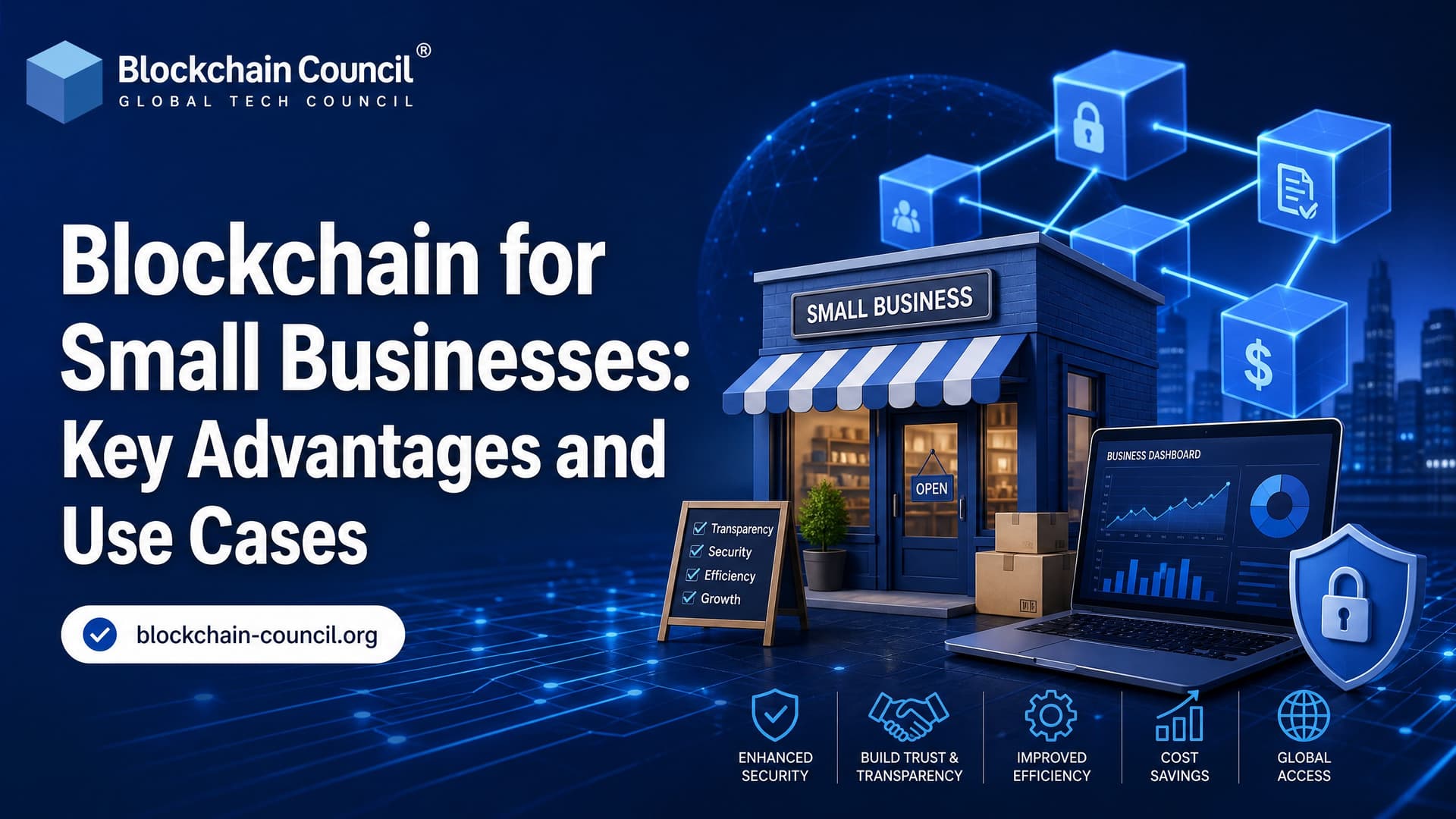
Blockchain for small businesses is no longer a theoretical topic limited to cryptocurrency startups. Small firms now use blockchain for faster payments, stronger security, supply chain visibility, automated contracts, digital identity, and new financing models. As adoption grows, the value of blockchain for small businesses lies in solving practical operational problems that often affect smaller teams more severely than large enterprises.
A blockchain is a distributed digital ledger that records transactions in chronological blocks linked by cryptography. Because the ledger is shared across a network and protected by consensus mechanisms, records are difficult to alter without detection. For small businesses, this creates a trusted environment for payments, contracts, customer records, inventory, and partner collaboration.

Why Blockchain Matters for Small Businesses
Small businesses often operate with limited budgets, smaller technology teams, and tighter cash flow. They need systems that reduce administrative work, lower transaction costs, and improve trust with customers and suppliers. Blockchain can help by creating shared, tamper-evident records across business networks.
Industry analysis from logistics providers such as DHL indicates that businesses of all sizes are adopting blockchain to improve payment processes, security, and supply chain visibility. Reports suggest that a meaningful share of small and medium-sized businesses began using blockchain technology in 2021, showing that adoption has moved beyond early experiments. Global blockchain spending has also continued to rise, reflecting growing enterprise and SME interest.
IBM describes blockchain for business as a shared, immutable ledger that improves trust, transparency, and efficiency, particularly in multi-party networks such as supply chains and financial services. These advantages are highly relevant for small businesses that rely on external partners, vendors, banks, payment processors, marketplaces, and logistics providers.
Blockchain for Small Businesses: Key Advantages
1. Lower Transaction Costs and Faster Settlement
One of the most practical advantages of blockchain for small businesses is the ability to process peer-to-peer transactions without depending entirely on traditional intermediaries. Banks, card networks, and payment processors can add fees, delays, and settlement risk, especially for cross-border payments.
Blockchain-based payments can reduce some of these costs by enabling direct transfer of value between parties. For small businesses accepting cryptocurrency or stablecoin payments, settlement may occur in minutes rather than days. Depending on the network, blockchain transaction verification can take anywhere from seconds to several minutes, while traditional banking transactions may take a day or more.
Faster settlement can improve cash flow, which is especially important for small firms with limited working capital. It can also reduce dependency on chargeback-heavy payment models, although businesses must still manage volatility, compliance, and customer experience carefully.
2. Stronger Security and Fraud Reduction
Blockchain uses cryptographic hashing, distributed consensus, and immutable record keeping. Once a transaction is recorded and confirmed on a well-designed blockchain network, changing it without detection is extremely difficult. This is valuable for small businesses that may not have large cybersecurity teams.
IBM notes that blockchain records are encrypted end-to-end and provide a tamper-evident audit trail. Shared blockchain records create an immutable transaction history, helping businesses identify suspicious changes and respond faster. Payment providers such as ACI Worldwide have pointed to blockchain-based transaction recording as a way to reduce payment fraud and chargeback risk for retailers.
This does not mean blockchain removes all security responsibilities. Small businesses still need secure wallets, private key management, employee training, and safe integrations. Even so, blockchain can strengthen the integrity of transaction records and reduce fraud in shared business processes.
3. Better Transparency, Traceability, and Auditability
Blockchain creates a shared source of truth. In a permissioned blockchain network, authorized participants can view the same verified information at the same time. This improves transparency and reduces disputes between suppliers, distributors, customers, and auditors.
For small businesses in food, fashion, pharmaceuticals, electronics, and specialty manufacturing, traceability can directly support customer trust. A product's origin, movement, ownership, and quality checks can be recorded on blockchain. Platforms such as Provenance allow suppliers, manufacturers, retailers, and consumers to trace product journeys and verify authenticity.
For small brands, verified origin and sustainability claims can be a meaningful differentiator. Instead of asking customers to rely only on marketing statements, businesses can provide auditable records that support product claims.
4. Automation Through Smart Contracts
Smart contracts are self-executing programs stored on a blockchain. They run automatically when predefined conditions are met. For example, a smart contract can release payment when a delivery confirmation is recorded, or apply warranty terms when a verified product event occurs.
For small businesses, smart contracts can reduce manual paperwork and administrative delays. Common use cases include:
- Automated invoicing and payment release
- Subscription billing and service agreements
- Payroll and contractor payments
- Insurance claims and policy execution
- Equipment rental agreements
- Warranty registration and transfer
IBM notes that smart contracts can reduce human error and speed up processes. Common small business applications include invoicing, bill payments, employee payments, startup loans, and insurance policies. These workflows can improve reliability and reduce disputes over terms, deadlines, and payment status.
Professionals who want to understand these systems more deeply may explore learning paths such as Blockchain Council's Certified Blockchain Expert, Certified Blockchain Developer, and Certified Smart Contract Developer programs.
5. Improved Access to Finance and Global Markets
Access to finance remains a challenge for many small firms. Traditional lenders often rely on limited credit histories, manual documentation, and slow approval processes. Blockchain-based financial infrastructure can support more transparent lending records, tokenized assets, and smart contract-based loan agreements.
Research into financial services innovation suggests that blockchain could reshape small business lending by enabling alternative, data-driven credit models and more efficient loan origination. This could help lenders assess risk more accurately and allow businesses to access funding channels beyond traditional bank loans.
Blockchain can also help small businesses reach international customers. By accepting digital assets or using blockchain-based remittance rails, businesses may reduce dependence on local banking networks and support faster cross-border settlement. This should be implemented with proper accounting, tax, and regulatory guidance.
6. Better Supply Chain and Inventory Management
Supply chain visibility is another important benefit of blockchain for small businesses. When suppliers, logistics providers, retailers, and customers share verified records, it becomes easier to track orders, shipments, receipts, and product conditions.
IBM reports that blockchain can provide end-to-end supply chain visibility and improve trust between trading partners. Shared blockchain records can also shorten payment cycles and reduce delays because all parties can see the same order and shipment data.
For small businesses, this can support:
- Lean inventory management
- More accurate demand forecasting
- Fewer disputes over delivery status
- Improved quality control
- Reduced counterfeit risk
- Faster warranty and returns processing
Blockchain-based warranty management, including services such as Warranteer, can move product warranties from paper records to digital systems supported by blockchain. This simplifies warranty access, updates, and transfers.
7. Data Integrity and Digital Identity
Small businesses handle sensitive data, including customer records, supplier details, invoices, financial transactions, and compliance documents. Blockchain can help improve data integrity by creating verifiable records and reducing reliance on a single centralized database.
Some decentralized storage platforms allow businesses to store data across distributed networks, paying for the storage they need while maintaining verifiable integrity. Blockchain can also support digital identity and KYC workflows by allowing cryptographic verification without requiring businesses to store large volumes of personal data directly.
This can reduce the risk surface for data breaches, although businesses still need strong privacy policies, access controls, and compliance processes.
Challenges Small Businesses Should Consider
Blockchain offers meaningful advantages, but it is not suitable for every workflow. Small businesses should assess adoption carefully before investing.
- Complexity: Blockchain implementation requires knowledge of wallets, smart contracts, networks, and integrations.
- Regulatory uncertainty: Cryptocurrency, digital identity, tokenization, and data protection rules vary by jurisdiction.
- Integration costs: Businesses may need new software, staff training, and process redesign.
- Scalability: Some public blockchains experience congestion and fluctuating fees.
- User experience: Customers and suppliers may not understand blockchain, so simple interfaces are essential.
A practical strategy is to start with a clear business problem rather than adopting blockchain for its own sake. Payments, traceability, warranty records, digital identity, and smart contract automation are often better starting points than broad enterprise-wide transformation.
How to Get Started with Blockchain
- Identify the pain point: Choose a problem involving trust, verification, delays, fraud, or multi-party coordination.
- Evaluate blockchain fit: Ask whether a shared, tamper-evident ledger provides value beyond a standard database.
- Select the right model: Consider public, private, permissioned, or hybrid blockchain designs.
- Start small: Pilot one use case, such as crypto payments, supplier traceability, or automated invoicing.
- Address compliance: Work with legal, accounting, and cybersecurity professionals.
- Train your team: Build internal literacy through structured programs such as Blockchain Council's blockchain and smart contract certifications.
The Future of Blockchain for Small Businesses
Blockchain adoption among small businesses is expected to expand as solutions become easier to use and more integrated with mainstream financial systems. Banks, fintechs, logistics platforms, and retail technology providers are increasingly packaging blockchain capabilities into user-friendly services.
Vertical-specific platforms for agriculture, retail, logistics, and manufacturing are also likely to grow. These platforms may provide ready-made tools for product authenticity, warranty records, automated settlement, and supply chain visibility. Over time, blockchain may also converge with AI and IoT, with connected devices generating trusted supply chain data and AI systems using that verified data for forecasting, risk scoring, and automation.
Conclusion
The key advantages of blockchain for small businesses include lower transaction costs, faster settlement, stronger security, greater transparency, smart contract automation, improved financing access, and better supply chain visibility. These benefits can help smaller firms operate with greater efficiency and trust in markets that increasingly depend on digital transactions and multi-party collaboration.
The best approach is practical and use case driven. Small businesses should begin with specific problems, measure value carefully, and choose solutions that match their technical capacity and regulatory environment. For professionals and teams seeking deeper expertise, Blockchain Council's blockchain, smart contract, and Web3 learning pathways can provide a structured foundation for responsible adoption.
Related Articles
View All
Blockchain
Blockchain in Banks: Use Cases, Benefits, Risks, and the AI Connection
Explore how blockchain in banks is reshaping payments, trade finance, tokenized deposits, KYC, AML, and AI-driven risk workflows.
Blockchain
Top Blockchain Use Cases in Banks and Financial Services
Explore the top blockchain use cases in banks, from payments and trade finance to tokenization, settlement, lending, KYC, and digital asset services.

Blockchain
Blockchain Train Technology: Rail Use Cases, Benefits, and Limits
Blockchain train technology is moving from pilots to practical rail use cases in freight, ticketing, asset records, IoT security, and audit trails.
Trending Articles
AWS Career Roadmap
A step-by-step guide to building a successful career in Amazon Web Services cloud computing.

Top 5 DeFi Platforms
Explore the leading decentralized finance platforms and what makes each one unique in the evolving DeFi landscape.
What is AWS? A Beginner's Guide to Cloud Computing
Everything you need to know about Amazon Web Services, cloud computing fundamentals, and career opportunities.