

Blockchain for Digital Identity: DIDs, Verifiable Credentials, and KYC Beyond Crypto

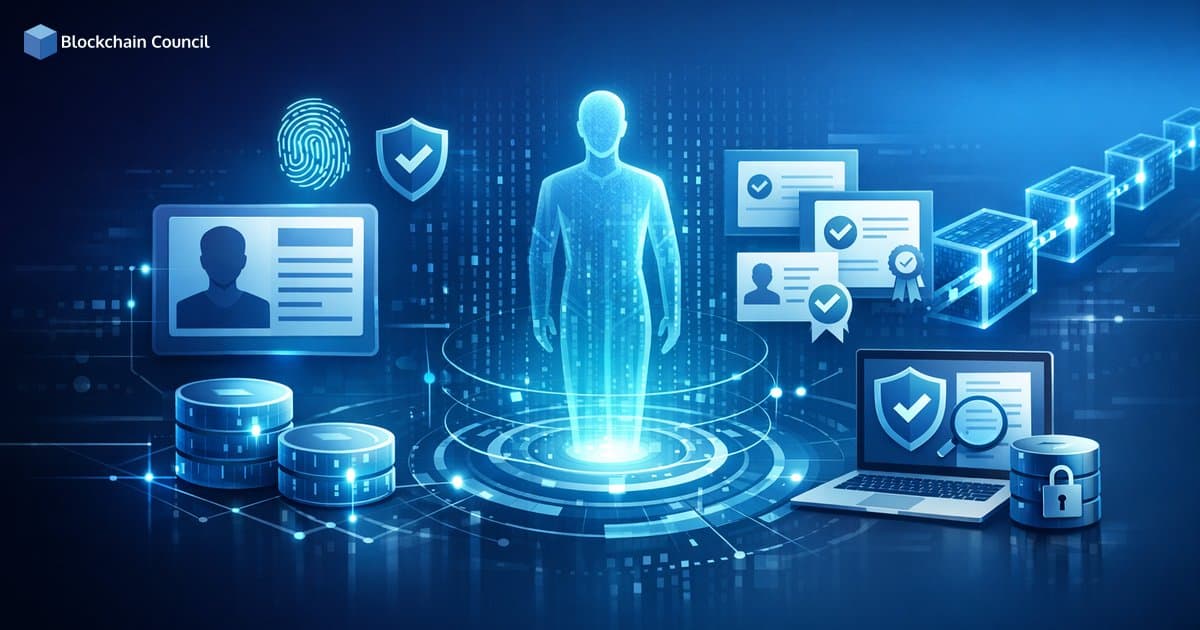
Blockchain for digital identity is moving from pilots to production across finance, government, healthcare, and Web3. The transition is driven by standards-based building blocks such as Decentralized Identifiers (DIDs), Verifiable Credentials (VCs), and privacy-preserving approaches to KYC that reduce duplication, improve auditability, and minimize data exposure. Instead of uploading the same documents repeatedly to different institutions, users can hold reusable credentials in a digital wallet and share only what is required for a given transaction.
This article covers the technical foundations, how blockchain fits without placing personal data on-chain, and how VC-based KYC is expanding well beyond crypto exchanges into mainstream regulated sectors.

Why Blockchain for Digital Identity Matters Now
Digital identity sits at the center of remote onboarding, fraud reduction, access control, and digital public services. Market demand is rising alongside regulatory pressure and the growing need for secure remote verification. MarketsandMarkets projects the broader digital identity solutions market to grow from approximately USD 34.5 billion in 2023 to approximately USD 83.2 billion by 2028, reflecting sustained momentum in identity modernization.
At the same time, the World Bank ID4D program reported that roughly 850 million people lacked official identification as of 2021, limiting their access to banking, benefits, and essential services. Identity systems that are portable, privacy-preserving, and interoperable are increasingly treated as necessary infrastructure rather than optional features.
Technical Foundations: DIDs and Verifiable Credentials
Decentralized Identifiers (DIDs)
DIDs are globally unique identifiers created and controlled by the subject - a person, organization, or device - without relying on a central identity provider. The W3C published Decentralized Identifiers (DID) v1.0 as an official recommendation in July 2022, marking a significant step toward stable, interoperable decentralized identity.
A DID resolves to a DID Document that can include:
- Public keys and verification methods
- Authentication and key agreement mechanisms
- Service endpoints for communication and credential exchange
DID methods define how an identifier is anchored or resolved. Common examples include did:ion, did:ethr, did:key, and did:web. This variety enables flexibility but also introduces interoperability work across methods, wallets, and registries.
Verifiable Credentials (VCs)
VCs are tamper-evident digital credentials that can be cryptographically verified. They function like digital passports, licenses, or diplomas, but with stronger privacy options such as selective disclosure. The W3C finalized the Verifiable Credentials Data Model 1.1 in March 2022, and the ecosystem continues to evolve around new encodings and data integrity approaches.
VCs involve three core roles:
- Issuer - the party that attests to a claim, such as a bank, government agency, university, or employer
- Holder - the subject who stores the credential, typically in a digital wallet
- Verifier - the party that checks the credential's validity and authenticity
A key property is that verifiers can validate issuer signatures and check credential status - including revocation - without repeatedly contacting the issuer. This reduces friction and limits unnecessary data sharing, which in turn improves user privacy.
How Blockchain Fits (and What Should Not Go On-Chain)
In mature blockchain for digital identity architectures, personal data is kept off-chain. The World Economic Forum has emphasized that decentralized digital ID can bind identifiers and metadata to blockchain infrastructure while keeping personal attributes in user-controlled wallets, reducing the risk of centralized data honeypots and systemic surveillance.
Blockchains are typically used for:
- DID and public key anchoring via immutable registries
- Credential status registries for revocation, suspension, or validity proofs without publishing personal attributes
- Audit and governance for identity networks, particularly in consortium models and shared trust frameworks
This design choice is also a practical response to data protection requirements. When personal data is not written immutably to a public ledger, it is easier to align with data minimization and deletion obligations while still benefiting from cryptographic verification and transparent audit trails.
KYC Beyond Crypto: Reusable, Privacy-Preserving Compliance
KYC and AML requirements apply across regulated financial services, not only crypto exchanges. Traditional KYC relies on document uploads, manual checks, and repeated verification across institutions. Industry analyses commonly estimate that KYC costs banks up to USD 100 to USD 150 per customer in high-risk jurisdictions and can take weeks, creating significant friction and duplicative effort across the system.
How DIDs and VCs Change KYC Workflows
VC-based KYC introduces a reusable credential model:
- A regulated entity such as a bank, licensed KYC provider, or trust service provider completes identity verification.
- The entity issues a KYC Verifiable Credential to the customer.
- The customer stores it in a wallet tied to their DID.
- When onboarding elsewhere, the customer presents the credential instead of resubmitting documents.
- The verifier checks the issuer signature and credential status using a registry - often blockchain-based - without receiving raw documents.
This approach reduces duplication across banks and fintechs while improving auditability, since credential issuance and revocation can be verified cryptographically at any point.
Selective Disclosure and Zero-Knowledge Proofs
Selective disclosure and zero-knowledge proofs (ZKPs) enable users to prove specific facts without revealing underlying data. Typical examples include:
- Proof of being over 18 or over 21
- Residency in a specific country or region
- Credential validity and non-revocation status
- Compliance with a policy requirement without exposing full identity details
J.P. Morgan has highlighted this value in Web3 identity contexts, where proving a fact such as age eligibility is preferable to sharing a full birthdate and identity documents. This approach aligns with privacy-by-design principles and reduces the data liability footprint for service providers.
Real-World Use Cases in Production and Pilots
Financial Services: Onboarding, Lending, and Regulated Web3
In mainstream banking, analysts have described how current KYC is siloed across institutions, with each bank collecting and storing similar documents independently. Shared identity networks and reusable VCs can enable consent-based reuse, accelerating onboarding and reducing cost for both institutions and customers.
In lending and underwriting, scenarios have been outlined where applicants present credentials for identity, employment, and income from a single wallet, enabling faster credit decisions and cross-border financial products. In regulated DeFi, VC-based attestations can gate access to specific smart contracts while preserving user privacy - a model discussed across Chainlink and Consensys identity use case analyses.
Government Digital ID and Public Services
Government programs are exploring decentralized identity to improve inclusion, portability, and privacy. The European Commission has described how eIDAS 2.0 and the European Digital Identity Wallet initiative incorporate support for W3C Verifiable Credentials as part of their technical direction, though implementation details vary by member state.
The WEF has also cited pilots where blockchain serves as a verification and audit layer while citizen data remains off-chain, helping reduce centralized surveillance risks and limiting the impact of large-scale data breaches.
Healthcare: Consented Sharing of Sensitive Attributes
Healthcare identity carries strict privacy and compliance requirements. VC-based proofs can represent insurance coverage, prescriptions, or allergy information, shared selectively with relevant providers. This model can improve consent management and audit trails while avoiding broad replication of sensitive health records across disconnected systems.
Enterprise Workforce, Access Control, and IoT Identities
Blockchain is not a replacement for all identity infrastructure, but it can add value for attestations, auditability, and decentralizing trust. In enterprise environments, VCs can support:
- Workforce credentials for roles, access rights, and training completion
- Zero-trust access checks using verifiable claims and contextual signals
- Vendor and partner access with portable, signed attestations
Nonhuman identities are also a growing consideration. IoT devices and AI agents will need strong, verifiable identities to interact safely across systems. Assigning DIDs and issuing device credentials can enable secure machine-to-machine authorization and more reliable audit trails.
Standards, Interoperability, and Governance
Standards Are Maturing, but Fragmentation Remains
With W3C DID and VC standards in place, the next challenge is consistent interoperability across DID methods, wallet implementations, and credential formats. Bridge standards from the OpenID Foundation - including OpenID for Verifiable Credential Issuance (OpenID4VCI) and OpenID for Verifiable Presentations (OpenID4VP) - aim to connect enterprise login patterns with VC-based identity flows, making adoption more feasible for organizations already using OpenID Connect.
Trust Frameworks and Liability
Cryptography alone does not create trust. Verifiers must trust issuers, which requires governance models, accreditation processes, compliance obligations, and clear liability rules. The Trust over IP Foundation has developed layered models for governance and technical interoperability that are frequently referenced in government and consortium identity work. In Europe, eIDAS 2.0 introduces qualified trust services that define which entities are authorized to issue high-assurance credentials in specific categories.
Challenges and Limitations
- User experience and key management: Wallet usability, recovery, and secure key handling remain major adoption barriers. Social recovery and custodial models are improving, but patterns are not yet fully standardized across implementations.
- Privacy and surveillance risks: Even decentralized systems can become surveillance tools if implemented with mandatory universal identifiers. The WEF has positioned decentralized approaches as a way to avoid centralized tracking architectures, but design and policy choices remain decisive factors.
- Legacy integration: Banks, governments, and enterprises have entrenched identity and access management systems. Realistic integration strategies involve blockchain augmenting existing identity providers rather than replacing them entirely.
- Regulatory interpretation: Data protection and audit requirements vary by jurisdiction. Keeping personal data off-chain and relying on status registries is a common mitigation approach, but legal review remains essential for each deployment context.
Skills and Learning Roadmap for Professionals
Implementing blockchain-backed identity systems requires expertise across security architecture, cryptography, compliance, and product design. Key focus areas for teams building or auditing these systems include:
- DID resolution, DID Documents, and DID method tradeoffs
- VC data model, signing, verification, and status management including revocation and suspension
- Wallet architecture, threat modeling, and key recovery patterns
- Selective disclosure and ZKP-based credential presentations
- Governance frameworks, trust registries, and issuer accreditation
Blockchain Council offers structured learning paths for professionals working in this space, including the Certified Blockchain Expert, Certified Web3 Professional, and Certified Smart Contract Developer programs, as well as specialized certifications covering blockchain security, privacy, and enterprise implementation strategies.
Conclusion
Blockchain for digital identity is becoming a practical foundation for reusable trust on the internet, with DIDs and Verifiable Credentials enabling portable, cryptographically verifiable claims. The most durable architectures keep personal data off-chain, using blockchains for registries, status management, and governance rather than data storage. As standards mature and bridge protocols bring VCs into enterprise and public-sector workflows, privacy-preserving KYC is expanding beyond crypto into banking, lending, healthcare, government services, and enterprise access control.
Organizations that invest now in interoperability, governance, and user-centered security will be better positioned to reduce onboarding costs, strengthen compliance auditability, and deliver privacy-respecting digital experiences at scale.
Related Articles
View All
Blockchain
Blockchain Digital Identity Management Patents: Key Innovations and Market Trends
A practitioner-focused look at blockchain digital identity management patents, from biometric wallets and DIDs to KYC, EU wallets, IoT, and market growth.

Blockchain
Blockchain Product Manager Certification Guide: Best Credentials to Advance Your Career
A practical guide to Blockchain Product Manager Certification paths, including blockchain, product, agile, and finance credentials for Web3 careers.

Blockchain
The Future of Blockchain Wallets: Smart Wallets, Account Abstraction, and Web3 Identity
Explore the future of blockchain wallets through smart wallets, account abstraction, gas abstraction, recovery, and Web3 identity.
Trending Articles
The Role of Blockchain in Ethical AI Development
How blockchain technology is being used to promote transparency and accountability in artificial intelligence systems.
AWS Career Roadmap
A step-by-step guide to building a successful career in Amazon Web Services cloud computing.
What is AWS? A Beginner's Guide to Cloud Computing
Everything you need to know about Amazon Web Services, cloud computing fundamentals, and career opportunities.