

Blockchain Digital Identity Management Patents: Key Innovations and Market Trends

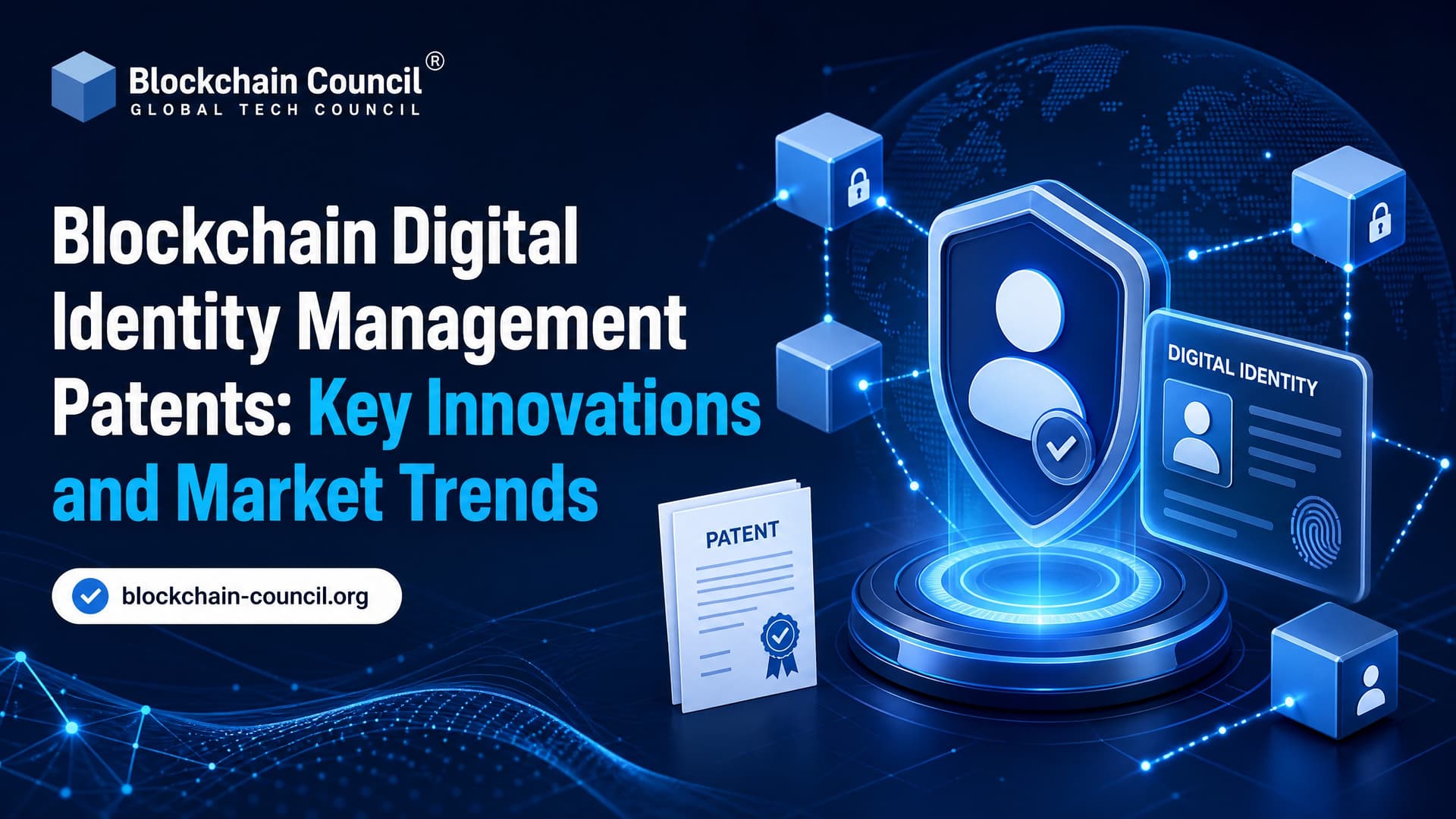
Blockchain digital identity management patents are moving from abstract filings into working systems: identity wallets, biometric-bound credentials, zero-trust access, KYC reuse, and machine identity for IoT. The common pattern is clear. Sensitive identity data stays off chain, while blockchains hold proofs, issuer registries, revocation data, and audit records.
That distinction matters. Storing passports, health records, or biometric templates directly on a public ledger is usually the wrong architecture. You cannot easily delete on-chain data, and privacy laws such as GDPR require careful handling of personal information. The stronger designs use decentralized identifiers, verifiable credentials, secure hardware, and selective disclosure.

Why Blockchain Digital Identity Patents Are Accelerating
Digital identity has become a board-level problem. Password databases keep leaking. Synthetic identities are harder to spot. Deepfakes are getting better. Enterprises also want reusable credentials that cut repeated onboarding checks.
Market forecasts reflect that pressure. One recent projection estimates the global blockchain identity management market could rise from about 2.36 billion US dollars in 2026 to roughly 207.12 billion US dollars by 2034. Treat that figure with care, since forecasts in emerging markets can run hot. Still, the direction is hard to dispute: government wallets, enterprise zero-trust programs, and financial compliance are pulling this category into production.
Policy is another driver. The EU Digital Identity Wallet under eIDAS 2.0 is pushing wallet-based identity models across Europe. These systems do not require blockchain in every implementation, but distributed ledgers can support verifiable credential registries, trust lists, and revocation infrastructure.
Core Patent Themes in Blockchain Digital Identity Management
Decentralized Identifiers and Verifiable Credentials
Many patent filings build around decentralized identifiers, known as DIDs, and verifiable credentials. The World Wide Web Consortium DID Core standard defines a way to identify people, organizations, devices, and services without depending on a single centralized identity provider.
In a typical architecture, the user holds a credential in a wallet. The issuer signs it. The verifier checks the signature, issuer status, and revocation state. A blockchain may store DID documents, issuer registries, credential hashes, or revocation lists.
This is where patent claims often appear:
- How credentials are issued and bound to a wallet
- How issuer trust is registered and updated
- How revocation is checked across multiple domains
- How credentials are presented without exposing extra attributes
If you are building in this area, study W3C DID Core and W3C Verifiable Credentials before you read patent claims. Otherwise it is too easy to confuse a real invention with standard plumbing.
Selective Disclosure and Privacy-Preserving Proofs
The most useful identity systems answer narrow questions. Is this person over 18? Is this clinician licensed? Has this supplier passed KYC? They should not reveal a full birth date, home address, or passport scan unless required.
Patent activity is rising around selective disclosure, consent capture, attribute-level proofs, and zero-knowledge proof schemes. The World Economic Forum has argued that decentralized digital identity can reduce dependence on centralized data stores and give users more control over personal data sharing, but only if governance and privacy design are handled properly.
To be blunt, this is where many demos break. A wallet that only shows a QR code is not enough. You need clear consent records, revocation handling, issuer trust, recovery paths, and a privacy model that holds up when credentials are reused hundreds of times.
Biometric-Bound Wallets and Secure Enrollment
Biometric blockchain wallets are a major patent hotspot. Vendors are filing around systems that combine fingerprint, face, or iris checks with hardware-backed keys and blockchain-anchored credentials.
TECH5, for example, has secured patents covering scalable digital identity issuance, storage, and real-time verification using biometrics and cryptography. Another notable patent, US10637665B1, describes a blockchain-based digital identity system where a mobile device Trusted Execution Environment creates public-private key pairs and anchors identity data to a blockchain-backed system.
The security goal is simple: stop private keys from being copied, phished, or casually exported. On mobile devices, this usually means secure enclaves, TEEs, or hardware-backed key stores. The trade-off is recovery. If a wallet is tied too tightly to one device, losing that phone can become an identity disaster. Strong products solve account recovery without turning the help desk into the weakest link.
Smart Contract Access Control and Identity Workflows
Some blockchain digital identity management patents focus less on the wallet and more on what identity enables. Patent landscape studies have found clusters around invoicing, data management, and communication workflows tied to digital identity.
Digital-identity-based invoicing is a good example. A supplier signs an invoice using a verified organizational identity. A buyer validates the issuer and contractual attributes. A smart contract can then trigger approval, settlement, or dispute routing. That has direct relevance for trade finance, factoring, procurement, and cross-border payments.
There is a catch. Smart contracts are poor places to store sensitive identity data. Use them for rule enforcement, hashes, permissions, and event logs. Keep personal and commercial data off chain, encrypted, and governed by clear access policies.
Real-World Use Cases Driving Patent Value
Government Digital Identity
Government programs are among the strongest demand drivers. National ID, border control, public benefits, and digital public services all need high assurance. Patents around biometric enrollment, credential issuance, and fast verification are valuable here because scale is unforgiving. A system that works for 20,000 users may fail badly at 50 million.
Financial Services, KYC, and AML
Banks and fintechs want reusable KYC credentials. If a customer has already been verified by a trusted institution, another regulated entity can check a verifiable credential instead of repeating the whole process. Blockchain can support tamper-evident issuer records and revocation status.
This cuts friction, but it does not remove compliance responsibility. Regulators still expect proper risk scoring, sanctions checks, and audit trails. A credential is evidence, not a magic shield.
Education and Professional Credentials
Degrees, diplomas, licenses, and certifications fit naturally into verifiable credential systems. Employers can verify a credential without calling the issuing institution. Certification bodies can revoke or update status when needed.
For Blockchain Council readers, this is directly relevant to professional learning paths such as Certified Blockchain Expert™, Certified Blockchain Developer™, and Certified Smart Contract Developer™. These credentials sit inside the broader market shift toward portable, independently verifiable professional records.
Healthcare Identity and Consent
Healthcare identity use cases include patient consent, clinician licensing, vaccination records, and access to electronic health records. The privacy bar is high. A patient should be able to prove eligibility or share a specific credential without broadcasting their entire medical history.
Patent claims in this area often focus on consent workflows, revocation, encrypted data access, and identity-linked audit trails.
Mobility, IoT, and Machine Identity
Transportation systems are testing decentralized identity for cross-operator ticketing and passenger credentials. A commuter could hold a credential issued by one authority and present it to another operator in a different region.
IoT may turn out to be even bigger. Vodafone's Pairpoint initiative has highlighted blockchain-based identity for devices, vehicles, and agents that must transact without one central authority. Think signed telemetry, trusted software updates, roaming device credentials, and automated service payments.
Practitioner Notes: What Breaks in Real Deployments
On paper, decentralized identity looks neat. In test environments, the boring parts cause the outages.
- Revocation is hard: In Hyperledger Aries and ACA-Py based AnonCreds deployments, if the revocation tails file is unavailable, verification can fail even when the credential proof itself is valid.
- Wallet recovery is risky: Social recovery, custodial recovery, and seed phrase recovery each create different attack paths.
- Interoperability claims need testing: A DID method that works in one wallet may not resolve cleanly in another verifier.
- Biometrics are not secrets: You can rotate a private key. You cannot rotate your face.
That last point should shape patent and product strategy. Biometrics are best used for local authentication and liveness checks, not as raw identifiers stored in broad databases.
Market and Patent Trends to Watch
Enterprise Zero-Trust Identity
Identity and access management vendors increasingly describe decentralized credentials as part of zero-trust security. Employees, contractors, devices, and workloads must prove who they are at each interaction. Wallet-based credentials can help, especially when tied to device posture and risk signals.
Continuous Identity Assurance
Digital identity is shifting from one-time verification to continuous assurance. AI-driven risk scoring, behavioral signals, device checks, and credential status get evaluated together. Expect patents around the connection between static credentials and dynamic risk signals.
Patent Clusters by Sector
Patent analysis already shows clusters in invoicing, data management, and communication. Watch for new filings in healthcare consent, AI agent identity, transport ticketing, and cross-border trust registries.
Regulatory Alignment
eIDAS 2.0, GDPR, and national digital ID policies will influence which architectures win. Systems that keep personal data off chain, support selective disclosure, and provide clear governance will age better than systems that treat blockchain as a database for everything.
How Professionals Should Prepare
If you work in blockchain, cybersecurity, IAM, fintech, or public sector technology, do not treat blockchain digital identity management patents as a legal side issue. They reveal where vendors are placing long-term bets.
Start with the foundations: DIDs, verifiable credentials, wallet security, public key infrastructure, smart contract access control, and privacy engineering. Then map those concepts to real use cases such as KYC reuse, employee access, credential verification, and IoT identity.
A practical next step is to build a small credential flow: issue a test credential, verify it, revoke it, and test what happens when the revocation endpoint is down. Pair that work with structured learning through Blockchain Council programs such as Certified Blockchain Expert™ or Certified Blockchain Developer™ if you need a wider technical base. If your role touches risk or access control, add cybersecurity and smart contract security skills before you evaluate vendors or patent-heavy platforms.
Related Articles
View All
Blockchain
Blockchain Future Trends and Emerging Innovations to Watch
Explore blockchain future trends and emerging innovations, including DeFi, CBDCs, Web3, tokenized assets, gaming, interoperability, and enterprise adoption.

Blockchain
How to Write a PRD for Blockchain Products: Key Sections, Examples, and Best Practices
Learn how to write a PRD for blockchain products with key sections, practical examples, tokenomics, security, governance, and success metrics.

Blockchain
Blockchain Product Manager vs Traditional Product Manager: Key Differences Explained
Learn how a blockchain product manager differs from a traditional PM across tokens, wallets, governance, analytics, metrics, risk, and skills.
Trending Articles
AWS Career Roadmap
A step-by-step guide to building a successful career in Amazon Web Services cloud computing.
How Blockchain Secures AI Data
Understand how blockchain technology is being applied to protect the integrity and security of AI training data.
What is AWS? A Beginner's Guide to Cloud Computing
Everything you need to know about Amazon Web Services, cloud computing fundamentals, and career opportunities.