

The Future of Blockchain Wallets: Smart Wallets, Account Abstraction, and Web3 Identity

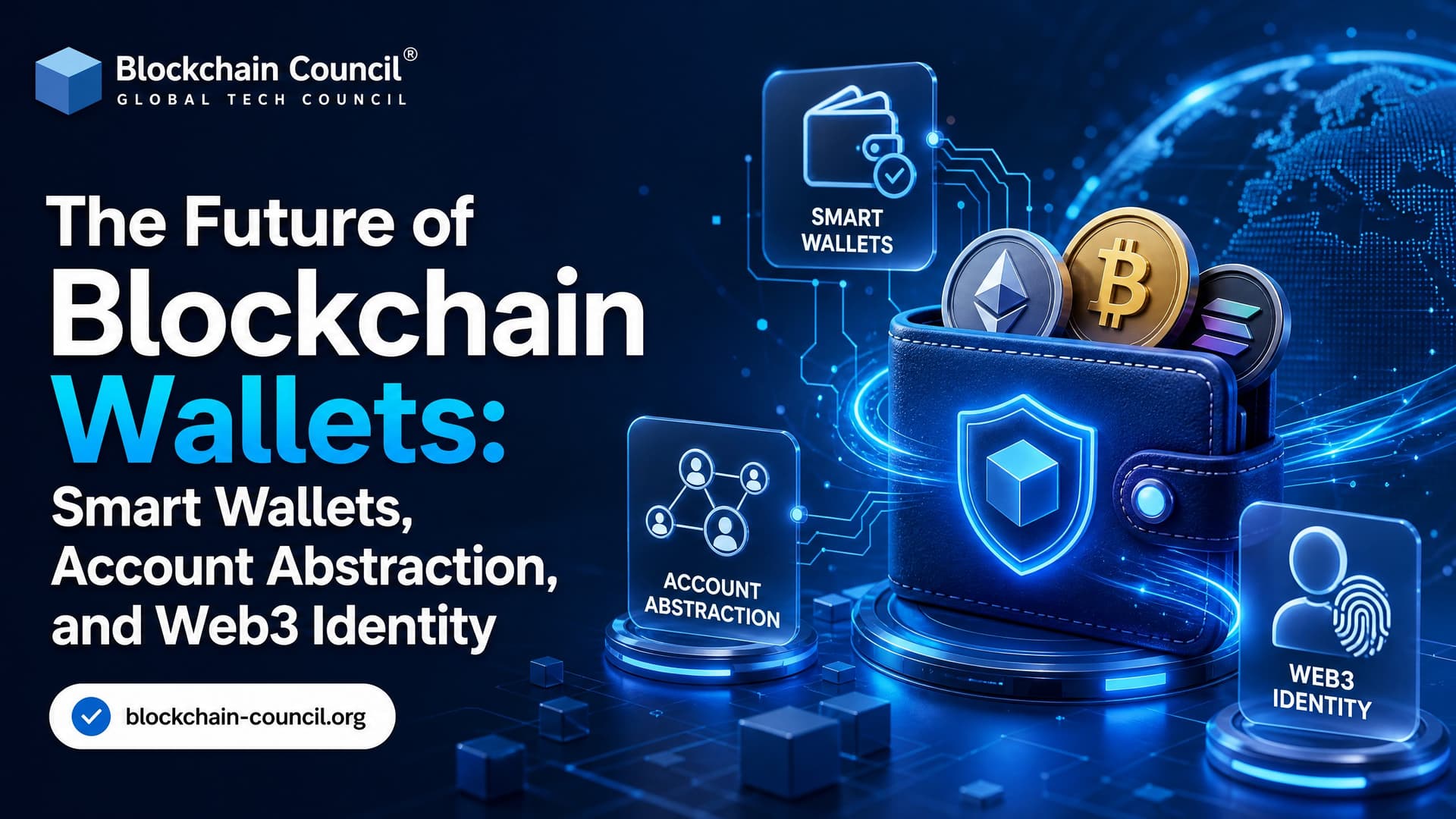
The future of blockchain wallets is not about prettier seed phrase screens. It is about wallets becoming programmable accounts, policy engines, and identity hubs for Web3 applications. Smart wallets and account abstraction are turning the wallet from a key holder into the main control layer for assets, permissions, recovery, and authentication.
That shift matters because the current model asks too much from users. Save 12 or 24 words. Hold the right gas token. Sign messages you barely understand. Never lose a device. Never get phished. For developers and enterprises, that is not a serious onboarding model. It worked for early adopters. It will not work for the next billion users.

Where Blockchain Wallets Stand Today
EOA Wallets Are Simple, but Brittle
Most traditional non-custodial wallets use externally owned accounts, often called EOAs. On Ethereum, an EOA is controlled by a private key and has fixed validation rules at the protocol level. If the private key signs a valid transaction and the account has enough ETH for gas, the network accepts it.
That simplicity is powerful. It is also unforgiving.
- If you lose the private key or seed phrase, recovery is usually impossible.
- If malware gets the key, the attacker can drain the account.
- If a user signs a malicious approval, the wallet often cannot enforce sensible limits.
- If a dapp needs three actions, the user may need three separate signatures and gas payments.
EOAs are fine for experienced crypto users moving assets manually. They are the wrong default for mainstream finance, gaming, enterprise treasury, and identity-aware Web3 apps.
Smart Wallets Make the Account Programmable
A smart wallet is a wallet where the account is implemented as a smart contract. Instead of one hard-coded private key deciding everything, the contract defines what counts as a valid action.
That means the wallet can support:
- Multi-signature approvals for teams, DAOs, and company treasuries.
- Social recovery through trusted contacts or recovery services.
- Spending limits based on asset, amount, user role, or time period.
- Session keys for games and apps, so users do not sign every small action.
- Automated operations such as recurring payments or scheduled transfers.
In practice, smart wallets already ship in products such as Safe, Argent, and account abstraction wallet stacks across Ethereum layer 2 networks. The important point is not the brand. It is that wallet behavior can now be written in code.
Account Abstraction: The Technical Shift Behind Smart Wallets
Account abstraction means account validation is programmable. A wallet no longer has to follow only the default EOA model. It can verify different signature schemes, accept different authentication methods, batch actions, and use flexible gas payment logic.
On Ethereum, ERC-4337 is the most important production standard for account abstraction because it enables smart contract wallets without changing the base protocol. Instead of sending a normal transaction directly from an EOA, a user creates a UserOperation. Bundlers package these operations and submit them to an EntryPoint contract. Paymasters can sponsor gas or allow alternative fee flows.
Small detail from the trenches: when testing ERC-4337 wallets, a failed operation often returns errors such as AA21 didn't pay prefund or AA24 signature error. These are not cosmetic. They usually mean your wallet contract did not deposit enough funds into the EntryPoint, or your signature validation path does not match what the bundler expects. People preparing for smart contract work often understand multisig theory, then get stuck on this exact operational layer.
There is also growing interest in EIP-7702, which lets EOA-style accounts delegate behavior to contract code under supported conditions. The direction is clear: Ethereum and EVM ecosystems are moving toward accounts that act more like software objects than static key pairs.
Some ecosystems go further. Starknet uses smart contract accounts as the default account model, so account abstraction is native rather than added through an ERC-4337-style flow. That design makes programmable validation a first-class part of the chain.
Why Smart Wallets Improve User Experience
Recovery Becomes a Design Choice
Seed phrase loss is one of crypto's oldest problems. Smart wallets cut that risk through programmable recovery.
You can define recovery rules such as:
- Three out of five trusted guardians can approve recovery.
- A recovery request becomes active only after a 48-hour delay.
- A hardware key is required for high-value withdrawals.
- A company admin can rotate employee access without moving funds to a new wallet.
This is not the same as handing custody back to an exchange. Done correctly, the user or organization still controls the wallet logic. But the recovery path is no longer a single fragile secret.
Gas Can Move Into the Background
Gas abstraction is one of the most practical benefits of account abstraction. New users should not need ETH, MATIC, or another native token before they can try an app. With paymasters and meta-transactions, an application can sponsor gas or let users pay fees in another token.
For consumer apps, this removes a major drop-off point. For enterprises, it simplifies internal accounting. Nobody wants an operations analyst blocked because a treasury wallet holds USDC but no native gas token on the right network.
Transactions Can Be Batched
DeFi has trained users to accept awkward workflows: approve, swap, stake, claim, bridge, repeat. Smart wallets can batch several steps into one user-approved operation.
A wallet can combine token approval and swap execution. A game wallet can allow session-based low-value actions for 30 minutes. A DAO treasury can require two approvals for normal payments and five for protocol upgrades. Different actions, different rules.
That is how wallet UX should work.
Web3 Identity: Wallets as Authentication and Reputation Hubs
The next stage of the future of blockchain wallets is identity. Wallet addresses already act as pseudonymous identifiers. They carry transaction history, NFTs, governance participation, token balances, and protocol reputation. The wallet is no longer just where assets sit. It is where a user proves who they are in a Web3 context.
Several identity patterns are already common:
- ENS names map human-readable names to Ethereum addresses and related records.
- Sign-In with Ethereum, formalized through EIP-4361, lets users authenticate with a wallet signature instead of a password.
- Decentralized identifiers and verifiable credentials can connect attestations to a wallet without exposing unnecessary personal data.
- Soulbound or non-transferable credentials can represent memberships, qualifications, or permissions, though designs vary widely.
Account abstraction makes this more useful because identity can shape wallet behavior. A smart wallet could require a verified credential before accessing a regulated marketplace. It could let a certified employee approve payments up to a limit, while requiring a director for larger transfers. It could grant temporary dapp access without exposing the main signing key.
To be blunt, not every identity claim belongs on-chain. Public, permanent identity data creates privacy problems. The better design is selective disclosure: prove what is needed, reveal as little as possible, and keep sensitive data off-chain where appropriate.
Enterprise Wallets Will Look Different From Consumer Wallets
For individuals, smart wallets are mainly about recovery, safer signing, and easier onboarding. For enterprises, they are about governance.
An institutional wallet needs policy controls that map to real operations:
- Role-based transaction approval.
- Daily and monthly spending limits.
- Asset-specific rules for stablecoins, NFTs, and governance tokens.
- Integration with custody workflows and audit logs.
- Separation of duties between finance, compliance, and technical teams.
Many institutions will combine smart contract wallets with multi-party computation, or MPC. MPC protects key material by splitting signing responsibility across parties or systems. Smart wallet logic then enforces on-chain rules. The two approaches solve different problems. MPC protects signing. Smart wallets govern execution.
If you are building for an enterprise, do not copy a consumer recovery model and call it institutional-grade. Use explicit policies, tested upgrade paths, and clear incident procedures.
Risks Developers Should Not Ignore
Smart wallets beat EOAs for many use cases, but they add complexity. Complexity creates new failure modes.
- Higher gas costs: Contract-based validation can cost more than a basic EOA transfer.
- Contract bugs: A wallet contract vulnerability can affect every account using that implementation.
- Upgrade risk: Upgradeable wallets need strict controls, or the upgrade path becomes the attack path.
- Bundler and paymaster dependency: ERC-4337 flows depend on supporting infrastructure.
- User confusion: Hiding too much can make users approve actions without understanding risk.
My view: smart wallets should become the default for most users, but not because they hide everything. They should become the default because they let developers encode safer defaults. The best wallet UX explains risk at the right moment, not on every screen.
What This Means for Developers and Professionals
If you build Web3 products, treat wallets as part of application architecture, not as an external login widget. The wallet decides authentication, authorization, recovery, transaction flow, and sometimes compliance behavior.
Focus on these skills:
- Understand ERC-4337 concepts: UserOperation, EntryPoint, bundler, paymaster, aggregator, and smart account.
- Learn Solidity 0.8.x security patterns for wallet contracts.
- Test account recovery and upgrade paths, not just happy-path transfers.
- Design identity flows around EIP-4361, ENS, DIDs, and verifiable credentials.
- Know when an EOA is still acceptable. For simple developer wallets and cold storage, EOAs can still make sense.
For structured learning, Blockchain Council's Certified Blockchain Expert™, Certified Blockchain Developer™, Certified Smart Contract Developer™, Certified Ethereum Expert™, and Certified Web3 Expert™ are relevant learning paths to explore. If your goal is wallet engineering, start with smart contracts and Ethereum architecture before moving into account abstraction tooling.
Where Blockchain Wallets Are Heading
The future of blockchain wallets is a move from key storage to programmable control. Smart wallets will handle recovery, gas payment, batching, access policy, and identity-aware permissions. Account abstraction provides the technical foundation. Web3 identity gives the wallet a larger role: proving access, reputation, membership, and authority across decentralized applications.
Build one. Do not stop at reading. Deploy a minimal ERC-4337 smart account on a testnet, trigger a failed UserOperation, inspect the EntryPoint error, then add one practical feature such as a spending limit or guardian recovery. That exercise will teach you more than another wallet UI review.
Related Articles
View All
Blockchain
Agile for Blockchain Teams: Managing Sprints, Smart Contracts, and Decentralized Roadmaps
Learn how agile for blockchain teams works when sprints, smart contracts, audits, governance, and decentralized roadmaps are planned around risk.

Blockchain
Product Discovery for Blockchain Products: A Step-by-Step Guide for Web3 Product Managers
A practical Web3 product discovery guide covering wallet behavior, token validation, governance, security, metrics, and testnet pilots.

Blockchain
Go-to-Market Strategy for Blockchain Products in Competitive Web3 Markets
Learn how to build a go-to-market strategy for blockchain products with value-first positioning, token design, community, security, and Web3 metrics.
Trending Articles
The Role of Blockchain in Ethical AI Development
How blockchain technology is being used to promote transparency and accountability in artificial intelligence systems.
AWS Career Roadmap
A step-by-step guide to building a successful career in Amazon Web Services cloud computing.

Can DeFi 2.0 Bridge the Gap Between Traditional and Decentralized Finance?
The next generation of DeFi protocols aims to connect traditional banking with decentralized finance ecosystems.