

All About Blockchain: Definition, How It Works, Use Cases, and Trends
 Suyash Raizada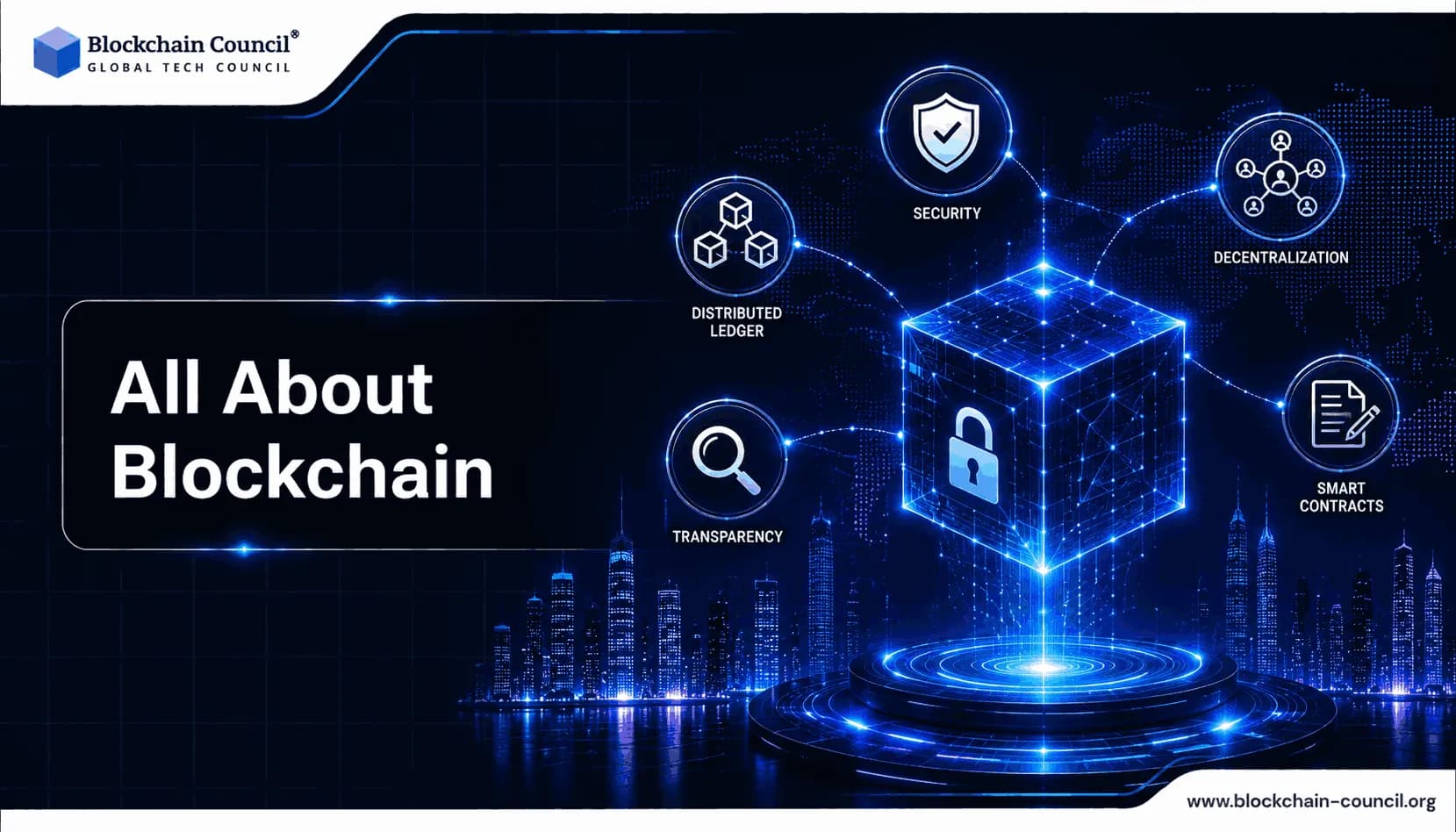
Blockchain is a distributed, append-only ledger that records transactions across a network of computers in a way that is transparent, tamper-resistant, and verifiable. While it became widely known through cryptocurrencies, blockchain technology now supports far broader applications, including decentralized finance (DeFi), supply chain traceability, digital identity, tokenized real-world assets, and emerging Web3 services. As adoption moves from pilots to production systems, professionals and organizations increasingly treat blockchain as foundational infrastructure for data integrity, programmable automation, and multi-party coordination.
What is Blockchain?
A blockchain is a shared database where data is grouped into blocks and linked together using cryptography in chronological order. Each new block references the previous one, creating a chain that is designed to be extremely difficult to alter retroactively. Instead of relying on a single central administrator, the ledger is maintained by a distributed network of computers called nodes.

This architecture enables parties who do not fully trust each other to agree on a single source of truth for transactions, ownership, and state changes, without requiring a central intermediary.
Public vs Private vs Consortium Blockchains
Public (permissionless) blockchains allow anyone to participate, validate transactions, and read data, depending on the protocol design. Examples include Bitcoin and Ethereum.
Private blockchains restrict participation to approved entities, commonly used in enterprises for internal workflows and data sharing among known participants.
Consortium blockchains are governed by a group of organizations, often used in multi-party industry scenarios such as trade finance or cross-company supply chain networks.
How Blockchain Technology Works
Although implementations vary, most blockchain systems follow the same core flow: transactions are created, validated, ordered, and then committed to the ledger.
1) Transactions and Blocks
Users submit transactions - for example, transferring tokens, updating an asset record, or calling a smart contract function. The network collects these transactions and packages them into blocks.
2) Cryptographic Linking and Tamper Resistance
Each block includes a cryptographic reference to the prior block. If someone attempts to change an older record, it alters the block data and breaks the cryptographic linkage, making tampering detectable and impractical at scale.
3) Consensus Mechanisms
Because there is no central authority, nodes must agree on which transactions are valid and what the current state of the ledger is. This agreement process is handled by consensus mechanisms, such as:
Proof of Work (PoW), which uses computational effort to secure the chain.
Proof of Stake (PoS), which uses economic stake and validator selection to secure the chain more energy-efficiently.
Proof of Authority (PoA), common in permissioned settings where known validators are authorized to produce blocks.
4) Smart Contracts and Programmability
Many modern networks support smart contracts, which are self-executing programs stored on-chain. Smart contracts enable automated workflows and enforce rules transparently. This programmability is a primary reason blockchain is used for DeFi protocols, DAOs, NFTs, tokenization platforms, and more.
Why Blockchain Matters: Key Properties
Immutability: once confirmed, changing data becomes extremely difficult because it would require altering subsequent blocks and controlling consensus.
Transparency and auditability: participants can verify ledger history and current state, simplifying reconciliation and audit processes.
Verifiability: cryptographic proofs allow participants to validate data integrity and transaction authenticity.
Disintermediation and shared control: networks can coordinate value transfer and data updates without a single controlling intermediary.
Current State of Blockchain Adoption
Blockchain technology has moved from experimental use to large-scale deployments across finance, logistics, gaming, and digital assets. Industry reports project strong growth, with estimates of the global blockchain market expanding from USD 27.84 billion in 2024 to USD 825.93 billion by 2032. This trajectory is driven by cryptocurrency infrastructure, enterprise adoption, tokenization, and Web3 services.
Notable Adoption Signals
DeFi maturity: DeFi supports lending, borrowing, trading, and derivatives through transparent smart contracts, with peak total value locked figures approaching USD 250 billion during high-activity periods - illustrating both the scale of adoption and the sector's volatility.
CBDCs and payment modernization: multiple central banks are piloting or launching central bank digital currency (CBDC) initiatives using blockchain or distributed ledger technology for faster settlement and improved cross-border efficiency.
Supply chain deployments: enterprises use permissioned chains for provenance tracking, anti-counterfeiting, and trade finance document coordination.
Gaming activity: industry analyses indicate blockchain gaming participation has grown sharply, with one high-growth period recording approximately 2,000% year-over-year increases and blockchain gaming accounting for around 52% of total blockchain activity.
Real-World Use Cases of Blockchain
1) Finance, DeFi, and Digital Assets
Public blockchains enable financial applications that operate without traditional intermediaries:
Decentralized exchanges (DEXs) let users trade from self-custody wallets via automated market makers.
Lending and borrowing protocols provide collateralized loans and algorithmic interest rates.
On-chain derivatives and synthetic assets offer exposure to off-chain prices through tokenized representations and smart contract logic.
Professionals building in this space benefit from structured learning in smart contract development and DeFi architecture. Blockchain Council offers relevant certifications including the Certified Blockchain Developer, Certified DeFi Expert, and Certified Smart Contract Developer programs.
2) Payments and Cross-Border Settlement
Blockchain rails can reduce settlement time and improve transparency for remittances and B2B payments. Stablecoins, tokenized deposits, and CBDC pilots are all part of the broader shift toward programmable, near-instant settlement systems.
3) Supply Chain Provenance and Trade Finance
Permissioned blockchain networks are used to track products from origin to consumer, supporting authenticity checks and anti-counterfeiting efforts in industries such as pharmaceuticals, luxury goods, and food. In trade finance, multiple parties - banks, shippers, and importers - can share a synchronized record of documents and payment triggers, reducing manual reconciliation and fraud risk.
4) Tokenization of Real-World Assets (RWA)
Tokenization represents ownership or claims on physical or traditional financial assets as blockchain-based tokens. This can enable:
Fractional ownership of assets such as real estate, reducing entry barriers for investors.
Improved liquidity through easier transfer and potentially broader market access.
Faster settlement and programmable compliance controls for regulated instruments.
5) Identity and Verifiable Credentials
Self-sovereign identity and verifiable credential systems use blockchain as a trust anchor, allowing individuals to present proofs about themselves without exposing all underlying data. Use cases include education credentials, professional certifications, and healthcare data sharing models where integrity and user consent are critical.
6) NFTs, Gaming, and Metaverse Economies
NFTs have expanded beyond digital art into in-game assets, intellectual property licensing, and tokenized rights. In gaming, play-to-own models use NFTs to represent items and enable secondary markets. In metaverse environments, NFTs can represent avatars, digital fashion, and virtual land, while tokens support in-world currencies and governance structures.
7) DePIN: Decentralized Physical Infrastructure Networks
DePIN uses blockchain coordination and token incentives to build and operate real-world infrastructure - such as bandwidth, storage, or energy resources - through distributed contributors. Participants are rewarded via tokens, and the chain records proof of contribution and manages governance.
Technical Trends Shaping Blockchain (2025-2030)
Modular and Scalable Architectures
Scalability efforts increasingly focus on modular designs that separate execution, data availability, and consensus. Layer-2 solutions, including rollups, aim to increase throughput while maintaining security assumptions tied to a base layer.
Interoperability as a Requirement
With many layer-1 and layer-2 networks operating in parallel, interoperability has become essential. Cross-chain bridges and interoperable protocols aim to move assets and data between networks, while projects focused on regulated finance explore interconnected infrastructure for compliant instruments.
Zero-Knowledge Proofs and Privacy-Preserving Cryptography
Zero-knowledge proofs (ZKPs), secure multi-party computation (MPC), and homomorphic encryption are advancing to support privacy-preserving transactions and selective disclosure. ZKPs are also a key component in certain scaling approaches, enabling succinct verification with reduced on-chain data requirements.
Energy Efficiency and Sustainability
Environmental concerns have accelerated the shift from energy-intensive designs toward more efficient consensus approaches such as Proof of Stake and Proof of Authority. Sustainability is increasingly linked to institutional adoption requirements and governance expectations.
AI and Blockchain Convergence
Blockchain is increasingly paired with AI to provide data integrity, access controls, and incentive mechanisms for decentralized data and model marketplaces. Cryptographic safeguards can help verify the provenance of training data or model updates, and privacy tools can protect sensitive inference workflows.
For readers exploring this intersection, Blockchain Council offers programs such as Certified AI Expert and Certified Blockchain Expert to build applied knowledge across both domains.
Key Considerations for Adoption: Security, Governance, and Compliance
Blockchain systems reduce certain trust problems but introduce new operational and technical risks. Practical adoption typically requires attention to:
Security engineering: secure smart contract development, independent audits, key management, and incident response planning.
Governance design: clear rules for upgrades, parameter changes, and dispute handling, particularly in consortia and DAOs.
Regulatory alignment: frameworks for digital assets, tokenized securities, and stablecoins are actively evolving, and organizations must plan for compliance, reporting, and risk controls.
Privacy strategy: selecting the appropriate network type - public or permissioned - and determining where privacy-preserving cryptography is required.
Conclusion: Blockchain as Core Digital Infrastructure
Blockchain has evolved from a niche concept into a versatile foundation for digital value transfer, multi-party coordination, and verifiable data systems. From DeFi and tokenization to supply chain traceability, identity, and decentralized infrastructure, blockchain technology is deployed where transparency, auditability, and programmable trust are strategic advantages.
For professionals, the most direct path to impact combines fundamentals - distributed systems, cryptography, and smart contracts - with applied knowledge in security and regulation. As the ecosystem matures, organizations that invest in governance, compliance-aware design, and scalable architecture will be best positioned to adopt blockchain responsibly and effectively.
FAQs
1. What is blockchain?
Blockchain is a distributed ledger technology (DLT) that records transactions across a network of computers in a secure, transparent, and tamper-evident manner. Instead of relying on a single central database, multiple participants maintain synchronized copies of the ledger, helping improve trust and data integrity.
2. How does blockchain work?
Blockchain groups transactions into blocks that are cryptographically linked to previous blocks, forming a chronological chain. Network participants validate transactions using a consensus mechanism before new blocks are added, helping ensure that records remain consistent across the network.
3. What are the key components of a blockchain?
Core blockchain components include blocks, transactions, cryptographic hashes, distributed ledgers, nodes, consensus mechanisms, smart contracts, wallets, and digital signatures. Together, these elements enable secure data storage, verification, and transfer without requiring a central authority.
4. What are the different types of blockchain?
The primary types are public, private, consortium (federated), and hybrid blockchains. Public blockchains are open to anyone, while private and consortium networks restrict participation to approved users, making them common choices for enterprise applications.
5. What is a blockchain node?
A node is a computer connected to a blockchain network that stores, validates, or relays blockchain data. Depending on the network, nodes may participate in transaction verification, block validation, governance, or maintaining a complete copy of the ledger.
6. What is a consensus mechanism?
A consensus mechanism is the process blockchain participants use to agree on the validity of transactions and the state of the ledger. Common mechanisms include Proof of Work (PoW), Proof of Stake (PoS), Delegated Proof of Stake (DPoS), and Proof of Authority (PoA), each offering different trade-offs in security, decentralization, and efficiency.
7. What are smart contracts?
Smart contracts are self-executing programs deployed on a blockchain that automatically perform predefined actions when specified conditions are met. They are widely used in decentralized finance (DeFi), tokenization, supply chain automation, gaming, insurance, and digital identity applications.
8. What are digital assets on a blockchain?
Digital assets include cryptocurrencies, stablecoins, non-fungible tokens (NFTs), governance tokens, utility tokens, tokenized real-world assets (RWAs), and digital securities where permitted by law. Ownership and transfers are typically recorded and verified on a blockchain.
9. How is blockchain different from a traditional database?
Traditional databases are usually managed by a single organization with centralized control, while blockchain distributes data across multiple participants. Blockchains emphasize transparency, immutability, and consensus, whereas traditional databases often prioritize speed, centralized administration, and flexible data modification.
10. What industries use blockchain technology?
Blockchain is being adopted across financial services, healthcare, supply chain management, manufacturing, insurance, retail, logistics, government, energy, education, real estate, telecommunications, and digital identity. Each industry applies blockchain to improve transparency, automation, and recordkeeping.
11. What are the benefits of blockchain?
Potential benefits include enhanced transparency, improved traceability, stronger security through cryptography, reduced reconciliation efforts, automated workflows via smart contracts, and increased efficiency for certain business processes. Actual benefits depend on the use case and implementation.
12. What are the limitations of blockchain?
Blockchain faces challenges including scalability, interoperability, energy consumption for some consensus models, regulatory uncertainty, governance complexity, implementation costs, and integration with legacy systems. Not every business problem requires a blockchain solution.
13. How does blockchain improve cybersecurity?
Blockchain can strengthen cybersecurity by creating tamper-evident audit trails, supporting decentralized identity, improving data integrity, and enabling secure verification processes. It complements, rather than replaces, traditional cybersecurity measures such as encryption, network security, and access controls.
14. How does AI work with blockchain?
Artificial intelligence and blockchain complement each other in areas such as fraud detection, predictive analytics, compliance automation, blockchain monitoring, cybersecurity, supply chain optimization, and digital asset management. Blockchain can provide trustworthy data, while AI analyzes that data to generate insights.
15. What regulations affect blockchain technology?
Blockchain applications may be subject to laws covering digital assets, financial services, securities, anti-money laundering (AML), know-your-customer (KYC), taxation, consumer protection, privacy, cybersecurity, and electronic transactions. Regulatory requirements vary significantly across jurisdictions.
16. What skills are needed to learn blockchain?
Useful skills include blockchain fundamentals, cryptography, distributed systems, smart contract development, programming languages such as Solidity or Rust, cybersecurity, cloud computing, tokenomics, decentralized finance concepts, and regulatory awareness.
17. What are the biggest blockchain trends in 2025-2026?
Major trends include tokenized real-world assets (RWAs), enterprise blockchain adoption, AI integration, decentralized identity, Layer 2 scaling solutions, cross-chain interoperability, institutional digital asset adoption, zero-knowledge proofs, and expanding regulatory frameworks.
18. How can businesses implement blockchain successfully?
Organizations should begin by identifying a clear business problem, assessing whether blockchain is the appropriate technology, defining governance structures, conducting security assessments, ensuring regulatory compliance, integrating with existing systems, and measuring outcomes through pilot projects before large-scale deployment.
19. What are blockchain best practices?
Best practices include prioritizing security by design, conducting independent smart contract audits, protecting private keys, implementing strong governance, maintaining regulatory compliance, monitoring network activity, educating users, documenting operational procedures, and continuously evaluating risks as the technology evolves.
20. What is the future of blockchain technology?
Blockchain is expected to become increasingly integrated with artificial intelligence, digital identity, tokenization, financial infrastructure, supply chains, healthcare, and enterprise automation as standards and regulations continue to mature. Organizations that focus on practical use cases, interoperability, security, and responsible governance are likely to gain the greatest long-term value from blockchain adoption. Blockchain may distribute trust across thousands of computers, but someone will still ask if turning it off and back on again fixes the problem.
Related Articles
View All
Blockchain
Blockchain in Banking and Finance: Use Cases, Benefits, and Future Trends
Explore blockchain in banking and finance, including payments, tokenization, custody, lending, trade finance, compliance, benefits, and future trends.

Blockchain
Blockchain in Banks: Use Cases, Benefits, Risks, and the AI Connection
Explore how blockchain in banks is reshaping payments, trade finance, tokenized deposits, KYC, AML, and AI-driven risk workflows.
Blockchain
Top Blockchain Use Cases in Banks and Financial Services
Explore the top blockchain use cases in banks, from payments and trade finance to tokenization, settlement, lending, KYC, and digital asset services.
Trending Articles
The Role of Blockchain in Ethical AI Development
How blockchain technology is being used to promote transparency and accountability in artificial intelligence systems.
How Blockchain Secures AI Data
Understand how blockchain technology is being applied to protect the integrity and security of AI training data.
What is AWS? A Beginner's Guide to Cloud Computing
Everything you need to know about Amazon Web Services, cloud computing fundamentals, and career opportunities.