

AI in Blockchain in 2026: Agents, On-Chain Inference, and Tokenized Ownership
 Suyash Raizada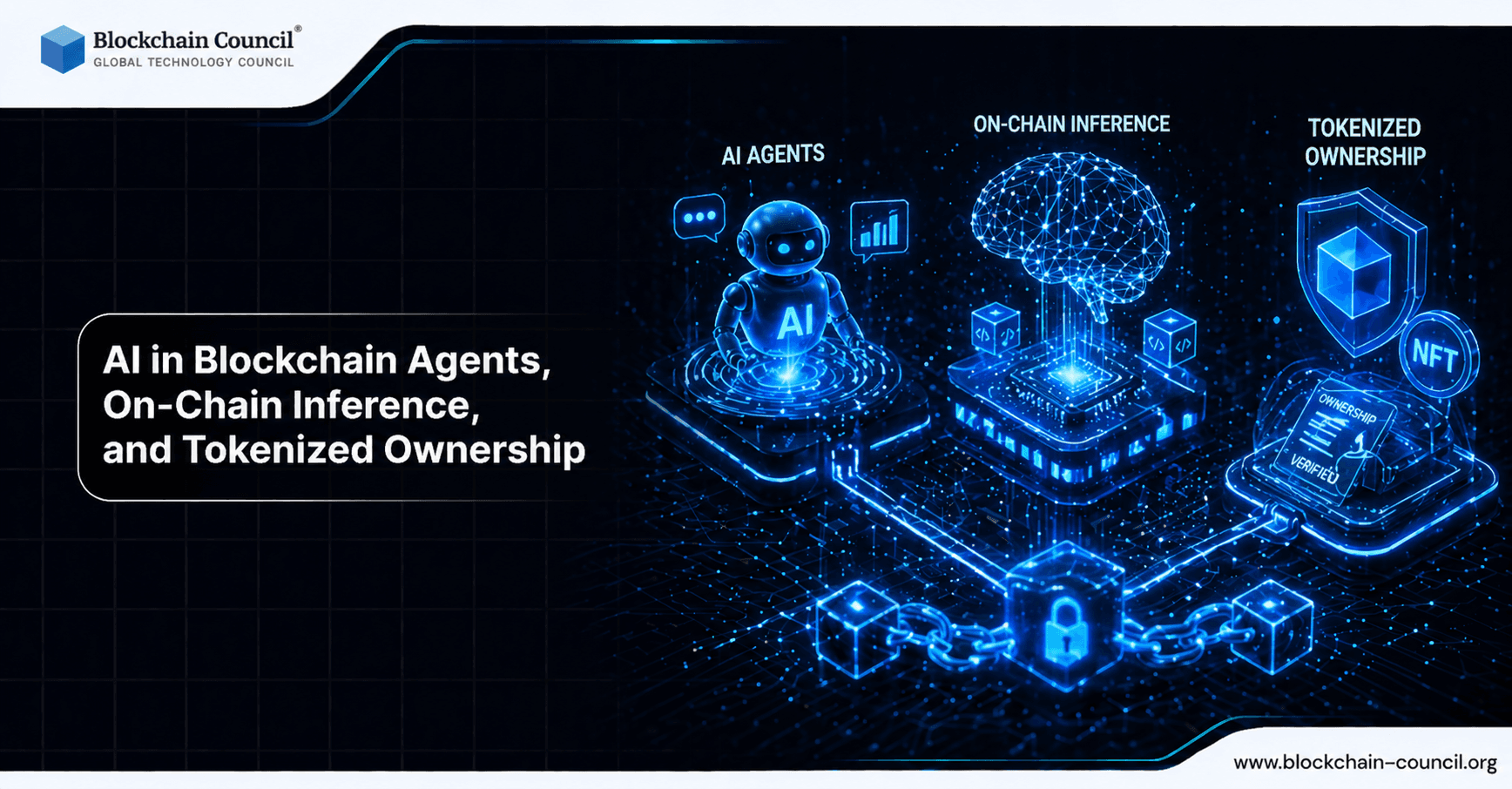
AI in blockchain is moving from pilots to production in 2026. The shift is not just smarter analytics, but autonomous AI agents that can hold wallets, execute transactions, and interact with smart contracts under programmable controls. In parallel, decentralized infrastructure is making verifiable AI inference possible on-chain or in blockchain-secured off-chain networks. Add token economies that define ownership of data and models, and the result is a practical stack for enterprise automation, compliance, and new digital markets.
For blockchain developers and enterprise decision-makers, this convergence of artificial intelligence blockchain systems is redefining how applications are built, audited, and monetized. Below is what is changing in 2026, how it works, and what to plan for next.

Why 2026 Is a Turning Point for AI in Blockchain
In 2025, many teams experimented with AI bots that read dashboards and suggested actions. By early 2026, the industry is implementing systems where AI can decide, blockchains can verify, and payments can execute automatically, often with stablecoins and tokenized assets as the settlement layer. This represents the start of a self-coordinating model where software agents can perform economic work without constant human intervention.
Three developments are driving the change:
Agent tooling and autonomy: Protocol work such as MCP and A2A-style agent-to-agent communication, plus longer-duration execution from newer model families, enables agents to plan, act, and retry over extended sessions.
Wallet-native agents: Smart account standards and account abstraction patterns associated with ERC-4337 and EIP-7702 make it easier to give agents controlled spending power.
Decentralized, verifiable AI services: On-chain or blockchain-secured inference is emerging via decentralized GPU operators and cryptoeconomic guarantees.
Key Blockchain Innovation Areas Shaped by AI in 2026
1) Autonomous AI Agents with Wallets
The most visible change is the rise of AI agents that can hold and use wallets to execute tasks: rebalancing treasury positions, paying for APIs and compute, placing orders, managing subscriptions, and interacting with DeFi and tokenized assets. This is becoming more practical due to smart accounts, gas abstraction, and cross-chain intent systems that reduce operational friction for non-human users.
Enterprise-grade agent wallets in 2026 increasingly include:
Budget limits: Daily, weekly, and per-transaction caps with dynamic risk scoring tied to spending permissions.
Allowlists and policy engines: Approved contracts, assets, chains, counterparties, and methods.
Audit logs: Human-readable traces linking an agent decision to on-chain actions and approvals.
Emergency stops: Pause switches, circuit breakers, and recovery paths if abnormal behavior is detected.
For developers, the design pattern is clear: treat the agent as an operator with constrained authority rather than an all-powerful signer. For enterprises, the governance layer - policies, approvals, monitoring - becomes as important as the model itself.
A Python Certification can help professionals strengthen their skills in automation, scripting, API integration, data processing, and secure software development, enabling them to build and manage AI-powered systems with greater reliability and control.
2) On-Chain AI Inference via Decentralized Infrastructure
A major development is AI inference offered through decentralized networks that provide verifiability and economic accountability. A prominent approach in 2026 is running inference as Actively Validated Services (AVS) on restaking-based security models. In this setup, GPU nodes host models such as open-weight LLM families, stake collateral, and can be penalized (slashed) for returning incorrect or non-compliant results according to the AVS rules.
This matters because enterprise adoption of artificial intelligence blockchain solutions often depends on trust across three dimensions:
Integrity: Was the inference produced by the claimed model and configuration?
Availability: Can the service resist outages and single-provider failures?
Accountability: Is there an economic consequence for provable misbehavior?
From an engineering standpoint, many decentralized inference nodes use high-throughput serving stacks such as vLLM- or SGLang-style engines to host models efficiently. The blockchain role is to coordinate tasks, record commitments, and apply cryptoeconomic guarantees, rather than to run heavy compute directly on the base layer.
3) Tokenized Data and Model Ownership
As AI systems become embedded in blockchain applications, ownership and licensing of training data and model access becomes a first-class requirement. In 2026, tokenization is being used to clarify rights and incentives through structures such as:
Data NFTs: Licensing frameworks for datasets used in training or evaluation, with terms encoded or referenced on-chain.
Model NFTs: Access tokens that represent rights to run inference, receive outputs, or use a fine-tuned variant.
Contributor tokens: Rewards for data providers, labelers, evaluators, or compute operators based on measurable contribution.
This is blockchain innovation with a practical goal: reduce ambiguity around who owns what, who gets paid, and what usage is permitted. For enterprises, it can also simplify vendor and partner relationships by turning model and dataset usage into auditable, programmable entitlements.
4) Federated Learning Coordinated by Blockchains
Federated learning is gaining traction as a way to train models across many participants without centralizing raw data. The 2026 direction is: nodes train locally, submit gradients or updates through blockchain-coordinated workflows, and receive token rewards based on contribution quality. On-chain records help track provenance and enforce incentive rules.
For regulated industries, the appeal is clear:
Data minimization: Keep sensitive data local while still improving shared models.
Traceability: Prove when updates were submitted and how the global model changed.
Incentives: Encourage honest contributions with rewards and penalties.
Real-World Applications in 2026
Payments in Chat Apps and Agent-Driven Commerce
Consumer and SMB usage is emerging through messaging platforms where AI agents initiate and verify on-chain payments. Wallet experiences in apps like Telegram and X are turning chats into transaction interfaces. In practice, a user can ask an agent to send funds, pay a bill, or move assets, and the agent executes via on-chain verification.
For enterprises, the broader opportunity is agent-driven commerce: procurement bots paying for services, finance bots settling invoices, and support bots issuing refunds, with stablecoins and tokenized money improving settlement speed and programmability.
AI-Assisted Smart Contract Security and Enterprise Auditing
Security remains a primary barrier to adoption, and AI is being applied to code review, vulnerability detection, and policy enforcement. A growing pattern is hybrid architectures where:
Training data, prompts, and key outputs are stored or hashed in tamper-evident ledgers.
Agents propose changes or transactions.
Controls such as approvals, audit trails, and emergency stops manage operational risk.
This supports decision provenance, which is critical for enterprise governance: when a system acts, teams need to know why it acted and what information it used.
Architecture Blueprint: Building AI in Blockchain Systems Safely
For developers and decision-makers planning 2026 roadmaps, a practical reference architecture typically includes:
Agent layer: LLM plus tools and memory, with clear task boundaries and retry logic.
Policy layer: Spend limits, allowlists, role-based permissions, and multi-step approvals.
Wallet and account abstraction: Smart accounts, session keys, and gas abstraction to streamline execution.
Verification layer: On-chain logs, attestations, or zero-knowledge proof patterns where applicable.
Execution layer: Smart contracts, cross-chain intents, and stablecoin rails for settlement.
Monitoring and incident response: Real-time anomaly detection, circuit breakers, and post-incident forensics.
Teams should treat AI agent permissions like production access credentials. The stronger the autonomy, the more rigorous the controls must be.
Challenges and Risk Considerations for 2026
Despite rapid progress, AI in blockchain brings distinct risks that leaders should address early:
Key management and delegated authority: Agents need signing capabilities, but unsafe delegation can create catastrophic loss scenarios.
Model and tool manipulation: Prompt injection, tool hijacking, and malicious contract interactions require hardened tooling and strict allowlists.
Inference correctness: Decentralized inference networks reduce dependence on a single provider, but verification methods, slashing conditions, and dispute resolution must be well designed.
Standardization gaps: Cross-chain intents, agent protocols, and model ownership tokens need clearer interoperability standards to scale reliably.
Future Tech Outlook: What to Expect Through Late 2026
Industry roadmaps commonly anticipate staged maturity across two overlapping phases:
Q1-Q3 2026: Agent wallets mature with better smart account support, policy controls, and operational guardrails. Decentralized inference AVS-style services improve reliability and unit economics.
Q2-Q4 2026: Tokenized ownership for data and models expands, and federated learning coordination becomes more production-relevant, strengthening incentive alignment for AI development.
As stablecoins and tokenization continue to expand, AI agents will increasingly transact on crypto-native rails because they are programmable, global, and automated. This pushes the market toward systems where decisions, verification, and settlement happen in one continuous loop.
Skills and Certification Pathways for Teams
Organizations adopting AI in blockchain in 2026 need hybrid skill sets across smart contracts, security, AI tooling, and governance. For structured upskilling, consider internal training paths aligned with roles, with opportunities to explore certifications such as Certified Blockchain Developer, Certified Smart Contract Developer, Certified Artificial Intelligence (AI) Expert, and Certified Web3 Professional from Blockchain Council as relevant internal link opportunities.
Conclusion
AI in blockchain in 2026 is defined by autonomous agents with wallets, verifiable inference delivered through decentralized infrastructure, and tokenized frameworks that clarify data and model ownership. For developers, the focus is building safe agent execution with account abstraction, auditable policies, and robust monitoring. For enterprises, the priority is governance: budget controls, allowlists, provenance, and incident response.
The organizations that succeed in this cycle will treat AI agents as production actors with constrained authority, use blockchains for verification and accountability, and leverage programmable payments to automate settlement. This combination is moving blockchain innovation from experimentation into measurable operational value across finance, security, and digital commerce.
FAQs
1. What is AI in Blockchain?
AI in blockchain refers to integrating intelligent systems with decentralized networks. It includes AI agents, on-chain inference, and tokenized assets. This combination enables automation, trust, and data-driven decision-making.
2. What are AI agents in blockchain?
AI agents are autonomous programs that perform tasks on blockchain networks. They can analyze data, execute transactions, and interact with smart contracts. These agents operate without human intervention.
3. How do AI agents work on blockchain systems?
AI agents use machine learning models to make decisions based on on-chain and off-chain data. They interact with smart contracts to execute actions. Blockchain ensures transparency and security of their operations.
4. What is on-chain inference in AI and blockchain?
On-chain inference refers to running AI model predictions directly on the blockchain. This ensures transparency and verifiability of AI outputs. It is useful for trust-sensitive applications.
5. Why is on-chain inference important in 2026?
It allows users to verify AI decisions without relying on centralized systems. This increases trust in decentralized applications. It is especially important for finance and governance use cases.
6. What is tokenized ownership in AI and blockchain?
Tokenized ownership represents assets or AI models as blockchain-based tokens. These tokens define ownership, access, and revenue rights. It enables decentralized control and monetization.
7. How does tokenized ownership benefit AI developers?
Developers can monetize their models through tokenized access and usage rights. It enables shared ownership and revenue distribution. This creates new economic models for AI innovation.
8. What are the key use cases of AI agents in blockchain?
Use cases include automated trading, portfolio management, and supply chain optimization. AI agents also support governance and data analysis. They improve efficiency and automation.
9. How does AI improve blockchain automation in 2026?
AI enables predictive decision-making and real-time execution. It automates complex processes beyond fixed smart contract logic. This leads to more adaptive and efficient systems.
10. What are the challenges of on-chain AI inference?
Challenges include high computational costs and limited scalability. Blockchain networks may struggle with large AI models. Efficient design and off-chain support are often required.
11. How are AI models stored or accessed on blockchain?
Models are typically stored off-chain, while references or hashes are stored on-chain. This ensures integrity without heavy storage costs. Access is managed through smart contracts.
12. What role do smart contracts play in AI-driven blockchain systems?
Smart contracts execute actions based on AI outputs. They enforce rules and automate transactions. This creates a seamless connection between AI decisions and blockchain execution.
13. How does AI enhance decentralized finance (DeFi) in 2026?
AI supports automated trading, risk management, and credit scoring. It analyzes market data to improve decision-making. This makes DeFi platforms more efficient and reliable.
14. What industries are adopting AI agents and blockchain integration?
Industries include finance, healthcare, logistics, and gaming. They use AI agents for automation and blockchain for transparency. This combination improves operational efficiency.
15. How does tokenization change data and AI ownership?
Tokenization allows fractional ownership of data and AI models. It enables secure sharing and monetization. This shifts control from centralized entities to users.
16. Are AI agents secure on blockchain networks?
AI agents can be secure if properly designed and audited. Blockchain provides transparency, but AI models must be tested for reliability. Continuous monitoring is essential.
17. What tools are used for AI and blockchain integration in 2026?
Developers use AI frameworks like TensorFlow and PyTorch. Blockchain platforms such as Ethereum and Layer 2 solutions are common. Integration tools connect AI models with smart contracts.
18. How can developers build AI agents for blockchain?
Developers need knowledge of machine learning, smart contracts, and APIs. Building prototypes and using open-source tools is helpful. Understanding real-world use cases is important.
19. What is the future of AI agents and tokenized ownership?
The future includes autonomous systems and decentralized AI marketplaces. Tokenized ownership will enable new business models. This will drive innovation in Web3 ecosystems.
20. Why is AI in blockchain a major trend in 2026?
It combines intelligence, automation, and trust in a single system. This addresses limitations of both AI and blockchain individually. The result is more scalable and efficient decentralized technology.
Related Articles
View All
Blockchain
Blockchain Product Manager Skills: What You Need in 2026
A practical guide to the blockchain product manager skills needed in 2026, from DeFi and AI to compliance, UX, analytics, and security.

Blockchain
Essential Blockchain Terms Every Beginner Should Know in 2026
Learn the essential blockchain terms beginners need in 2026, including consensus, wallets, smart contracts, DeFi, NFTs, Layer 2, and tokenization.

Blockchain
What Is Blockchain Intelligence? A Complete Guide to On-Chain Data Analysis
Learn what blockchain intelligence means, how on-chain data analysis works, and how professionals use it for compliance, trading, investigations, and risk.
Trending Articles
AWS Career Roadmap
A step-by-step guide to building a successful career in Amazon Web Services cloud computing.
What is AWS? A Beginner's Guide to Cloud Computing
Everything you need to know about Amazon Web Services, cloud computing fundamentals, and career opportunities.
Claude Code Vs Cursor
Claude Code vs Cursor compares two AI coding tools based on features, automation, and developer workflows.