

AI Blockchain Trends: Future of Blockchain and AI Convergence to 2030
 Suyash Raizada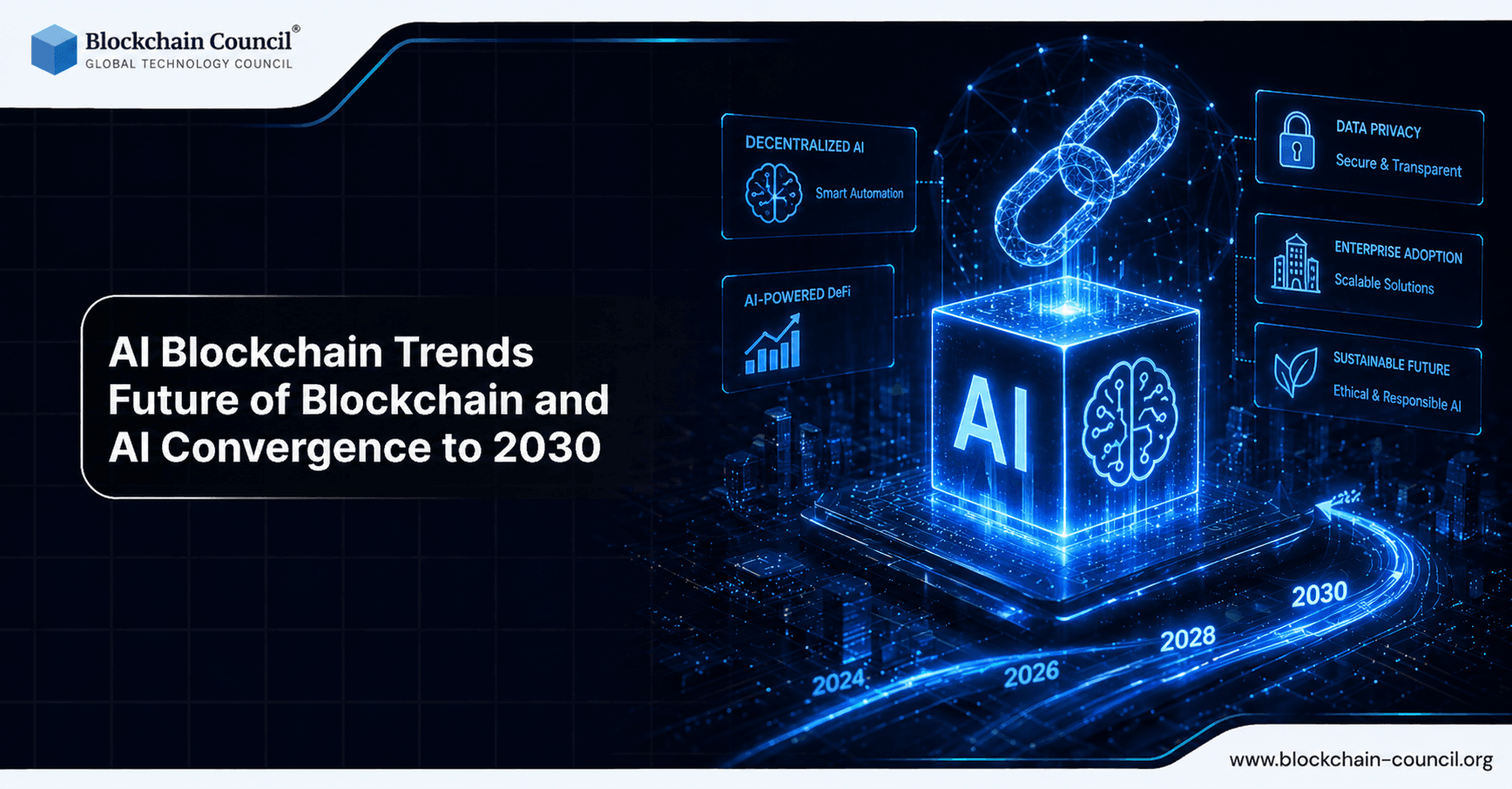
AI blockchain trends are moving from experimentation to early commercialization as enterprises look for better trust, privacy, and scalability in data-driven systems. AI brings prediction, automation, and decision support. Blockchain contributes verification, auditability, and shared coordination across parties that do not fully trust each other. Together, they are shaping a practical Web3 future where data, compute, and autonomous agents can be exchanged with clearer accountability.
This article breaks down where the market stands today, the most important architecture shifts enabling adoption, and what technology analysts and enterprise leaders should watch through 2030.

Stay ahead of AI-blockchain convergence-build expertise with a Blockchain Course, understand models through a machine learning course, and explore market impact via a Digital marketing course.
Why AI and Blockchain Converge Now
Modern AI systems face three recurring enterprise challenges: unclear data provenance, limited transparency around model behavior, and concentrated control of compute and distribution. Blockchain helps anchor provenance and accountability by creating tamper-resistant records of data lineage, model updates, and agent actions. AI complements blockchain by improving automation, risk detection, forecasting, and user experience across complex networks.
In practice, the convergence is less about placing everything on-chain and more about building verifiable workflows where critical events, permissions, and proofs are recorded in a shared ledger, while high-volume compute remains off-chain. This hybrid approach is becoming more achievable thanks to improvements in modular blockchain architectures and privacy technologies such as zero-knowledge proofs (ZKPs) at scale.
Current AI Blockchain Trends Shaping the Market
Several patterns stand out across enterprise pilots and Web3-native platforms. These are the AI blockchain trends most likely to influence roadmaps in the next 12 to 36 months.
1) Decentralized AI Marketplaces for Data and Models
Decentralized marketplaces enable organizations to buy, sell, and share datasets and AI models with clearer usage rules and traceability. This responds to rising concerns about training data sourcing and intellectual property. A blockchain layer can provide:
Data provenance and licensing records for compliance and audits
Usage tracking for monetization and revenue sharing
Permissioned access across multi-party collaborations
Ocean Protocol is a practical example of secure, decentralized data sharing and monetization that can support AI training, particularly where organizations want to collaborate without fully centralizing sensitive datasets.
2) Tokenized AI Infrastructure for Compute and Hosting
AI workloads are constrained by GPU availability and cost. Tokenized infrastructure models aim to coordinate compute supply and demand through incentives for GPU rendering, model hosting, and distributed inference. The enterprise relevance is straightforward: more flexible compute procurement and improved resiliency through multi-provider networks.
This aligns with the broader future of blockchain trend toward modular stacks, where compute, data availability, and settlement can be composed rather than relying on a single monolithic chain.
3) AI-Powered DeFi and Adaptive Risk Controls
DeFi protocols increasingly use AI techniques for predictive analytics, anomaly detection, and parameter optimization. For enterprise leaders evaluating DeFi integrations or tokenized cash management experiments, the value centers on:
Real-time fraud detection and threat monitoring
Automated risk scoring for liquidity, collateral, and counterparty exposure
Improved user operations via intelligent interfaces and conversational support
Industry analysis commonly reports that AI can improve operational efficiency by around 30% in blockchain-related contexts through predictive analytics and automation, including conversational interfaces.
4) AI Agent Coins and Autonomous Transaction Execution
Autonomous agents are emerging as a distinct design pattern: software that can plan and execute tasks such as trading, procurement, scheduling, and logistics. Tokenized incentives can reward agent performance, while blockchain can record agent decisions and enable payments.
Fetch.ai is a widely referenced example where autonomous AI agents coordinate on-chain for automation, data exchange, and payments. For enterprise decision-makers, the near-term opportunity is agent-based automation in constrained domains, such as supply chain event handling, energy optimization, or internal service orchestration.
5) Blockchain as AI Infrastructure for Trust and Verification
As model opacity becomes a board-level concern, blockchain is increasingly positioned as a trust layer for AI systems. The goal is to verify:
What data was used, by whom, and under what rights
Which model version produced a given output
Whether an agent followed approved policies
This is especially relevant in regulated industries where audit trails and reproducibility are compliance requirements.
Market Signals Enterprises Should Not Ignore
Commercialization is accelerating alongside more mature infrastructure and compliance conversations:
Blockchain-as-a-Service (BaaS) is projected to reach $25 billion by 2027, driven by efficiency and security needs.
The AI-blockchain integration market is expected to grow to around $973 million by 2027, with a focus on privacy and scalability enhancements.
These figures reflect an important shift: AI and blockchain are increasingly evaluated as enterprise infrastructure choices, not only as experimental technologies.
Use Cases: What Is Working in Practice
Real-world projects help clarify what the convergence looks like in deployment.
Decentralized Data Monetization for AI
Ocean Protocol supports controlled access and monetization of data assets used for AI training. For enterprises, this pattern maps to cross-company consortia where data sharing is valuable but centralization introduces unacceptable risk.
Incentivized Model Collaboration and Competition
Bittensor (TAO) enables AI models to collaborate and compete within a token-incentivized network. Even where enterprises do not adopt public networks directly, the mechanism is influential: it demonstrates market-driven approaches to pricing model performance and allocating compute resources.
AI Tool Marketplaces and Composable AI Services
SingularityNET is an example of an open marketplace for AI tools, supporting composable AI services that can be discovered and integrated with transparent usage terms.
Tokenized Real-World Assets and Optimization Layers
Real-world asset tokenization links on-chain settlement with traditional markets and is a significant component of the Web3 future. SunContract, focused on peer-to-peer electricity trading, illustrates how blockchain systems can coordinate real economic activity. AI can add demand forecasting, dynamic pricing, and grid optimization on top of these settlement rails.
What Changes by 2030: Predictions and Technology Shifts
Several developments are forecast as building blocks for widespread adoption by 2030, largely driven by trust, scalability, and privacy requirements.
Energy-Efficient Consensus Tied to Useful AI Work
One predicted direction involves energy-efficient consensus mechanisms such as Proof of Useful Intelligence, where network work is more directly linked to valuable computation. If realized, this could reframe infrastructure economics by aligning security budgets with AI utility.
On-Chain or Verifiably Governed AI Training and Inference
Full on-chain training remains cost-prohibitive, but governance and verification can move on-chain in meaningful ways. Expect more architectures where:
Training and inference occur off-chain
Proofs, commitments, and key events are recorded on-chain
ZKPs support privacy-preserving verification of claims
Cross-Chain Interoperability for AI Data Marketplaces
As enterprises adopt multiple chains and layers, interoperability becomes essential for marketplace liquidity. Cross-chain standards can enable data, models, and credentials to move with fewer integration bottlenecks, supporting global AI data markets.
Utility-Focused AI Tokens and Community-Governed Compute Networks
Speculation alone is unlikely to sustain enterprise-grade ecosystems. The direction toward utility-focused AI tokens ties incentives to measurable outputs such as compute availability, model accuracy, or service-level commitments. In parallel, community-governed networks may allocate resources and set policies in ways that resemble cooperative infrastructure procurement.
Hybrid AI-DeFi and Enterprise Risk Management
Institutional uptake is expected to push AI into on-chain risk management, compliance monitoring, and predictive analytics. As regulatory frameworks mature, enterprises will likely adopt controlled versions of AI-enhanced DeFi patterns for settlement, treasury operations, and collateral workflows.
Enterprise Roadmap: Evaluating AI and Blockchain Together
For technology analysts and enterprise leaders, the key is to treat AI and blockchain as complementary layers within a single system design.
Questions to Ask in Vendor and Architecture Reviews
Trust model: Which parties need shared truth, and what must be auditable?
Privacy: Can ZKPs or permissioned controls meet confidentiality requirements?
Data provenance: How will you prove dataset rights, lineage, and model versioning?
Scalability: What remains off-chain, and what is anchored on-chain?
Operational maturity: Monitoring, incident response, key management, and governance processes
Future-ready professionals combine AI, blockchain, and strategy-start with an AI Course, enhance coding with a Python certification, and learn adoption strategies through a Digital marketing course.
Conclusion: The Web3 Future Is Verifiable Intelligence
The most durable AI blockchain trends are not about placing AI inside a ledger. They are about making intelligence verifiable: provable data rights, auditable model behavior, privacy-preserving compliance, and resilient coordination across organizations. As the future of blockchain moves toward modular architectures, ZKPs at scale, and real-world asset tokenization, AI becomes the optimization and decision layer that makes these systems more usable and efficient.
By 2030, the convergence is expected to materialize as global AI marketplaces, tokenized compute networks, agent-based automation, and hybrid AI-DeFi risk controls. Enterprises that start with clear trust boundaries, measurable ROI, and governance-first design will be best positioned to adopt what works while avoiding unnecessary complexity.
FAQs
1. What are AI blockchain trends?
AI blockchain trends refer to the growing integration of artificial intelligence with blockchain technology. These trends focus on automation, data security, and decentralized intelligence. They are shaping the next generation of digital systems.
2. Why is the convergence of AI and blockchain important?
The convergence improves trust, automation, and data analysis. AI enhances decision-making, while blockchain ensures transparency and security. Together, they create more reliable and efficient systems.
3. How will AI impact blockchain by 2030?
AI will optimize blockchain operations, improve scalability, and enhance smart contract functionality. It will also enable predictive analytics and automation. This will make blockchain systems more efficient and intelligent.
4. How will blockchain support AI development?
Blockchain provides secure and transparent data for training AI models. It ensures data integrity and traceability. This helps improve the reliability of AI systems.
5. What industries will benefit most from AI blockchain convergence?
Industries such as finance, healthcare, supply chain, and logistics will benefit significantly. These sectors rely on secure data and automation. AI and blockchain together improve efficiency and trust.
6. What are decentralized AI platforms?
Decentralized AI platforms use blockchain to distribute AI processing and data storage. They reduce reliance on centralized systems. This improves privacy, security, and accessibility.
7. How will AI improve smart contracts?
AI can make smart contracts more adaptive and intelligent. It enables dynamic decision-making based on real-time data. This expands the use cases of smart contracts.
8. What role does data privacy play in AI blockchain trends?
Data privacy is a key concern in both AI and blockchain. Combining them allows secure data sharing with controlled access. This helps protect sensitive information while enabling analysis.
9. What are tokenized AI ecosystems?
Tokenized AI ecosystems use blockchain tokens to incentivize data sharing and model training. Participants are rewarded for contributing resources. This supports decentralized AI development.
10. How will AI blockchain impact decentralized finance (DeFi)?
AI will enhance DeFi through better risk management, trading strategies, and automation. Blockchain ensures secure transactions. This combination will drive innovation in financial services.
11. What are the challenges of AI blockchain integration?
Challenges include scalability, high costs, data management, and technical complexity. Integrating two advanced technologies is difficult. Proper architecture and planning are required.
12. How will regulation affect AI blockchain trends?
Regulation will shape how AI and blockchain are adopted across industries. Governments will focus on data protection and compliance. Clear regulations can increase trust and adoption.
13. What is the role of edge computing in AI blockchain?
Edge computing enables data processing closer to the source. It reduces latency and improves performance. Combined with blockchain, it supports real-time and secure AI applications.
14. How will AI blockchain improve supply chain management?
AI can analyze supply chain data for efficiency and forecasting. Blockchain ensures transparency and traceability. This improves trust and reduces fraud.
15. What is the future of decentralized data marketplaces?
Decentralized data marketplaces allow users to buy and sell data securely. Blockchain ensures ownership and transparency. AI uses this data for training and insights.
16. How will AI blockchain affect cybersecurity?
AI can detect threats and anomalies, while blockchain secures data and transactions. Together, they strengthen cybersecurity systems. This reduces risks of breaches and fraud.
17. What are real-world examples of AI blockchain applications?
Examples include fraud detection systems, smart healthcare platforms, and automated supply chains. These applications combine intelligence with secure data handling. They are already emerging in various sectors.
18. How will scalability evolve in AI blockchain systems?
New solutions like layer-2 scaling and optimized AI models will improve performance. These technologies reduce costs and increase speed. Scalability will be a key focus by 2030.
19. What skills are needed for AI blockchain development?
Developers need knowledge of AI, machine learning, blockchain, and smart contracts. Understanding data engineering and security is also important. Cross-disciplinary skills are essential.
20. What is the long-term outlook for AI and blockchain convergence?
The convergence is expected to drive innovation across industries. It will enable smarter, more secure, and decentralized systems. By 2030, it could become a foundational technology stack.
Related Articles
View All
Blockchain
Blockchain in Banking and Finance: Use Cases, Benefits, and Future Trends
Explore blockchain in banking and finance, including payments, tokenization, custody, lending, trade finance, compliance, benefits, and future trends.
Blockchain
Blockchain Future Trends and Emerging Innovations to Watch
Explore blockchain future trends and emerging innovations, including DeFi, CBDCs, Web3, tokenized assets, gaming, interoperability, and enterprise adoption.

Blockchain
Blockchain Product Manager Salary in the USA: Average Pay, Factors, and Trends
A practical guide to blockchain product manager salary in the USA, including average pay, seniority bands, location effects, skills, and trends.
Trending Articles

Top 5 DeFi Platforms
Explore the leading decentralized finance platforms and what makes each one unique in the evolving DeFi landscape.
What is AWS? A Beginner's Guide to Cloud Computing
Everything you need to know about Amazon Web Services, cloud computing fundamentals, and career opportunities.
Claude AI Tools for Productivity
Discover Claude AI tools for productivity to streamline tasks, manage workflows, and improve efficiency.