

Blockchain Future Trends and Emerging Innovations to Watch
 Suyash Raizada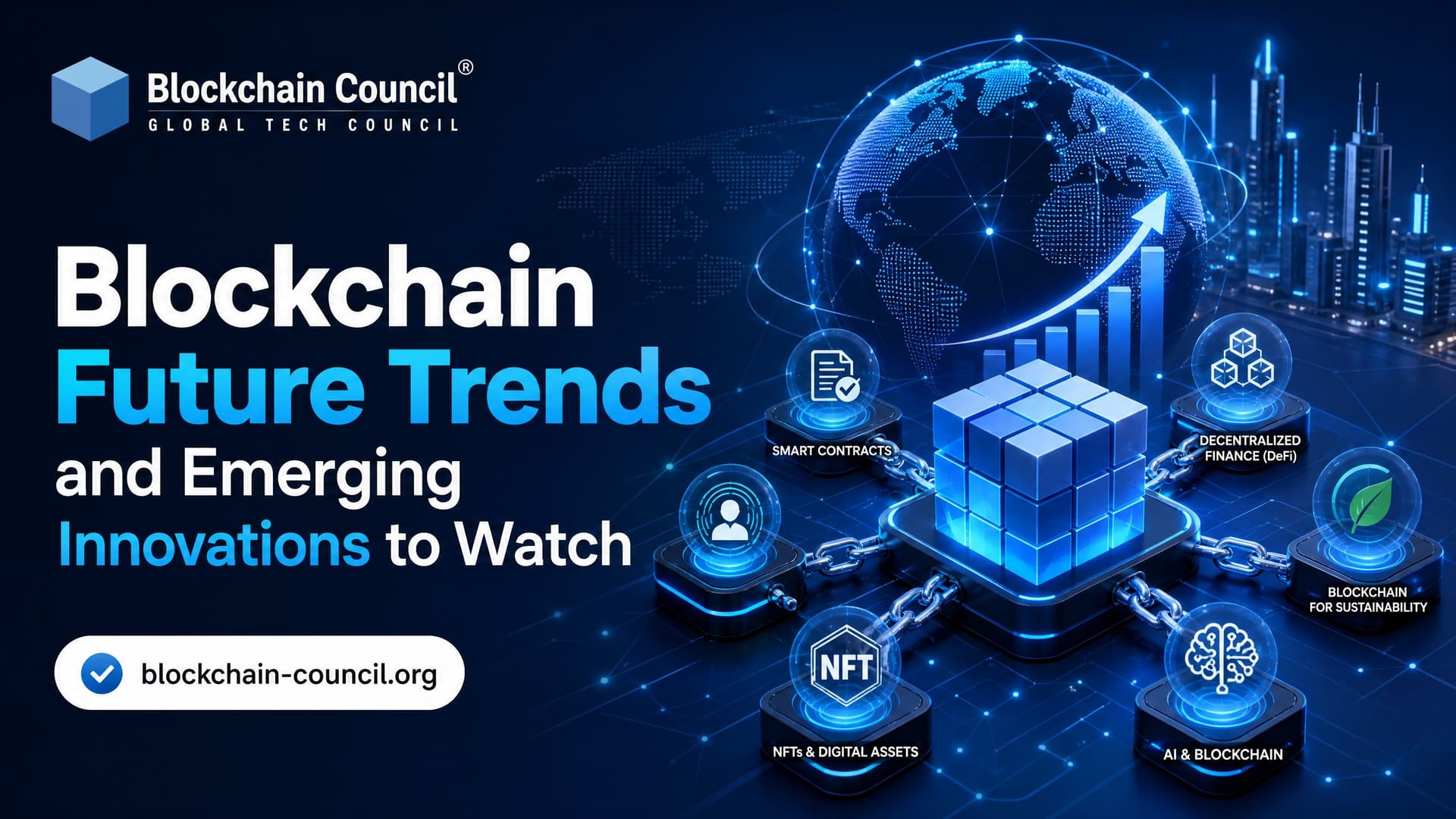
Blockchain Future Trends and Emerging Innovations are no longer limited to cryptocurrency speculation. The serious work now sits in tokenized assets, decentralized finance, CBDCs, interoperability, Web3 identity, and enterprise networks that replace slow multiparty reconciliation with shared records.
The shift shows up in the forecasts. Fortune Business Insights projects the global blockchain market to grow from $27.84 billion in 2024 to $825.93 billion by 2032. PwC also classifies blockchain among its Essential 8 emerging technologies, pointing to its value in simplifying and securing transactions between parties. That does not mean every blockchain project deserves funding. Many do not. But the infrastructure is maturing.

Where Blockchain Stands Now
Blockchain has moved past the first wave of pilots. Banks, fintech firms, game studios, supply chain operators, and governments now test or run systems tied to real money, real assets, and real compliance obligations.
Cryptocurrency is still the most visible use case. It is not the full story. DeFi protocols support lending, borrowing, decentralized exchange, and collateralized products. NFTs have moved from profile pictures into tickets, game assets, access rights, and asset records. Enterprises use permissioned or hybrid ledgers for trade finance, provenance, and shared audit trails.
If you build in this space, you also see the maturity in the tooling. Solidity 0.8.x added automatic overflow and underflow checks, which changed how many older smart contract examples behave. A beginner running a copied Solidity 0.7 contract in Hardhat may hit this: VM Exception while processing transaction: reverted with panic code 0x11. That small error teaches a big lesson. Blockchain development is not just theory. Versioning, gas mechanics, chain IDs, and wallet defaults matter.
Top Blockchain Future Trends and Emerging Innovations
1. DeFi Moves Toward Regulated Finance
DeFi total value locked reached almost $250 billion in November 2021. The market later cooled, but the core idea survived: financial products can run through smart contracts rather than centralized ledgers.
The next stage is less about anonymous yield farming and more about compliant financial rails. Expect more activity around:
- On-chain identity for know-your-customer and anti-money laundering controls
- Tokenized collateral, including money market funds, invoices, and real estate interests
- Institutional custody for funds that cannot use browser wallets or seed phrases
- Risk-managed lending with clearer liquidation rules and audit trails
To be blunt, DeFi is not ready to replace banking for most users. Transaction signing is still unforgiving. Bridges remain a security risk. But for programmable settlement and transparent collateral, DeFi is one of the strongest trends here.
2. Tokenized Real-World Assets
Tokenization means representing rights to an asset on a blockchain. That asset may be a bond, property share, warehouse receipt, carbon credit, fund unit, or invoice. This matters because most global value is not crypto-native.
NFTs helped popularize unique digital ownership, but the bigger opportunity may be real-world asset tokenization. A token can carry ownership rules, transfer restrictions, dividend logic, redemption terms, or compliance checks. For finance teams, the appeal is practical: faster settlement, programmable ownership, and clearer audit history.
Do not confuse tokenization with instant liquidity. A tokenized asset still needs legal enforceability, custody, valuation, and buyers. If those pieces are weak, the token is just a receipt with nice metadata.
3. CBDCs and Programmable Money
Central Bank Digital Currencies, or CBDCs, are a major government-led trend. They are not always built on public blockchains, but they borrow ideas from distributed ledgers: digital settlement, traceability, programmability, and direct issuance.
CBDCs may coexist with stablecoins and commercial bank money. The policy questions are difficult. Should a CBDC be retail or wholesale? Should transactions be private? Can offline payments work? How should limits be set to avoid pulling deposits from banks?
El Salvador and the Central African Republic made headlines by adopting Bitcoin as legal tender. CBDCs take a different route. Instead of adopting a decentralized crypto asset, central banks experiment with digital versions of sovereign currency. Both paths show that governments now treat digital money as a strategic issue, not a fringe topic.
4. Interoperability and Cross-Chain Infrastructure
Blockchain networks are fragmented. Ethereum, Solana, Bitcoin, Polygon, Avalanche, Cosmos, and private enterprise chains do not naturally share state. Users feel this when they bridge assets, wrap tokens, switch RPC endpoints, or send funds to the wrong network in MetaMask.
Interoperability aims to let data and value move across chains with less friction. Cosmos uses the Inter-Blockchain Communication protocol for communication between compatible chains. Polkadot uses a relay chain and parachain model. Ethereum scaling networks increasingly rely on rollups and messaging systems.
Here is the trade-off: cross-chain bridges have been some of the most attacked parts of the blockchain stack. If your application does not truly need multi-chain support, do not add it just because investors like the phrase. Start with one secure network, then expand when there is a user reason.
5. Web3 Identity and User-Owned Data
Web3 is often described as a decentralized internet where users control identity, data, and digital assets. Some claims are overhyped. Most users still rely on centralized exchanges, app stores, cloud hosting, and social platforms. Still, the identity layer is worth watching.
Wallet-based login, verifiable credentials, decentralized identifiers, and token-gated access can change how users prove membership, qualifications, or ownership. A professional certification, event ticket, or contributor badge can be issued in a way that is easy to verify without calling a central database every time.
This is relevant for professionals studying with Blockchain Council. If you are exploring this path, look at learning routes such as the Certified Blockchain Expert™, Certified Web3 Expert™, and Certified Smart Contract Developer™ as next steps for understanding architecture, wallets, and application design.
6. Blockchain Gaming and Digital Economies
Gaming has been one of the first consumer sectors to generate high blockchain activity. A DappRadar and Blockchain Game Alliance report found blockchain-based game activity grew by 2,000 percent over one year and represented 52 percent of blockchain activity at that time.
The useful idea is not forcing every sword, skin, or badge on-chain. That gets expensive and clumsy. The better model is selective ownership: high-value items, marketplace assets, tournament credentials, and player-controlled economies.
Metaverse projects depend on similar building blocks: payments, identity, NFTs, governance, and virtual property rights. The winning products will not be the ones that shout Web3 the loudest. They will be the ones where blockchain quietly solves ownership or settlement problems players already have.
7. Sustainability and Efficient Consensus
Energy use remains part of the blockchain debate. Bitcoin still uses Proof of Work. Ethereum moved to Proof of Stake in 2022 through The Merge, cutting its energy consumption by roughly 99.95 percent according to the Ethereum Foundation. Newer networks often use Proof of Stake or related consensus designs from the start.
The sustainability trend is broader than consensus. Layer 2 rollups, batching, off-chain computation, and better data availability can reduce cost and resource use. Enterprises also care about this, because environmental reporting and procurement rules increasingly affect technology choices.
Enterprise Blockchain: Less Noise, More Infrastructure
Enterprise blockchain is often boring in the best way. It focuses on reconciliation, provenance, permissions, shared workflow, and auditability. Deloitte has argued that blockchain-enabled business models can reshape commerce across industries. PwC highlights the same practical angle: blockchain can simplify and secure transactions among multiple parties.
Strong enterprise use cases usually share three conditions:
- Multiple parties need the same record, but no single party should fully control it.
- Audit history matters, especially for finance, healthcare, logistics, or regulated reporting.
- Manual reconciliation is expensive, slow, or error-prone.
If only one company writes and reads the data, use a normal database. Blockchain is the wrong tool there. Good architects say no often.
Skills Professionals Need for the Next Blockchain Cycle
For developers, the skill set is becoming more demanding. You need smart contract security, token standards such as ERC-20 and ERC-721, EIP-1559 gas fee behavior, wallet flows, testing, and deployment discipline. Learn Hardhat or Foundry. Test your reverts. Understand why Ethereum mainnet uses chain ID 1 before you sign anything valuable.
For business and enterprise professionals, focus on token economics, regulation, custody, governance, and process design. The best blockchain projects usually start with a workflow problem, not a token idea.
Useful Blockchain Council learning paths include the Certified Blockchain Expert™ for broad strategy and fundamentals, the Certified Blockchain Developer™ for technical implementation, and the Certified DeFi Expert™ if your work touches decentralized finance, tokenized assets, or on-chain markets.
What to Watch Next
These trends will not all move at the same speed. DeFi and tokenized assets are already active. CBDCs will move at government speed. Web3 identity needs better user experience. Gaming will keep experimenting, but weak token models will fade.
Your next step should be practical: choose one trend, build or analyze a small project, and learn the constraints. Deploy an ERC-20 token on a testnet. Map a supply chain record flow. Compare a CBDC design with a stablecoin model. If you want structured guidance, start with the Certified Blockchain Expert™, or move into the Certified Blockchain Developer™ if you plan to write and audit smart contracts.
Related Articles
View All
Blockchain
Blockchain in Banking and Finance: Use Cases, Benefits, and Future Trends
Explore blockchain in banking and finance, including payments, tokenization, custody, lending, trade finance, compliance, benefits, and future trends.

Blockchain
Blockchain Digital Identity Management Patents: Key Innovations and Market Trends
A practitioner-focused look at blockchain digital identity management patents, from biometric wallets and DIDs to KYC, EU wallets, IoT, and market growth.

Blockchain
Blockchain Product Manager Salary in the USA: Average Pay, Factors, and Trends
A practical guide to blockchain product manager salary in the USA, including average pay, seniority bands, location effects, skills, and trends.
Trending Articles
AWS Career Roadmap
A step-by-step guide to building a successful career in Amazon Web Services cloud computing.
How Blockchain Secures AI Data
Understand how blockchain technology is being applied to protect the integrity and security of AI training data.
Claude AI Tools for Productivity
Discover Claude AI tools for productivity to streamline tasks, manage workflows, and improve efficiency.