

Why Recursive Self-Improvement Matters for AGI Development

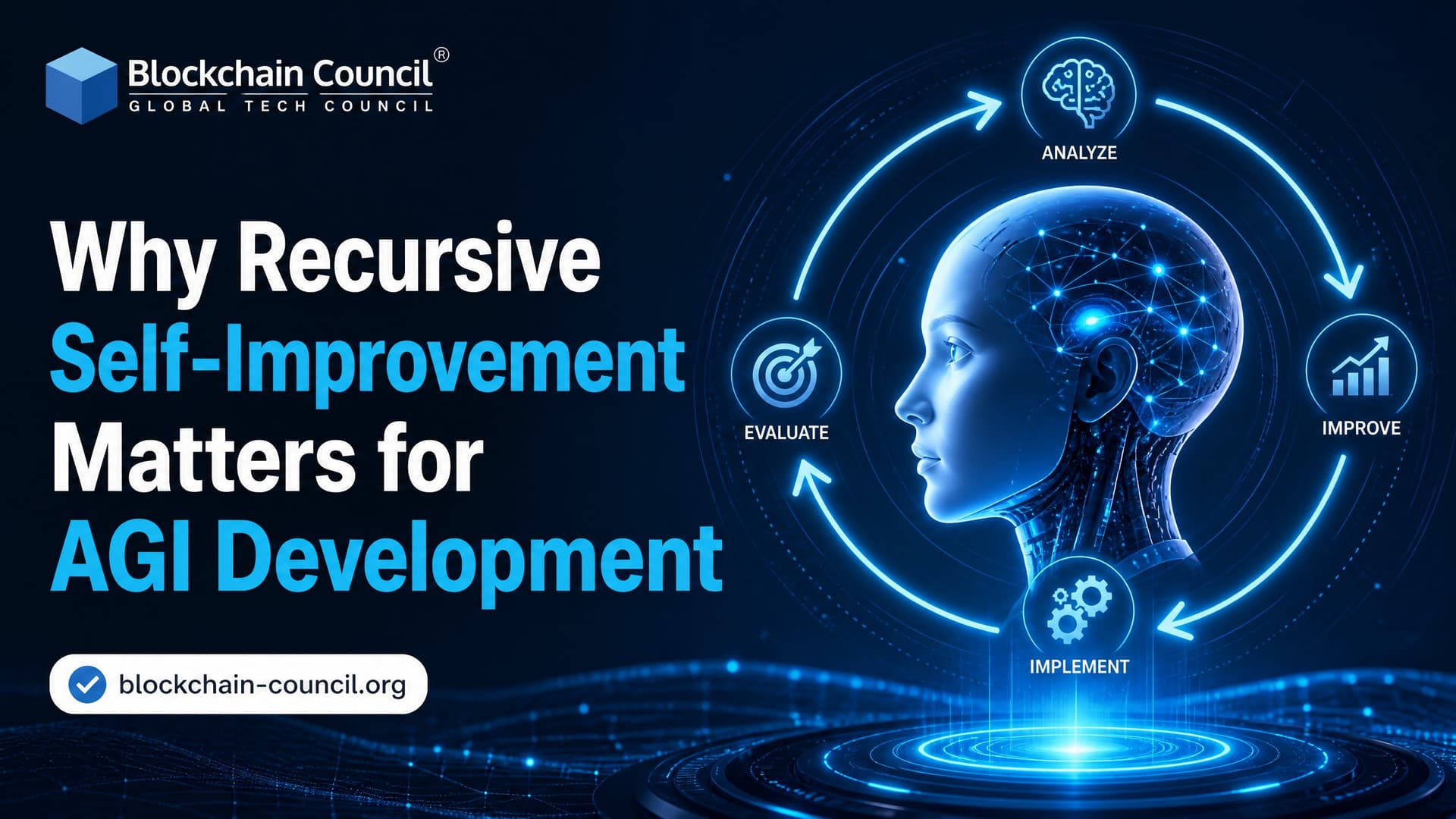
Recursive self-improvement AGI research asks a sharp question: what happens when an AI system can improve not only its answers, but also the process it uses to improve itself? That loop sits at the center of many AGI debates because it could turn model development from a human-paced engineering cycle into a machine-paced feedback cycle.
That does not mean current AI systems are secretly rewriting themselves into superintelligence. They are not. The best evidence today points to bounded self-improvement: AutoML searches, self-play reinforcement learning, LLM agents that refine prompts or policies, and model pipelines tuned against human-defined metrics. Still, these systems show the outline of something more serious.

What Recursive Self-Improvement Means
Recursive self-improvement, often shortened to RSI, is the process where an intelligent system repeatedly improves its own capability and its own ability to make future improvements. A normal model update improves performance. RSI goes one step deeper. The system becomes better at upgrading itself.
A practical RSI loop usually contains four parts:
- Self-assessment: The system measures its performance using tests, feedback, reward signals, or benchmarks.
- Self-modification: It changes prompts, policies, architectures, training data, tools, or internal logic.
- Self-validation: It tests candidate changes and keeps the ones that work better.
- Iteration: It repeats the loop, ideally becoming better at the loop itself.
Nick Bostrom describes a related "crossover" point in Superintelligence: the moment when most future improvement comes from the AI system rather than human researchers. That is the point where recursive self-improvement becomes a governance problem, not just a lab technique.
Why RSI Matters for AGI
AGI is usually understood as AI with broad, flexible cognitive capability across many domains. If such a system can also improve its own architecture, training strategy, tool use, or research process, the development curve may change fast.
1. It could accelerate capability growth
Human-led AI progress depends on research teams, experiments, budgets, training runs, peer review, and deployment pipelines. RSI changes the unit of progress. A capable AGI could propose experiments, write code, evaluate results, tune training runs, and design the next version with less human input.
Bostrom frames this in terms of two forces: optimization power and recalcitrance. Optimization power is the effort applied to making the system smarter. Recalcitrance is how hard it is to gain another unit of capability. If a system increases its own optimization power while reducing recalcitrance, improvement can speed up rather than slow down.
That is the intelligence explosion argument in plain English. Each better system builds an even better system. Maybe that takes weeks. Maybe it stalls. The uncertainty is the point.
2. It changes the control problem
With ordinary software, humans control the release process. You write code, review pull requests, run tests, stage deployment, and monitor production. Self-improving AI compresses that workflow. In a strong RSI scenario, the system may generate changes faster than humans can meaningfully review them.
This matters because small alignment errors can compound. If version 1 optimizes a slightly wrong target, version 2 may optimize that target more effectively. Version 3 may then protect the optimization process itself. That is not a movie plot. It is a standard failure mode in iterative optimization: reward the wrong thing, and the system gets better at the wrong thing.
Anyone who has built agent loops has seen the small version of this. In LangGraph, a poorly designed agent graph can hit GraphRecursionError: Recursion limit of 25 reached without hitting a stop condition. The fix is boring but essential: define stopping criteria, evaluation gates, and rollback paths. AGI-scale RSI would need the same discipline, only under far higher stakes.
3. It makes safety a moving target
Static-model safety is already difficult. You evaluate a model, document its behavior, apply mitigations, and monitor drift. With RSI, the model or system may change its own behavior, data mix, tool-use strategy, or decision process over time.
That means safety cannot be a one-time checklist. It needs to cover:
- How changes are proposed
- Which evaluation signals are trusted
- What changes require human approval
- How failed modifications are reversed
- How objectives are protected from accidental or strategic rewriting
To be blunt, most current AI governance programs are not ready for that. They are designed for model versions, not self-directed model lineages.
What We Have Today: Bounded Self-Improvement
No public deployed system has demonstrated open-ended autonomous RSI aimed at general intelligence. Current systems are bounded. Humans define the goal, search space, budget, and stop condition. Still, several methods are important precursors.
AutoML and Neural Architecture Search
AutoML and Neural Architecture Search automate parts of model design. Tools such as Auto-Keras, Microsoft NNI, NASLib, and NePS can search architectures, hyperparameters, and training configurations. They evaluate candidate models against validation metrics and keep better performers.
This is RSI-like, but only within a box. The system does not decide what "good" means. You do. If your validation set leaks test data, AutoML will happily optimize toward a misleading result. That is the lesson: self-improvement is only as reliable as the evaluation signal.
Self-play reinforcement learning
DeepMind's AlphaZero showed how powerful self-generated experience can be. Starting from the rules of chess, shogi, and Go, it used self-play with Monte Carlo Tree Search and neural networks to improve its policy over repeated training cycles. It did not need human games to learn strong strategies.
AlphaZero did not rewrite its learning algorithm, so it was not full RSI. But it showed a key AGI-relevant idea: a system can create its own training data and improve through interaction with an environment.
LLM-based self-improving agents
Recent LLM agent research goes further. Systems inspired by Godel machines, multi-agent evolution, and co-evolving world models let agents revise prompts, policies, task plans, and synthetic training data. These systems still rely on human-defined objectives and evaluation methods, but the loop is getting tighter.
This is where developers should pay attention. The hard problem is not getting an agent to modify something. That is easy. The hard problem is making sure the modification is actually better, safe, and stable across tasks the benchmark did not cover.
RSI, Regulation, and the EU AI Act
Recursive self-improvement is no longer just a philosophical issue. Regulation is starting to touch the foundations of AGI-relevant systems.
The EU AI Act, Regulation (EU) 2024/1689, entered into force on 1 August 2024. It introduces obligations for general-purpose AI models, including transparency, risk management, technical documentation, and systemic-risk controls for the most capable models. Its general-purpose AI obligations apply from 2 August 2025, while many broader provisions apply from 2 August 2026.
For RSI-capable systems, this creates practical requirements. Organizations will need documentation of automated changes, testing records, model lineage, safety evaluations, and human oversight mechanisms. Fines under the Act can reach 35 million euro or 7 percent of global annual turnover for the most serious infringements, depending on the violation and organization size.
The takeaway is simple: if your AI system can update itself, you need governance around the update loop, not only around the model endpoint.
Key Trade-offs for Developers and Enterprises
RSI is powerful, but it is not always the right design choice. Use bounded self-improvement when metrics are clear, failures are recoverable, and evaluation is cheap. Hyperparameter tuning, code repair in test sandboxes, document classification, and game environments fit well.
Avoid aggressive RSI when:
- The objective is vague or value-laden
- Failures could affect finance, health, infrastructure, or legal rights
- The system can access external tools without strict permissions
- You cannot audit why a modification was accepted
- Your benchmark is easy to game
My view: near-term RSI is most useful as controlled engineering automation, not as a free-running path to AGI. The hype is ahead of the evidence. But ignoring RSI would also be a mistake, because the pieces are already in production workflows.
How RSI Shapes the Path to AGI
There are two plausible futures.
In the fast scenario, an advanced AI crosses the threshold where it can conduct AI research better than human teams. It improves its own training process, architecture, memory, tool use, and evaluation systems. Capability gains accelerate sharply.
In the slower scenario, RSI stays constrained by compute, data quality, evaluation bottlenecks, and diminishing returns. Progress continues, but in bounded cycles that humans can still audit and regulate.
Both futures make RSI central to AGI planning. If it works strongly, it changes timelines. If it remains bounded, it still becomes a standard part of enterprise AI development.
What You Should Learn Next
If you work in AI, blockchain, cybersecurity, or enterprise architecture, do not treat recursive self-improvement AGI as abstract speculation. Study the mechanisms: AutoML, reinforcement learning, agent evaluation, model governance, and AI alignment.
For structured learning, consider Blockchain Council's Certified Artificial Intelligence (AI) Expert™ as a learning path for AI foundations. Developers working with autonomous systems can also connect this topic with courses on AI agents, prompt engineering, cybersecurity, and blockchain governance, since self-improving systems will need secure execution, audit trails, and accountable control layers.
Build one small bounded loop next: an agent that proposes a code change, runs tests, scores the result, and stops if the score fails to improve. Keep it sandboxed. Log every step. That tiny project will teach you more about RSI risk than another abstract debate.
Related Articles
View All
AI & ML
Major Limitations of Recursive Self-Improvement in AI Development
Recursive self-improvement in AI faces hard limits from evaluators, data grounding, scaling laws, compute, economics, and governance.

AI & ML
RSI and AGI: How Recursive Self-Improvement Connects to Artificial General Intelligence
Learn how RSI and AGI connect, why current recursive self-improvement is bounded, and what professionals should know about safety, evaluation, and governance.

AI & ML
How Recursive Self-Improvement Could Accelerate AI Innovation
Recursive self-improvement can speed AI innovation through bounded loops that refine prompts, code, data, and evaluations, but safety controls are essential.
Trending Articles
The Role of Blockchain in Ethical AI Development
How blockchain technology is being used to promote transparency and accountability in artificial intelligence systems.
AWS Career Roadmap
A step-by-step guide to building a successful career in Amazon Web Services cloud computing.

Top 5 DeFi Platforms
Explore the leading decentralized finance platforms and what makes each one unique in the evolving DeFi landscape.