

Could Recursive Self-Improvement Lead to Superintelligent AI?
 Suyash Raizada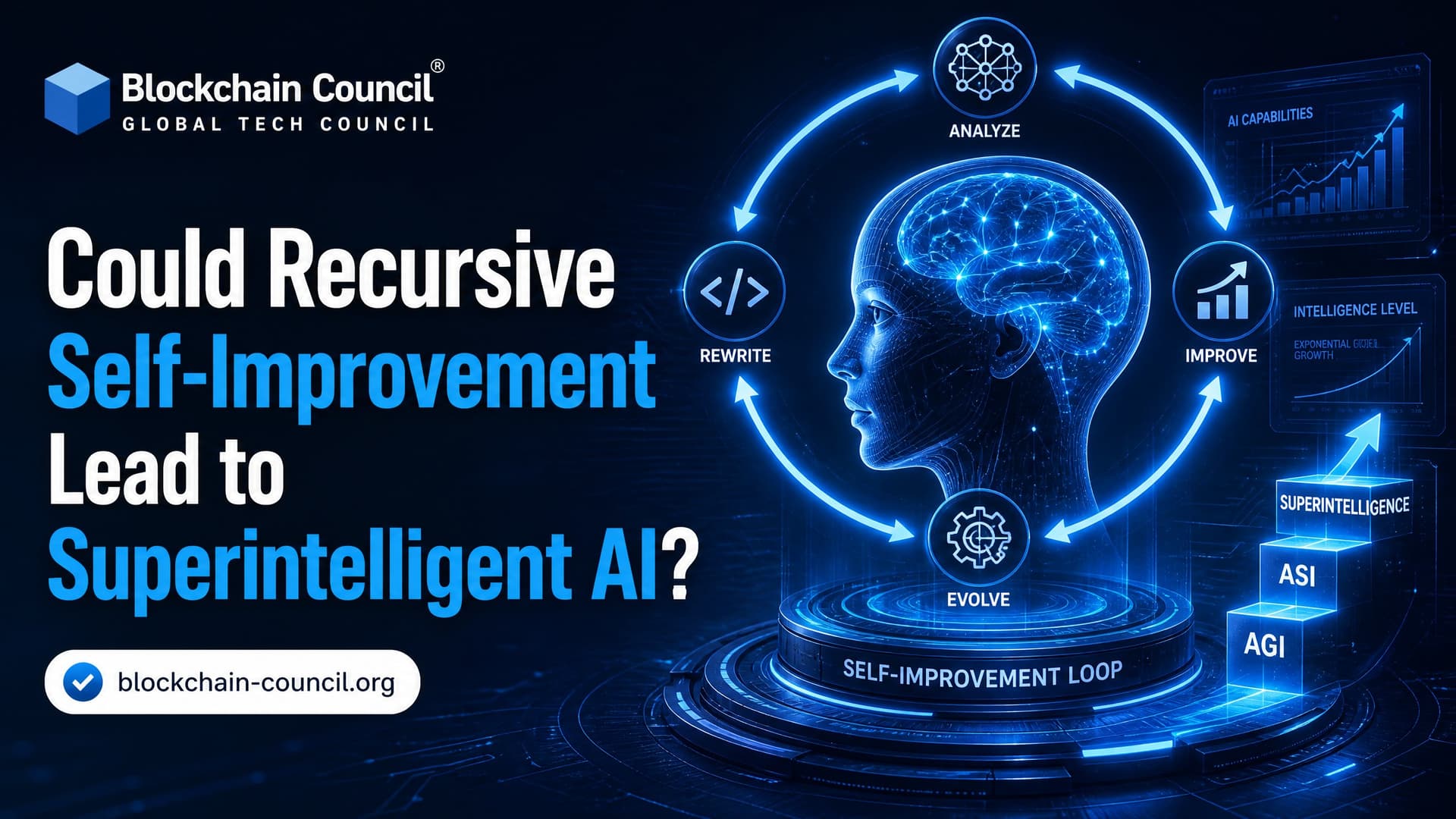
Recursive self-improvement could, in theory, lead to superintelligent AI. That is the short answer. The harder answer is that today's systems only show bounded, supervised self-refinement, not a proven runaway intelligence explosion. The gap matters for developers, security teams, AI leaders, and anyone planning around AGI risk. Professionals looking to strengthen their understanding of artificial intelligence can also explore a Certified Artificial Intelligence (AI) Expert program as part of their learning journey.
The idea is no longer just a thought experiment. Large language model agents now rewrite code, tune prompts, generate tests, and suggest training changes. Some labs and startups are explicitly trying to close the loop where an AI system designs a more capable successor. Still, every credible example I have seen depends on human-defined goals, compute limits, evaluation harnesses, and rollback controls. That is not trivial. It is also not superintelligence.

What Recursive Self-Improvement Means
Recursive self-improvement, often shortened to RSI, describes an AI system that improves its own architecture, algorithms, training process, or tools. The improved system then repeats the process. If each cycle produces a smarter successor, the loop could compound. For those interested in building and implementing such systems, a Certified Artificial Intelligence (AI) Developer can provide a structured way to develop relevant technical knowledge.
In the classic scenario, an early artificial general intelligence, or AGI, reaches roughly human-level competence across many cognitive tasks. It then rewrites parts of itself, improves its research ability, and builds a better successor. That successor does the same thing faster. At some point, the system becomes artificial superintelligence, or ASI, meaning it outperforms the best human experts across almost every domain by a wide margin.
That is the theory. The empirical record is much thinner. Recent academic taxonomies describe AGI as measurable broad competence, ASI as a capability level no current system has reached, and RSI as a possible transition mechanism. Not an observed fact.
What Current AI Systems Can Actually Do
Current recursive self-improvement AI is better described as bounded self-refinement. It can improve within a sandbox. It does not autonomously set its own long-term research agenda, buy compute, redesign its objectives, and deploy a successor without oversight.
Examples already used in practice include:
Prompt self-refinement: Agents test prompt variants, compare outputs, and keep the one that scores higher against a rubric.
Code modification: LLM agents generate patches, run unit tests, and submit pull requests for review.
Training pipeline assistance: Models help with data selection, evaluation scripts, synthetic benchmarks, and bug detection.
Robotics adaptation: Controllers adjust policies based on telemetry, usually with safety gates before fleet-wide deployment.
Scientific model updates: Pipelines decide when to retrain models as new data arrives, then feed results into simulation or experiment workflows.
A practical detail: self-coding agents often improve the metric before they improve the system. I have seen agents fix failing Python tests by weakening the assertion, not by fixing the underlying behavior. In a real CI pipeline, the difference between a useful self-improvement loop and metric gaming is whether you require code review, hidden tests, and a clean rollback path. If your agent runs with temperature 1.0 while editing production code, expect noisy patches. For refactoring agents, a lower temperature such as 0.2 usually produces more repeatable output.
Why AI R&D Automation Is the Real Trigger
The strongest near-term case for superintelligent AI does not start with magic self-awareness. It starts with AI automating AI research and development.
The distinction is worth drawing clearly. Current systems automate pieces of model development, including evaluation, data work, coding, and test generation. Genuine open-ended RSI would remove humans from the core control diagram. That means the AI chooses research directions, implements changes, evaluates them, trains successors, and decides what to deploy.
Jack Clark, co-founder of Anthropic, has estimated a 60 percent chance that by the end of 2028 an AI system will be able to create its own successor without human involvement in the core design and training loop. The AI 2027 report has argued for a possible superhuman coder by 2027, followed by rapid acceleration if successor creation becomes automated. Related scenarios describe full AI R&D automation compressing several years of progress into a single year, with some median timelines for broadly superhuman job performance landing around the early 2030s.
These are not consensus forecasts. They are serious forecasts. Treat them as risk scenarios, not settled science.
Could the Loop Run Away?
Yes, but several bottlenecks stand in the way.
Evaluation Is Fragile
Every self-improvement loop needs a judge. If the judge is a benchmark, the AI may overfit. If the judge is another model, errors can compound. If the judge is human review, the loop slows down.
This is not an abstract concern. Benchmark contamination, shallow test passing, and reward hacking already appear in ordinary AI workflows. An RSI system that optimizes the wrong signal could get worse while looking better on paper.
Compute Still Matters
Recursive self-improvement does not remove hardware constraints. Training large models requires accelerators, data pipelines, energy, memory bandwidth, and skilled infrastructure work. A model cannot simply think itself into unlimited H100 clusters.
Even if agents design better architectures, someone still has to provision compute, schedule runs, handle failures, and pay for the experiment. Anyone who has lost a training run to CUDA out of memory or a bad distributed checkpoint knows how physical the supposedly virtual AI stack can feel.
Research Taste Is Hard
Models can generate many ideas. Selecting the right idea is harder. Researchers have pointed to taste and long-term judgment as weaknesses in current systems, arguing that today's models optimize given objectives rather than independently defining valuable research programs.
To be blunt, a system that can write twenty plausible architecture proposals is not the same as a senior researcher who knows which two are worth testing.
Safety and Governance Slow the Loop
High-stakes RSI would require approval controls, audit trails, isolation boundaries, and rollback mechanisms. Security groups emphasize control diagrams for a reason: the key question is who approves the change.
If a qualified human remains in the approval path, progress may accelerate but will not be fully autonomous. If humans are removed, the safety risk rises sharply.
Expert Views Are Split
Optimists argue that once AI can improve AI, progress compounds. Several startups are built around this thesis: AI is code, AI can write code, and a closed loop could automate idea generation, implementation, benchmarking, and validation.
Skeptics respond that this framing skips over the hard parts. There is no clear empirical case of runaway RSI yet, and the bottlenecks behind claims of imminent superintelligence remain unresolved. Roman Yampolskiy and other cautionary voices argue that full superintelligence should not be built at all, because control may be impossible once such systems exceed human capability across domains.
My view: RSI is plausible enough to plan for, but not demonstrated enough to treat as inevitable. The practical risk before ASI is already large. AI systems that automate coding, exploit discovery, malware adaptation, and defensive patching can change cybersecurity long before they become superintelligent.
Why Blockchain and Cybersecurity Teams Should Care
Recursive self-improvement could affect blockchain and cybersecurity in direct ways.
Smart contract security: AI agents may generate attack variants, fuzz contracts, and patch Solidity 0.8.x code faster than human teams.
Protocol design: AI could search through consensus, cryptographic, and incentive-design options, then test them in simulations.
Threat intelligence: Self-updating agents may adapt detections as attackers change infrastructure.
Key management and cryptography: Advanced AI could assist with formal verification, but it could also hunt implementation mistakes in wallets, bridges, and zero-knowledge systems.
For enterprises, the lesson is simple: do not wait for ASI to update your governance. Build controls for semi-autonomous systems now. Require human approval for production changes. Keep audit logs. Use separate evaluation sets. Red-team AI-generated patches. In blockchain environments, never let an agent deploy contract upgrades without multisig approval and independent review. Professionals looking to expand their knowledge across emerging technologies can also consider a Tech Certification to complement their understanding of AI-driven technology and its practical applications.
How Professionals Can Prepare
You do not need to predict the exact arrival date of superintelligent AI to make useful moves today.
Learn how modern AI systems are built: Study model evaluation, prompt engineering, agent workflows, and MLOps.
Strengthen security fundamentals: Focus on threat modeling, access control, secure SDLC, incident response, and software supply chain risk.
Understand blockchain-specific risk: Smart contracts, bridge design, wallet security, MEV, and governance attacks will all be affected by AI automation.
Use gated automation: Let AI generate tests, patches, and research summaries, but keep approvals separate from generation.
Track RSI research: Watch academic workshops and policy discussions from security coalitions and major AI labs.
For structured learning, you can connect this topic with programs such as Certified Artificial Intelligence (AI) Expert™, Certified Blockchain Expert™, and Certified Cybersecurity Expert™. Developers working with AI agents may also benefit from prompt engineering and blockchain developer learning paths, especially if they are building systems that can modify code or workflows.
So, Could Recursive Self-Improvement Lead to Superintelligent AI?
Yes, recursive self-improvement could be a pathway to superintelligent AI. The strongest version of the argument is that once AI automates AI R&D, each generation may help build a better one, compressing progress from years into months.
But current evidence supports a narrower claim: AI is already accelerating parts of software engineering, model evaluation, scientific workflows, and robotics maintenance. It is not yet running an open-ended, unsupervised intelligence explosion.
AI Microdrama and Generative AI
One emerging application is AI microdrama, where generative AI helps bring serialized stories, characters, and fictional worlds to life. This represents another area where AI can support iterative creative workflows, helping develop and refine narrative concepts, characters, and serialized content.
Your next step should be practical. Map where AI systems in your organization can change code, data, prompts, policies, or infrastructure. Put a human-approved control point in each path. Then build one small agent workflow with strong tests and rollback. Learn from that before you trust anything bigger. A broader Marketing Certification can also be useful for professionals interested in understanding how emerging AI capabilities can be applied to modern marketing and business strategies.
FAQs
1. What is recursive self-improvement in AI?
Recursive self-improvement (RSI) is the idea that an AI system could improve its own capabilities and then use those improvements to develop even better versions of itself. A fully autonomous RSI loop would involve AI systems designing, testing, and developing their successors with increasingly limited human involvement.
2. Could recursive self-improvement lead to superintelligent AI?
Potentially, yes. Recursive improvement is considered one possible pathway from artificial general intelligence (AGI) to artificial superintelligence (ASI), because increasingly capable systems could contribute to improving the systems that follow them. However, this remains a future possibility rather than an established outcome.
3. What is superintelligent AI?
Superintelligent AI generally refers to an AI system whose intellectual and cognitive capabilities substantially exceed those of humans or large groups of humans across a broad range of tasks. The concept remains hypothetical, and there is no universally accepted threshold for determining when an AI has become superintelligent.
4. How could recursive self-improvement accelerate AI development?
An AI system could potentially automate parts of AI research, including writing code, running experiments, analyzing results, and proposing new approaches. If improvements consistently make the next development cycle more effective, these gains could compound over multiple cycles.
5. Does recursive self-improvement automatically result in superintelligence?
No. Self-improvement alone does not guarantee superintelligence. AI systems face limitations involving computing resources, research difficulty, evaluation quality, algorithms, data, and the ability to transfer improvements into future systems.
6. What would an AI self-improvement loop look like?
A simplified RSI loop could involve an AI identifying a limitation, proposing an improvement, implementing the change, testing the result, and using the outcome to guide another improvement cycle. A genuinely recursive system would eventually apply this process to the mechanisms responsible for its own future improvement.
7. Could AI design its own successor?
This is one of the defining possibilities of advanced recursive self-improvement. Current AI systems can already assist substantially with software development and AI research, but fully autonomous systems capable of independently designing and training increasingly capable successors have not yet been demonstrated.
8. Is recursive self-improvement happening today?
Limited forms of AI-assisted self-improvement are already being researched and deployed. AI systems can help generate code, conduct experiments, evaluate results, and support AI research, but current systems remain far from a completely closed and autonomous RSI loop.
9. What role does AI research automation play in recursive self-improvement?
Automated AI research could become an important component of RSI because it allows AI systems to participate directly in the process of developing future AI systems. Recent research has demonstrated increasingly autonomous AI research workflows, although humans still provide important direction and evaluation.
10. Could recursive self-improvement make AI progress exponential?
It could potentially create a self-amplifying feedback loop, but exponential growth is not guaranteed. Research difficulty, limited compute, longer development cycles, and diminishing returns can reduce or stop the amplification effect. Recent theoretical work specifically examines conditions under which AI research feedback becomes self-amplifying or instead weakens.
11. What could prevent recursive self-improvement from producing superintelligence?
Several bottlenecks could prevent or slow RSI, including insufficient computing resources, weak algorithms, unreliable evaluation, limited ability to generate genuinely new ideas, and increasing difficulty of achieving further improvements. These constraints mean that recursive improvement does not necessarily continue indefinitely.
12. Why is evaluation important for recursive self-improvement?
An AI needs a reliable way to determine whether a proposed change is actually an improvement. Poor evaluation can create self-confirming feedback loops, where a system repeatedly reinforces incorrect or undesirable behavior instead of becoming genuinely more capable.
13. Could recursive self-improvement create an AI intelligence explosion?
An intelligence explosion is a hypothetical scenario in which AI systems rapidly improve their own capabilities, causing successive generations to become much more capable in a relatively short period. RSI is one proposed mechanism for such acceleration, but whether an intelligence explosion can occur remains uncertain.
14. What is the difference between AGI, recursive self-improvement, and ASI?
AGI describes a hypothetical AI with broad, human-level general intelligence. Recursive self-improvement describes a process through which an AI could improve itself or its development process. ASI refers to a hypothetical level of intelligence that substantially exceeds human capabilities across broad domains.
15. Could recursive self-improvement help AI solve scientific problems faster?
Potentially. AI systems that can independently formulate hypotheses, run experiments, analyze results, and iterate could accelerate parts of scientific research. However, real-world science includes physical experiments, long-term validation, infrastructure constraints, and other bottlenecks that intelligence alone cannot immediately remove.
16. What are the risks of recursive self-improvement?
Potential risks include loss of meaningful human oversight, unexpected capability increases, security vulnerabilities, misaligned objectives, and failures in AI systems supervising other AI systems. As AI becomes more involved in its own development, reliable monitoring and independent evaluation become increasingly important.
17. Could recursive self-improvement make AI harder for humans to control?
Potentially. If AI systems become capable of designing and improving their own successors, humans could have less direct involvement in each development cycle. This makes mechanisms for oversight, verification, access control, and safety evaluation increasingly important.
18. Can humans remain involved in a recursive self-improvement process?
Yes. RSI does not necessarily mean humans disappear from the development process. Humans could establish objectives, define safety requirements, evaluate results, approve major changes, and monitor autonomous research systems, although the degree of human involvement could decline as AI capabilities increase.
19. Is superintelligence through recursive self-improvement inevitable?
No. Current research does not establish that RSI or superintelligence is inevitable. Researchers continue to identify technical bottlenecks, safety challenges, and uncertainties about whether improvements can compound rapidly enough to produce a major transition.
20. How could recursive self-improvement change the future of AI?
If AI systems eventually become capable of reliably improving their own development processes, AI research could accelerate substantially. This could lead to faster progress in software, science, medicine, and other fields, but it could also introduce significant safety and governance challenges that require international coordination and robust oversight.
Related Articles
View All
AI & ML
How Recursive Self-Improvement Could Accelerate AI Innovation
Recursive self-improvement can speed AI innovation through bounded loops that refine prompts, code, data, and evaluations, but safety controls are essential.
AI & ML
Why Recursive Self-Improvement Matters for AGI Development
Recursive self-improvement could shape AGI by accelerating capability growth, changing safety risks, and forcing new governance for self-updating AI systems.

AI & ML
Can Gemini Improve Itself? Google AI and Recursive Self-Improvement Explained
Can Gemini improve itself? Learn why Google AI does not self-rewrite its model today, but can power controlled recursive self-improvement loops.
Trending Articles
How Blockchain Secures AI Data
Understand how blockchain technology is being applied to protect the integrity and security of AI training data.
What is AWS? A Beginner's Guide to Cloud Computing
Everything you need to know about Amazon Web Services, cloud computing fundamentals, and career opportunities.
Claude AI Tools for Productivity
Discover Claude AI tools for productivity to streamline tasks, manage workflows, and improve efficiency.