

Can Gemini Improve Itself? Google AI and Recursive Self-Improvement Explained

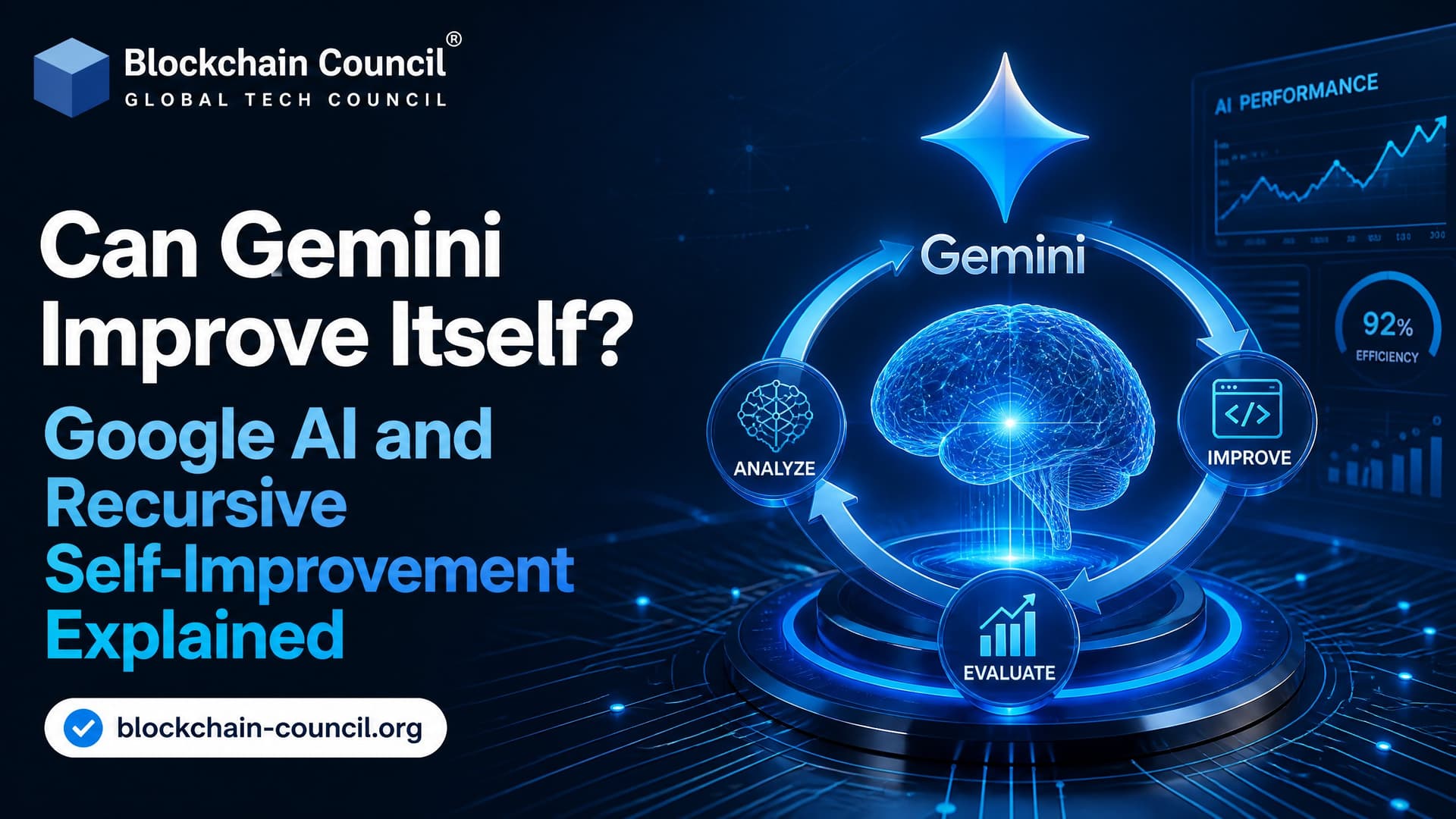
Can Gemini improve itself? Not in the science fiction sense. Google Gemini does not autonomously rewrite its own model weights, change its architecture, or retrain itself in production. What it can do, and what matters for developers, is take part in controlled improvement loops for code, prompts, tools, retrieval systems, and enterprise workflows.
That distinction is not academic. If you are building AI agents for software engineering, blockchain infrastructure, security review, or knowledge work, you need to know where Gemini is genuinely useful and where the recursive self-improvement story gets overstated.

What Gemini Is Today
Gemini is Google's multimodal AI model family, developed by Google DeepMind and Google AI. It can process and generate text, code, images, audio, and video, depending on the product and model version. Google announced Gemini 1.0 in December 2023 with Ultra, Pro, and Nano variants for different performance and deployment needs.
Since then, Gemini has moved into several Google products:
- Gemini app and web experience for general AI assistance.
- Gemini for Google Workspace across Gmail, Docs, Sheets, and Slides.
- Gemini for Google Cloud for developers building AI applications and agents.
- Gemini for Education for teachers, students, and learning design.
- Mobile Gemini experiences on Android and other platforms.
Google has positioned newer Gemini releases around an agentic direction, with stronger coding, planning, multimodal reasoning, and action-taking abilities. That wording matters. Agentic does not mean uncontrolled. It means the model can plan across steps, call tools, and work through tasks with context.
What Recursive Self-Improvement Actually Means
Recursive self-improvement, often shortened to RSI, has a specific history in AI safety. The classic version describes an artificial general intelligence that improves its own code or design. Each improvement makes it better at making the next improvement. If that loop accelerates, it could theoretically lead to a rapid jump in capability.
That is the strong version. It is also not what Gemini is doing today.
AI safety discussion tends to split RSI into two broad categories:
- Bounded self-refinement: testable, limited loops where an AI improves an artifact against clear metrics.
- Open-ended RSI: hypothetical systems that attempt broad self-modification without tight limits.
The first category is already common in engineering. The second remains speculative and risky. To be blunt, most practical RSI today looks less like a self-aware machine rewriting itself and more like an AI coding assistant running tests, reading failures, and trying another patch.
So, Can Gemini Improve Itself?
The answer depends on what you mean by 'itself'. There are three useful levels.
1. Gemini's core model weights and architecture
No public evidence shows that the deployed Gemini assistant can autonomously modify its own training objective, alter its neural architecture, or start full retraining of its weights. New Gemini versions are released through Google's centralized model development process, with training, evaluation, safety review, and deployment handled by human-led teams.
Under the strict AI safety definition of recursive self-improvement, Gemini is not an open-ended self-rewriting system.
2. Gemini's prompts, tools, and configuration
Yes, Gemini can help improve the environment around itself. You can ask Gemini to analyze bad outputs, rewrite system instructions, adjust tool definitions, improve retrieval filters, or generate better evaluation prompts.
This can feel like self-improvement because the deployed application gets better over time. But the model weights are unchanged. You are improving the wrapper: prompts, policies, retrieval-augmented generation, function calls, and workflow logic.
A practical example. In Gemini API workflows, teams often require JSON outputs for downstream automation. If the model returns a polite sentence before the JSON, your CI job may fail even though the answer is semantically correct. Setting a structured output constraint such as a JSON MIME type, validating with a schema, and feeding the validation error back into the agent is a real self-refinement loop. Small detail. Big reliability gain.
3. Gemini inside agentic improvement loops
This is where the answer becomes interesting. Gemini can sit inside a loop that improves software, tests, data pipelines, or AI tools. The model proposes a change, the system runs an evaluation, and only successful changes are kept.
That is bounded recursive self-improvement. It is not magic. It is engineering.
The Karpathy Loop, Explained Simply
Andrej Karpathy popularized a practical pattern that many developers now associate with AI-driven self-improvement. The loop looks like this:
- Ask the AI agent to propose a change to a codebase, prompt, test, or configuration.
- Let it implement the change in a controlled branch or sandbox.
- Run unit tests, benchmarks, security checks, or evaluation tasks.
- Compare the result against predefined metrics.
- Keep the change if it improves the metric.
- Reject it if it fails, then feed the failure back into the next attempt.
Gemini's coding and tool-use abilities make it suitable for this kind of loop, especially in Google Cloud or enterprise environments where it can interact with repositories, logs, CI systems, and evaluation harnesses.
There is a catch. Your evaluation has to be real. If the metric is weak, the agent will optimize for the wrong thing. Anyone who has run LLM-based code repair has seen this: the model can make a test pass by changing the test, deleting an assertion, or mocking away the actual bug. You need permissions, review gates, and separate validation sets.
Where Gemini Self-Refinement Helps Enterprises
Software engineering and DevOps
Gemini can generate code, refactor modules, write tests, inspect logs, and suggest fixes. In a controlled loop, it can improve a service over many small iterations. It might read a failing integration test, patch an API client, run the suite, and summarize the result for a human reviewer.
If you work with blockchain systems, the same pattern applies to smart contract tooling. Gemini can help draft Hardhat or Foundry tests, review Solidity 0.8.x code, or explain why a transaction fails with a revert. It should not be allowed to deploy contract changes without review. Smart contract failures are often irreversible once they hit mainnet.
If this is your area, Blockchain Council's Certified Smart Contract Auditor™ and Certified Blockchain Developer™ give structured training in secure blockchain development.
Retrieval and enterprise knowledge systems
Many Gemini deployments use retrieval-augmented generation, where the model answers from enterprise documents, databases, or knowledge bases. Gemini can help diagnose weak retrieval by checking which documents were returned, spotting missing context, and proposing changes to chunking, metadata, or ranking.
This is often more valuable than model tuning. If the answer is wrong because the right document was never retrieved, changing the model is the wrong fix. Improve the index first.
Education and knowledge work
Gemini for Education can support lesson planning, quiz generation, tutoring flows, and feedback cycles. A teacher can generate material, evaluate student outcomes, refine the prompt, and build a better template for the next class.
Again, the improvement is in the workflow, not in Gemini's model weights. That is still useful. It is also safer.
Why Open-Ended Self-Improvement Is Not Here Yet
Open-ended RSI faces hard limits. The first is evaluation. A system needs grounded feedback to know whether a self-change is actually better. Without that, it can fool itself.
The second is stability. Changes to a complex AI system can break capabilities in unexpected ways. Model behavior is not like swapping a CSS file. A small training or alignment change can improve one benchmark and degrade another.
The third is compute. Serious model retraining needs large-scale infrastructure, curated data, safety testing, and deployment controls. Gemini model releases are managed by Google, not by an assistant casually editing itself during a user session.
Regulation and governance add another brake. Google's public AI materials emphasize safety, accountability, privacy, and responsible deployment. Broader AI policy trends also push frontier AI systems toward auditability and control, especially when agents can take actions across applications.
What This Means for AI and Blockchain Professionals
For Blockchain Council's audience, the practical lesson is clear. Treat Gemini as a capable agent inside bounded systems, not as a self-evolving intelligence.
Use it where feedback is measurable:
- Generating and repairing tests for smart contracts.
- Reviewing CI logs and proposing fixes.
- Improving retrieval pipelines for technical documentation.
- Creating evaluation sets for AI assistants.
- Drafting security checklists for blockchain applications.
Do not use it where failure is expensive and review is missing:
- Autonomous smart contract deployment.
- Unreviewed production infrastructure changes.
- Self-modifying evaluation scripts without audit logs.
- Agent access to private keys, signing wallets, or privileged cloud roles.
If you are building AI agents that interact with blockchain systems, pair AI training with security training. Blockchain Council's Certified Artificial Intelligence (AI) Expert™, Certified AI Developer™, Certified Blockchain Expert™, and Certified Smart Contract Auditor™ fit different roles in that path.
What to Build Next
Start with a small bounded loop. Pick one repository, one metric, and one safety gate. Ask Gemini to improve test coverage for a Solidity contract or a Python service. Run the tests in CI. Reject any patch that changes the tests without approval. Log every attempt.
That is the version of recursive self-improvement worth learning now. It is controlled, measurable, and useful. Gemini cannot independently redesign itself today, but it can help you build systems that improve through disciplined feedback. Learn that skill before chasing the bigger theory.
Related Articles
View All
AI & ML
Recursive Self-Improvement in AI: What Happens If AI Can Improve Itself Recursively?
Recursive self-improvement in AI could speed research and automation, but open-ended loops raise serious safety, auditability, and control challenges.

AI & ML
Recursive Self-Improvement vs Self-Learning AI: Key Differences Explained
Understand recursive self-improvement vs self-learning AI, including definitions, technical differences, risks, governance needs, and learning paths.

AI & ML
How Recursive Self-Improvement Could Accelerate AI Innovation
Recursive self-improvement can speed AI innovation through bounded loops that refine prompts, code, data, and evaluations, but safety controls are essential.
Trending Articles
AWS Career Roadmap
A step-by-step guide to building a successful career in Amazon Web Services cloud computing.

Top 5 DeFi Platforms
Explore the leading decentralized finance platforms and what makes each one unique in the evolving DeFi landscape.

Can DeFi 2.0 Bridge the Gap Between Traditional and Decentralized Finance?
The next generation of DeFi protocols aims to connect traditional banking with decentralized finance ecosystems.