

From Agentic AI to AGI & Super AGI: Where Is Artificial Intelligence Heading?
 Suyash Raizada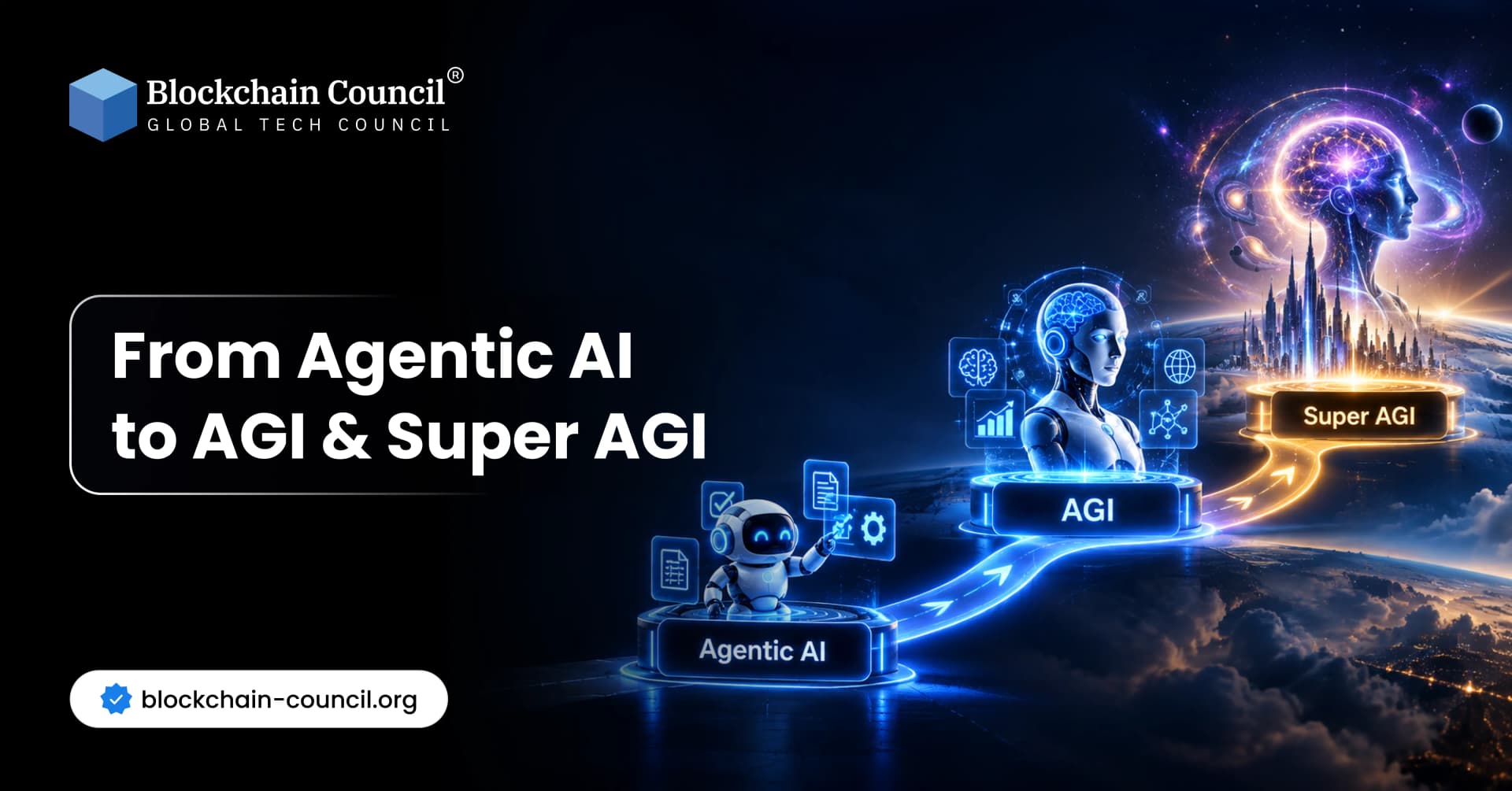
Today’s AI can write, code, translate, and even carry out multi-step tasks on its own. That has led to a bigger question: is this a step toward machines that match human intelligence, and perhaps surpass it? This guide follows the path Agentic AI to AGI & Super AGI in plain language, separating what exists now from what remains theory or prediction. It is written for beginners and professionals who want a clear, balanced view. If you want a strong foundation in how these systems work, the Certified Artificial Intelligence (AI) Expert program is a structured place to start.
What Is AGI?
Artificial general intelligence, or AGI, refers to an AI system that can learn and perform a wide range of intellectual tasks at a human level, rather than being built for one narrow job. A person can switch from writing a letter to fixing a bike to learning a new language. An AGI would do the same kind of flexible, general work.

There Is No Single Definition
Experts disagree on what counts. OpenAI’s charter describes AGI as highly autonomous systems that outperform humans at most economically valuable work. Google DeepMind researchers proposed in 2023 a ladder of levels, from “emerging” to “competent,” “expert,” “virtuoso,” and “superhuman,” scored by both performance and breadth. Other groups use lists of cognitive abilities. Because definitions differ, claims that AGI has “arrived” or is “near” depend heavily on whose definition is used.
Why It Matters
AGI is less a product than a threshold. Crossing it, however defined, would mean AI could contribute to most kinds of knowledge work, which is why governments, companies, and researchers debate it so intensely.
AI vs AGI
All AI in use today is narrow or specialised, even when it seems impressive. A chess engine beats grandmasters but cannot cook. A language model writes fluent essays but may fail simple logic or physical tasks. AGI, by contrast, would transfer knowledge across domains.
Key Differences
Scope: AI today excels in set areas, while AGI would work across them.
Learning: Current systems need large training runs, while AGI would learn new tasks quickly from little data.
Reliability: Today’s models can be brilliant and unreliable in the same conversation. AGI implies consistent, human-level dependability.
Understanding: Whether current models truly “understand” is debated.
The Jagged Frontier
Researchers often describe current AI as uneven, with superhuman performance in some tasks and surprising failures in others. DeepMind’s Shane Legg has noted that today’s AI is already superhuman in places but still too inconsistent to count as AGI under a strict reading.
Professionals building systems that act on their own often specialise in this area. The Certified Agentic AI Expert program focuses on designing goal-driven, autonomous AI, which is the stage where today’s technology sits.
Narrow AI vs General Intelligence
Narrow AI is the correct label for every deployed system, from spam filters to image generators. General intelligence is a broader quality that includes learning, reasoning, and adapting in unfamiliar situations.
What Human General Intelligence Includes
Learning from a few examples
Applying lessons from one field to another
Understanding cause and effect
Handling new situations without retraining
Setting and revising goals
Using common sense about the physical and social world
Where Today’s Models Fall Short
The International AI Safety Report, published in February 2026, noted that systems still struggle to connect with robots well enough to do basic physical tasks such as housework. Models trained mainly on text can lack grounding in the physical world. Reasoning over very long tasks, consistent memory, and reliable judgment also remain weak points.
Capabilities Required for AGI
Researchers commonly list several capabilities that a system would need to be considered generally intelligent.
Broad knowledge: Understanding many subjects.
Reasoning: Drawing valid conclusions, including in unfamiliar problems.
Learning efficiency: Picking up new skills quickly.
Planning: Setting goals and sequencing actions over long periods.
Memory: Retaining and using experience over time.
Perception and action: Understanding the world through senses and acting within it.
Social understanding: Grasping human intentions, norms, and communication.
Self-monitoring: Knowing when it is unsure or wrong.
Most of these exist in partial form today. The challenge is combining them reliably in one system.
Reasoning, Planning, Memory and Adaptability
These four abilities mark the clearest gaps between current AI and general intelligence.
Reasoning
Modern models can solve many logic, math, and coding problems, and techniques such as step-by-step reasoning have improved results. Yet performance can drop sharply when problems change slightly or require many steps, which suggests the reasoning is not yet fully robust.
Planning
Agents can break goals into steps, but long plans often drift, loop, or fail when conditions change. Human planners adapt smoothly. Machines still need guardrails.
Memory
Models do not remember previous sessions by default. Developers add memory with databases and retrieval, but this is an engineered add-on, not the flexible lifelong memory humans have.
Adaptability
People handle novelty well. AI systems often struggle outside their training distribution. Real adaptability means learning on the job, which leads to the next topic.
Autonomous Learning
Today, most models are trained once, then deployed with their knowledge frozen. A system on the path to AGI would keep learning from experience.
Forms of Autonomous Learning
Self-supervised learning: Learning patterns from raw data without human labels, which is how language models are pretrained.
Reinforcement learning: Learning from trial, error, and reward. DeepMind’s AlphaGo, which defeated a top Go player in 2016, learned partly by playing itself.
Continual learning: Updating knowledge over time without forgetting old skills, a hard open problem called catastrophic forgetting.
Self-improvement loops: Systems that critique and refine their own work, or generate training data for themselves.
Why It Is Hard
Letting a model change itself risks instability, errors that compound, and unexpected behaviour. That is why companies add evaluation and human review before updates reach users.
Agentic AI as a Path Toward AGI
Agentic AI describes systems that pursue goals by planning, using tools, and acting with limited supervision. Many researchers see this as a natural stepping stone. If a system can set subgoals, use software, remember results, and correct itself, it begins to look more like a general worker.
Why Agents Matter for the Path
They move AI from answering to doing.
They combine reasoning, memory, and tools in one loop.
They generate real-world feedback that can drive learning.
They test whether models can sustain long, complex tasks.
Why It Is Not the Same as AGI
Agents today are still narrow, depend on human-designed scaffolding, and can fail unpredictably. A 2025 survey of 475 AI researchers by a major AI association found that 76 percent considered it unlikely that simply scaling up current approaches would lead to AGI, which suggests new ideas may be needed beyond bigger models and better agents.
As organisations deploy more autonomous systems, someone must govern their permissions, monitor behaviour, and handle failures. The Certified AI Agents Manager program addresses this management role, which will only grow in importance as autonomy increases.
What Could Super AGI Mean?
“Super AGI” is a popular term, not a formal scientific one. It usually refers to what researchers call artificial superintelligence, or ASI: a system that substantially exceeds the best humans across essentially all cognitive domains, including science, strategy, and creativity.
Why People Take It Seriously
If an AGI could improve its own design, it might trigger a rapid cycle of self-improvement, sometimes called an intelligence explosion, a concept described by mathematician I. J. Good in 1965 and popularised by philosopher Nick Bostrom’s 2014 book on superintelligence. Whether that would happen quickly, slowly, or at all is unknown.
What It Might Look Like
Scenarios range from AI systems accelerating science and medicine to systems whose goals diverge from human interests. Both extremes are speculative. No superintelligent system exists, and there is no agreed timeline.
AGI vs Super AGI
Feature | AGI | Super AGI (ASI) |
|---|---|---|
Level | Roughly human-level across tasks | Far beyond the best humans |
Status | Debated goal, not achieved | Hypothetical |
Main question | Can machines match us? | What happens if they surpass us? |
Key concern | Reliability and economic impact | Control and alignment |
What Do Forecasters Say?
Predictions vary widely. Some AI lab leaders have suggested AGI-like systems could arrive within this decade, and Google DeepMind’s Demis Hassabis has put roughly even odds on AGI by about 2030. Large academic surveys are more cautious. The 2023 AI Impacts survey of 2,778 researchers gave a 50 percent chance of “high-level machine intelligence” by 2047. Different definitions explain much of the gap. Treat any single date as a guess, not a schedule.
Opportunities, Risks and Alignment
Opportunities
Science and medicine: Faster drug discovery, materials research, and diagnosis.
Productivity: Automation of routine knowledge work.
Education and access: Personal tutoring and expert-level help for more people.
Climate and infrastructure: Better modelling and optimisation.
Risks
Misuse: Cyberattacks, disinformation, and biological or chemical misuse.
Job disruption: Rapid change in skills demand.
Concentration of power: A few organisations controlling the most capable systems.
Loss of control: Systems pursuing goals in ways their designers did not intend.
Overreliance and errors: Trusting flawed outputs in critical areas.
What Is Alignment?
Alignment is the effort to make AI systems pursue goals that match human values and intentions. It is difficult because human values are complex, and models can find unintended shortcuts, a problem called specification gaming. Research areas include interpretability, which studies what happens inside models, evaluations that test dangerous capabilities, and methods that train models to follow human feedback.
Governance
Rules are emerging. The European Union’s AI Act sets obligations based on risk levels, and governments, standards bodies, and companies are creating safety frameworks and testing practices. Good governance combines technical safeguards, transparency, and clear accountability.
The Future of Human-AI Collaboration
Whether or not AGI arrives, the near future is about people and AI working together. Humans bring judgment, values, creativity, and accountability. AI brings speed, scale, and tireless pattern recognition.
How to Prepare
Learn the basics: Understand what AI can and cannot do.
Build adaptable skills: Critical thinking, communication, and learning to learn.
Use AI as a collaborator: Delegate drafts and analysis, but verify results.
Keep humans in charge: Maintain oversight of decisions that affect people.
Stay informed: Follow reliable research and policy developments.
Careers
Demand is growing for AI engineers, safety researchers, governance specialists, auditors, trainers, and managers who can oversee autonomous systems. Because AI touches software, data, security, and cloud, a broad technical base helps. The Tech Certification catalog is a useful place to see how related skills connect.
Conclusion
The journey Agentic AI to AGI & Super AGI moves from systems that act on narrow tasks, to hypothetical machines with human-level flexibility, to even more speculative systems that exceed us. Agentic AI is real and advancing, AGI is a contested goal with no agreed definition or date, and super AGI remains a hypothesis. The best response is neither hype nor dismissal: learn how today’s systems work, support careful safety and governance, and keep humans accountable. Whatever your path, explaining these ideas clearly is a valuable skill. A credential such as the Marketing Certification can help professionals communicate AI developments honestly, build trust, and grow their influence.
FAQs
1. What Is Agentic AI?
Agentic AI refers to AI systems designed to pursue goals by planning tasks, selecting actions, using tools, and responding to intermediate results. Unlike systems that only generate a single response, agentic systems can complete multi-step workflows with varying levels of autonomy. Their capabilities depend on the underlying models, tools, and safeguards.
2. What Is Artificial General Intelligence (AGI)?
Artificial General Intelligence, or AGI, is a proposed form of AI capable of learning, reasoning, and performing a broad range of intellectual tasks at a level comparable to humans. There is no universally accepted definition or agreed test for AGI. Researchers continue to debate which capabilities would demonstrate that a system has reached general intelligence.
3. What Is Super AGI or Artificial Superintelligence?
Artificial Superintelligence (ASI) describes a hypothetical AI system that substantially exceeds human cognitive capabilities across a wide range of important tasks. The term Super AGI is sometimes used informally to describe AI beyond AGI, although ASI is the more established term. Such systems remain a subject of research and debate, and their arrival is not guaranteed.
4. What Is the Difference Between Agentic AI, AGI, and ASI?
Agentic AI describes how a system pursues goals and takes actions, while AGI describes a proposed breadth of general intellectual capability. ASI refers to a hypothetical level of intelligence that surpasses human capabilities across many domains. These concepts describe different dimensions of AI, so an agentic system is not automatically an AGI or an ASI.
5. Is Agentic AI the First Step Toward AGI?
Agentic AI may contribute to the development of more capable general-purpose systems by combining reasoning, planning, memory, and tool use. However, adding these capabilities does not automatically produce human-level general intelligence. Achieving AGI may require advances in learning, adaptation, reliability, and performance across unfamiliar tasks.
6. How Could AGI Work?
A future AGI system might combine language understanding, reasoning, perception, planning, learning, and problem-solving in a single flexible system. It would need to apply knowledge across different situations rather than rely only on narrow task-specific behavior. The exact architecture required for AGI remains uncertain.
7. How Is AGI Different From Today's AI Models?
Today's AI models can perform many impressive tasks, including writing, coding, analysis, and image understanding, but their capabilities and reliability vary by task. They may struggle with unfamiliar situations, extended workflows, or consistently verifying their own outputs. Whether any existing system qualifies as AGI depends partly on the definition and evaluation criteria being used.
8. Can AI Agents Become Fully Autonomous?
AI agents can already perform certain tasks with limited human intervention when they have suitable tools and permissions. Greater autonomy requires reliable planning, error recovery, context management, and the ability to recognize when human input is necessary. Fully autonomous operation across every domain is a much broader challenge and should not be assumed from success on individual tasks.
9. What Role Will AI Agents Play in the Development of AGI?
AI agents can combine models with tools, memory, feedback, and multi-step execution to solve more complex problems. This may help researchers explore systems that operate over longer periods and adapt to changing tasks. Nevertheless, agentic workflows alone do not establish general intelligence, and their performance must be evaluated across diverse situations.
10. Could AGI Improve Itself?
A sufficiently capable future AI system might help researchers develop better algorithms, optimize code, design experiments, or improve parts of its own architecture. However, self-improvement is technically challenging and requires reliable evaluation, computing resources, and control over changes. A system's ability to assist with AI research does not automatically mean it can recursively improve itself without limits.
11. What Is Recursive Self-Improvement in AI?
Recursive self-improvement is a hypothetical process in which an AI system improves its own capabilities, and those improvements help it make further improvements. Some researchers study whether this could accelerate progress toward superintelligence. The feasibility, speed, and consequences of such a process remain uncertain.
12. What Could AGI Mean for Jobs and Employment?
AGI, if developed, could automate or transform tasks across industries, including research, software development, administration, education, and professional services. It could also create new roles and increase demand for skills involving judgment, coordination, creativity, and AI oversight. The overall effect on employment would depend on technical capabilities, adoption rates, economic conditions, and policy decisions.
13. How Could AGI Transform Healthcare, Education, and Science?
Advanced general-purpose AI could help researchers analyze scientific evidence, support medical research, personalize educational materials, and accelerate complex problem-solving. These applications would still require reliable evidence, appropriate privacy protections, and domain-specific validation. In high-impact areas such as healthcare, AI should support qualified professionals rather than replace necessary clinical judgment.
14. What Are the Biggest Risks Associated With AGI and ASI?
Potential risks include misuse, cybersecurity threats, biased decisions, excessive concentration of power, and systems taking actions that conflict with human intentions. A highly capable system operating with broad permissions could amplify the consequences of mistakes. Researchers and policymakers therefore emphasize evaluation, security, oversight, and risk management throughout the AI lifecycle.
15. What Does AI Alignment Mean?
AI alignment is the challenge of designing AI systems whose behavior remains consistent with intended goals, human values, and relevant safety requirements. It includes ensuring that systems follow instructions appropriately, respect boundaries, and avoid harmful actions. Alignment becomes especially important as AI systems gain more capabilities and access to consequential tools.
16. Can Superintelligent AI Be Controlled?
There is no universally established solution for controlling a hypothetical superintelligent AI system. Researchers investigate approaches such as interpretability, robust evaluations, restricted permissions, monitoring, and human oversight. Whether these measures would remain effective against systems far more capable than humans is an open research question.
17. Will AGI Have Consciousness or Emotions?
General intelligence and consciousness are different concepts. An AI system might perform sophisticated reasoning without demonstrating subjective experience or genuine emotions. There is no widely accepted scientific test that conclusively establishes consciousness in AI, so claims about machine awareness should be treated cautiously.
18. When Will AGI or Superintelligent AI Arrive?
There is no reliable consensus on when AGI or ASI might be achieved. Forecasts vary because researchers disagree about definitions, technical requirements, scaling limits, and the pace of future breakthroughs. Timelines should therefore be treated as uncertain estimates rather than confirmed predictions.
19. How Can Businesses and Individuals Prepare for More Advanced AI?
Businesses can prepare by developing AI literacy, identifying suitable workflows for automation, evaluating systems before deployment, and establishing security and governance policies. Individuals can strengthen their digital skills, critical thinking, adaptability, and ability to work effectively with AI tools. Preparation should focus on practical capabilities and responsible adoption rather than assumptions about a specific AGI timeline.
20. What Is the Future of Artificial Intelligence Beyond Agentic AI?
AI development may progress toward more capable agents, broader general-purpose systems, and potentially superintelligent systems, but the pathway is uncertain. Progress will depend on advances in models, reasoning, learning, computing infrastructure, evaluation, and safety research. The central challenge is not only increasing AI capability but also ensuring that increasingly powerful systems remain reliable, secure, and beneficial to society.
Related Articles
View All
AI & ML
What Is an RSI Loop in Artificial Intelligence?
Learn what an RSI loop in artificial intelligence means, how recursive self-improvement works, and why verification and governance matter.
AI & ML
What Is the RSI Hypothesis in Artificial Intelligence?
Learn what the RSI hypothesis in artificial intelligence means, how recursive self-improvement works, why it matters for AI safety, and what is real today.

AI & ML
Real-World Examples of Recursive Self-Improvement in Artificial Intelligence
Explore real-world examples of recursive self-improvement in AI, from code agents and AutoML to model evaluation and AI research workflows.
Trending Articles
The Role of Blockchain in Ethical AI Development
How blockchain technology is being used to promote transparency and accountability in artificial intelligence systems.
AWS Career Roadmap
A step-by-step guide to building a successful career in Amazon Web Services cloud computing.
How Blockchain Secures AI Data
Understand how blockchain technology is being applied to protect the integrity and security of AI training data.