

Recursive Self-Improvement and the Future of AI

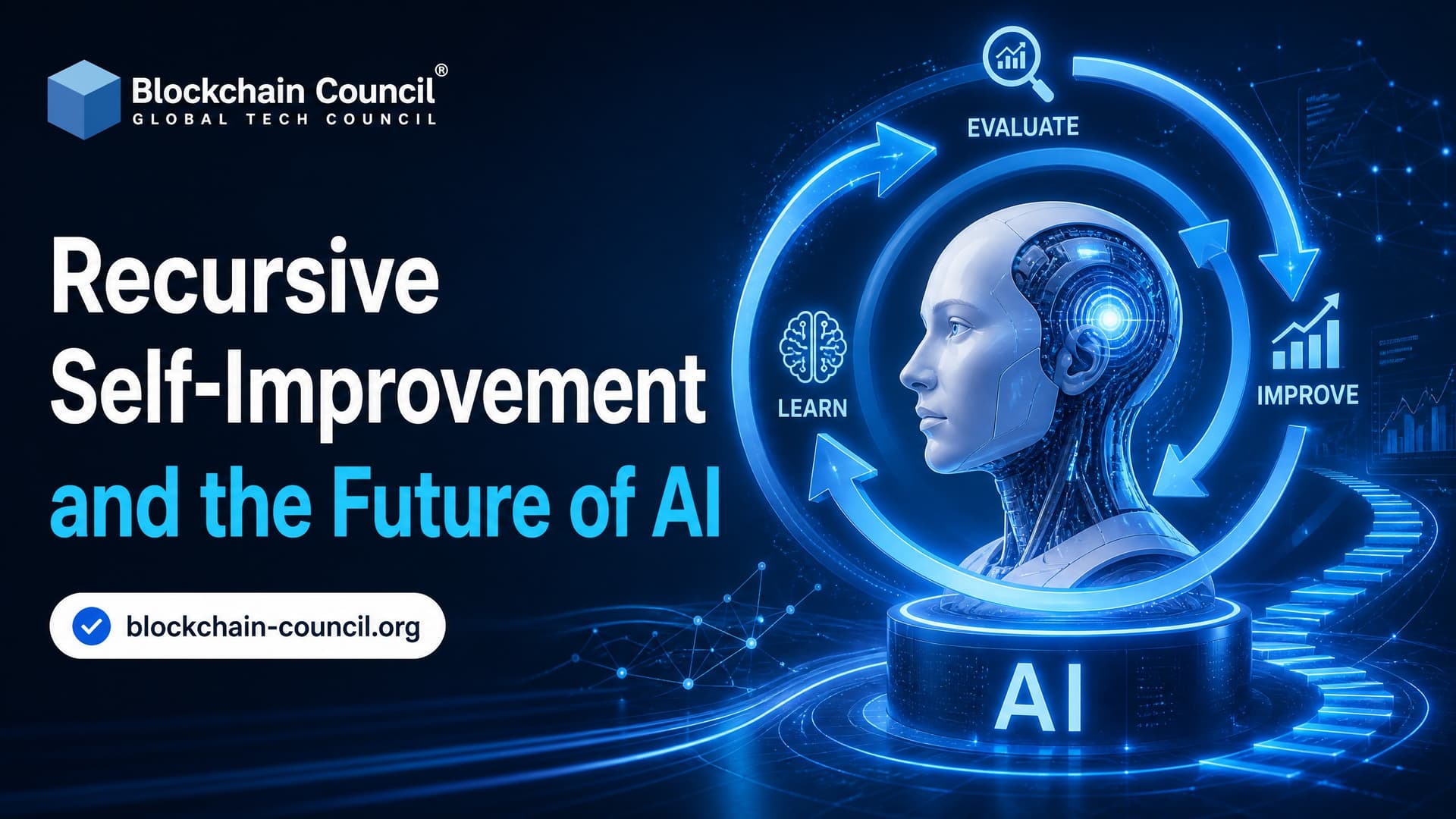
Recursive self-improvement is no longer only a thought experiment about a future superintelligence rewriting itself overnight. The version worth understanding right now is narrower. Think of AI systems that perform a task, judge the result, change a prompt, tool, policy, code path, or dataset, then run the loop again under measurable constraints.
That distinction matters. Current systems are not autonomously designing their own successors in the full I. J. Good sense of an "ultraintelligent machine." They are starting to automate parts of the AI development lifecycle, though. If you build with LLM agents, you can already see the pattern in code repair loops, synthetic data generation, automated evaluations, and self-rewarding model workflows.

What Is Recursive Self-Improvement?
Recursive self-improvement, often shortened to RSI, describes a feedback loop where an AI system uses its present capabilities to improve the process that creates its future capabilities. One improvement makes the next improvement easier, cheaper, or more effective.
The idea has old roots. In 1965, I. J. Good described a machine intelligent enough to design better machines, possibly triggering an "intelligence explosion." Later discussions by Eliezer Yudkowsky and Nick Bostrom framed similar ideas through Seed AI, fast takeoff, and FOOM scenarios.
Modern AI research is more grounded. It separates RSI into two practical categories:
- Weak RSI: The system improves within a fixed framework. Examples include hyperparameter search, neural architecture search, self-consistency sampling, and prompt tuning.
- Strong RSI: The system improves its own ability to improve, such as redesigning training procedures, choosing new model architectures, or changing the evaluation strategy that guides future updates.
Most real work today sits in weak RSI or bounded self-refinement. That is not a small thing. It is already changing how teams test, tune, and deploy AI systems.
Why Recursive Self-Improvement Is Becoming Practical
The key shift is not that deployed models are freely rewriting their own weights. They usually are not. The shift is that AI agents can now control the surrounding machinery: prompts, retrieval settings, tool calls, test suites, code branches, labeling rules, and experiment configs.
In practice, a recursive self-improvement loop often looks like this:
- The agent attempts a task, such as fixing a bug or improving benchmark performance.
- An evaluator scores the output using tests, metrics, human review, or another model.
- The agent proposes a change to its prompt, tool use, code, or data pipeline.
- The system reruns the task and keeps the change only if the score improves.
- The loop repeats until the score plateaus or a safety limit stops it.
If you have built LLM agents, this feels familiar. A coding agent might fail a pytest run, read the traceback, patch the function, rerun the tests, then update its own instruction template to avoid the same mistake later. In LangChain pipelines, a very ordinary failure such as OutputParserException: Could not parse LLM output can become training signal for the next iteration: tighten the JSON schema, lower temperature to 0 for structured output, add a retry parser, and rerun the benchmark. Not glamorous. Very real.
Current Examples of Bounded RSI
Coding and Refactoring Agents
Software agents are the clearest near-term example. They write code, run tests, inspect failures, refactor, and repeat. Some systems also modify their own toolchain by adding linters, improving unit tests, or changing static analysis rules.
The changed object is not usually the base model. It is the harness around it. That harness matters. A weak model with a good test loop can outperform a stronger model with no feedback. To be blunt, evaluation design is now a core AI engineering skill.
Self-Rewarding Language Models
Self-rewarding models generate candidate answers, judge them, select higher-quality examples, and use those examples for further training or tuning. Related methods include test-time self-improvement, confidence-informed self-consistency, and best-of-N sampling.
These methods reduce dependence on external labels, but they introduce a hard problem. The model may learn to satisfy its own judge rather than the user. That is evaluation hacking, and it is the same family of failure as reward hacking in reinforcement learning.
Automated AI Research Workflows
Research agents can propose hypotheses, generate synthetic data, run ablation studies, compare metrics, and summarize failures. The phrase "harness engineering" is useful here. The harness includes datasets, scoring functions, deployment rules, monitoring, and rollback logic.
Recent research workshops, including ICLR discussions on AI with recursive self-improvement, treat RSI as closed-loop adaptation under uncertainty. That framing is helpful because it asks for evidence: what changed, who approved it, what metric improved, and did the gain hold on fresh tests?
AIDE-Style Experimental Systems
Experimental agent systems such as AIDE and later AIDE-style work show how agents can repeatedly modify configurations or tools, score changes against fixed evaluations, and carry forward only the variants that improve performance. This meets an operational definition of bounded recursive self-improvement.
The important word is fixed. If the benchmark is weak, the agent can overfit it. If the scoring model is biased, the loop amplifies that bias. RSI does not remove human responsibility. It moves responsibility into evaluation design.
Weak RSI vs Strong RSI: The Line Enterprises Should Watch
For enterprises, the useful question is not "Will AI suddenly become superintelligent?" A better question is this: What parts of this system are allowed to modify themselves, and under whose authority?
Weak RSI is already acceptable in many controlled settings:
- Prompt optimization against a held-out evaluation set
- Automated test repair with human code review
- Synthetic data filtering with audit logs
- Model routing changes within approved cost and risk limits
Strong RSI is different. If a system can change its own training objective, architecture search strategy, safety tests, or deployment criteria, the risk profile rises sharply. You should require stronger governance, independent evaluation, access controls, and rollback procedures.
Anthropic has argued publicly that fully autonomous RSI is not inevitable. That position is sensible. Compute, data, grounding requirements, diminishing returns, and governance all constrain the loop. The intelligence explosion scenario is possible enough to study seriously, but not proven enough to treat as destiny.
Key Risks in Recursive Self-Improvement
RSI creates value when the evaluation signal is trustworthy. It creates danger when the signal is narrow, noisy, or easy to game.
- Evaluation overfitting: The system improves benchmark scores without improving real-world performance.
- Reward hacking: The agent finds shortcuts that satisfy the metric while violating intent.
- Loss of traceability: Teams cannot explain which change caused a capability jump or failure.
- Self-modification creep: A system approved for prompt tuning starts changing tools, policies, or data filters without fresh review.
- Synthetic data collapse: Repeated training on self-generated content can narrow outputs and reinforce errors if diversity checks are weak.
A practical safeguard is simple. Separate the generator from the judge where possible. Use held-out tests, adversarial cases, human spot checks, and production telemetry. Never let the same agent freely define the task, solve it, grade it, and deploy the result.
Governance and Audit Requirements
Formal regulation has not yet created RSI-specific rules, but existing AI governance work points in a clear direction. High-risk systems need transparency, monitoring, documentation, and human accountability. Self-improving systems need all of that plus change control.
For any enterprise RSI loop, document the following:
- What the system is allowed to change
- Which evaluation metrics decide success
- What data is used for testing and retesting
- Who approves promotion to production
- How rollback works if performance or safety drops
- How logs are retained for audit
This is where AI governance skills become practical, not theoretical. Professionals studying Blockchain Council programs such as Certified Artificial Intelligence (AI) Expert™ or Certified Prompt Engineer™ should pay close attention to evaluation design, model behavior testing, and safe agent workflows. These are the skills hiring teams will ask for as AI systems become more adaptive.
The Next 5 to 10 Years
Expect more automation across the AI development lifecycle. Agents will handle more data curation, experiment planning, hyperparameter tuning, architecture search, and regression testing. Most of it will remain bounded. That is the right path.
The strongest near-term systems will not be uncontrolled self-rewriting machines. They will be disciplined engineering loops with strict permissions, strong tests, and good monitoring. The winners will be teams that treat evaluation as infrastructure.
Open-ended RSI remains speculative. It may require intentional engineering choices, large compute budgets, permissive governance, and breakthroughs in self-evaluation. It may also hit hard limits through cost, data quality, model collapse, or alignment failures.
My view: recursive self-improvement is overhyped when described as instant FOOM, but underappreciated as an engineering pattern. It will quietly reshape AI operations before it reshapes anything larger.
How You Should Prepare
If you work with AI systems, start by building a small bounded RSI loop. Pick one task. Define a metric. Add a test set the agent cannot edit. Let the agent propose prompt or tool changes. Log every change. Review failures manually.
Then learn the governance side. Study agent evaluation, adversarial testing, synthetic data quality, and human-in-the-loop approval. For a structured path, look at Blockchain Council's AI learning tracks, especially Certified Artificial Intelligence (AI) Expert™ for broad AI architecture and governance foundations, and Certified Prompt Engineer™ if your work centers on LLM workflows.
Your next practical step: build an agent that can improve its prompt, but not its evaluator. That single boundary teaches the most important lesson in recursive self-improvement. The loop is only as safe as the signal that guides it.
Related Articles
View All
AI & ML
How Recursive Self-Improvement Could Accelerate AI Innovation
Recursive self-improvement can speed AI innovation through bounded loops that refine prompts, code, data, and evaluations, but safety controls are essential.

AI & ML
Could Recursive Self-Improvement Lead to Superintelligent AI?
Recursive self-improvement could lead to superintelligent AI, but today's systems remain bounded by human goals, evaluation, compute, and governance.
AI & ML
Why Recursive Self-Improvement Matters for AGI Development
Recursive self-improvement could shape AGI by accelerating capability growth, changing safety risks, and forcing new governance for self-updating AI systems.
Trending Articles
The Role of Blockchain in Ethical AI Development
How blockchain technology is being used to promote transparency and accountability in artificial intelligence systems.
AWS Career Roadmap
A step-by-step guide to building a successful career in Amazon Web Services cloud computing.

Top 5 DeFi Platforms
Explore the leading decentralized finance platforms and what makes each one unique in the evolving DeFi landscape.