

Top Tools to Learn AI Security: Open-Source Frameworks for Adversarial ML, Red Teaming, and Monitoring
 Suyash Raizada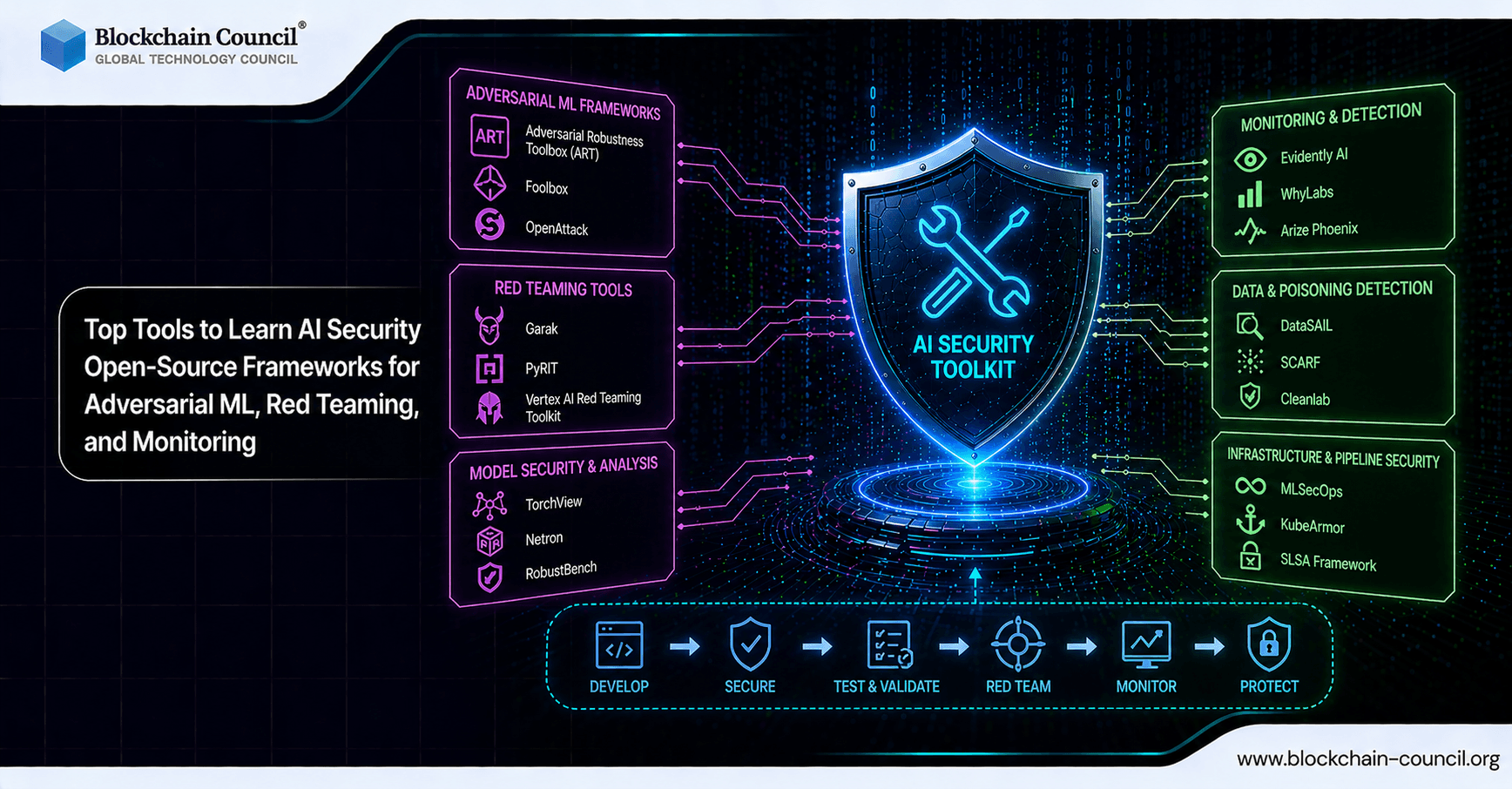
Top tools to learn AI security increasingly center on three practical skills: adversarial machine learning (AdvML) testing, red teaming through adversary emulation, and continuous monitoring using threat frameworks and datasets. The most effective way to build competence is to practice with open-source frameworks that let you reproduce real attacks, measure model robustness, and map findings to operational security frameworks like MITRE ATT&CK and MITRE ATLAS.
This guide organizes the most widely used open-source options and explains what each tool teaches you, how it fits into an AI security workflow, and where it performs best for TensorFlow, PyTorch, and common ML pipelines.

Learning AI security tools requires practical exposure-start with an AI Security Certification, build projects using a Python Course, and explore real-world applications via an AI powered marketing course.
Why Open-Source Tools Matter for Learning AI Security
AI security extends well beyond secure coding and access control. Practitioners also need to understand how models fail under adversarial pressure, how attackers can extract or infer sensitive data, and how AI systems can be exploited through their surrounding infrastructure.
Open-source AI security tools accelerate learning because they provide:
Reproducible attacks such as evasion, poisoning, extraction, and inference tests.
Benchmarks and metrics to quantify robustness and compare defenses.
Threat mapping to translate ML-specific issues into security team language using ATT&CK and ATLAS.
Automation for repeatable assessments that can run in CI pipelines or test labs.
Category 1: Adversarial ML Tools (Attacks, Defenses, and Evaluation)
Adversarial ML frameworks teach you how models break and how to systematically measure resilience. If your goal is hands-on robustness evaluation, start here.
Adversarial Robustness Toolbox (ART)
Adversarial Robustness Toolbox (ART) is widely regarded as one of the most comprehensive libraries for AdvML. It supports multiple attack classes, including evasion, poisoning, model extraction, and inference attacks, alongside defenses and evaluation utilities. ART is designed to work across major ML frameworks such as TensorFlow, Keras, PyTorch, MXNet, and scikit-learn, and it supports multiple data types including images and tabular data, as well as broader modalities like audio and video.
What ART is best for learning:
End-to-end robustness workflows: run an attack, apply a defense, then measure robustness metrics.
Cross-framework practice: compare behaviors across TensorFlow and PyTorch implementations.
Production-oriented evaluation: assess attacks that mirror real risk, such as extraction or inference.
Practical tip: Use ART to establish a baseline robustness score for a model, then re-run tests after changes to preprocessing, training, or defenses. This reinforces the principle that ML security is iterative, not a one-time exercise.
CleverHans
CleverHans is a well-established AdvML library associated with foundational research in adversarial examples and maintained by recognized researchers in the field. It is commonly used to test the rigor of adversarial attacks and build intuition around why certain perturbations succeed.
What CleverHans is best for learning:
Core adversarial example concepts and canonical attack implementations.
Research-oriented experimentation when you want to understand the mechanics behind attacks.
Foolbox
Foolbox offers an extensive range of adversarial attacks with a strong focus on computer vision use cases. For practitioners learning AI security through image classifiers, Foolbox provides a direct path to experimenting with many attack methods and comparing their effectiveness.
What Foolbox is best for learning:
Attack diversity for vision models and quick comparisons across methods.
How attack choice affects outcomes under different constraints and threat models.
AdverTorch and AdvBox
AdverTorch and AdvBox are additional options frequently used for building adversarial examples and experimenting with common attack patterns, particularly in PyTorch-centric workflows. Both tools are useful for targeted learning or for extending attacks in custom research setups.
Category 2: Red Teaming Tools (Adversary Emulation and ATT&CK Mapping)
Red teaming in AI security covers both classic infrastructure testing and AI-specific abuse scenarios. The tools below help you emulate attacker behavior in a way defenders can measure and improve against.
MITRE CALDERA
MITRE CALDERA is an adversary emulation platform that automates intrusion-like behaviors aligned to MITRE ATT&CK. While it is not specific to ML, it is highly relevant for AI systems because AI deployments rely on data pipelines, APIs, identity management, cloud services, and endpoints. CALDERA helps you practice how adversaries move through environments that host AI services.
What CALDERA is best for learning:
Automated adversary emulation for repeatable testing.
Operationalizing ATT&CK into controlled exercises.
Testing security controls around AI infrastructure, not only the model itself.
Atomic Red Team
Atomic Red Team provides small, portable tests mapped to ATT&CK techniques. It is especially useful when you want focused validation of detections on Windows, macOS, and Linux without building complex scenarios.
What Atomic Red Team is best for learning:
Detection engineering basics with fast feedback loops.
Technique-level testing to validate telemetry and alerting.
Stratus Red Team (Cloud-Focused)
Stratus Red Team focuses on cloud attack simulation, with strong relevance for teams running AI workloads on AWS. It simulates realistic cloud exploitation patterns, helping practitioners understand where AI security commonly breaks in practice: IAM misconfigurations, storage exposure, and misconfigured services.
What Stratus Red Team is best for learning:
Cloud attack paths that can lead to model theft, data exposure, or pipeline compromise.
Hands-on cloud security aligned to how AI is deployed today.
Red Team Automation (RTA) and Additional Simulation Tools
Red Team Automation (RTA) supports simulation across many ATT&CK tactics, enabling controlled execution of behaviors that defenders can detect and tune against. Other tools used for routine assessments include host and network testing options and specialized simulations such as ransomware behavior or privilege escalation scenarios.
Category 3: Monitoring, Threat Frameworks, and Datasets
Learning AI security requires practice in detection and continuous monitoring, not only attack execution. The following tools and frameworks help you structure threats and validate monitoring pipelines.
MITRE ATLAS (Adversarial Threat Landscape for AI Systems)
MITRE ATLAS serves as an ATT&CK-style knowledge base for AI-specific threats, shaped through ongoing industry and research collaboration. It helps security analysts and ML practitioners share a common language about attacks on AI systems, covering both model-level and pipeline-level tactics.
What ATLAS is best for learning:
Threat modeling for AI using a structured, security-friendly taxonomy.
Mapping tests to threats so results become actionable for security programs.
Mordor (Datasets for Detection and Hunting)
Mordor provides datasets, often in JSON event formats, that teams can use to validate hunting playbooks, reduce false positives, and test analytics. While not limited to AI, it is valuable for AI security because effective monitoring depends on reliable telemetry and tested detection logic across endpoints, pipelines, and cloud services.
Counterfit
Counterfit helps practitioners explore how AI systems can be probed and attacked in a security assessment context. For learners, it complements AdvML tools by framing AI attack surfaces beyond classical image perturbations, particularly when AI models are embedded in larger applications.
URET (Universal Robustness Evaluation Toolkit)
URET is a robustness evaluation approach that models evasion as graph exploration and uses configuration files to run tests across different scenarios. It supports text, tabular data, and broader ML settings, making it useful for practitioners whose real-world models extend beyond vision classifiers.
What URET is best for learning:
Config-driven robustness testing that reflects how security teams operationalize assessments.
Non-vision robustness for tabular and NLP workflows common in enterprise settings.
MLsploit (Cloud-Based Experimentation Across Modalities)
MLsploit supports experimentation across different modalities and security scenarios, including research use cases such as malware classification bypass and image classification testing. It is useful for building intuition about how adversarial techniques differ across domains and deployment environments.
How to Build a Learning Roadmap with These Tools
A structured progression helps new practitioners build depth and avoid shallow, one-off experiments.
Start with robustness basics (ART or Foolbox)
Pick one model and one dataset.
Run multiple evasion attacks and record metrics.
Apply a defense and re-measure.
Add threat mapping (MITRE ATLAS)
Translate your experiments into threats, tactics, and mitigations.
Document assumptions about attacker goals and constraints.
Expand to system-level security (CALDERA, Atomic Red Team)
Test AI hosting environment controls: endpoints, identity, secrets, and logging.
Validate detections using technique-level tests.
Operationalize monitoring (Mordor datasets)
Use datasets to validate detection logic and reduce false positives.
Build repeatable queries and alerts aligned to known threats.
Go beyond vision (URET, MLsploit)
Test tabular and text models commonly used in fraud, risk, and security analytics.
Compare robustness strategies across modalities.
Skills These Tools Help You Demonstrate
Used together, these open-source tools help practitioners build evidence of practical AI security competence, including:
Robustness evaluation with documented attack coverage and metrics.
Red team exercises mapped to ATT&CK techniques, including cloud scenarios.
Threat modeling for AI systems using ATLAS-aligned terminology.
Monitoring validation through datasets and repeatable detection tests.
To master adversarial ML and red teaming tools, combine expertise with an AI Security Certification, deepen knowledge via a machine learning course, and understand use cases through a Digital marketing course.
Conclusion
The most effective tools for learning AI security are those that let you practice realistic adversarial ML attacks, run repeatable red team exercises, and validate monitoring and detection through threat frameworks and datasets. ART, CleverHans, Foolbox, and related AdvML libraries build model-level intuition. CALDERA, Atomic Red Team, and cloud-focused tools like Stratus Red Team teach infrastructure security and adversary emulation. ATLAS, Mordor, and evaluation toolkits like URET help you structure threats and measure resilience in a form security teams can act on.
The most durable path to competence is to treat AI security as a full lifecycle discipline: test the model, test the environment, map results to frameworks, and continuously monitor and improve.
FAQs
1. What are AI security tools?
AI security tools are software frameworks used to test, monitor, and protect machine learning systems. They help identify vulnerabilities and improve model robustness. Many are open-source and widely used.
2. Why should you learn AI security tools?
AI systems are increasingly targeted by attacks like data poisoning and prompt injection. Learning these tools helps you detect and prevent risks. It also improves your ability to build secure models.
3. What are popular open-source tools for adversarial ML?
Popular tools include IBM Adversarial Robustness Toolbox (ART), CleverHans, and Foolbox. These frameworks simulate adversarial attacks. They help evaluate model resilience.
4. What is IBM Adversarial Robustness Toolbox (ART)?
ART is an open-source library for testing and defending against adversarial attacks. It supports multiple ML frameworks. It is widely used for security research and testing.
5. What is CleverHans in AI security?
CleverHans is a library focused on benchmarking adversarial attacks and defenses. It provides standardized implementations. This helps researchers compare results.
6. What is Foolbox used for?
Foolbox is a Python library for generating adversarial examples. It supports various attack methods. It is useful for testing model vulnerabilities.
7. What tools are used for LLM red teaming?
Tools include prompt testing frameworks and evaluation harnesses. These tools simulate jailbreak and injection attacks. They help identify weaknesses in language models.
8. What is red teaming in AI security tools?
Red teaming tools simulate real-world attacks on AI systems. They test how models respond to adversarial inputs. This improves system resilience.
9. What are monitoring tools for AI security?
Monitoring tools track model performance and detect anomalies. They identify unusual behavior or drift. This helps maintain system security over time.
10. How do evaluation harnesses support AI security?
Evaluation harnesses run structured tests across multiple scenarios. They measure performance and safety metrics. This ensures consistent testing.
11. What is the role of logging tools in AI security?
Logging tools record system activity and model outputs. They help track issues and investigate incidents. Detailed logs improve accountability.
12. Are there tools for detecting data poisoning?
Yes, anomaly detection and data validation tools can identify suspicious data. These tools monitor training datasets. They help prevent poisoning attacks.
13. What programming languages are used with AI security tools?
Most tools are built using Python due to strong ML ecosystem support. Libraries integrate with frameworks like TensorFlow and PyTorch. Python is the standard choice.
14. Can beginners use open-source AI security tools?
Yes, many tools provide documentation and examples for beginners. They offer easy setup and tutorials. Learning gradually helps build expertise.
15. How do these tools help in real-world applications?
They simulate attacks, monitor systems, and validate models. This helps organizations secure AI deployments. Practical testing improves reliability.
16. What are the limitations of AI security tools?
Tools may require technical expertise and computational resources. They may not cover all attack scenarios. Continuous updates are needed to stay effective.
17. How can developers choose the right AI security tools?
Developers should consider use cases, compatibility, and ease of use. Testing multiple tools can help identify the best fit. Requirements vary by project.
18. What is the role of open-source in AI security?
Open-source tools promote transparency and collaboration. They allow researchers to share and improve security methods. This accelerates innovation.
19. How often should AI security tools be used?
They should be used regularly during development and deployment. Continuous testing helps identify new vulnerabilities. Frequent use improves security posture.
20. What is the future of AI security tools?
AI security tools will become more automated and integrated into workflows. They will support real-time monitoring and advanced testing. Adoption will grow as AI systems expand.
Related Articles
View All
AI & ML
OpenAI Launches GPT-6.1 Terra: What’s New?
OpenAI has launched GPT-6.1 Terra, a faster and cheaper mid-tier model with stronger computer use, better image understanding and fewer errors. See what is new, what it costs, and who can use it.

AI & ML
Built to Catch AI Cheating: Rethinking Pre-Employment Assessments with HireValid
Explore how HireValid is rethinking pre-employment assessments with AI-resistant test design, integrity signals, candidate evidence, and human review to address AI-assisted cheating.

AI & ML
AI-Era Hiring Needs AI-Proof Tests: How HireValid Is Redefining Talent Assessment
Explore how HireValid is rethinking talent assessment for the AI era with job-relevant tests, anti-cheating design, integrity signals, and human-reviewed evidence of candidate ability.
Trending Articles
AWS Career Roadmap
A step-by-step guide to building a successful career in Amazon Web Services cloud computing.
Claude AI Tools for Productivity
Discover Claude AI tools for productivity to streamline tasks, manage workflows, and improve efficiency.
How to Install Claude Code
Learn how to install Claude Code on macOS, Linux, and Windows using the native installer, plus verification, authentication, and troubleshooting tips.