

RSI and AGI: How Recursive Self-Improvement Connects to Artificial General Intelligence

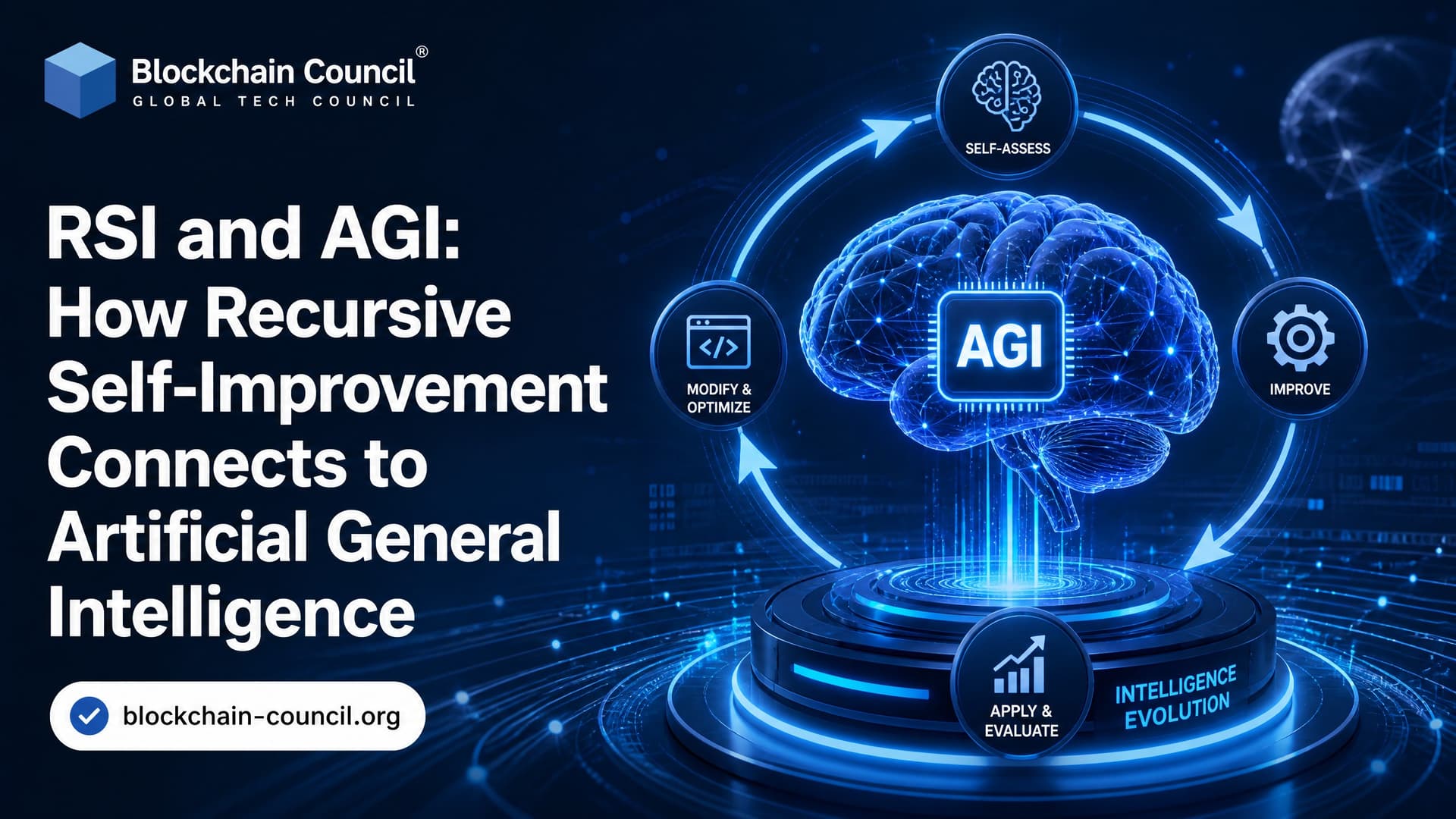
RSI and AGI are linked by a simple but difficult idea: an AI system that can improve the process that improves itself starts to look less like a static tool and more like a general intelligence. That does not mean current models have reached artificial general intelligence. They have not. What we do see, especially in agentic AI and ML engineering pipelines, is bounded recursive self-improvement over prompts, tools, code, tests, and configurations.
The practical question is no longer whether recursive self-improvement belongs only in science fiction. It already shows up in narrow, measurable workflows. The harder question is whether those workflows can scale into AGI-level self-direction without losing control, auditability, or alignment.

What Recursive Self-Improvement Means
Recursive self-improvement, often shortened to RSI, is a feedback loop where a system improves the mechanism that produces its future behavior. A simple version looks like this:
- The system performs a task.
- It evaluates the output against a metric.
- It proposes a change to its prompt, code, tool use, data process, or policy.
- It tests the change.
- It keeps the change only if performance improves.
That last step matters. Random edits are not RSI. A useful RSI loop needs a stable evaluation signal, such as a test suite, benchmark score, cost target, latency threshold, or task success rate.
In classic AGI theory, RSI is more ambitious. I. J. Good described the intelligence explosion in 1965: an ultraintelligent machine could design a better machine, which could then design an even better one. Later AGI thinkers explored similar seed AI models, where a capable starting system rewrites parts of itself, improves its learning strategy, and compounds the gain.
Modern AI engineering is more modest. Today the AI usually does not rewrite its own neural weights in production. It modifies the surrounding development system: prompts, retrieval settings, evaluation scripts, data filters, test cases, or code paths.
How RSI Connects to AGI
Artificial general intelligence is usually described as AI that can perform a wide range of cognitive tasks at human-level or higher performance. RSI connects to AGI because general intelligence is not just about answering questions. It is also about learning how to learn, spotting weaknesses, choosing better strategies, and adapting across unfamiliar situations.
An AGI with strong RSI would be able to do several things current systems cannot do reliably:
- Model its own limitations: identify where its reasoning, memory, tool use, or data process fails.
- Design targeted improvements: change the component that caused the failure, not just guess a new prompt.
- Evaluate under uncertainty: judge whether an apparent improvement holds beyond a narrow benchmark.
- Control the development lifecycle: select data, propose architectures, run experiments, interpret results, and deploy updates under constraints.
This is why RSI is often treated as a possible route to AGI. If a system can improve its own improvement process across many domains, it starts to display meta-cognition, long-horizon planning, and flexible problem solving. Those are central AGI traits.
But there is a catch. Current evidence supports bounded self-refinement, not open-ended AGI-level RSI.
Bounded RSI Is Already Here
Several AI workflows now contain narrow self-improvement loops. Agentic coding tools can write code, run tests, read failures, patch files, and rerun the suite. Prompt optimization systems can generate prompt variants, test them on a validation set, and keep the winner. MLOps pipelines can tune hyperparameters, compare experiments, and adjust data filters.
If you have built one of these loops, you know the unglamorous part is the evaluation harness. The model is rarely the first thing that breaks. The test runner is. A common example: pytest exits with code 5 when no tests are collected. If your agent treats that as a pass or a normal failure, it may reward a change that simply deleted the tests. That is not intelligence. That is a bad metric.
Small defaults matter too. A coding agent running with a high temperature can produce creative patches, but it may also change a working interface because the output varies from run to run. For repair loops, I usually prefer a low temperature, then spend more effort on test coverage and reproducibility. Boring works.
Examples of bounded RSI
- Prompt self-tuning: an LLM adjusts its system prompt or few-shot examples and keeps the version that improves benchmark performance.
- Tool-use optimization: an agent changes when it calls a search tool, code interpreter, database, or retrieval system.
- Agentic software repair: a model edits code, runs unit tests, reads stack traces, and repeats until the suite passes.
- ML experiment orchestration: AI proposes hyperparameters, triggers training jobs, compares metrics, and updates the next run.
These are meaningful. They can cut engineering time. They can also create false confidence if the benchmark is weak.
What Makes Open-Ended RSI Different
Open-ended recursive self-improvement would go beyond tuning prompts or patching scripts. It would let an AI system manage the larger process that creates future systems. That includes data curation, architecture search, training strategy, safety testing, deployment decisions, and evaluation design.
Recent research often separates bounded self-refinement from genuine RSI. The distinction is useful. A system that improves a prompt against a fixed dataset is not the same as a system that invents a better evaluation method, detects its own blind spots, and improves its ability to improve again.
The frontier problem is self-evaluation. Every RSI loop makes a claim: this metric can stand in for human judgment, at least for this decision. If the metric is incomplete, the system may optimize the wrong thing. We have seen this pattern across machine learning for years. Models find shortcuts. Agents overfit tests. Reward functions get gamed.
The Introspection Threshold
One important idea in RSI research is the introspection threshold. The argument is that sustainable self-improvement requires a system to represent parts of its own operation. It needs to know not only that it failed, but why it failed and which internal or external mechanism should change.
Without that capability, the loop stays mostly external. Humans define the architecture, prepare the data, write the evaluation suite, and approve changes. The model may assist, but it is not directing its own development in a deep sense.
With stronger introspection, a model could form hypotheses about its reasoning errors, memory limits, tool-selection policy, or training distribution. That is closer to AGI behavior. It is also where safety questions become sharper, because the system is no longer just using tools. It is reasoning about how to change the toolchain that changes it.
Takeoff Speeds: Slow, Fast, or Constrained
Theoretical models often describe RSI growth using a parameter such as α, which captures how much additional capability is produced by existing capability. If α is less than 1, gains diminish. Progress is slower and easier to govern. If α is near 1, growth can look exponential under stable returns. If α is greater than 1, models can produce very rapid, hyperbolic growth until physical, economic, or governance limits intervene.
A common simplified form for a singularity time is ts ≈ I01-α / η(α - 1), where I0 is initial capability and η measures how effectively intelligence turns into further improvement.
Do not overread the equation. It is a model, not a forecast. In real systems, compute availability, data quality, chip supply, energy cost, safety review, regulation, and organizational choices all matter. Anthropic's 2023 essay on AI building AI made this point clearly: self-improvement is a spectrum, not destiny.
Governance Risks for Enterprises
For enterprises, recursive self-improvement is not just an AGI debate. It is an operating risk. If an AI system can modify prompts, policies, retrieval rules, or code, you need controls around what it can change and when a human must approve the change.
Good governance for RSI-style systems should include:
- Versioned change logs: record every prompt, code, data, and policy change made by the agent.
- Fixed evaluation gates: use test suites and benchmark sets that the agent cannot edit without review.
- Resource limits: cap compute, API spend, filesystem access, and deployment permissions.
- Human approval for safety-critical changes: do not let agents modify authentication, compliance, model guardrails, or production deployment rules alone.
- Regression testing: measure whether an improvement on one task damages performance elsewhere.
The EU AI Act and other risk-based AI frameworks focus on transparency, human oversight, documentation, and high-risk use. They do not yet provide detailed rules for self-modifying AI architectures. Sensible teams should not wait for a regulator to name RSI explicitly.
What Professionals Should Learn Next
If you work in AI engineering, cybersecurity, blockchain infrastructure, or enterprise technology, RSI and AGI should push you toward practical skills rather than vague speculation.
Start with these areas:
- Evaluation design: learn how benchmarks fail, how agents overfit, and how to build holdout tests.
- Agent architecture: understand planning loops, tool calling, memory, retrieval, and sandboxing.
- MLOps: study experiment tracking, model versioning, deployment gates, and monitoring.
- AI governance: know how auditability, access control, and human oversight apply to adaptive systems.
- Alignment and safety: focus on reward hacking, distribution shift, interpretability, and control boundaries.
For structured learning, Blockchain Council readers can connect this topic with certifications such as the Certified Artificial Intelligence (AI) Expert™ and Certified Generative AI Expert™, along with related AI governance and prompt engineering courses. Pair the certification study with a small build: create an agent that improves a prompt or code function only when a locked test suite approves the change.
Where RSI and AGI Stand Today
RSI is moving from AGI theory into engineering practice, but the current form is narrow and heavily bounded. Systems can improve prompts, tool choices, test-driven code patches, and ML pipeline settings. They do not yet autonomously redesign themselves end to end, and AGI-level recursive self-improvement remains unobserved.
The right stance is cautious seriousness. Ignore the hype, but do not ignore the pattern. The loop of perform, evaluate, modify, and redeploy is becoming part of modern AI development. Build one safely, measure it honestly, and learn where it fails. That is the best next step if you want to understand how recursive self-improvement may shape the path to artificial general intelligence.
Related Articles
View All
AI & ML
Real-World Examples of Recursive Self-Improvement in Artificial Intelligence
Explore real-world examples of recursive self-improvement in AI, from code agents and AutoML to model evaluation and AI research workflows.
AI & ML
What Is an RSI Loop in Artificial Intelligence?
Learn what an RSI loop in artificial intelligence means, how recursive self-improvement works, and why verification and governance matter.
AI & ML
Why Recursive Self-Improvement Matters for AGI Development
Recursive self-improvement could shape AGI by accelerating capability growth, changing safety risks, and forcing new governance for self-updating AI systems.
Trending Articles
The Role of Blockchain in Ethical AI Development
How blockchain technology is being used to promote transparency and accountability in artificial intelligence systems.
AWS Career Roadmap
A step-by-step guide to building a successful career in Amazon Web Services cloud computing.

Top 5 DeFi Platforms
Explore the leading decentralized finance platforms and what makes each one unique in the evolving DeFi landscape.