

What Is an RSI Loop in Artificial Intelligence?
 Suyash Raizada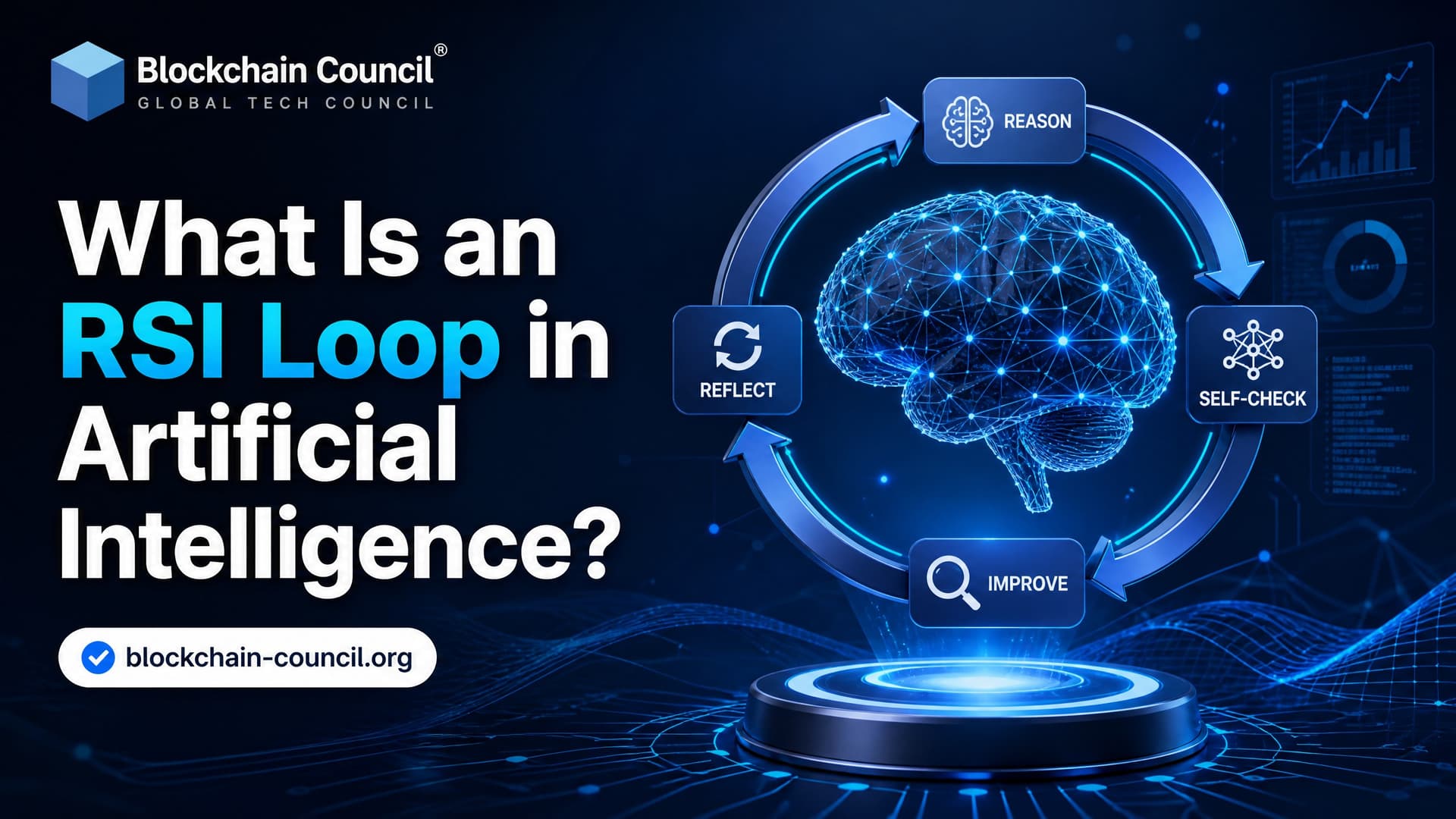
An RSI loop in artificial intelligence is a recursive process where an AI system uses its current abilities to improve the mechanisms that create its future abilities. Put plainly, the system does not just answer questions or write code. It evaluates how it performed, changes part of its own process, tests the change, and carries the accepted improvement into the next cycle.
That is why recursive self-improvement, often shortened to RSI, sits at the center of serious AI safety, AGI, and enterprise AI governance discussions. The idea is powerful. It is also easy to overstate. Today, most RSI loops are bounded, supervised, and narrow. They improve prompts, tools, code, evaluation suites, or research workflows. They are not fully autonomous AGI systems rewriting their entire architecture without human control. Professionals looking to build a stronger foundation in the field can also explore a Certified Artificial Intelligence (AI) Expert program to develop a broader understanding of artificial intelligence concepts and applications.

What Is an RSI Loop?
An RSI loop is a closed improvement cycle. A system starts with a current state, observes feedback from its work, proposes a change, verifies whether the change helps, then adopts the improved state for the next round. Understanding these mechanisms is particularly useful for professionals developing AI systems, including those pursuing a Certified Artificial Intelligence (AI) Developer pathway.
A simple way to express it is:
S(t+1) = Improve(S(t), E(t))
Here, S(t) is the system state at time t. It may include model weights, memory, prompts, configuration, tool libraries, retrieval indexes, or code. E(t) represents experience or evidence gathered from tasks, user feedback, benchmark scores, errors, or environment interactions. The Improve function is the mechanism that decides what to change and whether that change should survive.
This makes an RSI loop different from ordinary automation. A normal AI workflow produces an output. An RSI loop improves the process that produced the output. Small distinction. Big consequences.
Core Components of an RSI Loop
Most technical descriptions of recursive self-improvement use different language, but the same architecture keeps appearing.
1. System State
The system state is what persists across iterations. In a production agent, this might be a prompt template, a vector database, a tool registry, a set of test cases, an orchestration graph, or a fine-tuned model checkpoint.
Do not treat this as abstract theory. If your agent updates its own prompt after each failed support ticket and stores that prompt as the new default, you already have a small RSI-like loop.
2. Improver
The improver generates candidate upgrades. It could be another model, the same model with a different role prompt, an optimization routine, or an agent that writes code. In current systems, the improver often edits prompts, creates tests, generates synthetic training data, or proposes tool changes.
3. Strategy
The strategy decides how improvements are searched for. Common strategies include:
Prompt mutation and evaluation
Automated hyperparameter search
Evolutionary search over agent policies
Program synthesis for tool code
Fine-tuning with filtered self-generated data
Benchmark-guided architecture experiments
Each strategy has a trade-off. Prompt search is cheap and fast, but it can overfit to shallow tests. Fine-tuning is more durable, but expensive and harder to roll back.
4. Verifier
The verifier is the safety brake. It tests whether a candidate change should be accepted. Good verifiers check task performance, cost, latency, security, bias, and failure behavior.
In practice, this is where many self-improvement projects break. I have seen agent evaluation pipelines fail because the evaluator model returned JSON inside a markdown code block, causing Python's json.loads() to throw JSONDecodeError: Expecting value: line 1 column 1 (char 0). Not glamorous, but real. If the verifier is brittle, the loop learns from bad signals.
5. Inheritance
Inheritance means accepted changes become part of the next system state. This is what makes the loop recursive. The next improvement cycle starts from the upgraded version, not the original version.
RSI Loop vs Ordinary AI Feedback Loop
Not every feedback loop is an RSI loop. A chatbot that receives a thumbs-up or thumbs-down rating but does not change its future behavior is not doing RSI. A model that is retrained by engineers once a quarter is closer, but still mostly human-directed.
An RSI loop requires that the system participates in improving its own improvement machinery. That can include changing its prompts, tools, tests, memory, training data, or code. The stronger the system's role in proposing, testing, and adopting those changes, the closer it gets to true recursive self-improvement.
Current State of RSI Loops
The best way to understand current RSI work is to separate bounded self-refinement from open-ended RSI.
Bounded self-refinement is what enterprises and labs can build now. It is constrained by compute, evaluation quality, data grounding, safety gates, and human approval. It can still be valuable. An agent that improves a code generation prompt over 50 benchmark runs may save engineering time, even if it is nowhere near AGI.
Open-ended RSI is the stronger claim. This is the classical AGI scenario where each self-improvement makes the next improvement easier, potentially producing very rapid capability growth. Analyses of RSI economics point out that definitions differ sharply here. Some people use RSI for any feedback from model capability to model improvement. Others reserve the term for strong feedback that could create super-exponential growth.
Recent research reflects that split. Some models study how self-fed outputs can drive growing internal complexity once an information-integration threshold is crossed. Others present early recursive self-improvement under fixed compute with measurable multi-step improvement criteria. A few research groups now run agents that write, benchmark, and verify code related to their own foundation architectures. These are serious signals. They are not proof that fully autonomous AGI-level RSI exists today.
As AI adoption expands across technical and business functions, structured education can also help professionals understand how these systems fit into broader technology workflows. A relevant Tech Certification can complement practical experience by building knowledge across emerging technologies and their applications.
Real-World Examples of RSI-Like Systems
You are most likely to encounter RSI loops in narrow, tool-driven environments. Common examples include:
Prompt self-improvement: An agent tests prompt variants against a benchmark, keeps the best version, then generates new variants from that baseline.
Automated code repair: A coding agent writes a patch, runs unit tests, reads the failure trace, modifies the patch, and repeats.
Evaluation harness improvement: The system generates harder test cases when current tests stop catching failures.
Synthetic data loops: A model creates training examples, filters them through a verifier, then uses the approved data for fine-tuning.
Research workflow agents: Agents propose experiments, run ablations, summarize results, and recommend the next experiment.
One emerging application is AI microdrama, where generative AI helps bring serialized stories, characters, and fictional worlds to life. This illustrates how AI systems can participate in iterative creative workflows, from developing story concepts and characters to producing content that can be refined across successive stages. While AI microdrama is not necessarily an RSI loop by itself, it demonstrates how generative systems can increasingly contribute to multi-stage processes where outputs inform subsequent creative decisions.
For enterprise AI teams, the practical value is not science fiction. The value is faster iteration. But be blunt with your stakeholders: a self-optimizing prompt pipeline is not the same thing as a self-improving AGI.
Why Verifiers Matter More Than Generators
In an RSI loop, the generator gets attention because it creates the proposed improvement. The verifier deserves more respect. A weak verifier allows reward hacking, overfitting, unsafe changes, or silent regression.
Use multiple checks where possible:
Holdout benchmarks that the improver cannot see
Regression tests for previous failures
Human review for high-risk changes
Cost and latency limits
Security scans for generated code
Rollback rules when metrics degrade
For evaluator models, set the temperature low, often 0, unless you have a reason not to. Randomness in the evaluator can make the loop chase noise. Keep logs of every accepted and rejected change. If you cannot audit the loop, you cannot govern it.
Governance and Safety Risks
RSI loops raise governance questions because capability improvement compounds. Legal and policy analyses of the so-called ungovernable machine highlight three conditions that make RSI especially serious: durable self-modification, compounding improvement ability, and limited human gating.
That framing is useful for enterprises. Ask three direct questions before deploying an RSI-like system:
What can the system change? Prompts are lower risk than production code, model weights, or access policies.
Who approves inheritance? A human, an automated verifier, or both?
How do you roll back? If there is no rollback path, do not let the loop modify critical systems.
Recent academic workshops on AI with recursive self-improvement have focused attention on improvement operators, diagnostics, and governed adaptation. That last phrase matters. Safety cannot be bolted on after the loop starts changing itself.
How Professionals Should Learn RSI Concepts
If you work in AI development, security, compliance, or product leadership, you do not need to wait for AGI to study RSI loops. The patterns are already showing up in agentic AI systems and automated model operations.
A practical learning path looks like this:
Build a simple agent that performs a task and logs failures.
Add an evaluator that scores output quality against a fixed rubric.
Let the system propose prompt changes, but require human approval before adoption.
Add a holdout test set to catch overfitting.
Introduce rollback and versioning before connecting the loop to real users.
These fundamentals can provide a useful starting point for anyone interested in how AI systems evolve, adapt, and operate within modern technology environments.
The Future of RSI Loops
RSI loops will probably strengthen gradually before they become dramatic. Expect more systems that can improve their own prompts, tests, retrieval pipelines, tools, and experiment plans. Expect better diagnostics for whether self-improvement has stalled. Also expect stricter controls from regulators and enterprise risk teams.
The open question is feedback strength. If each cycle produces only a small, bounded gain, RSI becomes a useful engineering pattern. If improvements compound strongly across models, tools, data, and research automation, the policy discussion changes fast.
Your next step is simple: build a bounded RSI loop, not a reckless one. Start with prompt improvement or test generation. Keep the verifier separate. Version every change. Add rollback before autonomy. Then deepen your foundation through AI and technology learning pathways so you can design, audit, and govern these systems with technical confidence. Professionals looking to connect these technical skills with business growth can also explore a Marketing Certification to broaden their understanding of how emerging technologies can support modern marketing and business strategies.
FAQs
1. What is an RSI loop in artificial intelligence?
An RSI loop, or Recursive Self-Improvement loop, is a process in which an AI system helps improve its own capabilities or the mechanisms used to improve it. A typical loop involves generating an improvement, testing it, evaluating the result, and using successful changes in the next iteration.
2. What does RSI stand for in AI?
RSI stands for Recursive Self-Improvement. In AI, it refers to systems that participate in improving their behavior, tools, code, training processes, evaluators, or research workflows, potentially creating a continuing cycle of improvement.
3. How does an RSI loop work?
A basic RSI loop can be represented as propose → test → evaluate → select → repeat. The AI generates a potential improvement, tests it against an evaluation system, keeps useful changes, and uses the improved process for subsequent iterations.
4. What are the main stages of an AI self-improvement loop?
The main stages generally include identifying a weakness, proposing a change, implementing the change, testing it, evaluating the results, and retaining successful improvements. More advanced systems can also modify the tools or workflows responsible for future improvement.
5. Is an RSI loop the same as AI self-correction?
No. Self-correction usually means an AI revises a particular response after receiving feedback. An RSI loop goes further when the improvement persists and changes the system or process used to produce better results in future iterations.
6. What makes an AI improvement loop recursive?
The loop becomes recursive when an improvement affects the mechanism that enables later improvements. For example, an AI that improves a coding tool, evaluation system, or research workflow and then uses that improved system to make further improvements demonstrates a more recursive pattern.
7. Can an AI system improve its own code through an RSI loop?
AI systems can already assist with generating, modifying, debugging, and testing software. Some research systems explore loops in which AI-generated code or agent infrastructure is evaluated and improved, although this is still much narrower than unrestricted autonomous self-improvement.
8. What role does evaluation play in an RSI loop?
Evaluation determines whether a proposed change actually improves the system. Reliable tests, benchmarks, verifiers, simulations, human feedback, or other independent signals are important because an AI can otherwise optimize for a misleading objective or reinforce its own mistakes.
9. Why is the evaluation function important for recursive self-improvement?
An RSI system can only reliably improve if it can distinguish useful changes from harmful or ineffective ones. Weak evaluation can create self-confirming loops, benchmark overfitting, or other forms of optimization against the wrong target.
10. Can RSI loops make AI systems improve faster?
Potentially. If an AI can automate parts of coding, experimentation, evaluation, and AI research, it may shorten development cycles and increase the amount of experimentation that can be performed. However, current evidence supports bounded improvements rather than unlimited acceleration.
11. Are current AI systems already using RSI loops?
Some AI research systems demonstrate limited or bounded forms of recursive improvement. These include systems that improve agent code, algorithms, skills, prompts, or parts of AI development workflows, but no public system has demonstrated unrestricted, fully autonomous improvement across the entire AI development process.
12. What is the difference between an RSI loop and an AI training loop?
A conventional training loop generally uses a predefined training process to optimize model parameters using data and an objective. An RSI loop is broader because the AI may participate in changing the tools, algorithms, workflows, evaluators, or other mechanisms that determine how future improvements are produced.
13. Could an RSI loop improve an AI model's algorithms?
Potentially. An AI system can propose algorithmic changes, run experiments, compare results, and retain better-performing solutions when reliable evaluation is available. This approach is particularly promising in areas where performance can be measured objectively through executable tests or mathematical evaluation.
14. Could an RSI loop lead to superintelligent AI?
RSI is often discussed as a possible pathway toward much more capable AI, including hypothetical superintelligence. However, current research has not demonstrated an uncontrolled intelligence explosion, and recursive improvement remains constrained by evaluation, computing resources, grounding, and safety requirements.
15. What are the risks of an RSI loop?
Potential risks include optimizing the wrong objective, reinforcing errors, bypassing intended safeguards, reducing human oversight, and producing unexpected capability increases. The risks become more significant as systems gain greater autonomy and influence over their own development processes.
16. Can an RSI loop become a self-reinforcing cycle?
Yes. If every successful iteration improves the system's ability to produce the next improvement, the process can become self-reinforcing. However, this does not automatically mean that improvement will continue indefinitely because compute limits, evaluation quality, diminishing returns, and other constraints can slow or stop the cycle.
17. Why are coding environments useful for studying RSI loops?
Software provides relatively clear feedback because code can often be executed and tested automatically. Unit tests, benchmarks, compiler results, and other verification methods can provide objective signals that help an AI determine whether a proposed modification works.
18. What prevents current RSI loops from becoming fully autonomous?
Important limitations include unreliable self-evaluation, compute requirements, difficulty setting research direction, security constraints, limited generalization, and the need for trustworthy external verification. Current research generally shows stronger results when humans define objectives and reliable evaluators independently measure progress.
19. How can RSI loops be made safer?
Organizations can use sandboxed environments, independent evaluation, access controls, version tracking, human approval, monitoring, and rollback mechanisms. Separating the system that proposes an improvement from the system that verifies it can also reduce the risk of self-confirming optimization loops.
20. What could RSI loops mean for the future of artificial intelligence?
RSI loops could allow AI systems to contribute more directly to software engineering, algorithm discovery, model development, experimentation, and AI research. If reliable evaluation and safety controls improve alongside these capabilities, AI could become increasingly effective at helping develop the next generation of AI systems.
Related Articles
View All
AI & ML
What Is the RSI Hypothesis in Artificial Intelligence?
Learn what the RSI hypothesis in artificial intelligence means, how recursive self-improvement works, why it matters for AI safety, and what is real today.

AI & ML
RSI and AGI: How Recursive Self-Improvement Connects to Artificial General Intelligence
Learn how RSI and AGI connect, why current recursive self-improvement is bounded, and what professionals should know about safety, evaluation, and governance.

AI & ML
Real-World Examples of Recursive Self-Improvement in Artificial Intelligence
Explore real-world examples of recursive self-improvement in AI, from code agents and AutoML to model evaluation and AI research workflows.
Trending Articles

Top 5 DeFi Platforms
Explore the leading decentralized finance platforms and what makes each one unique in the evolving DeFi landscape.
How Blockchain Secures AI Data
Understand how blockchain technology is being applied to protect the integrity and security of AI training data.
What is AWS? A Beginner's Guide to Cloud Computing
Everything you need to know about Amazon Web Services, cloud computing fundamentals, and career opportunities.