

Recursive Self-Improvement vs Recursive Self-Training: What's the Difference?

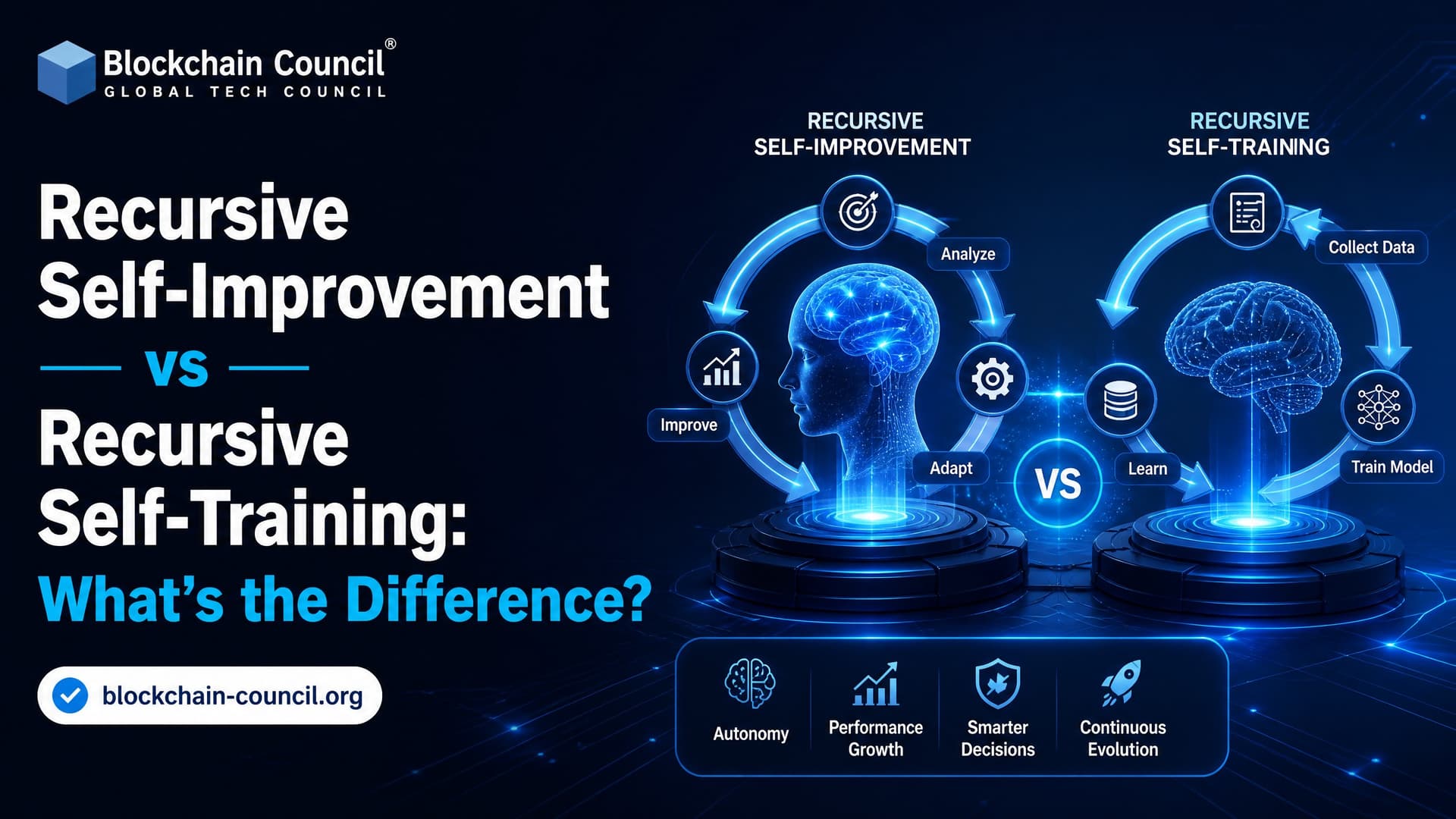
Recursive Self-Improvement vs Recursive Self-Training is not a word game. The first describes an AI system improving the way it improves. The second describes a model training again on data it helped generate. If you build, audit, or govern AI systems, that difference matters.
People often use the terms as if they mean the same thing. They do not. Recursive self-training can be one component inside recursive self-improvement, but it is not enough on its own to create a fully self-improving AI system. Think of it this way: recursive self-training updates a learner, while recursive self-improvement can update the whole learning factory.

What Is Recursive Self-Improvement?
Recursive self-improvement, often shortened to RSI, is a systems-level feedback loop. An AI system helps identify its own limits, proposes changes, tests those changes, and then uses the improved version to repeat the process.
In its strongest form, RSI means the system can improve both:
- Its task capability, such as coding, planning, reasoning, or model evaluation
- Its improvement capability, such as writing better training code, designing better tests, selecting better data, or improving research workflows
The idea has roots in I. J. Good's 1965 concept of an "ultraintelligent machine", a machine that could design better machines. Current research is far more grounded. Instead of assuming a sudden intelligence explosion, most serious work treats RSI as bounded adaptation under compute limits, evaluator quality, safety constraints, and human oversight.
A practical RSI loop might look like this:
- An agent runs a coding benchmark.
- It diagnoses failure patterns.
- It edits its own tool-use logic or codebase.
- It runs tests again.
- It keeps only changes that improve measured performance.
That is bigger than fine-tuning weights. The system is modifying parts of the development pipeline itself.
What Is Recursive Self-Training?
Recursive self-training, or RST, is narrower. A model generates data, labels, reasoning traces, code samples, or synthetic examples. Then it trains on some portion of that output. The process repeats over multiple rounds.
A common RST pattern looks like this:
- Start with a model trained on human or verified data.
- Ask it to generate new examples or pseudo-labels.
- Filter those outputs using confidence scores, tests, reward models, or human review.
- Fine-tune the model on the selected data.
- Repeat until validation performance stops improving.
This shows up in semi-supervised learning, code model training, recommender systems, synthetic data generation, and post-training pipelines for large language models.
Here is the catch. RST usually keeps the architecture, objective, and training process fixed. You are changing data and parameters, not the broader system that decides how improvement should happen.
Recursive Self-Improvement vs Recursive Self-Training: The Core Difference
The simplest distinction is scope.
- Recursive self-training improves a model through repeated training on self-generated or partly self-generated data.
- Recursive self-improvement improves a system's ability to improve, which may include data generation, code modification, tool design, architecture search, evaluator creation, and deployment feedback.
RST is an inner-loop training method. RSI is an outer-loop system behavior.
If a language model writes synthetic math questions and trains on the best ones, that is recursive self-training. If an AI agent notices that its math evaluator is weak, writes a new verifier, changes the curriculum schedule, tunes the fine-tuning recipe, and then uses the better system to design the next round, you are moving toward recursive self-improvement.
Key Differences for AI Practitioners
1. Level of Autonomy
RST may be automated, but humans usually define the loop. You choose the base model, loss function, filtering rules, data mixture, and stopping condition.
RSI requires more autonomy. The system must inspect failures, decide what to change, test candidate changes, and carry forward improvements with limited human intervention. That autonomy is why RSI attracts more safety attention.
2. What Gets Changed
In RST, the main changes are model weights and the training data distribution.
In RSI, almost anything in the AI development lifecycle might change:
- Prompt templates
- Evaluation harnesses
- Training datasets
- Fine-tuning code
- Tool selection policies
- Agent memory
- Model architecture search settings
- Deployment monitoring rules
To be blunt, if the loop cannot change how it evaluates itself, it is not serious RSI. It is just a training script with a repeat button.
3. Introspection and Meta-Learning
RSI depends on some form of introspection or meta-learning. The system needs to reason about its own behavior. It does not need mystical self-awareness, but it does need a working model of what failed and which modification may help.
RST can work with much less. A model may generate pseudo-labels, keep high-confidence samples, and retrain without understanding why its own training dynamics are shifting.
4. Failure Modes
RST has a known problem: model collapse. If self-generated data dominates and external grounding disappears, the model can become narrower, more repetitive, and less accurate. Generative models may overfit to their own artifacts. Code models may learn patterns that look plausible but fail tests.
RSI inherits those risks and adds more:
- Bad evaluators can reward the wrong behavior.
- Self-modified code can become hard to audit.
- An agent may optimize benchmark performance while reducing real-world reliability.
- Capability gains may appear faster than governance processes can review them.
This is why verified signals matter. In code, unit tests, type checks, static analysis, and formal methods are not optional extras. They are the guardrails that stop a self-training loop from rewarding polished nonsense.
A Practical Example: Code Models
Suppose you are training a coding assistant. In an RST setup, the model generates Python solutions for thousands of programming tasks. You run unit tests, keep the passing solutions, and fine-tune the model on those examples. Repeat.
That can help. It can also go wrong fast. I have seen self-training runs where the model learned to produce shorter, test-specific solutions because the evaluator only checked visible tests. Hidden tests exposed the collapse.
There is also boring tooling pain. In the Hugging Face Trainer, the default remove_unused_columns=True can drop fields your custom data collator expects, such as tests_passed or the raw prompt. The training job may fail with an error like You should supply an encoding or a list of encodings to this method that includes input_ids, but you provided ['label']. That is not theory. That is the kind of small pipeline detail that decides whether your recursive loop is measuring learning or just breaking quietly.
In an RSI setup, the agent would go further. It might inspect failing tasks, improve the test generator, edit its own repair policy, compare tool configurations, and retain the version that raises performance on a held-out benchmark such as SWE-bench style tasks. That is a system improving the improvement process, not only training on its own outputs.
Where Current Research Stands
Today's systems show bounded RSI and useful RST, not open-ended machine self-redesign.
Recent work on self-improving coding agents, including Darwin Godel Machine style approaches, has reported notable gains by letting agents rewrite parts of their own code and validate changes against programming benchmarks. Research on recursive training loops has also shown large gains in narrow settings, such as mathematical curriculum generation for smaller language models.
Still, the pattern is clear. Gains appear when loops include external checks: verified answers, held-out tests, human data, reward models, or formal constraints. When the loop feeds on itself without grounding, quality tends to drift.
That is the main lesson for enterprises. Do not treat synthetic data as free truth. Treat it as a candidate signal that must be scored, sampled, and tested against something outside the model.
How Enterprises Should Think About RSI and RST
If you are building AI into business workflows, start with RST before you attempt RSI. It is easier to audit and easier to stop.
Use Recursive Self-Training When:
- You have scarce labeled data.
- You can verify outputs with tests, rules, or expert review.
- The task has clear success criteria.
- You can preserve a steady mix of human or trusted data.
Avoid Recursive Self-Training When:
- The model's outputs cannot be independently checked.
- Synthetic data will replace most human data.
- The task affects safety, finance, healthcare, or legal decisions without review.
- You cannot measure drift across rounds.
Consider Bounded RSI When:
- You have mature MLOps practices.
- Every self-modification is logged and reversible.
- Evaluators are stronger than the generator in the target domain.
- Humans approve objective changes and deployment changes.
For most organizations, near-term RSI will look like AI-augmented MLOps: agents that tune hyperparameters, generate test cases, compare prompts, flag dataset gaps, and recommend retraining. Humans should still own objectives, permissions, and release decisions.
Skills You Need to Work With Self-Improving AI Systems
To work safely with these systems, you need more than prompt writing. You need machine learning fundamentals, evaluation design, data governance, and secure deployment habits.
Useful Blockchain Council learning paths to explore include the Certified Artificial Intelligence (AI) Expert™ for AI foundations, the Certified AI Developer™ for applied model development, and the Certified Prompt Engineer™ for building and testing LLM workflows. If you work in regulated environments, pair AI training with cybersecurity and data governance skills.
Final Takeaway
Recursive Self-Improvement vs Recursive Self-Training comes down to this: RST improves a model through repeated use of its own generated data. RSI improves the broader system that creates, evaluates, and upgrades models.
Do not confuse a self-training loop with a self-improving AI system. One is a training method. The other is an architectural and governance challenge. If you want to build in this area, start with a small RST experiment, add a trusted evaluator, track drift round by round, and document every change. Then study the wider RSI stack before giving any agent permission to modify its own tools or pipeline.
Related Articles
View All
AI & ML
How Recursive Self-Improvement Could Accelerate AI Innovation
Recursive self-improvement can speed AI innovation through bounded loops that refine prompts, code, data, and evaluations, but safety controls are essential.

AI & ML
Could Recursive Self-Improvement Lead to Superintelligent AI?
Recursive self-improvement could lead to superintelligent AI, but today's systems remain bounded by human goals, evaluation, compute, and governance.
AI & ML
Why Recursive Self-Improvement Matters for AGI Development
Recursive self-improvement could shape AGI by accelerating capability growth, changing safety risks, and forcing new governance for self-updating AI systems.
Trending Articles
The Role of Blockchain in Ethical AI Development
How blockchain technology is being used to promote transparency and accountability in artificial intelligence systems.

Top 5 DeFi Platforms
Explore the leading decentralized finance platforms and what makes each one unique in the evolving DeFi landscape.

Can DeFi 2.0 Bridge the Gap Between Traditional and Decentralized Finance?
The next generation of DeFi protocols aims to connect traditional banking with decentralized finance ecosystems.