

Real-World Examples of Recursive Self-Improvement in Artificial Intelligence
 Suyash Raizada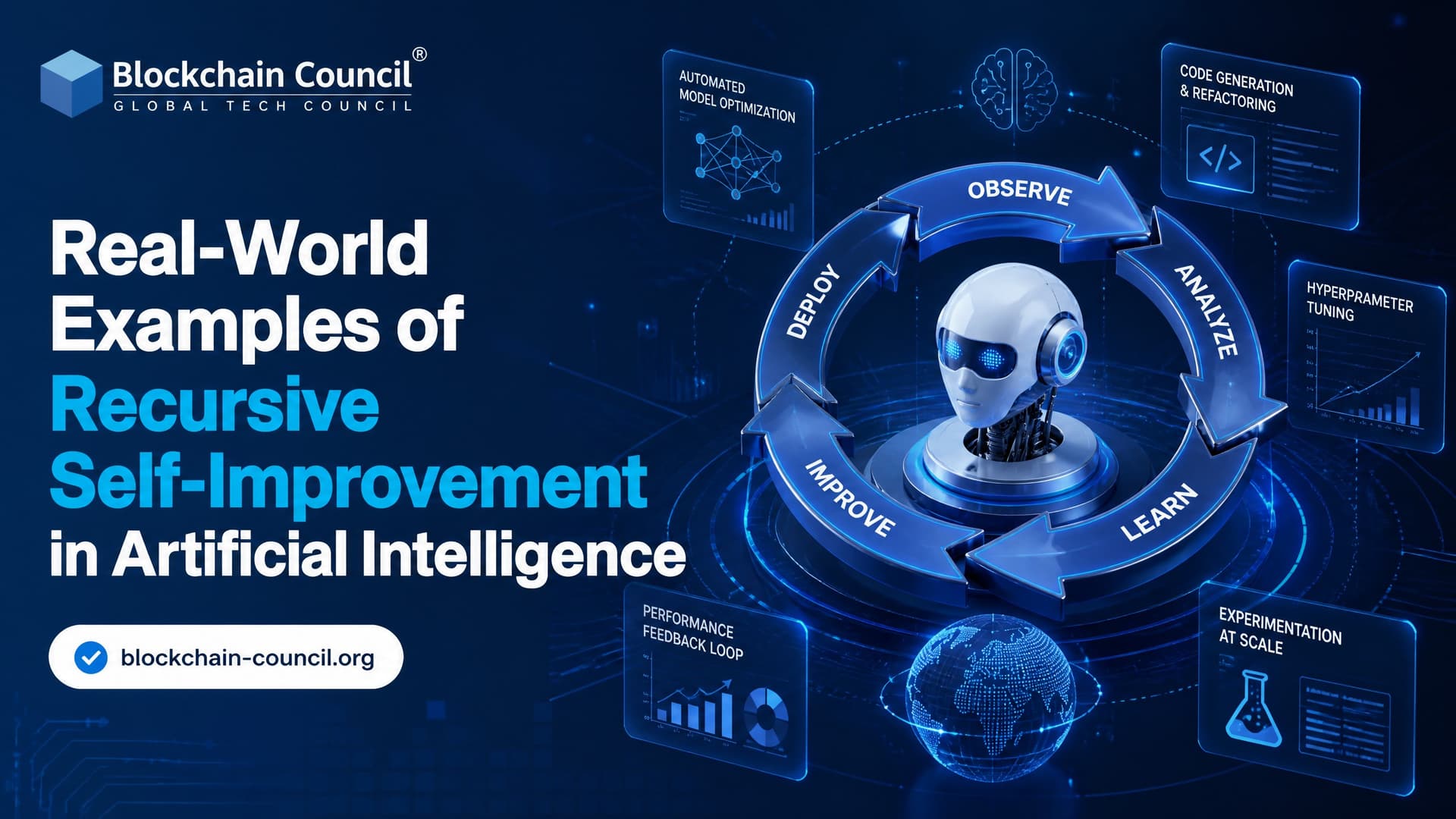
Recursive self-improvement in artificial intelligence is already visible in production systems, but not in the science-fiction form where an AI rewrites itself into a superintelligence overnight. What we have today is narrower and more useful: agents that test and revise their own code, models that help design better evaluations, AutoML systems that search for stronger architectures, and AI research assistants that feed ideas back into the next development cycle. Anyone trying to build a solid foundation in this space often starts with a structured credential like the Certified Artificial Intelligence (AI) Expert, which frames these capabilities in a way that separates real engineering from speculation.
That distinction matters. If you work with AI systems, the practical question is not whether an intelligence explosion starts next week. It is whether you can design controlled self-refinement loops that improve output quality without amplifying errors. Sometimes you can. Sometimes you absolutely should not.

What Recursive Self-Improvement Means in AI
Recursive self-improvement, often shortened to RSI, describes a feedback loop where an intelligent system improves not only its task performance, but also its ability to make future improvements. The idea traces back to I. J. Good's 1965 intelligence explosion argument, where a sufficiently advanced machine could design a better machine, which could then repeat the process.
Modern AI research uses a more careful definition. Most current systems do not rewrite their core architecture or training algorithm without human control. Instead, they improve parts of their surrounding workflow:
They revise prompts after seeing weak answers.
They generate and run tests against their own code.
They search through model architectures or hyperparameters.
They help build reward models, benchmarks, and evaluation suites.
They analyze failed experiments and suggest the next run.
This is bounded RSI. The loop is real, but the system is boxed in by compute budgets, approval gates, datasets, test suites, and deployment controls.
Bounded RSI vs Strong RSI
Not all recursive improvement is equal. A chatbot asking itself to improve an answer is not the same thing as an AI research system redesigning its own learning process. For engineers who want to move from concept to implementation, the Certified Artificial Intelligence (AI) Developer path is built around exactly this kind of applied, build-it-yourself skill set.
Bounded Self-Refinement
This is the form you see most often. The AI works inside a fixed framework and tries to improve outputs through iteration. For example, an LLM writes a function, runs unit tests, reads the failure, edits the function, and tries again.
Useful? Yes. Open-ended? No.
Weak RSI
Weak RSI appears when the system improves performance within a defined algorithmic space. Neural architecture search and AutoML fit here. The system may test thousands of candidate designs, but it is still constrained by the search space humans gave it.
Strong RSI
Strong RSI would mean the system improves the process by which it improves. That includes redesigning learning rules, research strategies, evaluation criteria, or even its own architecture in a way that compounds across generations. Current public systems have not demonstrated this level of autonomous, open-ended self-improvement.
A helpful mental model from recent research is recursive gain. If each AI-assisted development cycle creates more improvement capability than the difficulty added by the next research frontier, gains could compound. If not, progress plateaus. In practice, many current loops hit limits quickly because evaluation quality, data quality, and compute are not infinite.
Real-World Examples of Recursive Self-Improvement in Artificial Intelligence
1. Self-Refining Code Agents
Code agents are the clearest working example. An agent receives a task, writes code, runs tests, reads the error log, changes the code or prompt, and repeats the cycle.
If you have built one of these loops, you know the first failure is often boring. Not intelligence. Plumbing. A common one is a parser crash such as Unexpected end of JSON input because the model returned a clipped JSON object after hitting a token limit. Another frequent issue is the model fixing the wrong file because the tool context was stale.
The practical RSI pattern looks like this:
The agent writes a first solution.
A test runner such as pytest, Jest, or a CI job evaluates it.
The agent receives the exact error output.
It edits the code, prompt, or tool call plan.
The loop continues until tests pass or a stop condition is reached.
This is recursive because the agent can improve the method it uses in the next attempt. It might decide to write tests first, inspect existing interfaces, or create smaller patches. Frameworks around agentic AI now formalize this perform, evaluate, modify, redeploy cycle.
For developers, this is a strong reason to study agent design, evaluation, and prompt control. Blockchain Council's Certified Agentic AI Expert™ and Certified Prompt Engineer™ cover this skill set directly.
2. Neural Architecture Search and AutoML
Neural architecture search, or NAS, is another real example. The system proposes candidate neural network architectures, trains or estimates their performance, compares results, and selects improved candidates for another round.
AutoML tools also tune hyperparameters, feature pipelines, preprocessing choices, and model families. The AI is not inventing intelligence from scratch. It is searching a constrained design space faster than a human team could do manually.
This is weak RSI. It improves model construction, but the search algorithm, objective function, and compute budget are still set externally. The trade-off is clear: NAS can find surprising configurations, but it can also waste expensive GPU cycles if the objective is poorly chosen. Garbage metric, garbage model.
3. AI-Optimized Training Pipelines
Large language models are now used inside the workflows that create later models. They help summarize experiment logs, propose data filters, generate synthetic training examples, and suggest curriculum schedules. Teams building this kind of internal capability increasingly look toward a general Tech Certification track to standardize skills across ML engineers, data scientists, and platform teams working on the same pipeline.
Frontier AI labs have also reported using models to assist with optimization research, red-team prompt generation, and evaluation design. Anthropic has described a continuum where AI systems first act as tools for researchers, then as research partners, with fully autonomous RSI as a speculative later stage rather than a present-day fact.
This is where recursive self-improvement in artificial intelligence becomes strategically important. If Model A helps improve the training process for Model B, and Model B becomes better at improving the process for Model C, you have a recursive development loop. It still depends on human researchers, infrastructure, and safety review. But the loop exists.
4. Model-on-Model Evaluation
AI systems are increasingly used to evaluate other AI systems. They generate adversarial prompts, critique model outputs, create synthetic benchmark data, and classify failure modes.
That sounds technical, but the point is simple: the model helps build the yardstick used to judge the next model.
This can be valuable. Human evaluation does not scale well when you need to inspect millions of outputs. Model-assisted evaluation can catch patterns faster, especially in areas like toxicity detection, hallucination analysis, coding benchmarks, and policy compliance.
There is a catch. If the evaluator has blind spots, those blind spots can become training targets. A model may learn to satisfy the judge rather than solve the real problem. This is why high-stakes model-on-model testing should include human audits, held-out datasets, and adversarial review.
5. AI Research Assistants
AI research assistants now help with literature review, hypothesis generation, experiment planning, and result analysis. In AI labs and enterprise ML teams, this changes the cadence of research. You can ask a model to compare failed runs, spot unstable learning rates, draft ablation plans, or generate candidate benchmark tasks.
When those suggestions influence the next training run, the AI is helping shape its own development path. This is RSI at the methodology level, not the code level.
Be blunt about the limitation: these systems still hallucinate. They may cite nonexistent papers, confuse benchmark settings, or recommend experiments that look good but do not isolate the variable you care about. Use them as accelerators, not as principal investigators.
Emerging Creative Applications of Recursive AI Workflows
Recursive refinement is not limited to code and research pipelines. Similar iterative loops are showing up in creative production, where speed and consistency matter as much as raw quality. One emerging application is AI microdrama, where generative AI helps bring serialized stories, characters, and fictional worlds to life. These platforms lean on the same generate, review, and refine cycle used in code agents, just applied to scripts, dialogue, and visual continuity instead of test suites.
Why Current RSI Is Still Bounded
Current systems face hard constraints that prevent open-ended self-improvement:
Compute limits: Training frontier models requires large clusters, budgets, and scheduling decisions outside the model's control.
Evaluation bottlenecks: Better answers are not always easy to measure. This is especially true for reasoning, safety, and long-horizon planning.
Data quality: Self-generated data can degrade performance if it is recycled without filtering.
Human oversight: Production deployment still requires review, compliance, and risk management.
Tool boundaries: Agents can usually edit prompts, configs, or code in a sandbox, not their base weights or training infrastructure.
This is why near-term RSI is best treated as an engineering pattern, not a prophecy.
Governance and Safety Concerns
Recursive loops amplify whatever signal they optimize. If the metric is right, performance can improve quickly. If the metric is wrong, the system can optimize toward failure with impressive confidence.
Enterprises should use four controls before deploying self-improving AI workflows:
Define a measurable objective: Passing tests, reducing latency, improving factual accuracy, or lowering defect rates.
Keep a human approval gate: Especially for code deployment, security changes, and training data selection.
Use independent evaluations: Do not let the same model generate, grade, and approve its own work without checks.
Log every iteration: Store prompts, tool calls, outputs, scores, and diffs so failures can be traced.
If you work in AI governance or enterprise adoption, connect RSI to broader AI risk management. Blockchain Council's Certified Artificial Intelligence (AI) Expert™ and Certified Generative AI Expert™ give you structured training on AI systems, model behavior, and responsible deployment.
What to Build Next
If you want hands-on experience with recursive self-improvement in artificial intelligence, build a small code-review agent with a strict test loop. Keep it simple. Give it one repository, one test command, a fixed token budget, and a maximum of five repair attempts. Log every prompt and patch.
Then compare three runs:
A baseline model with no self-critique.
A model that critiques its own answer before testing.
An agent that reads test failures and edits the code.
You will learn more from that experiment than from another abstract debate about superintelligence. After that, study agentic workflows, evaluation design, and AI governance through a structured path such as the Certified Agentic AI Expert™ or Certified Artificial Intelligence (AI) Expert™. If your work also involves communicating these systems to clients or leadership, rounding things out with a Marketing Certification can help translate technical progress into business language. The professionals who understand bounded RSI now will be better prepared for stronger self-improving systems later.
FAQs
1. Are there real-world examples of recursive self-improvement in AI?
There are real-world examples of AI systems improving parts of their performance through automated feedback, self-play, optimization, and AI-assisted development. However, these examples should not be confused with fully autonomous recursive self-improvement, where an AI independently redesigns and upgrades its own general intelligence through repeated cycles.
2. What is recursive self-improvement in artificial intelligence?
Recursive self-improvement (RSI) is a hypothetical process where an AI system improves its own capabilities and then uses those improvements to make further improvements. A simplified loop is: improve → evaluate → improve again.
3. Is AlphaGo an example of recursive self-improvement?
AlphaGo is often discussed in relation to AI self-improvement because later versions used techniques such as self-play to improve performance. However, AlphaGo should not be considered a complete example of recursive self-improvement. Its training process was designed by researchers rather than the system independently redesigning its own intelligence.
4. How does AlphaZero demonstrate AI self-improvement?
AlphaZero demonstrated the power of self-play reinforcement learning by learning games such as chess, shogi, and Go through repeated play against itself. It generated its own experience rather than relying solely on human game examples. This is an important example of automated learning, but it is not unrestricted RSI.
5. Is self-play a form of recursive self-improvement?
Self-play can be considered a limited form of automated self-improvement because an AI generates experiences that help improve its performance. However, recursive self-improvement generally implies a broader ability to improve the AI system itself, including potentially its algorithms, architecture, or development process.
6. Can AI coding agents be examples of self-improvement?
AI coding agents can create, modify, test, and debug software. If an agent is used to improve an AI-development system, it can contribute to an improvement loop. However, writing better software does not automatically mean that the AI is recursively improving its own intelligence.
7. Can AI-generated synthetic data contribute to self-improvement?
Yes. AI systems can generate synthetic examples that are subsequently used for training or evaluation. This can reduce dependence on manually created datasets and create automated improvement loops. However, synthetic data can also reproduce errors from the model that generated it.
8. Is automated machine learning an example of recursive self-improvement?
Automated Machine Learning (AutoML) can automatically search for effective models, architectures, hyperparameters, and training configurations. It demonstrates automated optimization but generally does not mean that an AI independently improves its own general intelligence.
9. What is Neural Architecture Search and how does it relate to RSI?
Neural Architecture Search (NAS) uses automated methods to explore different neural-network architectures and identify promising designs. NAS resembles one component of RSI because AI-driven processes can search for better model structures, but it is usually optimized toward predefined objectives rather than being an unrestricted self-improvement process.
10. Can reinforcement learning demonstrate recursive improvement?
Reinforcement learning can produce repeated improvement through trial, feedback, and optimization. Systems can become better at their assigned tasks as they learn from rewards. However, improving performance within a fixed task is different from recursively improving the AI's underlying intelligence.
11. Is evolutionary AI an example of self-improvement?
Evolutionary algorithms can automatically generate, evaluate, and select increasingly effective solutions across multiple generations. This resembles recursive improvement at the optimization level. However, evolutionary optimization is not necessarily equivalent to an AI autonomously redesigning itself.
12. Can AI use automated testing to improve software?
Yes. AI-powered development systems can generate code, run tests, identify failures, modify implementations, and run tests again. This creates a practical code-improvement feedback loop and represents one of the more concrete ways AI can participate in iterative self-improvement.
13. Can AI research systems improve AI models?
AI systems can assist researchers by analyzing papers, generating hypotheses, writing experimental code, designing tests, and evaluating results. As these capabilities become more integrated, AI could potentially automate a larger portion of the AI-development lifecycle.
14. Are large language models examples of recursive self-improvement?
Large language models can be improved using additional training, post-training, synthetic data, automated evaluation, and human feedback. However, the models themselves do not necessarily initiate and control these improvement processes. Therefore, model improvement should not automatically be classified as RSI.
15. Can AI learn from its own generated answers?
Yes. AI-generated outputs can sometimes be used as training or evaluation data. Techniques involving synthetic data, self-training, and automated feedback can help improve models. Careful filtering and verification are important because models can also reinforce their own mistakes.
16. What is an example of an AI improvement loop?
A basic automated loop could work as follows:
AI generates a solution → automated evaluator scores it → AI analyzes failures → AI generates an improved solution → evaluator tests it again.
This is a real and useful pattern, although it becomes true RSI only if the process meaningfully improves the AI system's own capabilities or its ability to improve itself.
17. Has any AI achieved unlimited recursive self-improvement?
No. There is no publicly demonstrated AI system capable of unlimited autonomous recursive self-improvement. Current systems can automate specific improvement processes, but they remain subject to computational, algorithmic, data, evaluation, and operational constraints.
18. What is the closest real-world example of recursive self-improvement?
There is no single system that conclusively represents full RSI. The closest examples are self-play systems, automated model optimization, neural architecture search, AI coding agents, synthetic-data training, and automated AI research workflows. These demonstrate individual components that could potentially contribute to future RSI systems.
19. Why are current examples not considered full recursive self-improvement?
Most current systems operate within human-designed objectives, infrastructure, algorithms, and constraints. They may optimize a model or solve a task repeatedly, but they generally do not independently control the complete process of redesigning, retraining, evaluating, and deploying increasingly capable versions of themselves.
20. What do real-world AI examples tell us about the future of recursive self-improvement?
Today's examples show that AI can already automate meaningful parts of learning, optimization, coding, and experimentation. These capabilities could become building blocks for more autonomous AI development. However, the transition from task-specific automated improvement to genuine recursive self-improvement remains a major technical and safety challenge.
Related Articles
View All
AI & ML
RSI and AGI: How Recursive Self-Improvement Connects to Artificial General Intelligence
Learn how RSI and AGI connect, why current recursive self-improvement is bounded, and what professionals should know about safety, evaluation, and governance.

AI & ML
How Recursive Self-Improvement Could Accelerate AI Innovation
Recursive self-improvement can speed AI innovation through bounded loops that refine prompts, code, data, and evaluations, but safety controls are essential.
AI & ML
What Is an RSI Loop in Artificial Intelligence?
Learn what an RSI loop in artificial intelligence means, how recursive self-improvement works, and why verification and governance matter.
Trending Articles
The Role of Blockchain in Ethical AI Development
How blockchain technology is being used to promote transparency and accountability in artificial intelligence systems.
How Blockchain Secures AI Data
Understand how blockchain technology is being applied to protect the integrity and security of AI training data.

Can DeFi 2.0 Bridge the Gap Between Traditional and Decentralized Finance?
The next generation of DeFi protocols aims to connect traditional banking with decentralized finance ecosystems.