

Prompt Engineering vs Loop Engineering vs Context Engineering: Key Differences for AI Developers
 Suyash Raizada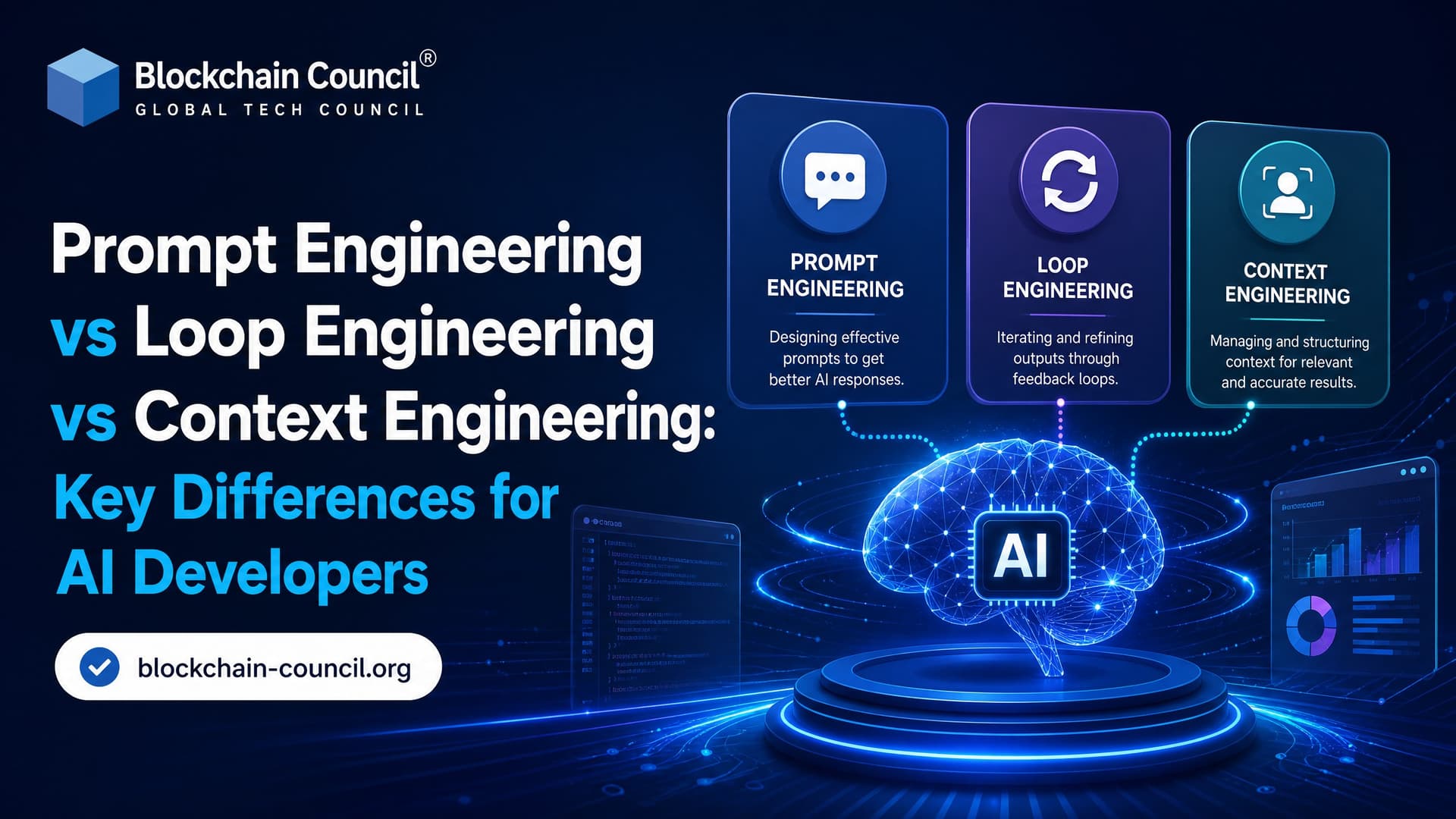
Prompt Engineering vs Loop Engineering vs Context Engineering is not a debate about which one replaces the others. It is a stack. Prompt engineering shapes the instruction, context engineering shapes the information the model sees, and loop engineering shapes the workflow that keeps the system running after the first model call.
If you are building production AI agents, this distinction matters. A better prompt can improve a one-off answer. It will not fix stale retrieval, missing permissions, runaway tool calls, or a workflow that retries the same bad step 40 times. Different layer, different failure.

As AI systems evolve from simple chat interfaces to production-grade agents, a Claude AI Certification can help professionals build practical expertise in prompt design, long-context reasoning, AI workflows, and responsible deployment for enterprise applications.
What Is Prompt Engineering?
Prompt engineering is the practice of writing and structuring instructions so a language model produces a useful response in a single inference window. It covers role instructions, task framing, examples, output formats, constraints, and reasoning instructions.
Anthropic describes prompt engineering as a core method for writing and organizing model instructions. That is still true. For many teams, it is the fastest way to improve output quality without changing infrastructure.
Where Prompt Engineering Works Best
Drafting emails, summaries, reports, and content outlines
Generating code snippets that a developer will review
Running quick experiments with few-shot examples
Building chat tools where users can refine the request
Creating structured outputs such as JSON, tables, or checklists
The unit of work is usually one prompt or one conversation turn. The model only knows what you put in the prompt, plus whatever is already in its trained weights. That is both its strength and its limit.
Here is the failure I see most often in workshops: the prompt says, summarize the policy, but never says which audience, which jurisdiction, whether exceptions matter, or what to do when the policy conflicts with another document. The model fills the gaps. Sometimes it guesses well. Sometimes it invents a clean answer from messy inputs.
What Is Context Engineering?
Context engineering is the discipline of deciding what information enters the model's context window, when it enters, and how it is organized. It includes retrieval, ranking, memory, tool outputs, metadata, access controls, compaction, and governance.
Put simply: prompt engineering asks, How should I phrase this? Context engineering asks, What does the model need to know right now?
This is why context engineering has become central to retrieval augmented generation, enterprise AI assistants, and agentic systems. Elastic and Anthropic both frame the problem as managing a limited attention budget. Even with larger context windows, you cannot throw every document, ticket, and chat history into a request and expect reliable reasoning.
What Context Engineering Includes
Retrieval: Selecting documents from vector databases, search indexes, SQL stores, or knowledge graphs
Ranking: Ordering retrieved content by relevance, freshness, authority, and user permissions
Memory: Deciding what persists across turns and what should be discarded
Tool results: Formatting API responses, search results, calculations, and database records
Governance: Preventing restricted or irrelevant data from entering the context
A small implementation detail can make or break the system. In LangChain, many retrievers default to returning k=4 documents unless you set search_kwargs. If the answer sits in the fifth best chunk, your prompt can be perfect and still fail. That is not a prompt problem. It is a context problem.
Knowledge graphs are gaining ground here too. Neo4j has argued that graph-backed context gives agents structured relationships, not just semantically similar text chunks. For compliance, supply chain, fraud, and enterprise search, that structure can reduce hallucination and make decision paths easier to audit.
What Is Loop Engineering?
Loop engineering is the practice of designing the system that manages model calls over time. It handles routing, retries, validation, tool calls, memory updates, escalation, and stopping conditions.
MindStudio frames loop engineering as the move from supervising every prompt to building a system that manages the conversation or workflow for you. Atlan uses a related phrase, harness engineering, to describe the operational environment around agents.
The key shift is this: the model is no longer the whole application. It is one component inside a control loop.
What Loop Engineering Handles
Breaking a task into multiple steps
Choosing which tool or model to call next
Checking output quality before moving forward
Retrying with adjusted instructions or different context
Routing uncertain cases to a human reviewer
Logging decisions for monitoring and audit
Loop engineering becomes essential when volume increases. A human can review ten model outputs. Nobody wants to inspect 500,000 support ticket classifications by hand. You need automated checks, confidence thresholds, retry paths, and a clean way to stop the agent when it is stuck.
One practical warning: temperature set to 0 does not make a full agent deterministic. Tool latency, retrieval order, updated indexes, and non-identical model backends can still change behavior. If your loop assumes perfect repeatability, it will break in production.
Prompt vs Context vs Loop Engineering: Side-by-Side
Dimension | Prompt Engineering | Context Engineering | Loop Engineering |
|---|---|---|---|
Core question | How should I phrase this? | What should the model know now? | How should the system manage the task? |
Unit of design | Prompt or message | Information environment | Workflow or control loop |
Typical scope | Single turn or short chat | Multi-turn, data-aware interaction | Multi-step operation at scale |
State | Mostly stateless | Stateful memory and retrieval | State transitions and orchestration |
Main failure | Ambiguous instruction | Wrong, stale, or missing context | Unreliable behavior at scale |
Main value | Better immediate output | Better reasoning over the right data | Reliable automation |
The cleanest mental model is nested layers: prompts live inside context systems, and context systems live inside loops. You still need all three.
Use Cases by Discipline
Use Prompt Engineering When the Task Is Short
Use prompt engineering for human-reviewed work: rewriting a paragraph, summarizing a call transcript, generating a test case, translating a passage, or asking a coding assistant to explain an error. It is also the right starting point for prototyping. If a task fails with a clear prompt and clean examples, do not rush into an agent framework. Fix the task design first.
As organizations adopt generative AI across business functions, the role of a Prompt Engineer is expanding beyond writing prompts to designing structured instructions, evaluation methods, and repeatable workflows that improve the reliability of AI outputs.
Use Context Engineering When Data Quality Matters
Context engineering is the right focus for enterprise knowledge assistants, legal research tools, medical information workflows, internal policy bots, and customer support agents. In these cases, the model's answer is only as good as the retrieved evidence.
DataHub's State of Context Management Report 2026 found that 82 percent of IT and data leaders say prompt engineering alone is no longer sufficient, and 95 percent say context engineering is important for powering AI agents at scale. That matches what many teams learn the hard way: once AI touches enterprise data, wording is the easy part.
The growing importance of retrieval pipelines, memory management, and knowledge orchestration is also creating demand for professionals who specialize as an AI Context Engineer, focusing on building reliable information environments that enable AI systems to reason over accurate, permission-aware data.
Use Loop Engineering When the System Must Act
Loop engineering fits research agents, coding agents, ticket triage systems, document processing pipelines, security alert investigation, and workflow bots. These systems must decide what to do next, not just answer once.
Take a research agent. It might generate search queries, retrieve documents, rank sources, extract claims, verify citations, write a draft, and ask for human review only when confidence drops. Prompt engineering shapes each instruction. Context engineering selects the evidence. Loop engineering keeps the workflow moving without losing control.
How These Skills Fit AI Development Careers
If you are learning AI for professional work, do not stop at prompt templates. They are useful, but limited. Learn the stack in this order:
Prompt engineering: Write clear instructions, constraints, examples, and output schemas.
Context engineering: Build retrieval pipelines, chunk documents, test ranking, manage memory, and apply permissions.
Loop engineering: Add evaluation, retries, routing, tool orchestration, monitoring, and human escalation.
For structured learning, you can explore Blockchain Council certifications such as Certified Prompt Engineer™, Certified Generative AI Expert™, and Certified Artificial Intelligence (AI) Expert™. If your goal is agent development, pair prompt skills with hands-on work in retrieval augmented generation, vector databases, evaluation frameworks, and orchestration tools.
From Prompt Tricks to AI Systems Engineering
The next phase of AI development is context-first and loop-aware. Prompt engineering will not disappear. It becomes the interface layer, the part that defines intent and task shape. But the hard engineering work is moving into data flow, memory, governance, and control.
A Tech Certification can further strengthen these capabilities by building broader expertise in cloud platforms, software engineering, automation frameworks, and emerging technologies that support scalable AI systems in production.
Expect three shifts:
Context management becomes a core AI skill: Teams will invest more in retrieval quality, knowledge graphs, metadata, and access controls.
Agent frameworks mature: More systems will standardize patterns for tool use, retries, scoring, rollback, and escalation.
Governance moves deeper into the stack: Policies will be enforced through context filters, audit logs, permission-aware retrieval, and loop-level checks, not just prompt warnings.
To be blunt, prompt-only AI applications are fine for demos. They are fragile for production. If you want to build systems that work with real users, real data, and real risk, start measuring retrieval quality, add evaluation to every loop, and treat prompts as one layer of the architecture.
Your next step: take one AI workflow you already use, such as summarizing documents or classifying support tickets, and map it into three parts. Write the prompt. List the context sources. Then design the loop: validation, retry, escalation, and logging. That exercise will show you where your current AI system is strong and where it is only pretending to be reliable.
As enterprise AI solutions continue to expand across industries, a Marketing Certification can also help professionals understand product positioning, user adoption, stakeholder communication, and go-to-market strategies for innovative AI technologies.
FAQs
1. What Is Prompt Engineering?
Prompt engineering is the practice of designing and refining prompts that guide AI models to generate accurate, relevant, and useful responses for specific tasks.
2. What Is Loop Engineering?
Loop engineering is the practice of building feedback-driven AI systems that continuously monitor outputs, collect feedback, evaluate performance, and optimize prompts, workflows, or models over time.
3. What Is Context Engineering?
Context engineering is the practice of designing the information, memory, retrieved knowledge, tools, and instructions provided to an AI model so it has the right context to perform a task effectively.
4. What Is the Difference Between Prompt Engineering, Loop Engineering, and Context Engineering?
Prompt engineering focuses on writing effective instructions, context engineering focuses on providing the right information and environment for the AI, while loop engineering focuses on continuously improving the entire AI system through monitoring and feedback.
5. Why Is Prompt Engineering Important?
Prompt engineering improves AI output quality by reducing ambiguity, providing clear instructions, and helping models generate more accurate, consistent, and task-specific responses.
6. Why Is Context Engineering Important?
Context engineering improves AI performance by supplying relevant documents, conversation history, business rules, retrieved knowledge, tool access, and memory, enabling more informed responses.
7. Why Is Loop Engineering Important?
Loop engineering enables AI applications to continuously improve through user feedback, automated evaluations, monitoring, and iterative optimization after deployment.
8. When Should You Use Prompt Engineering?
Use prompt engineering for content creation, coding assistance, customer support, summarization, translation, brainstorming, and tasks where improving instructions directly improves AI responses.
9. When Should You Use Context Engineering?
Use context engineering when AI applications require external knowledge, long conversations, enterprise documents, Retrieval-Augmented Generation (RAG), APIs, memory, or personalized user information.
10. When Should You Use Loop Engineering?
Loop engineering is best for production AI systems, AI agents, enterprise automation, customer service platforms, and workflows that require continuous monitoring, evaluation, and optimization.
11. Can Prompt Engineering, Context Engineering, and Loop Engineering Work Together?
Yes. Prompt engineering defines how the AI is instructed, context engineering determines what information the AI receives, and loop engineering continuously measures and improves the overall system based on feedback.
12. How Does Retrieval-Augmented Generation (RAG) Support Context Engineering?
RAG retrieves relevant information from trusted data sources before the AI generates a response, providing current and contextually relevant knowledge without retraining the model.
13. What Skills Are Required for Prompt Engineering?
Professionals should understand large language models (LLMs), prompt design, natural language processing, reasoning techniques, prompt testing, and response evaluation.
14. What Skills Are Required for Context Engineering?
Context engineers should understand RAG, vector databases, embeddings, APIs, knowledge management, AI memory systems, prompt orchestration, and enterprise data integration.
15. What Skills Are Required for Loop Engineering?
Loop engineers need expertise in AI agents, workflow automation, MLOps, monitoring, evaluation frameworks, feedback systems, APIs, prompt optimization, analytics, and systems engineering.
16. Which Technologies Support Prompt, Context, and Loop Engineering?
Common technologies include LLMs, AI agents, LangChain, LangGraph, LlamaIndex, vector databases, Retrieval-Augmented Generation (RAG), APIs, MLOps platforms, evaluation frameworks, and observability tools.
17. What Are the Benefits of Combining These Three Engineering Approaches?
Combining prompt, context, and loop engineering improves AI accuracy, response relevance, reliability, adaptability, workflow automation, user satisfaction, and long-term system performance.
18. What Challenges Exist When Implementing These Approaches?
Common challenges include prompt variability, poor context quality, incomplete data retrieval, managing memory, feedback bias, evaluation complexity, governance, scalability, and maintaining system performance over time.
19. What Common Mistakes Should AI Developers Avoid?
Avoid relying only on better prompts while ignoring context quality, assuming retrieved information is always correct, skipping automated evaluations, neglecting prompt versioning, and failing to monitor production performance. A strong AI application depends on effective prompts, relevant context, reliable retrieval, continuous evaluation, and human oversight where appropriate.
20. What Is the Future of Prompt, Context, and Loop Engineering?
As AI systems become more capable and agentic, these three disciplines are expected to work together rather than compete. Prompt engineering will refine interactions, context engineering will provide the knowledge and tools AI needs, and loop engineering will enable continuous learning and optimization. Together, they form the foundation for building scalable, reliable, and production-ready AI applications that can adapt to evolving business requirements and user expectations.
Related Articles
View All
AI & ML
Prompt Engineering to Context Engineering: How to Get Better Results From AI
Learn the journey from Prompt Engineering to Context Engineering. Understand prompts, few-shot and chain-of-thought techniques, context windows, memory, and RAG to get better results from AI.

AI & ML
NVIDIA Nemotron 3.5 Lightning vs NVIDIA Cosmos 3: Key Differences and Use Cases
Compare NVIDIA Nemotron 3.5 Lightning and NVIDIA Cosmos 3, including their architectures, reasoning capabilities, modalities, performance goals, and use cases across agentic and physical AI.
AI & ML
What Is an RSI Loop in Artificial Intelligence?
Learn what an RSI loop in artificial intelligence means, how recursive self-improvement works, and why verification and governance matter.
Trending Articles
The Role of Blockchain in Ethical AI Development
How blockchain technology is being used to promote transparency and accountability in artificial intelligence systems.

Top 5 DeFi Platforms
Explore the leading decentralized finance platforms and what makes each one unique in the evolving DeFi landscape.

Can DeFi 2.0 Bridge the Gap Between Traditional and Decentralized Finance?
The next generation of DeFi protocols aims to connect traditional banking with decentralized finance ecosystems.