

Forward Deployed Engineer vs Solutions Engineer: Key Differences in AI Teams
 Suyash Raizada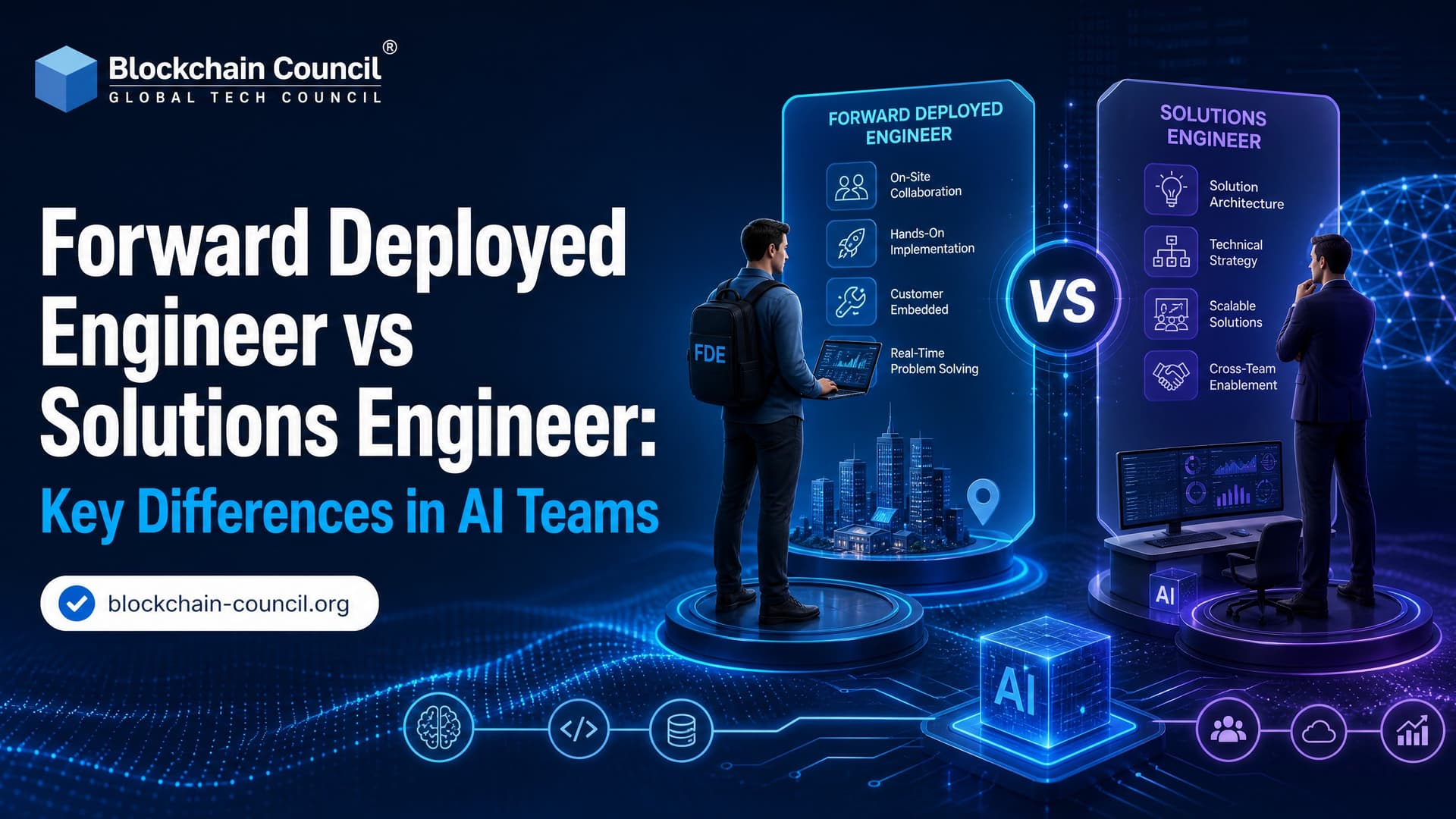
Forward Deployed Engineer vs Solutions Engineer is not just a title debate. In AI, data platforms, cybersecurity, and enterprise software, the difference decides who owns the customer outcome, who owns the technical sale, and who gets called when the model works in a demo but falls apart against real customer data.
Short version: a Forward Deployed Engineer embeds with customers, usually after the sale, and builds production systems inside the customer environment. A Solutions Engineer works mostly before the sale, proving technical fit through discovery, demos, architecture reviews, and proof-of-concept work. Both roles need real technical depth. They create value at different points in the customer lifecycle. Learn which career path aligns best with your skills, whether you prefer hands-on deployment, client engagement, solution architecture, or enterprise consulting through a Forward Deployed Engineer Certification, building operational ML expertise with an MLOps Certification, and developing professional influence through a Digital Marketing Course.

What Is a Forward Deployed Engineer?
A Forward Deployed Engineer, often shortened to FDE, is a software engineer who works close to the customer and close to production. The role became widely associated with Palantir, where engineers embedded inside government and enterprise customers to understand messy operational problems, model data, build workflows, and feed product lessons back into the platform.
That pattern now shows up across AI infrastructure, analytics, security, and enterprise SaaS. Baseten, for example, describes FDEs as part of the engineering organization, not a loosely technical support layer. That distinction matters. A real FDE is expected to meet engineering standards while handling customer constraints that never appear in a clean internal test environment.
What FDEs Typically Own
Production integrations with customer systems
Data pipelines, workflow automation, adapters, and deployment glue
Post-sale implementation outcomes
Technical trade-offs around latency, cost, security, and reliability
Feedback loops into product and engineering roadmaps
Here is the practitioner detail that exposes the difference fast. An FDE does not stop at a slide showing how retrieval-augmented generation could work. They debug why the customer's vector ingestion job keeps failing because one S3 bucket policy blocks s3:GetObject, or why a model server starts throwing CUDA out of memory after the batch size jumps from 8 to 16. That is production work. Not theatre.
What Is a Solutions Engineer?
A Solutions Engineer, also called a Sales Engineer, Technical Solutions Engineer, or Customer Engineer at some cloud companies, is the technical partner to the sales team. The SE helps the buyer figure out whether the product can solve their problem before the contract is signed.
The role is commercial, but it is not shallow. Strong SEs can explain architecture, answer security questions, build credible PoCs, handle objections, and turn buyer requirements into a technical story that executives and engineers both accept.
What SEs Typically Own
Technical discovery during sales cycles
Product demos and tailored walkthroughs
PoCs, sandbox environments, and sample integrations
RFP responses and competitive technical evaluations
Technical win rate, revenue influenced, and deal velocity
A good SE knows where the demo boundary is. If a prospect asks whether your AI system supports private VPC deployment, audit logs, SOC 2 controls, and per-tenant data isolation, the SE should answer plainly. But once the customer signs and the system has to run against production traffic, the SE usually hands off to implementation, customer success, professional services, or FDEs.
Forward Deployed Engineer vs Solutions Engineer: Side-by-Side Comparison
Dimension | Forward Deployed Engineer | Solutions Engineer |
|---|---|---|
Primary mission | Deliver working production outcomes | Win the technical evaluation |
Lifecycle stage | Mostly post-sale, sometimes late pre-sale | Mostly pre-sale |
Code ownership | Writes and owns production code or deployment logic | Builds demos, scripts, sample apps, and PoCs |
Main metric | Deployment success, adoption, value delivered | Technical win rate, pipeline influence, close support |
Reporting line | Engineering, product, or professional services | Sales, revenue, or solutions organization |
Quota | Usually not quota-carrying | Often tied to quota or variable compensation |
The cleanest distinction is this: SEs prove that the product can work. FDEs make it work when the environment is real, political, constrained, and full of edge cases.
Why the FDE Role Is Growing in AI
AI has made the Forward Deployed Engineer model more relevant. Generic demos are easy now. Production value is hard.
An AI chatbot that answers five curated questions in a demo is not the same as a system handling 40,000 messy support documents, conflicting access permissions, hallucination risk, latency targets, and legal review. The buyer's data shape, internal workflows, compliance rules, and tolerance for automation all change the implementation.
Hiring commentary from Exponent has pointed to a steep rise in FDE demand, with some estimates suggesting FDE postings grew several-fold over short periods while traditional software engineering listings fell in certain markets. Paraform's startup hiring analysis has placed FDE total compensation around $238,000 on average in growth-stage contexts, with high-end packages well above that at top companies. Treat these figures as directional, since they vary by market. The signal is clear: companies are paying for engineers who can convert complex technology into deployed outcomes.
Silicon Valley Product Group has also framed FDE work as part of modern product discovery. That is a useful lens. FDEs do not only implement requirements. They discover what the requirements should have been after seeing how the customer actually works.
Where Solutions Engineers Still Matter
Do not read this as a prediction that SEs are going away. They are not.
Solutions Engineers are the right answer when the bottleneck is buyer confidence. If deals stall because prospects do not understand your security model, pricing architecture, integration path, or AI governance controls, hire or train SEs first. They shorten evaluations, improve technical credibility, and keep account executives from overpromising.
For standardized SaaS products, a strong SE plus a repeatable customer success motion may be enough. You do not need an FDE for every customer who wants a dashboard field renamed. That would be expensive and slow.
When to Hire an FDE vs an SE
Hire a Solutions Engineer If
Your deals die during technical evaluation.
Prospects keep asking for architecture proof before signing.
Your product is mature enough to demo repeatedly.
The biggest problem is explaining value, not building missing deployment pieces.
You need someone comfortable with sales timelines and commercial pressure.
Hire a Forward Deployed Engineer If
Customers sign, then fail to reach production value.
Your product depends on complex data, infrastructure, or workflow integration.
You are building AI systems that must adapt to each customer's environment.
You need field learning to shape the product roadmap.
The work requires production-grade code, not just PoC scripts.
To be blunt, hiring an FDE to fix a weak sales motion is wasteful. Hiring an SE to own production deployment risk is unfair. The role design should match the bottleneck.
Skills Needed for Each Role
Forward Deployed Engineer Skills
Software engineering fundamentals: testing, debugging, APIs, data modeling, and system design
Production deployment experience across cloud, containers, CI/CD, and observability
Comfort with unclear customer requirements
Ability to explain trade-offs to executives and operators
Product judgment, especially knowing when a custom fix should become a platform feature
For AI FDEs, add model evaluation, prompt behavior, retrieval systems, data privacy, inference cost, and latency tuning. A small setting can change the result. Lowering temperature from 0.7 to 0.2 may improve consistency for compliance workflows, but it can also make the assistant less useful for exploratory analysis. Test against the user's actual task, not a generic benchmark.
Solutions Engineer Skills
Technical breadth across the product, cloud platforms, security, APIs, and integration patterns
Clear communication with both engineering teams and buying committees
Demo design and PoC scoping
Commercial awareness, including qualification and objection handling
Fast learning under pressure
SEs in AI also need credibility around data governance, model risk, evaluation methods, and deployment options. If you cannot explain why a PoC result may not predict production performance, you will lose trust with serious technical buyers.
Career Path: Which Role Should You Choose?
Choose FDE if you like building, debugging, and staying accountable after the exciting kickoff meeting is over. It suits software engineers who want customer contact without giving up hard technical work. It can also be a strong route into product leadership, because you see the gap between roadmap assumptions and real usage.
Choose SE if you enjoy persuasion, architecture conversations, demos, and deal strategy. The best SEs are technical enough to earn engineering respect and commercial enough to help buyers decide. Compensation can be attractive, especially where variable pay is tied to sales targets.
Compare Forward Deployed Engineers and Solutions Engineers across responsibilities, customer interaction, technical depth, and AI implementation roles through a Forward Deployed Engineer Certification, mastering AI deployment workflows with an MLOps Certification, and improving business communication through a Digital Marketing Course.
Common Role Confusion to Watch For
Titles lie. Job descriptions reveal the truth.
Some companies label pre-sales technical roles as FDE because the title is popular. Others call post-sale implementation engineers Solutions Engineers. Before you accept a role, ask direct questions:
Will I own production code or only PoCs?
Do I work before the sale, after the sale, or both?
Is there a sales quota or variable compensation target?
Who reviews my performance: engineering, product, services, or sales?
What happens when a customer deployment fails?
The last question is the best one. If the answer is "You stay until it works," the role is probably FDE-like. If the answer is "Implementation takes over after signature," it is probably SE-like.
The Practical Takeaway
Forward Deployed Engineer vs Solutions Engineer comes down to ownership. The SE owns technical confidence before purchase. The FDE owns working value after purchase.
For AI companies, both roles can be essential. Use SEs to win complex evaluations. Use FDEs when production deployment is where value is created or lost. If you are planning your own path, build one small AI deployment end to end this month: ingest real documents, add access control, evaluate outputs, deploy it, and monitor failures. That single project will tell you which side of the FDE-SE line you actually enjoy.
FAQs
1. What is a Forward Deployed Engineer (FDE)?
A Forward Deployed Engineer is a technical professional who works directly with enterprise customers to deploy, customize, integrate, and optimize software, AI systems, and technology solutions. FDEs act as a bridge between product teams and customers, ensuring successful implementation and business outcomes.
2. What is a Solutions Engineer?
A Solutions Engineer is a technical specialist who helps prospects and customers understand how a product can solve their business challenges. They often focus on pre-sales activities, demonstrations, technical presentations, proof-of-concepts, and solution design.
3. What is the primary difference between a Forward Deployed Engineer and a Solutions Engineer?
The main difference lies in their focus. Solutions Engineers primarily support the sales process by helping customers evaluate solutions, while Forward Deployed Engineers focus on implementation, integration, customization, and post-sales deployment success.
4. How do FDEs contribute to AI teams?
FDEs help deploy AI models, integrate AI agents into workflows, connect enterprise data sources, optimize AI performance, and ensure AI solutions align with customer requirements and business goals.
5. How do Solutions Engineers contribute to AI teams?
Solutions Engineers explain AI capabilities, demonstrate product value, conduct technical evaluations, support proof-of-concept projects, and help potential customers understand how AI solutions fit their needs.
6. Which role is more customer-facing?
Both roles are customer-facing, but in different ways. Solutions Engineers typically engage with prospects during the evaluation phase, while Forward Deployed Engineers work closely with customers during deployment and operational use.
7. Do Forward Deployed Engineers require coding skills?
Yes. FDEs often write code, build integrations, automate workflows, customize solutions, and troubleshoot technical issues. Strong programming and system integration skills are typically required.
8. Do Solutions Engineers need programming knowledge?
Many Solutions Engineers possess technical skills, but their role usually focuses more on solution design, demonstrations, and customer consultations rather than extensive software development.
9. Which role works more closely with engineering teams?
Forward Deployed Engineers generally work more closely with product and engineering teams because they handle implementation challenges, integrations, and deployment-related technical requirements.
10. Which role is more involved in enterprise software deployments?
Forward Deployed Engineers are usually responsible for deployment execution, system configuration, workflow customization, and implementation support, making them more involved in enterprise deployments.
11. How do the responsibilities differ during an AI implementation project?
Solutions Engineers help customers understand the AI solution and validate its value before purchase, while FDEs deploy the solution, integrate it with business systems, and ensure successful adoption after implementation.
12. Which role focuses more on problem-solving?
Both roles require problem-solving, but FDEs often tackle deeper technical challenges such as integrations, infrastructure issues, deployment bottlenecks, and workflow optimization.
13. How do FDEs support customer success?
They ensure technology is implemented correctly, provide technical guidance, resolve deployment issues, and help customers achieve measurable business outcomes from the solution.
14. How do Solutions Engineers support customer success?
Solutions Engineers help customers understand product capabilities, evaluate technical fit, and make informed purchasing decisions that align with business objectives.
15. What technical skills are important for Forward Deployed Engineers?
Programming, cloud computing, APIs, AI systems, DevOps, system integration, databases, data engineering, and solution architecture are highly valuable skills for FDEs.
16. What technical skills are important for Solutions Engineers?
Product knowledge, solution architecture, technical presentations, pre-sales consulting, cloud technologies, business analysis, and customer engagement skills are important for Solutions Engineers.
17. Which role is better suited for someone who enjoys building and deploying systems?
Forward Deployed Engineering is generally a better fit for professionals who enjoy hands-on implementation, coding, integrations, and technical problem-solving.
18. Which role is better suited for someone who enjoys consulting and client presentations?
Solutions Engineering may be a better fit for professionals who enjoy product demonstrations, customer discovery, technical consulting, and helping organizations evaluate technology solutions.
19. How do career paths differ between the two roles?
Forward Deployed Engineers often move into Solutions Architecture, Product Management, Technical Program Management, AI Engineering, or Enterprise Architecture roles. Solutions Engineers frequently advance into Sales Engineering leadership, Solution Architecture, Product Strategy, or Customer Success leadership positions.
20. Which role is more important in modern AI organizations?
Both roles are critical. Solutions Engineers help organizations understand and adopt AI technologies, while Forward Deployed Engineers ensure those technologies are successfully implemented and deliver real-world value. Together, they play complementary roles in driving AI adoption and customer success.
Related Articles
View All
AI & ML
Is the Certified Forward Deployed Engineer Certification Worth It in 2026? A Complete Review
The Certified Forward Deployed Engineer certification validates the technical, consulting, and customer-facing skills needed for one of tech's fastest-growing roles. Discover whether it's worth pursuing in 2026, who should earn it, and the career opportunities it can unlock.

AI & ML
Recursive Self-Improvement vs Self-Learning AI: Key Differences Explained
Understand recursive self-improvement vs self-learning AI, including definitions, technical differences, risks, governance needs, and learning paths.

AI & ML
Prompt Engineering vs Loop Engineering vs Context Engineering: Key Differences for AI Developers
Learn how prompt engineering, context engineering, and loop engineering differ, where each fits, and why production AI needs all three layers.
Trending Articles
AWS Career Roadmap
A step-by-step guide to building a successful career in Amazon Web Services cloud computing.
How Blockchain Secures AI Data
Understand how blockchain technology is being applied to protect the integrity and security of AI training data.
What is AWS? A Beginner's Guide to Cloud Computing
Everything you need to know about Amazon Web Services, cloud computing fundamentals, and career opportunities.