

How Prompt, Loop, and Context Engineering Shape Reliable AI Agents
 Suyash Raizada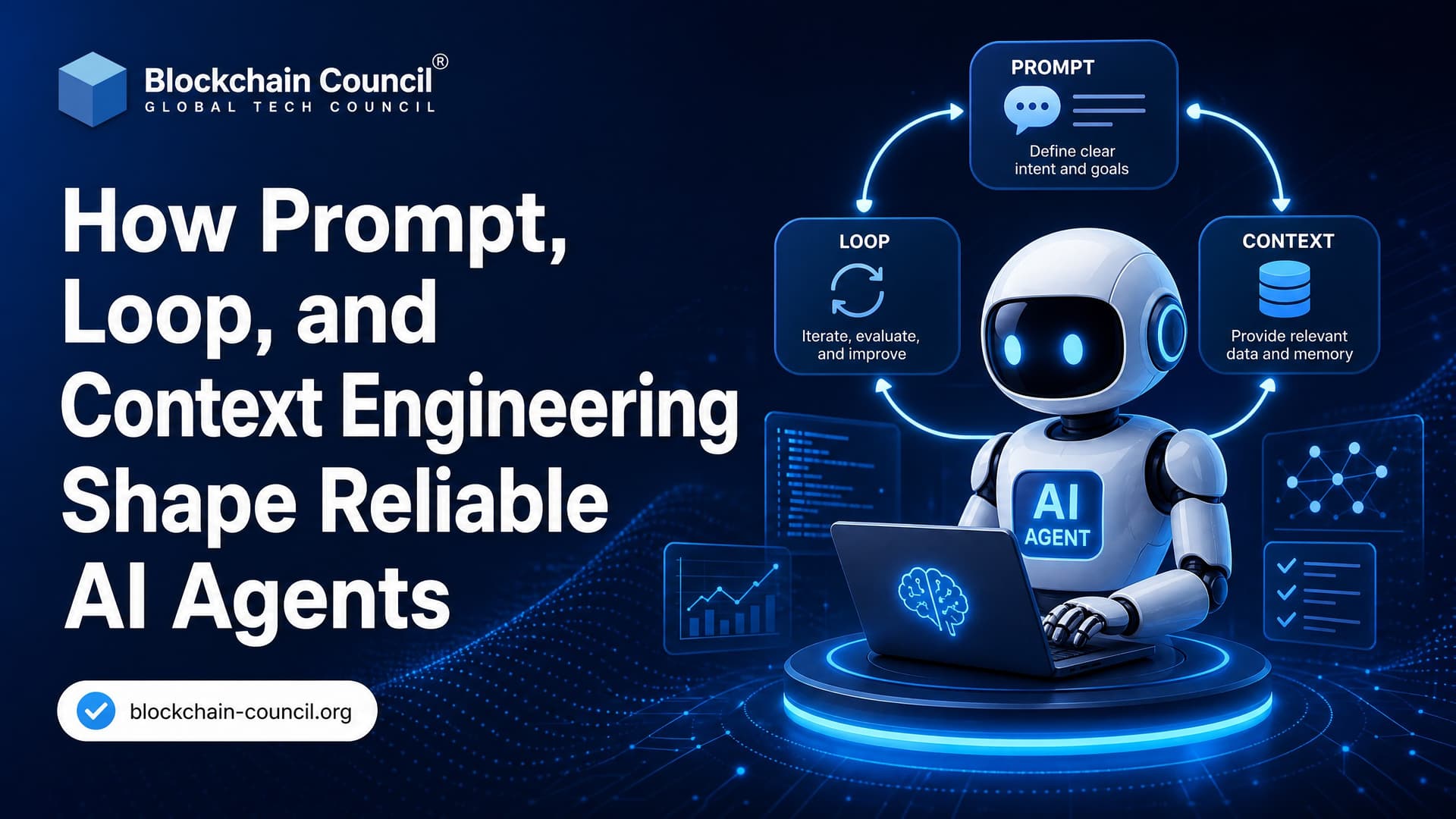
Prompt, loop, and context engineering are the three controls that turn generative AI from a clever chat interface into a reliable enterprise system. The prompt tells the model what to do. The loop decides how the agent acts over time. The context controls what the model can see before it answers or takes action.
That distinction matters now because enterprise GenAI is no longer a side experiment. Deloitte reports that 66 percent of organizations are seeing gains from AI investments, while Menlo Ventures estimates enterprise generative AI spend rose from 11.5 billion dollars in 2024 to 37 billion dollars in 2025. When that much budget moves into production workflows, weak prompt writing is not enough. You need engineering discipline.

As enterprise AI moves beyond chatbots into production-grade agents, a Claude AI Certification can help professionals build practical expertise in prompt design, long-context reasoning, AI workflows, and responsible deployment for real-world business applications.
What Prompt Engineering Actually Controls
Prompt engineering is the practice of designing, testing, and refining model inputs so the output matches a specific business or technical goal. IBM describes it as an iterative process for improving accuracy, relevance, and performance. Google Cloud calls it both art and science: give the model clear instructions, useful context, and examples so it responds with intent rather than guesswork.
In real projects, prompt engineering usually covers:
Role definition: Tell the model whether it is acting as a legal reviewer, support agent, code assistant, or analyst.
Task constraints: Define what it must do and what it must avoid.
Output format: Ask for JSON, a table, a summary, a SQL query, or a ranked list.
Examples: Use few-shot examples when the format or judgment criteria are not obvious.
Failure behavior: Tell the model to say when information is missing instead of inventing an answer.
Here is the blunt version: prompts are interface contracts. If your prompt says summarize this policy, you get a loose summary. If it says extract obligations, deadlines, responsible teams, exceptions, and open risks as valid JSON, you have a specification that can be tested.
This is why formal training is becoming useful. Blockchain Council's Certified Prompt Engineer™ gives professionals structured practice in prompt design for tools such as GPT models and enterprise GenAI systems.
Why Loop Engineering Matters for AI Agents
A chatbot answers once. An AI agent acts repeatedly. That is the difference loop engineering addresses.
Loop engineering designs the cycle an agent follows: plan, act, observe, evaluate, remember, and repeat until the goal is met or the system stops it. This is the shift from linear prompt chains to goal-seeking systems. The same pattern shows up in agents that find work, act on it, verify the result, and remember completed tasks.
A Practical Agent Loop
A common enterprise agent loop looks like this:
Receive a goal: For example, update a customer support article based on new release notes.
Retrieve context: Pull product documentation, prior tickets, release notes, and policy rules.
Plan work: Decide which sections need edits.
Use tools: Search a knowledge base, create a draft, open a pull request, or call an API.
Check output: Validate formatting, citations, policy compliance, and missing fields.
Repeat or stop: Continue if errors remain. Escalate to a human if risk is high.
This loop is where many agent projects fail. Not because the model is weak, but because the stop conditions are vague. I have watched coding agents loop for ten minutes fixing the same failing test because the system only gave them the test output, not the changed file diff. Another common one is a parser crash such as OutputParserException: Could not parse LLM output in LangChain when the model returns a sentence before the expected JSON. Small design mistake. Big workflow failure.
Good loop engineering sets limits: maximum iterations, confidence thresholds, validation checks, rollback paths, and human approval for irreversible actions. Do not let an agent update production records, send emails, or execute payments without a controlled approval step. That is not caution for its own sake. It is basic systems engineering.
Context Engineering: The Reliability Lever Most Teams Underestimate
Context engineering is the discipline of deciding what information goes into the model's context window. Anthropic describes it as selecting relevant information from a constantly changing universe of possible data. In practice it ties together Retrieval Augmented Generation, memory, structured outputs, and tools.
The model cannot use information it cannot see. It also performs worse when you stuff the context window with noisy, outdated, or conflicting documents. Bigger context windows help, but they do not replace selection. A 100-page policy dump can be less useful than five correctly retrieved clauses.
RAG Is Not Just Search Plus Chat
Retrieval Augmented Generation, or RAG, is a common context engineering pattern. It usually involves chunking documents, creating embeddings, storing them in a vector database, retrieving relevant chunks, and passing them to the model with the prompt.
The hard parts are practical:
Chunk size changes answer quality. Too small and the model misses meaning. Too large and retrieval becomes noisy.
Old documents must be removed or weighted lower, especially in policy and product support workflows.
Access control must happen before retrieval, not after the answer is generated.
Retrieved text should include source metadata so answers can be audited.
Structured data often belongs in tool calls or SQL queries, not in pasted text.
If you are building an internal assistant for finance, healthcare, insurance, or public sector work, context engineering is also a compliance issue. You need to know which documents were used, whether personally identifiable information was exposed, and whether the answer relied on approved sources.
As retrieval pipelines, memory management, and knowledge orchestration become more sophisticated, the role of an AI Context Engineer is emerging to focus on building secure, permission-aware information environments that enable AI systems to reason over the right data at the right time.
How the Three Disciplines Work Together
Prompt, loop, and context engineering are separate skills, but they are not separate systems.
Take an AI coding agent. The prompt defines coding standards, target language, and test expectations. The loop makes the agent write code, run tests, inspect errors, and try again. The context gives it repository files, package versions, previous commits, and test logs. Remove any one part and reliability drops.
The same pattern applies to a customer support assistant. Prompt engineering sets tone, escalation rules, and answer format. Loop engineering lets the agent ask clarifying questions, retrieve articles, draft a response, and check policy. Context engineering supplies the right product docs and customer history without exposing restricted data.
Agent Orchestration and Guardrails
Once agents start using tools and working across systems, orchestration becomes necessary. IBM describes AI agent orchestration as coordinating specialized agents, dependencies, tasks, and governance. Think of it as the control layer that lets agent workflows scale across tools and platforms.
In an enterprise workflow, you might have separate agents for extraction, classification, drafting, review, and action execution. Orchestration decides who does what, in which order, and under which policy.
Guardrails sit around that system. They are the safety and control mechanisms for agentic AI, and they include:
Input filtering for prompt injection and malicious instructions.
Output moderation for unsafe or policy-breaking content.
PII scanning before text is sent to a model or returned to a user.
Tool permissioning so agents cannot take high-risk actions by default.
Human approval for regulated, financial, legal, or operationally sensitive steps.
To be blunt, guardrails are not a finishing touch. They are part of the architecture. If your agent can read files, call APIs, or write to business systems, it needs policy enforcement and logging from day one.
Governance Pressure Is Rising
The EU Artificial Intelligence Act has made governance a board-level topic for many organizations. It uses a risk-based approach and sets expectations around transparency, data quality, human oversight, and system reliability for AI used in the European market.
That does not mean every internal assistant is a high-risk system. It does mean enterprises need traceability. Who designed the prompt? Which model was used? What context was retrieved? Which tool calls were made? When did a human approve the action?
Prompt, loop, and context engineering help answer those questions. They create design artifacts that can be tested, reviewed, and improved. That is the difference between experimentation and production AI.
Best Practices for Enterprise GenAI Workflows
If you are building or evaluating AI agents, use this checklist:
Version prompts: Store important prompts in source control, not in random documents.
Test with adversarial cases: Include incomplete inputs, prompt injection attempts, and contradictory context.
Define loop limits: Set iteration caps, timeouts, and escalation rules.
Separate memory from source truth: Agent memory is useful, but approved systems of record should win.
Log retrieval: Save document IDs, timestamps, and relevance scores where auditability matters.
Validate structured outputs: Use JSON schema or typed validators before downstream systems consume responses.
Restrict tools: Give agents the least privilege needed for the task.
Measure outcomes: Track accuracy, task completion, refusal quality, latency, and human override rates.
For teams building skills, Blockchain Council's Certified Prompt Engineer™ is a good starting point. If your role is broader than prompting, pair it with AI development and governance learning paths covering artificial intelligence, AI development, and enterprise AI adoption.
A Tech Certification can further strengthen these capabilities by expanding your knowledge of cloud platforms, software engineering, automation frameworks, and emerging technologies that support secure, scalable AI deployments.
What to Build Next
Start with one workflow that has clear inputs, measurable outputs, and moderate risk. A documentation assistant, ticket triage agent, or internal policy Q&A tool is a better first project than a fully autonomous finance or HR agent.
Write the prompt as a testable specification. Design the loop with stop conditions. Build context retrieval with source tracking and access control. Add guardrails before connecting high-impact tools. Then run the workflow against real edge cases, not just clean demo inputs.
If you want a structured skill path, begin with Blockchain Council's Certified Prompt Engineer™, then build a small RAG-based agent that logs prompts, retrieved context, tool calls, and validation results. That project will teach you more about reliable enterprise GenAI than a hundred polished demos.
As enterprise AI solutions continue to reach broader industries, a Marketing Certification can also help professionals understand product positioning, customer communication, user adoption, and go-to-market strategies for innovative AI technologies.
FAQs
1. What Are Prompt, Loop, and Context Engineering?
Prompt engineering focuses on crafting effective AI instructions, context engineering provides the information and tools an AI needs, and loop engineering continuously improves AI performance through feedback, monitoring, and optimization.
2. Why Are Prompt, Loop, and Context Engineering Important for AI Agents?
Together, these disciplines help AI agents generate accurate responses, access relevant information, learn from feedback, adapt to changing conditions, and operate more reliably in real-world applications.
3. How Does Prompt Engineering Improve AI Agents?
Prompt engineering helps AI agents understand user intent, follow structured instructions, maintain consistent behavior, and produce more relevant and accurate outputs for specific tasks.
4. How Does Context Engineering Improve AI Agents?
Context engineering supplies AI agents with conversation history, enterprise knowledge, retrieved documents, APIs, memory, and tools so they can make informed decisions and deliver context-aware responses.
5. How Does Loop Engineering Improve AI Agents?
Loop engineering continuously monitors AI performance, evaluates outcomes, collects feedback, identifies failures, and optimizes prompts, workflows, or system behavior over time.
6. What Is the Difference Between Prompt, Context, and Loop Engineering?
Prompt engineering defines how the AI is instructed, context engineering determines what information the AI receives, and loop engineering focuses on how the AI system continuously improves after deployment.
7. Why Is Context More Important Than Prompts Alone?
Even a well-written prompt cannot compensate for missing or outdated information. Context engineering ensures the AI has access to relevant knowledge, making responses more accurate, grounded, and useful.
8. How Do AI Agents Use Retrieval-Augmented Generation (RAG)?
AI agents use RAG to retrieve relevant documents, databases, or knowledge before generating responses, improving factual accuracy without retraining the underlying AI model.
9. How Does Memory Improve AI Agents?
Memory enables AI agents to remember previous interactions, user preferences, goals, and ongoing tasks, allowing for more personalized and consistent experiences across conversations.
10. How Does Feedback Improve AI Agents?
Feedback helps AI agents identify mistakes, improve future responses, optimize workflows, refine prompts, and increase overall reliability through continuous evaluation.
11. Can AI Agents Evaluate Their Own Performance?
Yes. AI agents can assist with automated evaluations by comparing outputs against predefined criteria or benchmarks. However, important decisions often still benefit from human review and validation.
12. What Role Does Human-in-the-Loop Play in Reliable AI Agents?
Human oversight helps review critical decisions, correct errors, identify edge cases, reduce risks, and improve AI systems through structured feedback and governance.
13. Which Technologies Support Reliable AI Agents?
Common technologies include large language models (LLMs), AI agents, LangChain, LangGraph, LlamaIndex, vector databases, RAG, APIs, MLOps platforms, observability tools, and evaluation frameworks.
14. Which Industries Benefit from Reliable AI Agents?
Healthcare, finance, legal services, education, cybersecurity, software development, customer support, manufacturing, retail, logistics, and enterprise automation all benefit from reliable AI agents.
15. What Are the Benefits of Combining Prompt, Context, and Loop Engineering?
Benefits include higher response accuracy, better personalization, stronger factual grounding, continuous optimization, improved workflow automation, increased user trust, and more reliable AI performance.
16. What Challenges Exist When Building Reliable AI Agents?
Challenges include maintaining high-quality context, managing long conversations, evaluating AI outputs, preventing hallucinations, ensuring security, controlling operational costs, and maintaining governance.
17. How Can Organizations Build Reliable AI Agents?
Organizations should combine effective prompt design, high-quality contextual data, continuous monitoring, automated evaluations, human oversight, version control, and measurable performance metrics.
18. What Skills Are Needed to Build Reliable AI Agents?
Professionals should understand prompt engineering, context engineering, loop engineering, Retrieval-Augmented Generation (RAG), AI agents, APIs, vector databases, MLOps, workflow automation, and AI governance.
19. What Common Mistakes Should Developers Avoid When Building AI Agents?
Avoid relying only on prompts while ignoring context quality, failing to monitor production performance, collecting feedback without using it, skipping evaluations, and assuming autonomous agents never require human oversight. Reliable AI systems combine strong prompts, relevant context, continuous optimization, and clear governance.
20. How Will Prompt, Loop, and Context Engineering Shape the Future of AI Agents?
Prompt, loop, and context engineering will form the foundation of next-generation AI agents by combining clear instructions, rich contextual understanding, and continuous learning. As AI systems become more autonomous, organizations that integrate these three disciplines with robust governance, monitoring, and human oversight will build agents that are more accurate, adaptable, scalable, and trustworthy for enterprise and consumer applications.
Related Articles
View All
AI & ML
System One Models for AI Agents
Explore how System One Models can support AI agents with fast, structured decisions, calibrated confidence, routing, verification, and reliable workflow automation.
AI & ML
Jev vs AI Agents
Compare Jev with AI agents and learn how Jev’s structured decision-making differs from autonomous systems that plan, use tools, and complete multi-step tasks.

AI & ML
YouTube Introduces Business Agents for YouTube Ads
YouTube is introducing Business Agent for ads, allowing shoppers to ask product questions, research purchases, and receive personalized guidance directly within YouTube ads.
Trending Articles
AWS Career Roadmap
A step-by-step guide to building a successful career in Amazon Web Services cloud computing.
How Blockchain Secures AI Data
Understand how blockchain technology is being applied to protect the integrity and security of AI training data.

Can DeFi 2.0 Bridge the Gap Between Traditional and Decentralized Finance?
The next generation of DeFi protocols aims to connect traditional banking with decentralized finance ecosystems.