

OpenAI Consultant vs AI Engineer: Key Differences, Skills, and Career Opportunities
 Suyash Raizada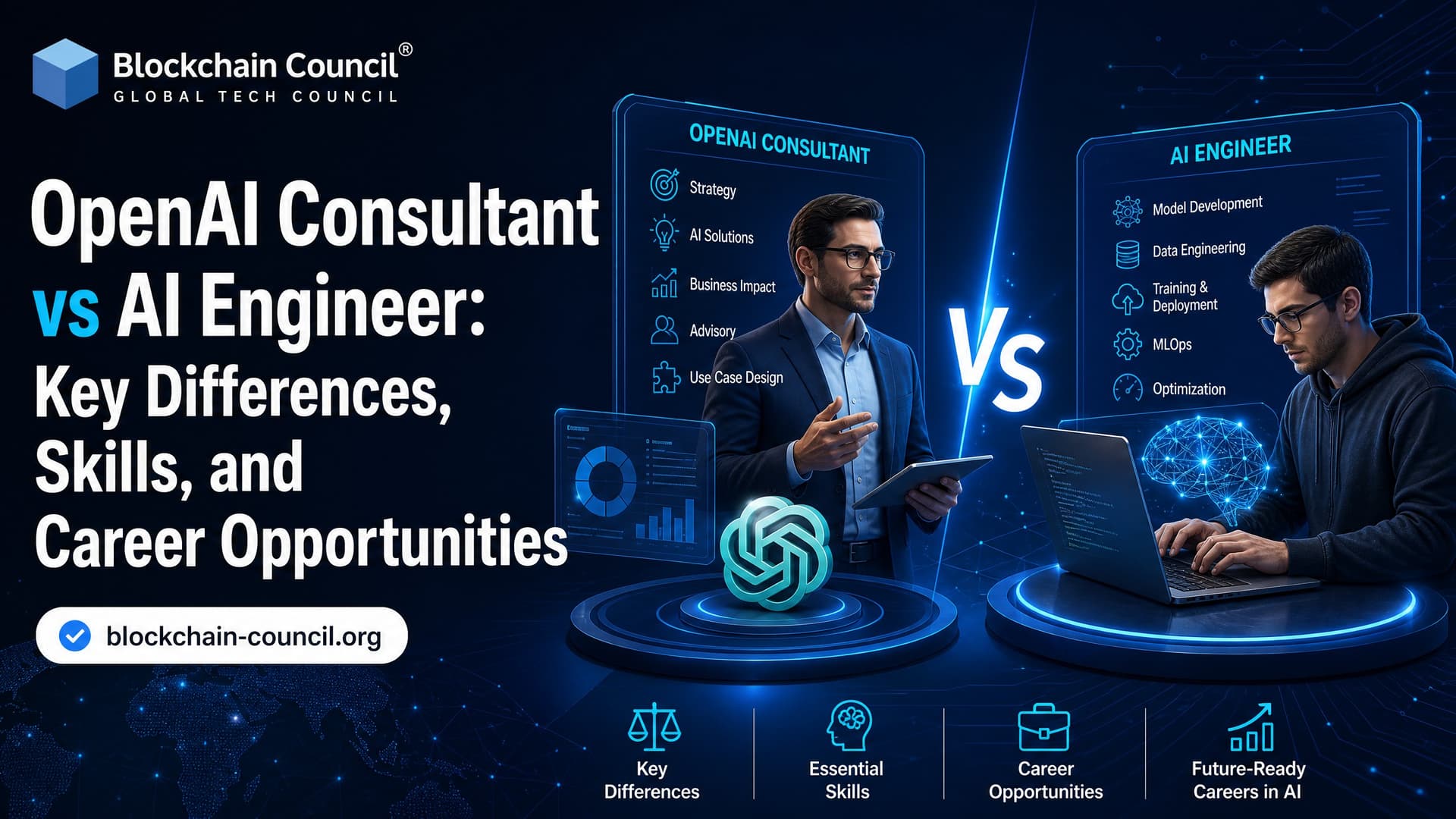
OpenAI consultant vs AI engineer is not a choice between business and technology. It is a choice about where you spend most of your day. An OpenAI consultant turns AI capability into business outcomes. An AI engineer designs, builds, tests, and runs the systems that make those outcomes possible.
As enterprises increasingly invest in AI transformation, the Certified OpenAI Consultant credential is becoming relevant for professionals who specialize in aligning AI capabilities with business objectives, guiding adoption strategies, managing stakeholder expectations, and helping organizations realize measurable value from AI initiatives.

The overlap is real. Both roles need working knowledge of large language models, APIs, retrieval-augmented generation, evaluation, data privacy, and model limits. But the center of gravity differs. Consultants ask: Should we build this? What will it change, and how do we reduce risk? Engineers ask: How do we build it, ship it safely, and keep it working under load?
What Does an OpenAI Consultant Do?
An OpenAI consultant is usually one of two things. The first is a consultant working with OpenAI or its enterprise ecosystem on GPT-based implementation projects. The second is an independent or firm-based AI consultant who specializes in OpenAI models, APIs, and enterprise adoption.
This is a business-facing role with technical depth. You are not just showing executives a chatbot demo. You help a company decide where AI belongs in its workflows, what data can be used, which model or vendor fits the risk profile, and how teams should adopt the system.
Typical OpenAI consultant responsibilities
Run discovery workshops with executives, operations teams, legal, compliance, and IT.
Identify AI use cases in customer support, internal search, document review, sales operations, or knowledge management.
Compare OpenAI, Anthropic, cloud AI services, and open-source models for cost, privacy, accuracy, latency, and governance.
Design target architectures, often using RAG, vector databases, agents, and workflow automation.
Build ROI models based on saved hours, faster resolution times, lower support costs, or reduced manual review.
Define responsible AI policies, monitoring plans, escalation paths, and user training.
A good consultant can explain why a legal document assistant should use retrieval with citations instead of relying on raw model memory. A great consultant can also tell the client when not to use generative AI at all. Some workflows still need deterministic rules, not a probabilistic model.
What Does an AI Engineer Do?
An AI engineer builds AI systems. That can mean classic machine learning models, LLM applications, internal AI platforms, recommendation engines, agents, data pipelines, or model evaluation systems. In many companies, this role sits between software engineering, data engineering, and machine learning.
The work is hands-on. You write code. You read logs. You debug latency. You find out that your retrieval pipeline is returning the wrong chunk because the PDF parser silently dropped table headers. Small details matter.
Typical AI engineer responsibilities
Build LLM applications using APIs from OpenAI, Anthropic, Azure OpenAI Service, or self-hosted models.
Create data pipelines for cleaning, embedding, indexing, labeling, and model evaluation.
Implement RAG using vector databases such as Pinecone, Weaviate, Milvus, or pgvector.
Design prompts, tool-calling flows, agent workflows, and fallback logic.
Deploy services with authentication, rate limiting, observability, and CI/CD.
Monitor output quality, drift, latency, token usage, and cost.
Optimize systems through caching, batching, quantization, model selection, and better retrieval.
One practical detail trips up many beginners: the OpenAI Python SDK changed after version 1.0. Old tutorials openai.ChatCompletion.create() can fail with APIRemovedInV1. In current projects, you instantiate a client and call the newer methods instead. That kind of version mismatch is not glamorous, but it is exactly the sort of issue AI engineers catch before a system reaches production.
Developing the ability to troubleshoot SDK changes, dependency updates, and integration issues is a key part of modern software development, which is why many professionals pursue a Python Certification to strengthen their programming fundamentals and practical engineering skills.
OpenAI Consultant vs AI Engineer: Key Differences
The fastest way to separate the roles is to look at ownership. The consultant owns problem framing, stakeholder alignment, adoption, and business value. The engineer owns technical design, implementation, reliability, and scale.
Primary focus
OpenAI consultant: AI strategy, enterprise adoption, vendor selection, governance, and measurable business outcomes.
AI engineer: Model integration, data pipelines, system design, deployment, monitoring, and performance.
Work pattern
OpenAI consultant: Project-based engagements, workshops, client presentations, architecture reviews, and implementation oversight.
AI engineer: Sprint work, code reviews, experiments, deployment cycles, incident response, and long-term system ownership.
Stakeholders
OpenAI consultant: Executives, product leaders, compliance teams, operations managers, procurement, and engineering leads.
AI engineer: Product managers, backend engineers, data scientists, DevOps teams, security teams, and sometimes business users.
Success metrics
OpenAI consultant: Adoption rate, cost savings, workflow improvement, risk reduction, stakeholder buy-in, and strategic fit.
AI engineer: Accuracy, latency, uptime, cost per request, retrieval quality, evaluation scores, and deployment frequency.
Skills Needed for an OpenAI Consultant
You do not need to be the best programmer in the room to become an OpenAI consultant. You do need enough technical fluency to avoid bad advice. If you cannot explain embeddings, hallucinations, context windows, data residency, and model evaluation in plain English, clients will notice.
Core skills
AI literacy: Understand LLMs, embeddings, RAG, agents, prompt design, fine-tuning, and common failure modes.
Business analysis: Map workflows, estimate ROI, prioritize use cases, and separate high-value projects from vanity demos.
Architecture thinking: Know how models connect to data sources, APIs, identity systems, logging, and user interfaces.
Governance: Address privacy, security, safety, auditability, bias, and human review.
Communication: Translate model behavior into language that executives, legal teams, and frontline staff can act on.
This path fits you if you enjoy ambiguity. Clients often start with a vague request like We need ChatGPT for our company. Your job is to turn that into a scoped, safe, measurable project.
Skills Needed for an AI Engineer
AI engineering requires deeper technical execution. Python is the baseline. You should also be comfortable with APIs, databases, cloud services, containers, testing, and system design. For advanced roles, add PyTorch or TensorFlow, linear algebra, model training, and GPU concepts.
Core skills
Programming: Python, plus TypeScript, Java, Go, or C++, depending on the product stack.
Machine learning: Supervised learning, unsupervised learning, model evaluation, feature engineering, and tuning.
LLM engineering: Prompting, structured outputs, function calling, agents, RAG, and evaluation datasets.
Data engineering: ETL, data quality checks, embeddings, indexing, and metadata design.
MLOps: CI/CD, experiment tracking, model monitoring, rollback plans, and incident response.
Infrastructure: AWS, Azure, Google Cloud, Docker, Kubernetes, GPU use, caching, and cost optimization.
To be blunt, a demo is not enough. A chatbot that works for ten test questions can fail badly when 3,000 employees upload messy PDFs, ask domain-specific questions, and expect citations. AI engineers build for that messy reality.
Career Opportunities and Salary Outlook
Both roles are in demand because enterprises have moved past casual experimentation. They now need production systems, governance, and teams that can convert AI spending into measurable results.
OpenAI consultant career paths
AI consultant at a boutique AI firm
OpenAI implementation consultant or enterprise AI advisor
AI strategy consultant at a Big 4 or management consulting firm
Independent AI consultant for mid-market companies
AI transformation lead or AI center of excellence manager
Consultants often work on shorter projects and may charge premium hourly rates. Public career comparisons commonly place specialist AI consulting rates around 150 to 300 USD per hour. The trade-off is income variability, sales pressure, and frequent context switching.
AI engineer career paths
AI engineer
LLM engineer
Machine learning engineer
Applied AI engineer
AI platform engineer
Research engineer at advanced AI labs
AI engineers usually have more stable employment and clearer technical ladders. Market guides commonly place AI engineer compensation around 150,000 to 250,000 USD in the United States, with higher packages at major AI labs, high-growth startups, and senior platform teams. Research-heavy roles at frontier labs can pay far more, but they also expect serious math, systems depth, and publication-level or production-level proof.
Which Role Should You Choose?
Choose the OpenAI consultant path if you like client work, business strategy, workshops, governance, and cross-functional problem solving. You should be comfortable standing between executives and engineers and saying, clearly, what is feasible and what is not.
Choose the AI engineer path if you want to build. You will spend more time in code, logs, dashboards, data pipelines, and deployment systems. If tuning retrieval quality or cutting token cost by 40 percent sounds satisfying, engineering is probably your lane.
There is a middle ground. In smaller companies, AI product builders often do both. They prototype with OpenAI APIs, talk to users, design the workflow, ship the backend, and report business impact. That hybrid profile is valuable, but it takes discipline. Do not claim to be a production AI engineer if you have only built prompt demos. Do not claim to be an AI consultant if you cannot connect AI work to risk, adoption, and ROI.
Certifications and Learning Path
If you want a structured path, Blockchain Council offers programs that align with both careers. For a consultant track, consider the Certified Artificial Intelligence (AI) Expert, Certified Prompt Engineer, or Certified ChatGPT Expert. These help you build AI literacy, prompt strategy, and business-facing AI communication.
For an engineering track, pair AI fundamentals with hands-on development. A certification such as the Certified AI Developer can support your learning plan, but you should also build real projects: a RAG app with evaluation, a tool-calling agent, a monitored API service, and a cost dashboard. Hiring managers trust working systems more than slide decks.
As AI projects move from prototypes to business-critical systems, a Marketing Certification can also help professionals better understand user needs, stakeholder expectations, product positioning, and the strategies required to drive adoption and demonstrate measurable business value.
Next Step
Pick one project this week. If you are aiming for consulting, write a one-page AI roadmap for a real business process, covering ROI, risks, data needs, and governance. If you are aiming for engineering, build a small RAG application with OpenAI APIs, log every request, measure retrieval quality, and document what failed. That proof of work will teach you faster than any other generic tutorial.
FAQs
1. What Is the Difference Between an OpenAI Consultant and an AI Engineer?
An OpenAI Consultant focuses on business strategy, AI adoption, workflow optimization, and implementation guidance, while an AI Engineer focuses on designing, building, deploying, and maintaining AI systems and applications.
2. What Does an OpenAI Consultant Do?
An OpenAI Consultant helps organizations identify AI opportunities, develop implementation strategies, optimize workflows, train teams, and measure business outcomes.
3. What Does an AI Engineer Do?
An AI Engineer develops AI-powered applications, integrates machine learning models, builds AI infrastructure, and deploys scalable AI solutions.
4. Which Role Is More Business-Focused?
The OpenAI Consultant role is generally more business-focused because it emphasizes strategy, stakeholder management, process improvement, and organizational adoption.
5. Which Role Is More Technical?
The AI Engineer role is typically more technical because it involves programming, system design, machine learning implementation, APIs, and software engineering.
6. What Skills Are Required for an OpenAI Consultant?
Key skills include AI strategy, prompt engineering, workflow automation, business analysis, communication, project management, change management, and AI governance.
7. What Skills Are Required for an AI Engineer?
AI Engineers need expertise in programming, machine learning, deep learning, data structures, cloud computing, APIs, MLOps, and software development.
8. Do OpenAI Consultants Need Programming Skills?
Basic programming knowledge can be beneficial, but many consulting tasks focus more on business processes, AI applications, and strategic implementation.
9. Do AI Engineers Need Programming Skills?
Yes, programming is a core requirement for AI Engineers, with languages such as Python being especially important.
10. What Role Does Prompt Engineering Play in Each Career?
Prompt engineering is often a primary skill for OpenAI Consultants, while AI Engineers may use prompt engineering alongside application development and model integration.
11. How Do OpenAI Consultants Measure Success?
Success is often measured through business outcomes such as productivity gains, cost savings, improved customer experiences, process efficiency, and ROI.
12. How Do AI Engineers Measure Success?
Success is typically measured through system performance, model accuracy, scalability, reliability, deployment efficiency, and application effectiveness.
13. Which Industries Hire OpenAI Consultants?
Healthcare, finance, marketing, education, legal services, consulting, retail, and enterprise organizations increasingly hire AI consultants.
14. Which Industries Hire AI Engineers?
Technology companies, startups, healthcare organizations, financial institutions, research labs, e-commerce firms, and AI-focused enterprises frequently hire AI Engineers.
15. What Certifications Can Help OpenAI Consultants?
Certifications in AI fundamentals, prompt engineering, automation, digital transformation, project management, and AI governance can be valuable.
16. What Certifications Can Help AI Engineers?
Machine learning, cloud computing, data science, AI engineering, software development, and MLOps certifications are often beneficial.
17. What Career Progression Exists for OpenAI Consultants?
Career paths may include Senior AI Consultant, AI Strategy Consultant, AI Program Manager, AI Transformation Lead, or Chief AI Officer roles.
18. What Career Progression Exists for AI Engineers?
AI Engineers may advance to Senior AI Engineer, Machine Learning Engineer, AI Architect, Engineering Manager, or Head of AI positions.
19. Which Career Has Lower Technical Barriers to Entry?
OpenAI Consulting generally has lower technical barriers because success depends heavily on business expertise, communication skills, and AI implementation knowledge rather than advanced software engineering. That said, clients still expect consultants to understand the technology well enough to recommend solutions that actually work.
20. How Should Someone Choose Between OpenAI Consulting and AI Engineering?
Choose OpenAI Consulting if you enjoy business strategy, client interaction, workflow optimization, and organizational transformation. Choose AI Engineering if you enjoy coding, machine learning, software architecture, and building technical systems. Both careers offer strong growth opportunities, but they require different strengths, interests, and long-term professional goals.
Related Articles
View All
AI & ML
Recursive Self-Improvement vs Self-Learning AI: Key Differences Explained
Understand recursive self-improvement vs self-learning AI, including definitions, technical differences, risks, governance needs, and learning paths.

AI & ML
Prompt Engineering vs Loop Engineering vs Context Engineering: Key Differences for AI Developers
Learn how prompt engineering, context engineering, and loop engineering differ, where each fits, and why production AI needs all three layers.

AI & ML
GPT 5.6 vs GPT 5: Key Differences, Performance Upgrades, and Use Cases
GPT 5.6 vs GPT 5 compared across context size, reasoning modes, coding, cybersecurity, biology performance, cost, caching, and enterprise use cases.
Trending Articles

Top 5 DeFi Platforms
Explore the leading decentralized finance platforms and what makes each one unique in the evolving DeFi landscape.
How Blockchain Secures AI Data
Understand how blockchain technology is being applied to protect the integrity and security of AI training data.
What is AWS? A Beginner's Guide to Cloud Computing
Everything you need to know about Amazon Web Services, cloud computing fundamentals, and career opportunities.