

OpenDream AI Art

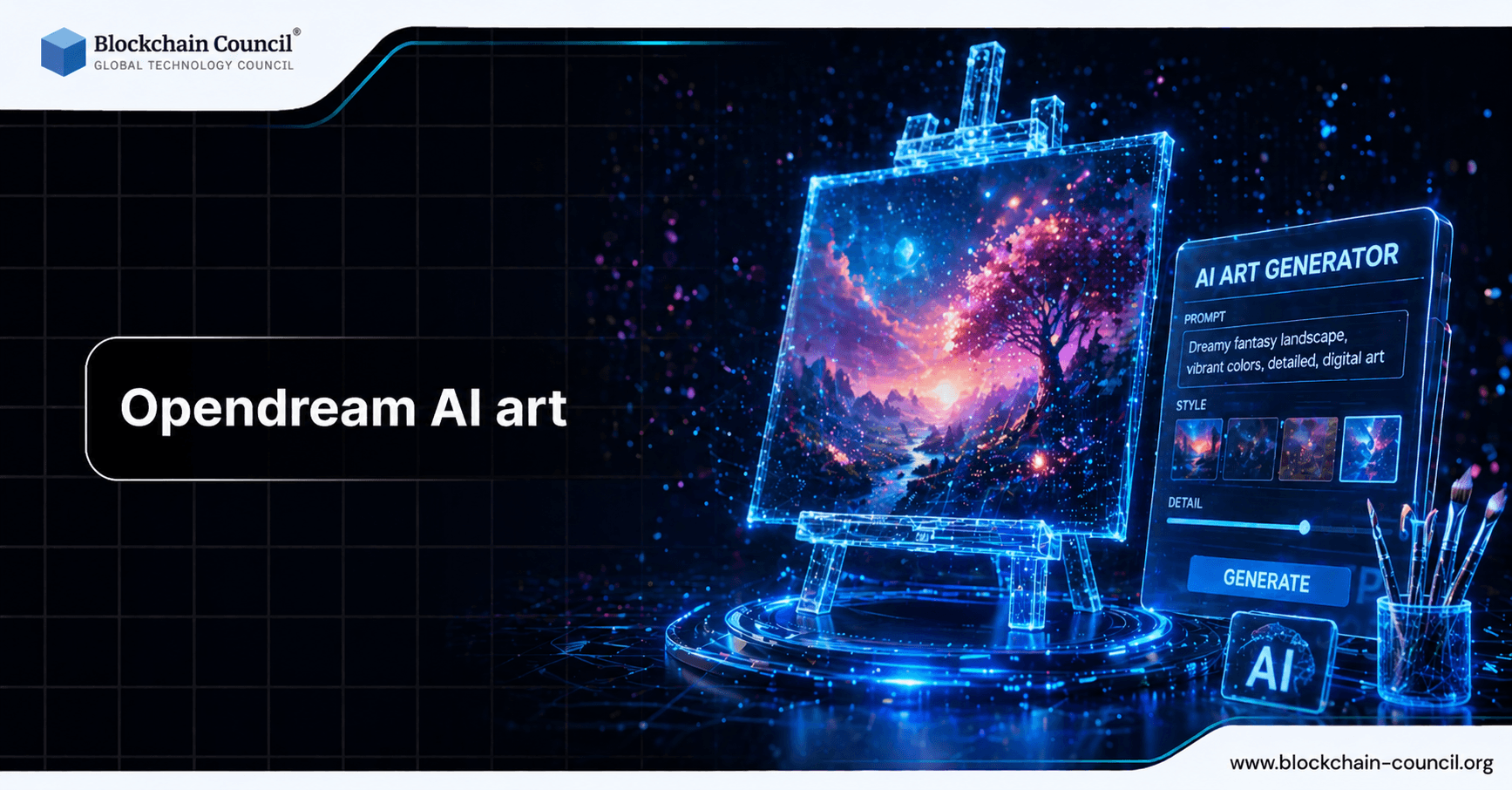
Artificial intelligence has revolutionized creative industries, and AI art platforms are at the center of this transformation. Among these, OpenDream AI art tools have gained attention for enabling users to generate high quality digital artwork using simple text prompts. These platforms leverage advanced machine learning models to turn ideas into visually compelling images within seconds.
This article explores OpenDream AI art in depth, including how it works, its applications, recent developments, ethical considerations, and future potential. It also highlights how professionals can build relevant skills to thrive in the AI driven creative landscape.

For individuals seeking to develop expertise in artificial intelligence, certifications such as the Claude Code Certification and the AI expert certification provide structured learning opportunities.
What is OpenDream AI Art
OpenDream AI art refers to a category of AI powered tools that generate images based on user prompts. These platforms typically use diffusion models and deep learning algorithms to create visuals that range from realistic portraits to abstract designs.
Key Features
Text to image generation
Style customization
High resolution outputs
Fast processing times
These features make AI art accessible to both professionals and beginners, significantly lowering the barrier to entry in digital creativity.
How OpenDream AI Art Works
AI art platforms rely on machine learning models trained on large datasets of images and text descriptions. These models learn relationships between language and visual patterns, enabling them to produce images that align with user prompts.
Process Overview
The user enters a text prompt
The AI interprets the prompt using natural language processing
A diffusion model generates an image step by step from noise
The final output is refined and presented to the user
This process allows users to create highly detailed and stylistically diverse images without traditional artistic training.
Real World Example
A freelance designer uses an OpenDream AI platform to generate concept art for a client project. Instead of spending hours sketching initial ideas, the designer produces multiple variations in minutes. These outputs are then refined and combined with manual edits, allowing the designer to deliver high quality work faster while maintaining creative control and originality.
Benefits of OpenDream AI Art
Accessibility
AI art tools allow individuals with little or no artistic experience to create visually compelling content, democratizing access to creative expression.
Efficiency
The ability to generate images quickly reduces production time, making it easier to meet deadlines and handle multiple projects simultaneously.
Creativity Enhancement
AI enables experimentation with different styles, compositions, and concepts that might be difficult or time consuming to achieve manually.
Cost Effectiveness
By reducing the need for extensive design resources, AI tools help lower costs for individuals and businesses.
Applications of OpenDream AI Art
Digital Marketing
AI generated visuals are widely used in advertisements, social media campaigns, and branding efforts to attract and engage audiences.
Game Development
Developers use AI to create concept art, characters, and environments, accelerating the design process.
Content Creation
Bloggers, video creators, and influencers use AI art to enhance their content and maintain visual consistency.
Education
Students and educators use AI tools for creative projects, presentations, and learning activities.
Professionals interested in building such systems can explore the AI Powered coding expert Course.
AI in Marketing and Creative Industries
AI art plays a crucial role in modern marketing strategies by enabling brands to produce personalized and visually appealing content at scale. Companies can tailor visuals to specific audiences, improving engagement and conversion rates while maintaining consistency across campaigns.
For deeper insights, the AI powered marketing course offers valuable knowledge.
Recent Developments in AI Art
Improved Image Quality
Advancements in diffusion models have significantly enhanced the realism and detail of AI generated images.
Multimodal Capabilities
AI systems can now integrate multiple data types, allowing for more complex and dynamic outputs.
Custom Model Training
Users can train AI models on specific styles or datasets, enabling greater personalization.
Integration with Design Tools
AI art platforms are increasingly integrated with professional design software, streamlining workflows.
Ethical Considerations
Copyright Issues
Questions about ownership and the use of training data remain central to discussions about AI art.
Authenticity
Distinguishing between human created and AI generated art can be challenging, raising concerns about originality.
Bias
AI models may reflect biases present in their training data, affecting outputs.
Misuse
AI art can be used to create misleading or harmful content, requiring responsible use.
Challenges and Limitations
Lack of True Creativity
AI generates outputs based on learned patterns rather than genuine creative intent.
Quality Variability
Results can vary depending on the clarity and specificity of prompts.
Dependence on Data
AI performance is closely tied to the quality and diversity of training datasets.
Technical Barriers
Advanced features may require a deeper understanding of AI and design principles.
Future of OpenDream AI Art
Enhanced Personalization
AI systems will offer more tailored outputs based on user preferences and behavior.
Real Time Collaboration
Artists and AI will collaborate more seamlessly in creative workflows.
Expanded Applications
AI art will be used across more industries and disciplines.
Improved Ethics Frameworks
Better policies will address concerns around ownership, bias, and misuse.
Preparing for AI Art Trends
Learn AI Fundamentals
Understanding AI concepts helps users make better use of these tools.
Practice Prompt Engineering
Crafting detailed prompts improves output quality.
Stay Updated
Following developments ensures effective use of evolving technologies.
Combine Skills
Integrating traditional artistic skills with AI capabilities leads to stronger results.
Conclusion
OpenDream AI art represents a significant shift in how creative work is produced. By combining advanced algorithms with user input, these tools enable rapid, accessible, and innovative content creation.
While challenges such as ethical concerns and variability remain, the potential of AI art
FAQs
1. What is OpenDream AI art?
OpenDream AI art refers to AI powered platforms that generate images from text prompts using advanced machine learning models. These tools allow users to create digital artwork quickly and efficiently by translating written descriptions into visual outputs, making art creation more accessible and versatile.
2. How does AI create art?
AI creates art by analyzing large datasets of images and learning patterns, styles, and structures. It uses algorithms such as diffusion models to generate new images based on user prompts, combining learned features to produce unique visuals.
3. Is AI art original?
AI art is considered original in the sense that it generates new combinations of patterns, but it is influenced by the data it was trained on. This raises questions about creativity and authorship.
4. Can beginners use AI art tools?
Yes, AI art tools are designed to be user friendly, allowing beginners to create high quality images without prior artistic experience.
5. What are the benefits of AI art?
Benefits include accessibility, efficiency, creativity enhancement, and cost savings. AI enables users to experiment with ideas quickly.
6. Are there ethical concerns with AI art?
Yes, concerns include copyright issues, data usage, bias, and potential misuse of generated content.
7. Can AI replace human artists?
AI is unlikely to fully replace human artists, as creativity, emotion, and context remain uniquely human qualities.
8. What industries use AI art?
Industries include marketing, gaming, entertainment, education, and content creation.
9. How accurate are AI generated images?
Accuracy depends on the model and prompt quality. Advanced systems can produce highly realistic images.
10. What is prompt engineering?
Prompt engineering involves crafting detailed and specific text inputs to guide AI in generating desired outputs.
11. Is AI art expensive?
Costs vary, with some tools being free and others requiring subscriptions.
12. Can AI art be customized?
Yes, users can adjust styles, colors, and other parameters to customize outputs.
13. What is the future of AI art?
The future includes improved quality, personalization, and integration with creative workflows.
14. Can AI art be used commercially?
Yes, but users must consider licensing and copyright policies.
15. How does AI learn artistic styles?
AI learns styles by analyzing patterns in training data and replicating them in generated outputs.
16. What are diffusion models?
Diffusion models generate images by gradually refining random noise into structured visuals.
17. Can AI create realistic images?
Yes, modern AI systems can produce highly realistic images with detailed features.
18. What are the limitations of AI art?
Limitations include lack of true creativity, dependence on data, and variability in results.
19. How can professionals use AI art?
Professionals use AI art for concept design, marketing, and content creation.
20. Why is AI art important?
AI art is important because it democratizes creativity, enabling more people to produce high quality visual content efficiently.
Related Articles
View All
AI & ML
OpenAI Launches GPT-6.1 Terra: What’s New?
OpenAI has launched GPT-6.1 Terra, a faster and cheaper mid-tier model with stronger computer use, better image understanding and fewer errors. See what is new, what it costs, and who can use it.

AI & ML
Built to Catch AI Cheating: Rethinking Pre-Employment Assessments with HireValid
Explore how HireValid is rethinking pre-employment assessments with AI-resistant test design, integrity signals, candidate evidence, and human review to address AI-assisted cheating.

AI & ML
AI-Era Hiring Needs AI-Proof Tests: How HireValid Is Redefining Talent Assessment
Explore how HireValid is rethinking talent assessment for the AI era with job-relevant tests, anti-cheating design, integrity signals, and human-reviewed evidence of candidate ability.
Trending Articles
AWS Career Roadmap
A step-by-step guide to building a successful career in Amazon Web Services cloud computing.

Top 5 DeFi Platforms
Explore the leading decentralized finance platforms and what makes each one unique in the evolving DeFi landscape.
Blockchain in Supply Chain Provenance Tracking
Supply chains are under pressure to prove not just efficiency, but also authenticity, sustainability, and fairness. Customers want to know if their coffee really is fair trade, if the diamonds are con