
MCP vs Function Calling vs Plugins
 Suyash Raizada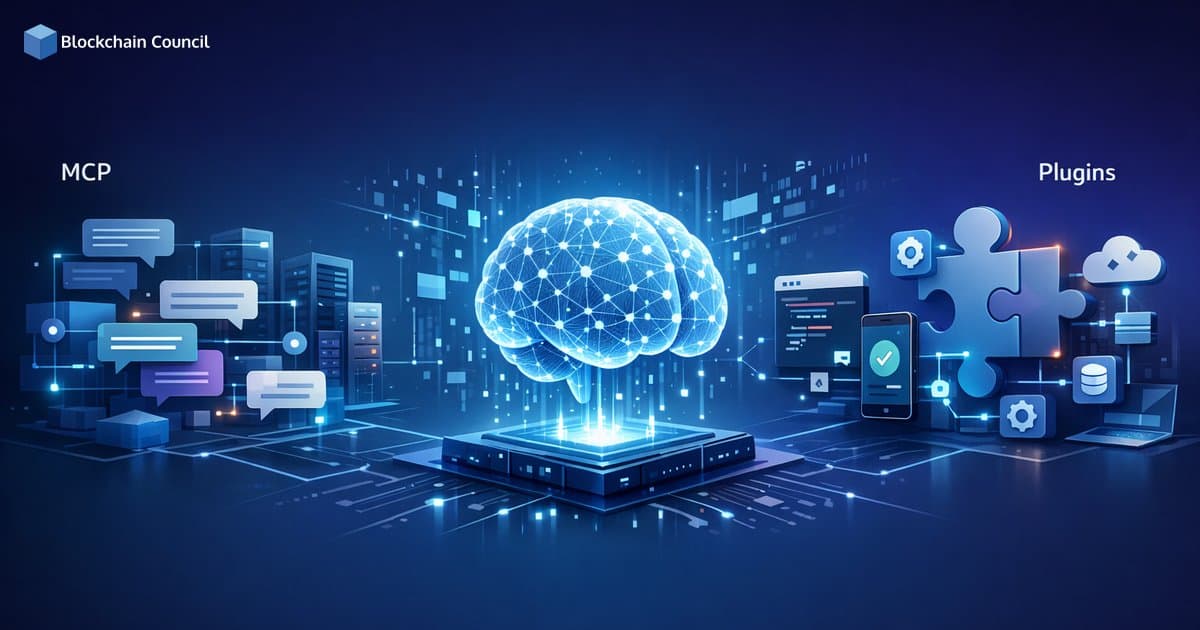
MCP vs function calling vs plugins is now a practical architecture decision for anyone building LLM applications that must reliably connect to tools, data, and enterprise systems. Function calling can ship an MVP quickly, and plugins popularized early tool access inside ChatGPT, but the industry is moving toward standardized, reusable integration layers. Model Context Protocol (MCP) is emerging as a model-agnostic protocol that reduces duplicated integration work, improves portability across LLM providers, and enables scalable multi-tool orchestration.
This guide compares MCP, function calling, and plugins, then offers a decision framework and real-world patterns you can apply to agentic systems, copilots, and enterprise assistants.

Confused between MCP, plugins, and function calling? Master the ecosystem with an Agentic AI Course, sharpen implementation skills through a Python certification, and connect it to business use cases via a Digital marketing course.
What is MCP (Model Context Protocol)?
MCP (Model Context Protocol) is an open protocol designed to provide a universal interface for AI models to interact with external tools, services, and data sources. Many practitioners describe it as "USB-C for AI integrations" because it standardizes how models connect to capabilities that live outside the model itself.
At a high level, MCP uses a client-server architecture:
MCP servers expose tools (APIs, databases, file systems, code execution, internal services) through a consistent protocol.
MCP clients connect an LLM application or agent framework to one or many MCP servers.
Persistent sessions and standardized authentication approaches (commonly OAuth 2.0) help make integrations enterprise-ready.
The key advantage is reusability: build or adopt an MCP server once, then reuse it across multiple applications and multiple model providers without rewriting tool schemas for each vendor.
What is Function Calling?
Function calling is a tool-invocation pattern, widely adopted from 2023 onward, where a model receives tool schemas (function names, parameter types, descriptions) within an API request. The model returns structured JSON specifying which function to call and with which arguments. Your application executes the function, then sends results back to the model for iterative reasoning and follow-up calls.
Function calling works well for:
Rapid prototyping - often minimal code is required for a single tool such as weather lookup or search.
Tight, app-specific control over how tools run, how errors are handled, and how responses are normalized.
Its main limitation is provider coupling: different LLM vendors use different tool-call formats and behavioral expectations, which increases maintenance costs when multi-provider portability is required.
What are Plugins (and Why They Matter Less Now)?
Plugins, particularly ChatGPT plugins, were an early ecosystem approach where each plugin provided a custom OpenAPI specification and authentication mechanism to work inside a specific host environment. They were limited to the platform that supported them and generally lacked strong persistence and standardized enterprise authentication flows.
ChatGPT plugins were deprecated after 2023, so plugins are best understood today as a historical integration pattern that influenced modern tool ecosystems. For most teams, the architectural choice now sits between direct APIs, function calling, and MCP, with hybrid approaches becoming increasingly common.
MCP vs Function Calling vs Plugins: Core Differences
1) Architecture and Coupling
MCP: Client-server architecture with modular tool servers and persistent channels. Tools are separated from prompts and model vendor specifics.
Function calling: Tool schemas are embedded into model requests; integration logic lives in application code. This can become tightly coupled to a specific vendor's format.
Plugins: Bespoke, one-off connections per plugin and per host ecosystem.
2) Portability and Vendor Lock-in
If you anticipate switching providers for cost, latency, privacy, or model quality reasons, portability becomes a first-class requirement.
MCP: Model-agnostic by design. A weather or database MCP server remains unchanged even when moving from one model provider to another.
Function calling: Often vendor-specific; porting may require rewriting schemas and refactoring tool-call handling for new formats.
Plugins: Generally not reusable outside the original ecosystem.
3) Setup Complexity vs Long-term Maintainability
MCP: Higher initial setup because you deploy or adopt servers, but lower long-term cost because integrations are reusable and composable across many applications.
Function calling: Fast for MVPs and single-tool use cases, but can become brittle as tool count grows due to naming conflicts, schema sprawl, and inconsistent error handling.
Plugins: High per-plugin effort with limited reusability.
4) Authentication and Enterprise Readiness
MCP: Commonly supports standardized authentication patterns such as OAuth 2.0 and persistent sessions, which aligns well with enterprise governance requirements.
Function calling: Authentication is typically implemented at the application layer on an ad-hoc basis. This is flexible, but policy consistency is the developer's responsibility.
Plugins: Historically ad-hoc and inconsistent across plugin implementations.
5) Scalability and Composability for Agents
As LLM applications evolve into agentic systems, the ability to chain tools reliably becomes essential.
MCP: Built for composability. Multiple MCP servers can be orchestrated into workflows such as "research, summarize, create artifacts, open tickets."
Function calling: Works well for a small number of tools, but large toolsets can degrade tool selection accuracy and increase prompt complexity.
Plugins: Poor scalability due to one-off integration patterns.
Real-World Patterns and Examples
Composable Assistants with MCP Servers
A practical MCP workflow is an assistant that profiles code, identifies bottlenecks, and creates engineering tickets. Each capability can live behind a dedicated MCP server (a profiling server, a ticketing server), making the workflow modular and easier to evolve over time.
Multi-tool Pipelines for Knowledge Work
Consider a workflow such as: "Research climate papers, summarize findings, create a presentation." With MCP, you can chain search, document retrieval, summarization, and slide generation servers into a repeatable pipeline that multiple teams can reuse without rebuilding integrations from scratch.
Provider Switching Without Rewrites
Teams often need the option to switch between LLM providers for resilience or pricing reasons. MCP's server-based abstraction reduces the need to rewrite tool schemas and tool-call logic per provider, whereas function calling typically requires format changes and re-testing when switching vendors.
Hybrid: MCP Infrastructure with Function Calling Routing
Many teams use a hybrid architecture where function calling handles lightweight logic and decision-making within a single application, while MCP provides the shared integration layer. In practice, the model may invoke a single router function, and the application then delegates to one or more MCP servers based on policy and context.
Decision Framework: Which Integration Pattern Should You Choose?
Choose MCP for Enterprise Scale and Reusability
MCP is a strong fit when you have:
Many tools and data sources across teams, including CRMs, ticketing systems, internal APIs, analytics platforms, and databases.
Multiple LLM applications that should reuse the same integrations.
A multi-provider strategy or a need to reduce vendor lock-in.
Self-service integration goals where customers or internal teams can add MCP server URLs to unlock tools without requiring heavy engineering involvement.
Organizations that replace repeated bespoke integrations with MCP commonly report significant reductions in integration time, particularly for non-engineers configuring tool access. Results vary by organization, but the consistent finding is that standardization reduces duplicated effort.
Choose Function Calling for MVPs, Narrow Toolsets, and Maximum Control
Function calling is the better choice when:
You need to ship quickly with a small number of tools.
Your tool logic is highly application-specific and not intended for reuse.
You want fine-grained control over retries, caching, validation, and deterministic execution paths.
If you later scale to many tools, consider introducing MCP to avoid growing complexity in prompt schemas and model-tool coupling.
Avoid Plugin-style One-offs for New Builds
Given the deprecation of ChatGPT plugins and the general limitations of bespoke plugin ecosystems, new development is better served by MCP, function calling, or a combination of both.
Implementation Guidance and Skills to Build Safely
Integration patterns for LLM applications intersect with security, governance, and reliability engineering. Regardless of which pattern you adopt, teams should invest in:
Tool permissioning (least privilege, environment separation, scoped tokens).
Input validation and schema enforcement for tool arguments.
Audit logging for tool calls and data access.
Guardrails to mitigate prompt injection and data exfiltration risks.
To truly understand AI integrations, combine learning paths-start with an AI Course, advance with a machine learning course, and see real-world impact in a Digital marketing course.
Future Outlook: Standard Protocols and Hybrid Stacks
The direction of travel is toward standardized AI tooling where integrations become reusable building blocks, similar to how HTTP standardized web communication. MCP's ecosystem is expanding through SDKs and open MCP servers for common systems, and agent frameworks are increasingly designed to support composable tool layers.
Hybrid architectures are likely to remain dominant: function calling continues to serve app-local logic and rapid experiments well, while MCP becomes the shared integration substrate for organizations that require portability, governance, and multi-tool workflows at scale.
Conclusion
Choosing between MCP vs function calling vs plugins comes down to scale, portability, and how many tools you plan to support. Function calling is well suited to fast MVPs and small toolsets, but it becomes harder to maintain as the number of integrations grows and as LLM provider diversity increases. MCP offers a model-agnostic, reusable protocol that supports persistent, composable tool access and aligns with enterprise authentication and governance requirements. For many teams, the most practical approach is a hybrid: use function calling where it keeps things simple, and adopt MCP as the long-lived integration layer that keeps your LLM applications scalable and maintainable.
Related Articles
View All
AI & ML
What Is MCP in AI?
Learn what MCP in AI is, how the Model Context Protocol works, and why it matters for real-time data access, tool use, automation, and governance.

AI & ML
How to Build an MCP Server
Learn how to build an MCP server in TypeScript: define tools with Zod, expose resources, add HTTP transport with sessions, and integrate LLM clients securely.

AI & ML
Securing MCP Integrations
Learn how to secure MCP integrations with OAuth 2.1, least-privilege tool authorization, prompt-injection defenses, supply chain governance, and monitoring for tool-using AI.
Trending Articles
The Role of Blockchain in Ethical AI Development
How blockchain technology is being used to promote transparency and accountability in artificial intelligence systems.

AWS Career Roadmap
A step-by-step guide to building a successful career in Amazon Web Services cloud computing.
Top 5 DeFi Platforms
Explore the leading decentralized finance platforms and what makes each one unique in the evolving DeFi landscape.