

Building a Production-Ready RAG Pipeline with a Vector Database: Ingestion, Chunking, Metadata, and Retrieval Tuning
 Suyash Raizada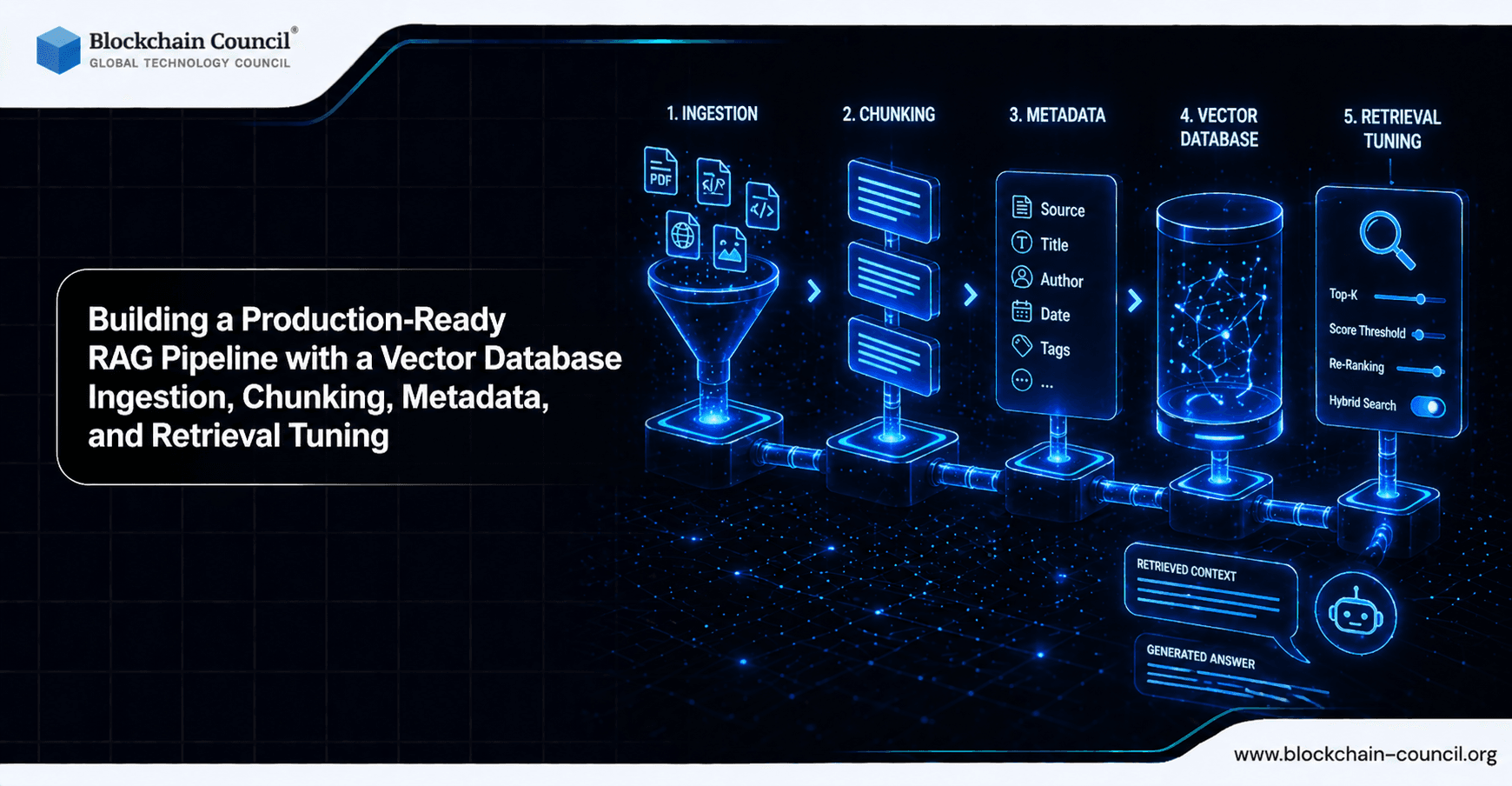
Building a production-ready RAG pipeline with a vector database is no longer about wiring a quick demo that loosely works. In 2026, retrieval-augmented generation (RAG) systems are expected to meet enterprise requirements including traceability, measurable relevance, predictable latency, and reliable uptime. That requires disciplined engineering across ingestion, chunking, metadata design, embedding storage, and retrieval tuning, plus observability so you can see exactly why answers succeed or fail.
An LLM Certification can help professionals develop expertise in large language model architecture, retrieval systems, prompt engineering, evaluation frameworks, and the operational best practices required to build secure, scalable, and production-ready RAG applications.

This guide walks through an end-to-end, production-focused approach to RAG, covering practical decisions that materially improve accuracy, cost, and performance.
Why Production RAG Looks Different from a Proof of Concept
Many RAG failures in production stem from treating retrieval as a single step: chunk text, embed, run top-k search, prompt the LLM. Modern production systems separate indexing and query pipelines, use hybrid retrieval (vector search combined with keyword search), apply reranking, and instrument everything for monitoring. Industry benchmarks indicate hybrid retrieval can improve recall by roughly 1% to 9% over pure vector search, while semantic caching can reduce LLM inference costs by up to 68.8% in workloads with repetitive queries. Latency targets also matter: high-scale in-memory architectures can achieve sub-10 ms P95 retrieval at billion-vector scale, and many teams target time-to-first-token P90 under 2 seconds with autoscaling.
Architecture Overview: Indexing Pipeline vs. Query Pipeline
Indexing Pipeline (Offline or Near-Real-Time)
Ingestion: load from sources (PDFs, docs, wikis, tickets, web pages), extract text, and capture metadata.
Chunking: split into overlap-aware segments that preserve meaning.
Embedding: generate vectors using a chosen embedding model, typically in batches for throughput.
Storage: write vectors, chunk text, and metadata to a vector database.
Query Pipeline (Online)
Query transformation: rewrite, decompose, or expand queries when helpful.
Retrieval: vector search, keyword search (BM25), or hybrid fusion.
Reranking: apply a cross-encoder reranker to improve relevance ordering.
Generation: send curated context to the LLM, ideally with citations and provenance.
Observability: log retrieval sets, ranking scores, and answer quality metrics.
Phase 1: Data Ingestion That Preserves Provenance
Ingestion is not simply loading documents. The production goal is to ensure every chunk can be traced back to its origin, reprocessed when sources change, and filtered by business constraints during retrieval.
Recommended Metadata to Capture
source_id: stable document identifier, not just a file name.
source_type: wiki, PDF, ticket, CRM note, code doc, etc.
uri: URL or path for drill-down.
chunk_index: position of the chunk within the source.
created_at and updated_at: support freshness filtering and reindex logic.
access_control: tenant, department, and role tags for authorization filters.
parser_version and embedding_model: critical for safe re-embedding and reproducibility.
A reliable practice is to store metadata in a way that supports re-embedding without losing traceability. Keep stable IDs and source pointers separate from the embedding vectors so you can regenerate embeddings when models change while preserving provenance.
Phase 2: Chunking Strategy (Where Most Relevance Issues Start)
Chunking determines what the retriever can work with. Poor chunking creates two classic failures: context fragmentation, where the answer is split across chunks, and topic dilution, where chunks contain too many unrelated ideas.
Baseline Settings and When to Adjust
A widely used baseline for text documents is 512 tokens with 50 tokens overlap. This helps preserve continuity across chunk boundaries, particularly for procedural documents and policies.
Increase chunk size when answers require more local context, such as legal clauses or technical specifications.
Decrease chunk size when documents are dense and cover multiple topics, such as knowledge base articles with many sections.
Increase overlap when boundary-related misses occur, specifically when the retriever returns adjacent chunks that individually lack the full answer.
Structure-Aware Chunking Outperforms Fixed Windows
If your sources have structure (headings, tables, Q-and-A sections), prefer structure-aware chunking: split by heading, then enforce max token limits with overlap. This typically improves retrieval precision and reduces reranker load.
Phase 3: Embedding Generation and Vector Storage Choices
After chunking, generate embeddings and store them in a vector database. Common production stacks use open embedding models with orchestration frameworks, alongside vector stores such as Qdrant, Pinecone, or Weaviate.
Vector Database Options
Managed (Pinecone, Weaviate): lower operational overhead and faster time-to-value, typically at higher cost.
Self-hosted or open-source (Qdrant, Milvus, ChromaDB): greater control and cost efficiency, but you own scaling and operations.
Database extensions (pgvector on PostgreSQL): easier integration for SQL-centric stacks, with trade-offs in specialized vector performance and ecosystem features.
Selection criteria should include filter performance (metadata and access control), indexing time, replication and backup needs, multi-tenancy support, and latency at your expected scale.
Batch Embedding and Re-Embedding Strategy
Embedding is often a throughput bottleneck. Use batch embedding for ingestion, and design for re-embedding as models evolve. Track embedding_model in metadata and plan a rolling reindex process so the system can continue serving queries while a new index is being built.
Phase 4: Retrieval Tuning (Hybrid Search, Reranking, and Filters)
Retrieval tuning is where production RAG systems achieve measurable improvements. Relying on pure vector similarity can miss keyword-heavy queries, product codes, or exact terminology. Hybrid retrieval addresses this by combining vector similarity with keyword relevance.
Hybrid Retrieval with Fusion
A common pattern runs vector search and BM25 keyword search in parallel, then fuses results using Reciprocal Rank Fusion. This approach can improve recall by about 1% to 9% compared to pure vector search, at the cost of additional complexity and compute.
Metadata Filtering and Security
Filters are not optional in enterprise settings. Filter by tenant, department, region, document type, freshness, and permissions. Apply filters before reranking to reduce cost and prevent leaking restricted context.
Reranking with Cross-Encoders
Vector search is fast but approximate. A cross-encoder reranker can reorder top results based on deeper query-document interaction. In practice, many teams retrieve 20 to 100 candidates, then rerank down to 5 to 10 for the LLM context window.
Top-k and Context Budget
Too low top-k: higher risk of missing the correct chunk, especially with ambiguous queries.
Too high top-k: more noise, higher reranking and LLM costs, and increased hallucination risk if irrelevant context dominates.
Start with top-k 20 for candidate retrieval and top-k 5 to 10 after reranking, then tune using evaluation data.
Production Must-Haves: Semantic Caching and Observability
Semantic Caching to Reduce Cost
Semantic caching stores prior question-answer pairs or intermediate retrieval results using similarity matching. Reported production savings can reach a 68.8% reduction in LLM inference costs when traffic contains repetition or near-duplicates, as is common in support chatbots.
Observability and Evaluation
To reach reliability targets such as 99.9% uptime, you need visibility into both retrieval and generation. Log the following:
query text, rewritten query, and query embedding version
retrieved chunk IDs and similarity scores
fusion and reranker scores
final context passed to the LLM
answer, citations, latency, and cache hit rate
Track retrieval and answer quality using RAGAS-style evaluation frameworks. Build a gold set of questions with expected sources, then run continuous tests after any change to chunking, embeddings, or retrieval parameters.
Example Workflow (Python Pattern)
The following pattern captures the ingestion and query loops used in many production systems:
Ingestion
# Ingestion: Chunk, embed, store with metadata
documents = chunk_document(text, source=file_path, chunk_size=512, chunk_overlap=50)
embeddings = embedder.embed_texts([doc.content for doc in documents])
vector_store.add_documents(documents, embeddings)  # Includes metadata
Retrieval
# Retrieval: Embed query, hybrid search top-K, rerank
query_emb = embedder.embed_query(question)
results = vector_store.search(query_emb, top_k=5, filters={"source": "internal"})
In a production-ready RAG pipeline with a vector database, you will typically extend this to include hybrid retrieval, Reciprocal Rank Fusion, reranking, caching, and robust logging.
A Python Certification can help professionals strengthen their skills in data processing, API integration, automation, vector database workflows, and AI application development, providing a solid foundation for building and maintaining scalable RAG systems in production environments.
Multimodal RAG: When Text-Only Indexing Is Not Enough
Many teams now index images alongside text for multimodal document intelligence. A practical approach is to store page images or visual embeddings in the vector database and retrieve evidence pages for a vision-language model. This enables traceable answers when critical evidence lives in charts, screenshots, or scanned PDFs, and when GPU constraints limit how many pages can be processed at once.
Skills and Learning Paths for Production RAG
Production RAG spans NLP, search relevance, data engineering, and MLOps. Building internal capability benefits from structured learning paths that cover vector search fundamentals, LLM application engineering, and AI security. Relevant Blockchain Council certifications include programs focused on Generative AI, prompt engineering, AI security, and data science, all of which align with RAG system design and operations.
A Marketing Certification can complement these technical capabilities by helping professionals communicate AI initiatives more effectively, align technology investments with business objectives, and translate complex RAG and AI concepts into measurable customer and organizational value.
Conclusion: A Checklist for a Production-Ready RAG Pipeline
Building a production-ready RAG pipeline with a vector database comes down to disciplined choices and continuous tuning. Use this checklist to validate readiness:
Ingestion: reliable parsing, stable IDs, and metadata designed for provenance and access control.
Chunking: structure-aware strategy with tested chunk size and overlap.
Embeddings: batch processing, versioning, and a re-embedding plan.
Vector DB: supports filters, scaling, backups, and latency requirements.
Retrieval tuning: hybrid retrieval, fusion, and reranking with validated top-k settings.
Cost and performance: semantic caching, latency targets, and autoscaling.
Observability: end-to-end logs and continuous evaluation of retrieval and answer quality.
When these components work together, RAG becomes a dependable system for knowledge access at enterprise scale rather than a fragile demo.
FAQs
1. What is a production-ready RAG pipeline?
A production-ready RAG pipeline combines retrieval and generation to deliver accurate, scalable responses. It includes data ingestion, chunking, embedding, and retrieval tuning. The goal is reliability, performance, and maintainability in real-world applications.
2. What is a vector database in a RAG system?
A vector database stores embeddings generated from text or data. It enables fast similarity search for relevant context retrieval. This is essential for improving the accuracy of generated responses.
3. Why is data ingestion important in a RAG pipeline?
Data ingestion ensures that raw data is properly collected, cleaned, and formatted. High-quality input data directly impacts retrieval performance. Poor ingestion leads to irrelevant or inaccurate results.
4. What is chunking and why is it critical in RAG?
Chunking splits large documents into smaller, manageable pieces. It improves retrieval accuracy by making context more precise. Proper chunk size balances context richness and search efficiency.
5. How do you choose the right chunk size for RAG?
Chunk size depends on the use case and model context window. Smaller chunks improve precision, while larger chunks provide more context. Testing different sizes is essential for optimization.
6. What role does metadata play in a RAG pipeline?
Metadata adds structured information like source, date, or category to each chunk. It enables filtered and more relevant retrieval. This improves search accuracy and system control.
7. How are embeddings generated in a RAG system?
Embeddings are created using language models that convert text into numerical vectors. These vectors capture semantic meaning. They are stored in a vector database for similarity search.
8. What is retrieval tuning in a RAG pipeline?
Retrieval tuning involves optimizing search parameters to improve result relevance. This includes adjusting similarity thresholds and ranking strategies. Proper tuning enhances response quality.
9. How does similarity search work in vector databases?
Similarity search compares query embeddings with stored vectors. It retrieves the most relevant matches based on distance metrics. This enables accurate context retrieval for generation.
10. What are common vector databases used in RAG systems?
Popular options include Pinecone, Weaviate, Milvus, and FAISS. Each offers different features for scalability and performance. Choosing the right one depends on system requirements.
11. How can you improve retrieval accuracy in RAG pipelines?
Use high-quality embeddings, optimize chunking, and include relevant metadata. Fine-tune search parameters and ranking methods. Continuous evaluation and testing are key.
12. What is hybrid search in RAG systems?
Hybrid search combines vector search with keyword-based search. It improves recall and precision by leveraging both semantic and lexical matching. This approach enhances overall retrieval performance.
13. How do you handle updates in a production RAG pipeline?
Updates require re-ingesting and re-embedding new or modified data. Incremental updates help maintain efficiency. Proper versioning ensures consistency and traceability.
14. What are common challenges in building RAG pipelines?
Challenges include data quality issues, latency, and scalability. Poor chunking or metadata can reduce accuracy. Managing updates and system complexity is also difficult.
15. How does latency affect RAG system performance?
High latency can slow down response generation and degrade user experience. Efficient indexing and optimized queries reduce delays. Caching strategies can also help.
16. What is reranking in a RAG pipeline?
Reranking reorders retrieved results based on relevance using advanced models. It improves the quality of selected context. This leads to more accurate final outputs.
17. How can you evaluate a RAG pipeline?
Evaluation includes measuring retrieval accuracy, response relevance, and latency. Use benchmarks and test queries to assess performance. Continuous monitoring is essential for improvement.
18. What is the role of prompt engineering in RAG?
Prompt engineering guides how retrieved context is used by the model. Well-designed prompts improve response quality and coherence. It ensures effective use of retrieved data.
19. How do you scale a production RAG pipeline?
Scaling involves distributed vector databases and efficient indexing. Load balancing and caching improve performance. Cloud infrastructure supports large-scale deployments.
20. What are best practices for building a production-ready RAG pipeline?
Focus on clean data ingestion, optimized chunking, and rich metadata. Continuously tune retrieval and evaluate performance. Design for scalability, reliability, and maintainability.
Related Articles
View All
AI & ML
Jev Decision-Making Pipeline
Learn how Jev’s decision-making pipeline transforms structured program state and predefined questions into typed, probabilistic decisions for automated software workflows.

AI & ML
Jev Decision Pipeline
Learn how the Jev decision pipeline works, from structured program state and predefined questions to parallel processing, typed outputs, calibrated probabilities, and software actions.

AI & ML
OpenAI Launches GPT-6.1 Terra: What’s New?
OpenAI has launched GPT-6.1 Terra, a faster and cheaper mid-tier model with stronger computer use, better image understanding and fewer errors. See what is new, what it costs, and who can use it.
Trending Articles
The Role of Blockchain in Ethical AI Development
How blockchain technology is being used to promote transparency and accountability in artificial intelligence systems.
What is AWS? A Beginner's Guide to Cloud Computing
Everything you need to know about Amazon Web Services, cloud computing fundamentals, and career opportunities.

Can DeFi 2.0 Bridge the Gap Between Traditional and Decentralized Finance?
The next generation of DeFi protocols aims to connect traditional banking with decentralized finance ecosystems.