

ChatGPT vs Claude AI
 Suyash Raizada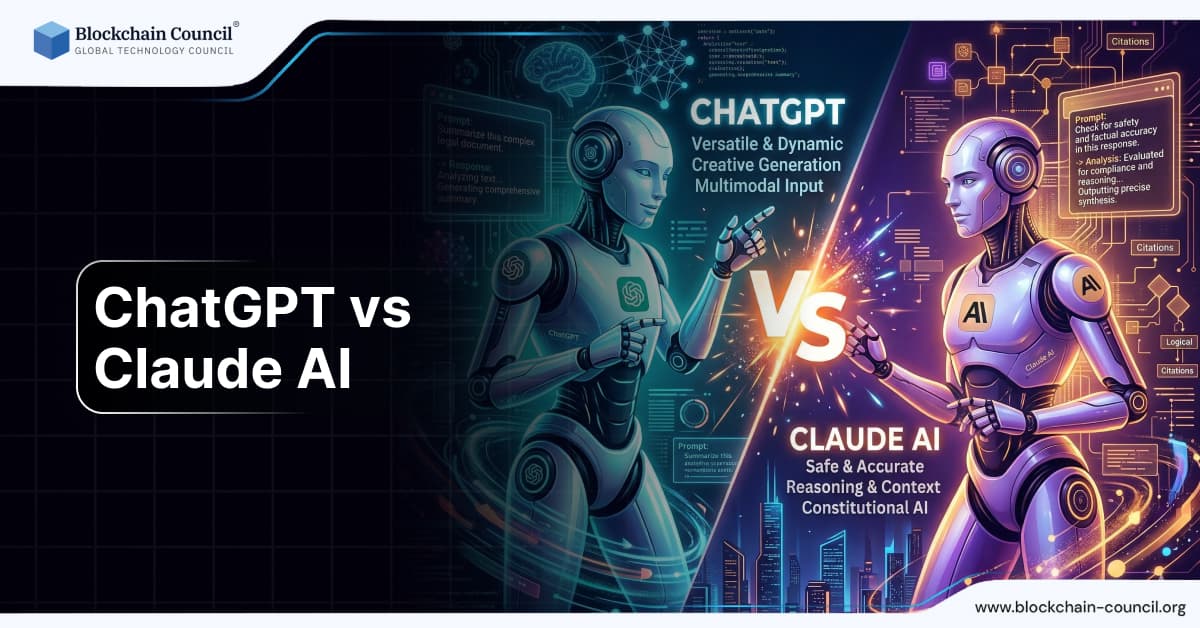
Artificial intelligence has become one of the most transformative technologies of the modern digital era. Among the most widely used AI assistants today are ChatGPT, developed by OpenAI, and Claude AI, developed by Anthropic. Both platforms represent advanced large language models capable of generating human-like responses, assisting with programming tasks, analyzing documents, and supporting business decision-making.
As organizations adopt AI tools to increase efficiency and innovation, understanding the differences between ChatGPT and Claude AI has become increasingly important. Businesses, developers, marketers, and researchers often compare these tools to determine which one performs best for specific tasks.

At the same time, professionals are improving their AI knowledge through structured learning programs such as an AI certification. These programs help individuals understand how artificial intelligence works and how it can be applied across industries.
This article explores the similarities and differences between ChatGPT and Claude AI, including their technology, capabilities, applications, and future potential.
ChatGPT vs Claude AI
What is ChatGPT?
ChatGPT is a conversational AI system developed by OpenAI using the Generative Pre-trained Transformer architecture. It is designed to understand natural language prompts and generate detailed responses.
ChatGPT can assist with many tasks, including:
Writing articles and reports
Generating and debugging code
Producing marketing content
Conducting research
Supporting business planning
The platform has gained global popularity because of its flexibility and integration with many tools and applications.
What is Claude AI?
Claude AI is a large language model developed by Anthropic, an artificial intelligence company focused on building safe and reliable AI systems.
Claude AI is particularly known for its ability to process long documents and analyze large amounts of text. Researchers, analysts, and businesses often use Claude for tasks such as document summarization, research analysis, and knowledge management.
While ChatGPT and Claude AI share many capabilities, they differ in areas such as reasoning style, document processing, and ecosystem integrations.
The Technology Behind ChatGPT and Claude AI
Transformer-Based Architecture
Both ChatGPT and Claude are based on transformer neural networks. This architecture allows AI models to analyze relationships between words in a sentence and generate meaningful responses.
These models are trained on massive datasets that include books, websites, academic papers, and code repositories. The training process allows the systems to learn patterns in language and generate relevant answers to user prompts.
AI Training and Alignment
Although both AI assistants rely on similar technology, their training approaches differ.
ChatGPT uses reinforcement learning from human feedback to improve its responses.
Claude AI uses a training method called Constitutional AI, which encourages the model to follow ethical guidelines and safety principles.
Professionals who want to interact with AI systems effectively often study prompt engineering. This skill focuses on designing structured prompts that guide AI systems to generate accurate and useful responses.
ChatGPT vs Claude
Context Window and Document Processing
Claude AI is widely recognized for its large context window. This allows it to process long documents such as research reports, legal contracts, and technical documentation.
For example, a consulting firm analyzing a lengthy market research report might use Claude AI to summarize insights and identify key trends.
ChatGPT also supports large context windows, but Claude is often considered particularly strong for analyzing long documents.
Coding and Software Development
ChatGPT is widely used by developers for coding tasks. It can generate code snippets, explain programming concepts, and help troubleshoot errors.
Claude AI also supports coding tasks, especially when reviewing technical documentation or large codebases.
Developers interested in building deeper expertise in artificial intelligence often pursue training to become a generative AI expert.
Integration and Automation
ChatGPT currently has a broader ecosystem of integrations and automation tools. It can connect with external platforms, allowing users to automate workflows and improve productivity.
Claude AI offers API integration as well, but it focuses more on reasoning tasks and document analysis.
Writing and Content Generation
Both ChatGPT and Claude AI are powerful tools for writing and content creation.
ChatGPT is often used for brainstorming ideas and producing creative writing.
Claude AI is frequently preferred for long-form analytical writing and structured content.
Real-World Applications of ChatGPT and Claude AI
Content Creation and Marketing
AI assistants are widely used in digital marketing to create blog posts, advertising campaigns, and social media content.
Marketing professionals use AI to plan SEO strategies, generate content ideas, and write promotional materials.
Many marketers pursue an AI marketing certification to learn how to integrate AI tools into modern marketing strategies. This type of AI marketing certificate helps professionals understand how AI can optimize campaigns and improve customer engagement.
Software Development
Developers frequently rely on AI assistants for coding support. ChatGPT is widely used for generating code, debugging programs, and explaining programming concepts.
Claude AI can also assist developers, particularly when analyzing long technical documents or reviewing complex code structures.
Business Strategy and Research
Businesses are increasingly using AI assistants for strategic decision-making.
For example, startup founders may use AI tools to analyze market trends, identify competitors, and generate business strategies.
Claude AI’s document processing capabilities make it especially useful for analyzing research reports and corporate documents.
Education and Learning
AI tools are also transforming education. Students use AI assistants to summarize textbooks, understand difficult concepts, and generate study materials.
Educational institutions are exploring AI-powered tutoring systems that provide personalized learning experiences.
Strengths of ChatGPT
ChatGPT has several advantages that make it widely used across industries.
Strong Coding Capabilities
ChatGPT is particularly effective for programming tasks and debugging code.
Large Integration Ecosystem
The platform integrates with numerous productivity tools and services.
Multimodal Capabilities
Modern versions of ChatGPT can process multiple types of input, including text and images.
Large Developer Community
ChatGPT benefits from a large community of developers who create plugins, extensions, and AI-powered tools.
Strengths of Claude AI
Claude AI also offers several distinct advantages.
Large Context Window
Claude can process extremely long documents in a single interaction.
Structured Writing Style
Many users find Claude’s responses clear and well organized.
Emphasis on Safety
Anthropic focuses heavily on AI safety and responsible model behavior.
Strong Document Analysis
Claude performs particularly well when summarizing reports, research papers, and long PDFs.
Limitations of Both AI Systems
Although ChatGPT and Claude AI are powerful tools, they have certain limitations.
Hallucination Risks
AI models may occasionally produce incorrect information. Users should verify critical details before relying on AI-generated responses.
Prompt Quality Dependency
The quality of AI output often depends on the clarity and structure of the prompt.
Data Privacy Considerations
Organizations should carefully review privacy policies when using AI tools with sensitive information.
Skills Needed to Work with AI Assistants
As AI technology continues to grow, professionals increasingly need specialized skills to use these systems effectively.
Important skills include:
Prompt engineering
Data analysis
Machine learning fundamentals
AI ethics and governance
Many professionals gain these skills by pursuing programs such as a tech certificate or a master in AI certificate
These programs help individuals develop practical knowledge about AI systems and their real-world applications.
Future of ChatGPT and Claude AI
The competition between ChatGPT and Claude AI is driving rapid innovation in artificial intelligence.
Future developments may include:
Improved reasoning capabilities
Advanced multimodal AI models
Autonomous AI agents capable of completing complex workflows
Deeper enterprise integrations
Both companies continue to invest heavily in research and development, suggesting that AI assistants will become even more powerful in the coming years.
If you want to learn Python and Node.js, learn with Global Tech Council.
Conclusion
ChatGPT and Claude AI represent two of the most advanced AI assistants available today. Both systems use large language models to perform tasks such as writing content, generating code, analyzing data, and assisting with research.
ChatGPT stands out for its coding capabilities, extensive integrations, and large developer ecosystem. Claude AI excels in long-document analysis, structured writing, and safety-focused design.
Rather than replacing each other, these tools often complement one another. Many professionals use both systems depending on the task they need to complete.
As artificial intelligence continues to transform industries, learning how to effectively use AI tools will become an essential skill for professionals across every sector.
FAQs
1. What is ChatGPT?
ChatGPT is an AI language model developed by OpenAI. It is designed for conversation, content creation, coding, and problem-solving. It supports a wide range of applications across industries.
2. What is Claude AI?
Claude AI is a conversational AI developed by Anthropic. It focuses on safety, alignment, and helpful responses. It is commonly used for writing, analysis, and enterprise tasks.
3. What is the main difference between ChatGPT and Claude AI?
The main difference lies in design philosophy and performance focus. ChatGPT emphasizes versatility and tool integration. Claude AI focuses more on safety, long context handling, and controlled outputs.
4. Which AI is better for content writing?
Both tools perform well in content writing, but ChatGPT often offers more creative flexibility. Claude AI tends to produce structured and safer responses. The choice depends on tone and use case.
5. Which is better for coding: ChatGPT or Claude AI?
ChatGPT is generally stronger for coding tasks and debugging support. It integrates well with development tools and workflows. Claude AI can assist with coding but may be less specialized.
6. How do ChatGPT and Claude AI handle long context?
Claude AI is known for handling longer context windows effectively. It can process larger documents in a single interaction. ChatGPT also supports long context but may vary by model version.
7. Which AI is more accurate?
Accuracy depends on the task and data access. Both models can produce high-quality responses but may generate errors. Using external data or verification improves reliability.
8. Is ChatGPT safer than Claude AI?
Claude AI is designed with a strong focus on safety and alignment. It may be more cautious in sensitive scenarios. ChatGPT also includes safety features but balances them with flexibility.
9. Which AI is better for enterprise use?
Both are suitable for enterprise use, depending on requirements. ChatGPT offers strong integrations and scalability. Claude AI is preferred for safety-focused and compliance-heavy environments.
10. Can ChatGPT and Claude AI access real-time data?
Both can access real-time data when integrated with external tools or APIs. Native capabilities may vary by platform. Proper setup is required for live data access.
11. Which AI is easier to use?
Both platforms offer user-friendly interfaces. ChatGPT is widely adopted and has extensive documentation. Claude AI is also simple but may be less familiar to some users.
12. How do pricing models compare between ChatGPT and Claude AI?
Pricing varies based on usage, features, and plans. ChatGPT offers multiple tiers including free and paid options. Claude AI pricing depends on access level and enterprise agreements.
13. Which AI is better for research and analysis?
Claude AI is often preferred for analyzing long documents and detailed content. ChatGPT is also strong in research tasks with broader capabilities. The best choice depends on the complexity of analysis.
14. Do ChatGPT and Claude AI support integrations?
Yes, both support integrations with APIs and external tools. ChatGPT has a more mature ecosystem of plugins and tools. Claude AI is expanding its integration capabilities.
15. Which AI is better for customer support automation?
Both can power customer support systems effectively. ChatGPT offers more customization and tool integration. Claude AI provides safer and more controlled responses.
16. How do ChatGPT and Claude AI handle hallucinations?
Both models can produce incorrect or fabricated information. Using retrieval systems and validation reduces this risk. Continuous improvements are being made in both platforms.
17. Which AI is faster in response time?
Response time depends on infrastructure and usage conditions. Both are optimized for speed but may vary under load. Performance can differ across plans and integrations.
18. Can developers build applications with ChatGPT and Claude AI?
Yes, both provide APIs for building custom applications. Developers can integrate them into web, mobile, and enterprise systems. Each platform offers different tools and documentation.
19. Which AI is better for long-form content generation?
Claude AI is often strong in maintaining coherence over long content. ChatGPT offers flexibility and creativity in long-form writing. The choice depends on structure versus style needs.
20. How do I choose between ChatGPT and Claude AI?
Choose ChatGPT for versatility, coding, and integrations. Choose Claude AI for safety, long context handling, and structured outputs. The decision depends on your specific use case and priorities.
Related Articles
View All
AI & ML
Can ChatGPT Improve Itself? Understanding RSI in Modern LLMs
ChatGPT can refine outputs, generate feedback, and support agentic workflows, but full autonomous recursive self improvement remains out of reach.

AI & ML
OpenAI Launches GPT-6.1 Terra: What’s New?
OpenAI has launched GPT-6.1 Terra, a faster and cheaper mid-tier model with stronger computer use, better image understanding and fewer errors. See what is new, what it costs, and who can use it.

AI & ML
Built to Catch AI Cheating: Rethinking Pre-Employment Assessments with HireValid
Explore how HireValid is rethinking pre-employment assessments with AI-resistant test design, integrity signals, candidate evidence, and human review to address AI-assisted cheating.
Trending Articles
The Role of Blockchain in Ethical AI Development
How blockchain technology is being used to promote transparency and accountability in artificial intelligence systems.

Top 5 DeFi Platforms
Explore the leading decentralized finance platforms and what makes each one unique in the evolving DeFi landscape.
What is AWS? A Beginner's Guide to Cloud Computing
Everything you need to know about Amazon Web Services, cloud computing fundamentals, and career opportunities.