

Masters in Artificial Intelligence Online USA
 Suyash Raizada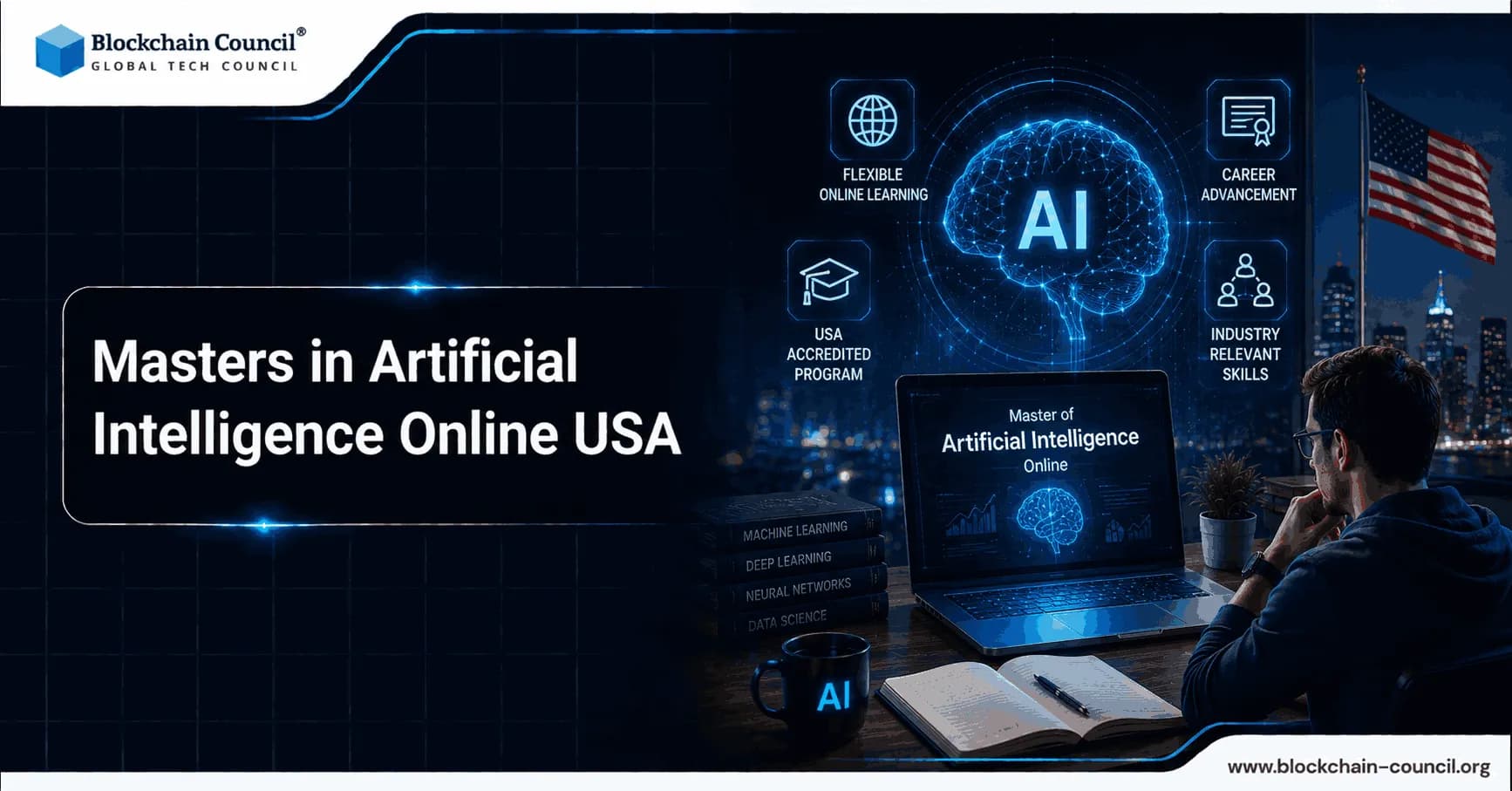
Artificial Intelligence (AI) is transforming every industry, from healthcare and finance to cybersecurity, manufacturing, education, and entertainment. As organizations continue investing in AI-powered solutions, the demand for AI professionals has reached an all-time high. This growing demand has encouraged thousands of students and working professionals to search for Masters in Artificial Intelligence Online USA programs that offer flexibility without compromising on quality.
However, not everyone needs a two-year master's degree. Today, many professionals accelerate their careers through Online AI Degrees, AI Courses with Certifications, and industry-recognized AI training programs that can be completed in a fraction of the time.

This guide explores everything you need to know about pursuing an online master's in AI in the USA while explaining why AI certifications have become one of the fastest-growing alternatives for career advancement.
Why Study Artificial Intelligence?
Artificial Intelligence has become one of the world's most valuable technologies. Businesses use AI to automate repetitive tasks, analyze massive datasets, improve customer experiences, predict outcomes, and develop intelligent applications.
AI professionals work on technologies including:
Machine Learning
Deep Learning
Natural Language Processing (NLP)
Computer Vision
Robotics
Generative AI
AI Agents
Reinforcement Learning
Predictive Analytics
Companies across the United States actively recruit AI professionals to solve complex business challenges and develop innovative products.
Why Choose a Masters in Artificial Intelligence Online USA?
An online master's degree allows students to earn advanced education without relocating or leaving their jobs.
Some major benefits include:
Flexible Learning
Students can attend classes from anywhere while managing work and personal commitments.
Lower Overall Cost
Many online programs reduce expenses associated with housing, transportation, and campus fees.
Access to Top Universities
Students can learn from respected universities across the United States regardless of their physical location.
Industry-Relevant Curriculum
Most AI master's programs cover practical topics including:
Python Programming
Machine Learning
Deep Learning
Neural Networks
AI Ethics
Data Science
Computer Vision
Natural Language Processing
Cloud AI Platforms
What Will You Learn in an Online AI Degree?
A quality Online Degree in AI usually covers both theoretical and practical knowledge.
Core subjects often include:
Machine Learning
Learn how algorithms identify patterns and make predictions using data.
Deep Learning
Study neural networks that power modern AI applications like ChatGPT, image recognition, and autonomous systems.
Natural Language Processing
Build systems capable of understanding human language.
Computer Vision
Develop AI systems that analyze and interpret images and videos.
Data Engineering
Learn how to collect, clean, process, and manage large datasets.
AI Ethics
Understand responsible AI development, fairness, privacy, and regulatory compliance.
Career Opportunities After an AI Master's
Graduates can pursue roles such as:
Artificial Intelligence Engineer
Machine Learning Engineer
AI Research Scientist
Data Scientist
Computer Vision Engineer
NLP Engineer
AI Product Manager
AI Solutions Architect
Robotics Engineer
AI Consultant
AI professionals are employed across industries including healthcare, finance, retail, logistics, manufacturing, cybersecurity, and government.
Is a Master's Degree the Only Way to Build an AI Career?
Not anymore.
While a master's degree provides academic depth, employers increasingly value practical skills, hands-on projects, and recognized industry certifications.
Many hiring managers now prioritize candidates who can demonstrate real-world AI implementation rather than only academic credentials.
This shift has made AI Courses with Certifications one of the fastest-growing learning paths worldwide.
Why AI Certifications Are Becoming More Popular
Professional AI certifications offer several advantages:
Faster completion
Lower cost
Industry-focused curriculum
Practical projects
Flexible online learning
Career-oriented training
Continuous skill updates
Instead of spending two years completing a degree, professionals can gain job-ready AI skills within weeks or months.
Best AI Skills Employers Want in 2026
Whether you pursue a master's degree or certification, employers expect expertise in:
Prompt Engineering
Generative AI
AI Agents
Machine Learning
Python
LangChain
Large Language Models (LLMs)
Small Language Models (SLMs)
AI Automation
Data Analytics
AI Ethics
Cloud AI Platforms
Learning these modern technologies significantly improves employability.
AI Courses with Certifications That Employers Value
Industry certifications focus on practical implementation rather than theoretical exams.
Popular learning areas include:
Artificial Intelligence
Machine Learning
Generative AI
Prompt Engineering
AI Agents
AI for Business
AI Leadership
Data Science
Automation
Deep Learning
These certifications allow professionals from non-technical backgrounds to enter the AI industry more quickly.
Who Should Pursue an Online AI Degree?
An Online Degree in AI is ideal for:
Computer Science graduates
Software Engineers
Data Analysts
IT Professionals
Researchers
Engineers
Mathematics graduates
It is especially suitable for those planning long-term research or academic careers.
Who Should Choose AI Certifications?
AI certifications are ideal for:
Working professionals
Business leaders
Project managers
Marketing professionals
Entrepreneurs
Students
Career changers
Consultants
Freelancers
These programs emphasize practical AI implementation for real-world business challenges.
How to Choose the Right AI Learning Path
Before enrolling, consider the following:
Career Goals
Do you want academic research or practical industry skills?
Learning Style
Can you commit to a two-year program, or do you prefer self-paced learning?
Budget
Certifications generally require a much smaller investment.
Industry Recognition
Choose programs recognized by employers and aligned with current AI technologies.
Hands-on Projects
Practical experience is often more valuable than theoretical knowledge alone.
Why AI Certifications Complement an Online Master's
Even students pursuing a master's degree often earn professional certifications because universities may not immediately update their curriculum to reflect rapidly evolving AI technologies.
Certifications help learners stay current with:
AI Agents
Prompt Engineering
Autonomous Systems
Agentic AI
Generative AI Applications
AI Automation Workflows
Enterprise AI
This combination creates a stronger professional profile.
Build Job-Ready AI Skills with Industry Certifications
If you're considering a Masters in Artificial Intelligence Online USA, adding professional certifications can significantly strengthen your resume.
Industry-focused AI Courses with Certifications provide practical knowledge that employers actively seek, including:
Real-world AI projects
Hands-on implementation
Generative AI tools
AI Agent development
Prompt Engineering
Business AI applications
Enterprise AI workflows
Whether you're a student, working professional, or career changer, combining an Online Degree in AI with recognized AI certifications creates a powerful pathway toward high-demand AI careers.
Frequently Asked Questions
Is an online master's in Artificial Intelligence worth it?
Yes. An online master's provides advanced academic knowledge while offering flexibility for working professionals.
Are AI certifications enough to get a job?
Many employers hire candidates based on practical skills, portfolios, and recognized certifications, especially for entry-level and mid-level AI roles.
Can beginners learn AI online?
Absolutely. Many AI certification programs start with foundational concepts before progressing to advanced topics.
Which is better: an Online Degree in AI or AI Courses with Certifications?
The best choice depends on your career goals. A master's degree offers comprehensive academic education, while AI certifications provide faster, practical, and industry-focused learning. Many professionals combine both for maximum career growth.
Final Thoughts
The demand for AI professionals continues to grow across the United States and globally. While pursuing a Masters in Artificial Intelligence Online USA remains an excellent choice for many learners, it is no longer the only path to success.
Modern employers increasingly value practical expertise, making Online Degrees in AI and AI Courses with Certifications powerful options for building future-ready skills. By combining academic education with industry-recognized certifications, professionals can stay ahead of rapidly evolving AI technologies and unlock exciting career opportunities in one of the world's fastest-growing fields.
Related Articles
View All
AI & ML
From Agentic AI to AGI & Super AGI: Where Is Artificial Intelligence Heading?
Follow the path from Agentic AI to AGI & Super AGI. Learn what AGI means, how it differs from today’s AI, what superintelligence could be, and the opportunities, risks, and alignment challenges ahead.
AI & ML
What Is an RSI Loop in Artificial Intelligence?
Learn what an RSI loop in artificial intelligence means, how recursive self-improvement works, and why verification and governance matter.
AI & ML
What Is the RSI Hypothesis in Artificial Intelligence?
Learn what the RSI hypothesis in artificial intelligence means, how recursive self-improvement works, why it matters for AI safety, and what is real today.
Trending Articles
The Role of Blockchain in Ethical AI Development
How blockchain technology is being used to promote transparency and accountability in artificial intelligence systems.
How Blockchain Secures AI Data
Understand how blockchain technology is being applied to protect the integrity and security of AI training data.
What is AWS? A Beginner's Guide to Cloud Computing
Everything you need to know about Amazon Web Services, cloud computing fundamentals, and career opportunities.