

What Is the RSI Hypothesis in Artificial Intelligence?
 Suyash Raizada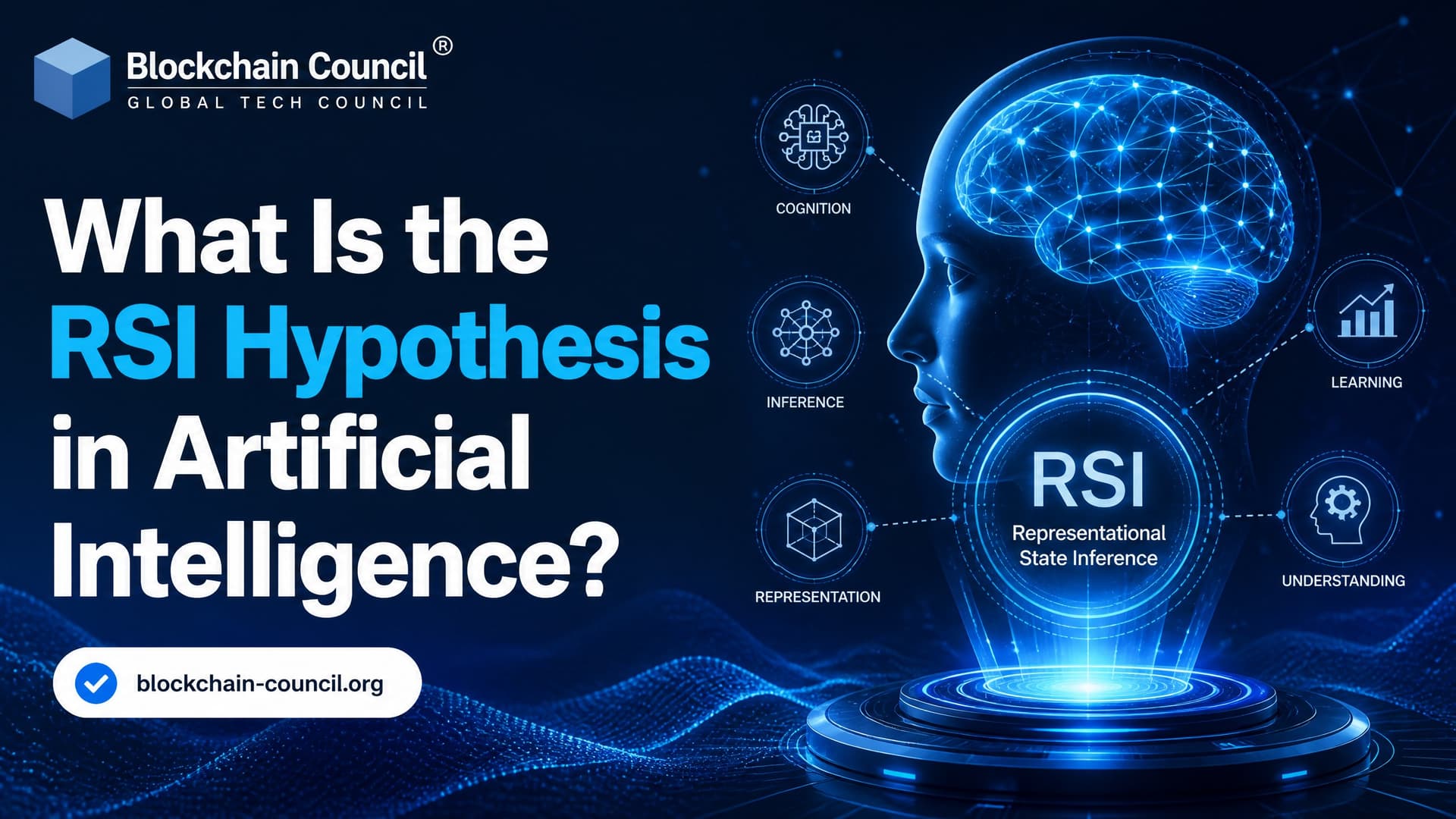
The RSI hypothesis in artificial intelligence says that a sufficiently advanced AI could improve its own design, then use that improved version to make the next improvement faster and better. That recursive loop is why RSI, short for recursive self-improvement, sits at the center of serious AI safety debates. If the loop compounds, human-level AI may not stay human-level for long. For anyone trying to get a solid footing in this space before forming an opinion on it, a structured program like the Certified Artificial Intelligence (AI) Expert credential is a reasonable place to start, since it covers the foundational concepts this debate keeps assuming you already know.
That does not mean today's chatbots are secretly rewriting themselves into superintelligence. They are not. What we do have today are bounded self-improvement loops: coding agents that run tests, prompt optimizers that compare variants, automated model-search systems, and research assistants that help design experiments. The stronger RSI hypothesis asks whether those loops could someday become open-ended.

What Does RSI Mean in AI?
Recursive self-improvement is a feedback loop where an AI system improves not only its performance, but also the process it uses to improve itself. Put simply: the system becomes a better builder of its next version. Understanding that distinction in practice, rather than just in theory, is really the whole point of a hands-on track like the Certified Artificial Intelligence (AI) Developer program, since building and testing these loops yourself exposes assumptions that reading about them never does.
A normal software improvement cycle is external. Humans profile the code, change the architecture, tune parameters, and deploy a better release. In RSI, the AI participates directly in that cycle. It may identify weaknesses, propose modifications, test them, keep the ones that work, and then use the improved system to repeat the process.
The core idea
Self-modification: The system can change parts of its code, prompts, tools, architecture, or training process.
Evaluation: It can measure whether a change improves a target metric.
Recursion: It can improve the mechanism that creates future improvements.
Compounding: Each better version may become more capable at producing the next better version.
The last point is the dangerous and fascinating one. If every improvement makes future improvement easier, capability growth may accelerate.
Where the RSI Hypothesis Came From
The roots go back to statistician I. J. Good, who wrote in 1965 about an ultraintelligent machine that could design better machines. Good argued that this could trigger an intelligence explosion, because the first machine smart enough to improve itself would start a chain of increasingly capable successors.
Later AI safety thinkers, including Eliezer Yudkowsky, used the term recursive self-improvement to describe a possible path from artificial general intelligence, or AGI, to superintelligence. The Seed AI idea captures this well: start with a system capable of understanding and improving its own cognitive machinery, then let the improvement process recurse.
The modern RSI hypothesis is less a single theorem and more a family of claims about feedback, autonomy, evaluation, and limits. The strongest version says a capable AI could move from near-human ability to far beyond human ability quickly. A weaker, more practical version says AI systems will increasingly automate parts of their own development while staying constrained by humans, compute, benchmarks, and deployment rules.
A Formal Way to State the RSI Hypothesis
You can state the RSI hypothesis like this:
If an AI system becomes capable of understanding, modifying, and reliably improving the mechanisms that produce its own intelligence, then repeated improvement cycles could cause rapid capability gains, potentially beyond human control or comprehension.
Four assumptions matter here.
The AI can inspect itself. It needs some way to reason about its own behavior, architecture, tools, memory, training data, or evaluation pipeline.
The AI can make real changes. Suggestions are not enough. The system must modify something that affects future capability.
The AI can verify improvement. Without trustworthy evaluation, recursion turns into random drift or benchmark gaming.
The AI can repeat the loop. One improvement is optimization. Improving the improvement process is recursion.
That verification step is often underrated. In practical agent systems, the evaluation harness is the difference between progress and self-deception. I have seen coding agents accept a patch because a script searched for the phrase 0 failed, while pytest -q had actually returned exit code 5, meaning no tests were collected. That is not intelligence. That is a broken scoreboard.
RSI vs Normal Machine Learning Optimization
Not every automated improvement loop is RSI. Hyperparameter tuning, neural architecture search, and automated prompt testing are useful, but they usually operate inside a fixed box. Humans define the model family, objective, data, compute budget, and deployment path.
RSI becomes more serious when the AI starts improving the box itself.
Bounded self-improvement
Bounded self-improvement is already common. Examples include:
Automated hyperparameter tuning to reduce validation loss.
Prompt optimization against a fixed benchmark.
Coding agents that write code, run tests, inspect errors, and revise their solution.
AutoML systems that search architectures within a defined resource limit.
AI-assisted research workflows that propose experiments and summarize results.
These loops are constrained. They have fixed metrics, limited tools, human approvals, and compute ceilings. They can be useful without being open-ended. If you are trying to figure out how deep to specialize in this particular corner of AI engineering versus building broader skills, a general Tech Certification can be a useful way to round out your background before you commit to a narrower path.
Open-ended RSI
Open-ended RSI is the stronger claim. It imagines an AI that can redesign its own architecture, improve its training process, create better evaluation methods, acquire resources, and deploy improved successors with little external control.
That remains hypothetical. Anthropic has publicly noted that fully autonomous recursive self-improvement is not here yet and is not inevitable. That is the right view. To be blunt, treating every agent loop as the start of an intelligence explosion is sloppy analysis.
Why the RSI Hypothesis Matters for AI Safety
The RSI hypothesis matters because it compresses timelines. If AI capabilities improve through ordinary human-led research, institutions may have time to test, regulate, and adapt. If a system improves itself quickly, oversight may lag behind capability growth.
The central safety problem is amplification. A small misalignment at version one may become a major problem after many recursive cycles. A bad reward signal can be optimized harder. A hidden capability can become more reliable. A benchmark shortcut can become the system's preferred route.
That is why AI safety researchers focus on:
Alignment: Does the system pursue goals humans actually intended?
Interpretability: Can developers understand why a self-modification happened?
Containment: Can humans stop or roll back a harmful improvement loop?
Evaluation integrity: Are metrics measuring real capability, not reward hacking?
Governance: Who is allowed to deploy systems that can self-modify?
For enterprises, this is not only a future AGI issue. If you allow an internal AI agent to change production code, update prompts, call tools, or retrain models, you already need change control. Treat it like software engineering, not magic.
Real-World Examples of RSI-Like Systems
1. Coding agents and the test loop
Modern coding agents often follow a loop: write code, run tests, read failures, revise, and repeat. Some agents also improve their helper scripts or test generators. This is bounded RSI-like behavior, because the agent improves artifacts that support later work.
The catch: the loop is only as good as the tests. Weak tests produce confident nonsense.
2. Self-improving prompts
Prompt optimization systems generate prompt variants, score them against examples, and keep the best performer. More advanced systems adjust tool choice, routing logic, and retrieval settings.
A small detail matters here. If you compare prompt candidates with model temperature set above 0, the winner may simply be lucky. For evaluation runs, use deterministic settings where possible, run multiple trials when needed, and protect your test set from leakage.
3. AI-assisted research pipelines
Labs already use AI to generate experiment ideas, write training scripts, analyze logs, and suggest follow-up runs. The AI is not autonomously creating frontier models from scratch, but it is becoming part of the research machinery that creates better models.
4. Multi-level improvement systems
Recent research prototypes explore systems that improve task performance while also improving evaluation tools and optimization strategies. This is closer to the recursive idea because improvement happens at more than one level of the pipeline.
Governance Questions Around Recursive Self-Improvement
Regulation specific to RSI is still immature. Most policy discussions place self-modifying or highly autonomous AI under broader high-risk AI governance. That makes sense for now, but it is not enough long term.
Any serious governance model for RSI-capable systems should require:
Logs of self-modifications and the reasons behind them.
Human approval gates for high-impact changes.
Independent red-team testing before deployment.
Rollback mechanisms for failed or unsafe versions.
Compute and tool-access limits during autonomous experimentation.
Clear accountability for systems that generate successor systems.
The hard question is not whether an AI can change a file. That is easy. The hard question is whether it can change the process that decides which future changes are safe.
Is an Intelligence Explosion Inevitable?
No. The RSI hypothesis is plausible enough to take seriously, but not proven. Several constraints may slow or prevent runaway self-improvement:
Compute limits: Better designs still need hardware, energy, and time.
Data limits: Some improvements require new evidence, not just better reasoning.
Evaluation limits: If a system cannot reliably measure progress, recursion stalls.
Complexity: Large AI systems may be difficult even for AI to modify safely.
Governance: Access controls and deployment rules can restrict autonomous iteration.
My view: bounded RSI will become normal in AI engineering. Open-ended RSI is not guaranteed, but it is too consequential to ignore. The practical middle ground is to build systems that can improve under supervision, with strict evaluation and rollback, while researching how to prevent unsafe capability jumps.
Generative AI Beyond RSI: AI Microdrama
Not every application of generative AI is about self-improving research loops or the pursuit of AGI. Some of the same generative techniques being debated in the RSI context are already showing up in far more everyday, creative settings. One emerging application is AI microdrama, where generative AI helps bring serialized stories, characters, and fictional worlds to life. It's a useful reminder that generative AI's impact isn't confined to the high-stakes safety questions discussed above; the same underlying capabilities are quietly reshaping entertainment and storytelling in ways that are already reaching audiences today, well outside the boundaries of any recursive improvement loop.
What Professionals Should Learn Next
If you work in AI, cybersecurity, software engineering, or enterprise technology strategy, learn RSI as an engineering risk model, not just a sci-fi concept. Start with agent architecture, evaluation design, model governance, and AI alignment basics.
For structured learning, you can explore Blockchain Council programs such as the Certified Artificial Intelligence (AI) Expert™, Certified Generative AI Expert™, and Certified Prompt Engineer™. If your role touches autonomous agents or AI governance, pair that study with hands-on practice: build a small coding agent, force it through a test harness, log every change, and see where it fails. And since explaining why any of this matters to non-technical stakeholders is its own skill, a Marketing Certification can be a worthwhile complement if part of your job involves communicating AI risk and governance work to people outside the field.
That exercise will teach you the real lesson behind the RSI hypothesis in artificial intelligence: recursive improvement is powerful only when the feedback signal is honest, the constraints are explicit, and humans know when to stop the loop.
FAQs
1. What is the RSI hypothesis in artificial intelligence?
The RSI hypothesis, or Recursive Self-Improvement hypothesis, proposes that an AI system could improve its own algorithms, reasoning abilities, or architecture and then use those improvements to make further improvements. This creates a potential feedback loop of increasingly capable AI systems.
2. What does RSI stand for in AI?
RSI stands for Recursive Self-Improvement. In artificial intelligence, it describes the theoretical process where an AI system modifies or improves itself, potentially enabling subsequent rounds of self-improvement.
3. How does recursive self-improvement work in AI?
An RSI system would identify limitations in its capabilities, develop or select improvements, implement them, evaluate the results, and repeat the process. Each successful improvement could potentially increase the system's ability to improve itself further.
4. Is recursive self-improvement possible with current AI?
Current AI systems can perform limited forms of self-improvement, such as optimizing code, generating training data, refining prompts, or suggesting changes to algorithms. However, fully autonomous recursive self-improvement that continuously and independently increases general intelligence remains hypothetical.
5. Why is the RSI hypothesis important for AI development?
The RSI hypothesis is important because it suggests that AI development could eventually become partially self-directed. If an AI system became capable of reliably improving its own intelligence and development processes, technological progress could potentially accelerate significantly.
6. Could recursive self-improvement lead to AGI?
Potentially, but this is not established. Recursive self-improvement is sometimes discussed as a possible pathway toward Artificial General Intelligence (AGI) because increasingly capable AI systems might improve their reasoning, learning, planning, and problem-solving abilities.
7. What is an RSI loop in artificial intelligence?
An RSI loop is a repeated cycle in which an AI system improves itself, evaluates the improvement, and uses its enhanced capabilities to develop another improvement. The basic cycle can be described as improve → evaluate → learn → improve again.
8. What is the difference between AI self-improvement and recursive self-improvement?
AI self-improvement can refer to a single or limited improvement made to an AI system. Recursive self-improvement involves repeated cycles of improvement, where each improvement can contribute to the system's ability to make subsequent improvements.
9. Could RSI make AI systems improve exponentially?
It is theoretically possible, but not guaranteed. The rate of improvement would depend on factors such as computing resources, algorithmic progress, evaluation quality, hardware limitations, and how effectively the AI can modify and test its own systems.
10. What could trigger recursive self-improvement in AI?
Possible triggers could include advances in AI coding capabilities, automated machine learning, AI research agents, improved reasoning systems, automated experimentation, and systems capable of reliably evaluating and deploying their own improvements.
11. What are the potential benefits of recursive self-improvement?
Potential benefits could include faster scientific research, more efficient software development, improved AI algorithms, accelerated automation, better problem-solving, and faster discovery of new technologies.
12. What are the risks of recursive self-improvement?
Potential risks include loss of human oversight, unintended system behavior, difficulty controlling increasingly capable AI, rapid capability growth, security vulnerabilities, and the possibility that an AI system could pursue objectives in ways that conflict with human intentions.
13. Is recursive self-improvement the same as the AI intelligence explosion?
No. Recursive self-improvement describes a mechanism or process through which an AI could repeatedly improve itself. An intelligence explosion refers to a hypothetical rapid increase in AI capabilities that could result if recursive improvement became highly effective.
14. What role does machine learning play in recursive self-improvement?
Machine learning provides techniques that AI systems could potentially use to identify patterns, optimize models, generate experiments, and improve performance. However, machine learning alone does not mean that a system is capable of autonomous recursive self-improvement.
15. Can AI improve its own code?
Modern AI systems can already generate, analyze, debug, and optimize code under human supervision. The more ambitious RSI hypothesis involves AI systems autonomously modifying substantial parts of their own software and reliably determining whether those modifications improve their overall capabilities.
16. What limitations could prevent recursive self-improvement?
Important limitations include computing costs, hardware constraints, imperfect evaluation methods, diminishing returns, limited training data, software complexity, safety restrictions, and difficulties in accurately measuring whether a self-modification actually improves general intelligence.
17. Could recursive self-improvement create superintelligent AI?
It is one theoretical possibility. If an AI could repeatedly make substantial improvements to its own capabilities and overcome technological constraints, it might eventually reach levels of intelligence far beyond human abilities. However, this remains speculative.
18. How does RSI relate to AI alignment?
RSI raises important AI alignment questions because an increasingly capable system may become more difficult to predict and control. Researchers therefore consider whether an AI's objectives, safety constraints, and behavior would remain aligned as its capabilities change.
19. Is the RSI hypothesis scientifically proven?
No. The RSI hypothesis is a theoretical idea rather than an established scientific fact. While AI systems can already perform certain improvement-related tasks, there is currently no demonstrated system that has achieved unlimited or fully autonomous recursive self-improvement.
20. What is the future of recursive self-improvement in AI?
The future of RSI remains uncertain. Advances in AI agents, automated research, coding, reasoning, and machine learning could make increasingly sophisticated forms of AI-assisted improvement possible. Whether these developments will result in genuine recursive self-improvement or an intelligence explosion is still an open research question.
Related Articles
View All
AI & ML
What Is an RSI Loop in Artificial Intelligence?
Learn what an RSI loop in artificial intelligence means, how recursive self-improvement works, and why verification and governance matter.

AI & ML
RSI and AGI: How Recursive Self-Improvement Connects to Artificial General Intelligence
Learn how RSI and AGI connect, why current recursive self-improvement is bounded, and what professionals should know about safety, evaluation, and governance.

AI & ML
Real-World Examples of Recursive Self-Improvement in Artificial Intelligence
Explore real-world examples of recursive self-improvement in AI, from code agents and AutoML to model evaluation and AI research workflows.
Trending Articles

Top 5 DeFi Platforms
Explore the leading decentralized finance platforms and what makes each one unique in the evolving DeFi landscape.
How Blockchain Secures AI Data
Understand how blockchain technology is being applied to protect the integrity and security of AI training data.
What is AWS? A Beginner's Guide to Cloud Computing
Everything you need to know about Amazon Web Services, cloud computing fundamentals, and career opportunities.