

Is AI Dying? Why AI May Collapse Under Its Own Data
 Suyash Raizada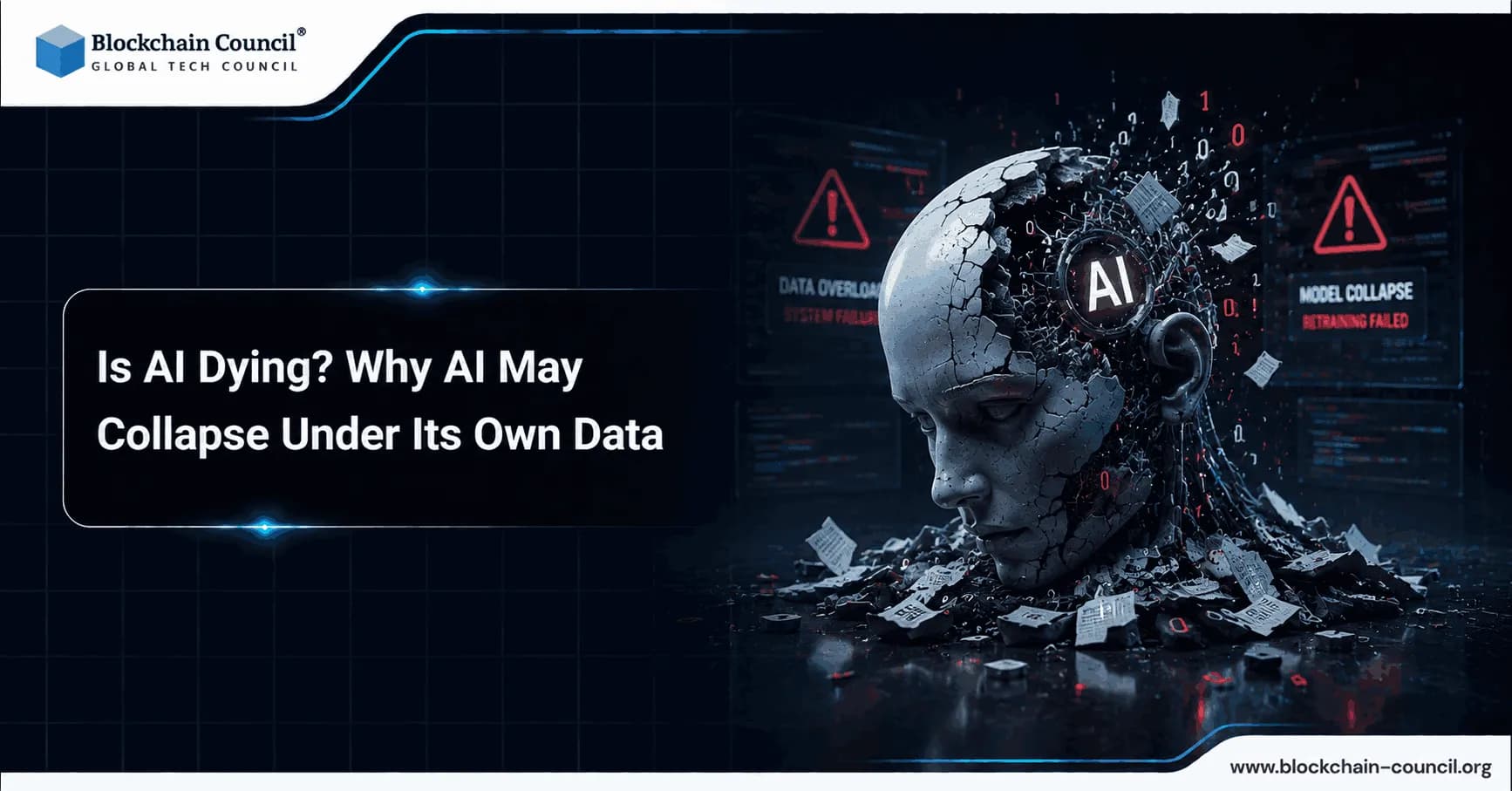
Artificial Intelligence has become one of the most important technologies of the modern era. AI tools now help people write articles, generate images, analyze business data, create software code, automate customer service, and even assist in medical research. Companies across the world are investing billions of dollars into AI development because they believe it represents the future of productivity and innovation.
However, despite its rapid growth, a serious debate has started inside the technology industry. Many researchers, engineers, writers, and digital experts are asking an uncomfortable question: Is AI slowly becoming weaker because of the quality of the data it depends on?

The real concern is not that AI will suddenly disappear overnight. The stronger and more realistic argument is that AI may slowly degrade if it continues training on outdated information and low-quality AI-generated content instead of authentic human-created knowledge.
This issue is becoming more important because the internet itself is changing. Today, AI-generated articles, blogs, videos, reviews, and social media posts are spreading rapidly across digital platforms. Future AI models may end up learning from content generated by earlier AI systems rather than learning from original human communication. If this continues for years, AI systems may become repetitive, less creative, less accurate, and less trustworthy.
Researchers describe this problem using a term called “model collapse.” Technology companies are already trying to avoid this situation by searching for fresh, human-generated content from platforms like Reddit, forums, podcasts, interviews, and real-world conversations.
The future of AI may depend not only on machine intelligence but also on the survival of authentic human knowledge.
The Main Argument: AI May Not Die, but It May Degrade
Many headlines online claim that AI will replace humans completely or dominate every industry permanently. At the same time, some critics dramatically argue that AI is “dying.” Neither extreme fully explains the real issue.
The better argument is that AI may become less useful over time if its training process continues depending heavily on outdated data and synthetic AI-generated content.
AI systems work by identifying patterns from massive amounts of information. They do not truly think or experience reality. Everything they know comes from data created by humans. If the quality of that data decreases, the quality of AI outputs may also decline.
This means AI may still exist everywhere in the future, but weaker versions of AI may produce repetitive, shallow, inaccurate, or generic responses. The technology itself may survive, but its usefulness could suffer significantly.
This concern is now being discussed seriously by researchers and major technology companies because AI systems are becoming deeply integrated into business, education, healthcare, journalism, and software development.
The Problem of Outdated Training Data
One of the biggest weaknesses of modern AI systems is outdated training data.
Most AI models are trained on massive datasets collected over long periods of time. However, many of these datasets stop at a certain cutoff date. This means the AI may not know about recent world events, updated laws, new technologies, changing market trends, or current industry standards.
For example, an AI system trained mainly on older internet data may provide outdated coding methods, old business strategies, inaccurate legal guidance, or incorrect financial information. This becomes dangerous when users assume AI systems always provide current and accurate answers.
Fast-changing industries are especially affected by this problem. These include:
Technology
Cybersecurity
Healthcare
Finance
Digital marketing
Law
Cryptocurrency
Artificial Intelligence itself
A software developer asking for updated coding practices may receive obsolete recommendations. A marketing team asking for SEO strategies may receive advice that no longer works under current Google algorithms. A legal professional using AI may receive inaccurate references if the information is outdated.
Explore how AI systems, model collapse, outdated data, and human-generated content are shaping the future of technology by building advanced expertise through an AI expert certification, understanding large language model workflows with a Claude AI Certification, and applying AI-driven growth strategies through an AI powered marketing course.
Several real-world incidents have already demonstrated this issue. Lawyers using AI tools have submitted fake court citations generated by AI systems. Businesses have relied on incorrect AI-generated reports. Students have submitted assignments containing inaccurate information.
The problem becomes more serious because AI responses often sound highly confident even when the information is wrong. Confidence without accuracy creates risk.
As industries continue evolving rapidly, outdated AI systems may lose public trust unless companies continuously retrain their models with fresh and verified information.
AI-Generated Content Is Polluting the Internet
The internet is increasingly filled with AI-generated content.
Businesses use AI tools to create blog posts, product descriptions, emails, advertisements, social media captions, and website content at massive scale. Students use AI for assignments. Content creators use AI for scripts and articles. Entire websites are now generated almost entirely by automation.
While this increases efficiency, it also creates a serious long-term problem for AI development.
Future AI systems may train on content written by previous AI systems instead of learning from genuine human communication. This creates a dangerous feedback loop where AI repeatedly learns from synthetic information rather than original knowledge.
Imagine repeatedly photocopying the same document. Every generation loses some quality, detail, and clarity. Eventually, the information becomes distorted. The same risk exists when AI models repeatedly learn from AI-generated content.
Over time, this can lead to:
Less originality
Reduced creativity
More repetitive writing
Lower factual accuracy
Generic communication styles
Loss of cultural nuance
Increased hallucinations
The internet slowly becomes a system where machines learn from other machines while authentic human perspectives become harder to find.
This issue is now one of the biggest concerns in AI research.
Understanding Model Collapse
The term “model collapse” describes what happens when AI systems are trained too heavily on synthetic data instead of fresh human-generated information.
Researchers studying this phenomenon discovered that AI systems can gradually lose diversity and accuracy over multiple generations of training.
Instead of producing rich and varied outputs, the models become narrower and more repetitive. Rare details disappear. Creative language becomes weaker. The systems begin recycling simplified versions of previous outputs.
This creates a decline in overall quality.
Human communication naturally contains emotional complexity, humor, cultural references, disagreements, mistakes, slang, storytelling, and unpredictability. AI-generated content often removes these imperfections in favor of smoother and safer responses.
However, those imperfections are actually important for learning.
If future AI systems mostly train on polished synthetic content, they may lose the ability to understand authentic human communication deeply. The outputs may become technically correct but emotionally empty and intellectually repetitive.
Model collapse does not mean AI suddenly stops working. Instead, it means the intelligence slowly becomes less diverse, less creative, and less reliable over time.
Why Human-Generated Content Matters More Than Ever
Human-generated content has become one of the most valuable resources in the AI industry.
Humans communicate through personal experience, emotion, memory, humor, culture, and social context. Even mistakes in human communication contain valuable information because they reflect real thinking patterns and emotional reactions.
AI systems cannot naturally experience the world. They cannot form memories, feel emotions, attend social events, or develop personal perspectives. Everything they know depends on data humans create.
This is why authentic human content is extremely important.
Human-created content includes:
Real-world experiences
Emotional reactions
Cultural understanding
Personal storytelling
Original opinions
Humor and sarcasm
Natural communication patterns
AI-generated text often sounds polished but lacks the unpredictability and emotional depth found in real human conversations.
Ironically, human flaws are now becoming valuable assets in the AI economy. Imperfect communication helps machines remain intelligent because it reflects genuine human behavior instead of artificial patterns.
Why Reddit and Human Conversations Matter
Platforms like Reddit have become highly valuable for AI companies because they contain authentic human discussions.
Unlike corporate websites or professionally edited articles, Reddit conversations are natural and unfiltered. People share opinions, argue, ask questions, discuss emotions, explain personal experiences, and communicate using everyday language.
This type of content is extremely useful for AI training because it represents how humans actually communicate in real life.
AI companies are increasingly interested in human conversation platforms because they provide:
Natural dialogue
Emotional reactions
Real opinions
Slang and informal language
Technical discussions
Personal experiences
Cultural context
Debate and disagreement
Several major technology companies have already partnered with platforms containing human-generated discussions because they understand the importance of authentic data.
Without access to genuine human communication, future AI systems may become disconnected from real-world language patterns and emotional understanding.
AI Lacks Fresh Real-World Experience
AI systems do not live in the real world.
They do not travel, attend meetings, experience relationships, participate in politics, or understand human emotions directly. Everything AI knows comes from information humans create and publish online.
This creates a major limitation.
Human society changes constantly. New technologies appear every year. Cultural trends evolve rapidly. Political situations change overnight. Scientific discoveries happen continuously. Language itself changes over time.
AI systems need fresh human-generated information to stay relevant.
If humans stop producing original content and the internet becomes dominated by AI-generated material, future AI models may struggle to access new ideas and real experiences.
This could make AI systems less connected to reality over time.
The future quality of AI depends heavily on humans continuing to create authentic knowledge, discussions, and experiences.
The Decline in Trust Toward AI
Trust is one of the most important factors behind the success of any technology.
People use AI because they expect accurate, useful, and reliable information. However, public trust in AI decreases when users repeatedly encounter:
Hallucinations
Fake citations
Outdated answers
Generic responses
Biased outputs
Incorrect information
Many users are already becoming more cautious about trusting AI-generated content. Readers increasingly question whether online articles were written by humans or machines. Businesses are learning that AI still requires strong human supervision for critical tasks.
In industries like law, healthcare, engineering, and finance, accuracy matters far more than speed. Even small AI mistakes can create serious consequences.
Without trust, AI becomes less valuable.
People may continue using AI for convenience and automation, but they may avoid relying on it for important decisions unless the systems become more reliable and transparent.
The Cost and Token Problem
Another major challenge facing AI development is cost.
Training advanced AI systems requires enormous computing power, cloud infrastructure, electricity, hardware, and maintenance. Large AI models consume massive financial resources.
Every interaction with an AI system requires processing tokens. Tokens are pieces of text that AI systems analyze and generate during conversations.
The more advanced and detailed the response becomes, the more computational power is required.
This creates major operational costs for AI companies.
Enterprise AI systems handling millions of users can become extremely expensive to operate at scale. Data centers consume huge amounts of energy, and hardware costs continue increasing.
As a result, companies may begin focusing more on efficiency instead of simply building larger models.
Businesses are also evaluating whether some tasks are more cost-effective when handled by human professionals rather than expensive AI systems.
The future of AI may depend not only on intelligence but also on economic sustainability.
Why Companies Still Need Human Engineers
Despite the rapid growth of AI tools, many companies are realizing that human expertise remains essential.
AI can assist engineers, programmers, writers, analysts, and designers, but it cannot fully replace human judgment and responsibility.
Human professionals are still necessary for:
Security analysis
System architecture
Ethical decision-making
Complex debugging
Infrastructure planning
Risk management
Research and innovation
AI-generated code may appear functional but still contain security vulnerabilities, logical errors, or inefficient structures. Human engineers must review, test, and improve the results.
Some businesses that initially believed AI would replace large teams are now adopting more balanced strategies where AI supports human workers instead of replacing them completely.
This does not mean AI is failing. It means companies are recognizing the practical limits of automation.
The future workplace will likely involve collaboration between humans and AI rather than total replacement.
The Token Usage Debate Around AI Tools
Token usage has become an important topic in enterprise AI discussions.
Some advanced AI tools consume large numbers of tokens during conversations, especially for complex reasoning and long-form outputs. This increases infrastructure and operational costs for companies using these systems at scale.
Businesses are now comparing AI platforms not only based on quality but also based on:
Cost efficiency
Token consumption
Processing speed
Scalability
Infrastructure requirements
This debate is important because AI systems must remain financially sustainable for long-term business adoption.
It is also important to avoid making unsupported claims such as “Microsoft said not to use Claude” unless there is verified evidence. Professional articles should rely on accurate information rather than internet rumors.
A stronger and more realistic argument is that companies are carefully evaluating AI costs and deciding where human expertise remains more efficient than expensive automation systems.
AI Content Is Becoming Generic
One growing criticism of AI-generated content is that much of it sounds repetitive and predictable.
Many AI-written articles follow the same structure, tone, and writing patterns. While the content may appear grammatically correct, it often lacks originality, personality, and deep insight.
This creates several problems for the internet:
Readers become bored
Websites lose uniqueness
Creative diversity decreases
Brand voices become weaker
Search engines detect repetitive patterns
Thousands of websites now publish similar AI-generated content optimized mainly for search rankings rather than genuine value.
As a result, the internet risks becoming filled with repetitive information that lacks originality and authentic expertise.
Ironically, this trend may increase the future value of human creativity and personal storytelling.
Learn how professionals are preparing for the next phase of artificial intelligence by mastering autonomous AI systems through an Agentic AI expert certification, exploring innovation through a Deeptech certification, and strengthening future-ready technical skills with a Tech certification.
Search Engines May Suffer From AI Spam
Search engines like Google depend on high-quality information to provide useful results.
However, the rapid growth of AI-generated spam content creates major challenges for search quality.
If the internet becomes flooded with low-quality AI articles, search engines may struggle to identify trustworthy and experience-based content. Users may find it harder to locate accurate information.
This affects industries such as:
SEO
Digital marketing
Journalism
Online publishing
Content marketing
Google has already updated its algorithms to prioritize high-quality, original, and experience-driven content.
Websites relying entirely on mass AI-generated articles may face long-term ranking problems if search engines continue improving spam detection systems.
The battle between authentic content and AI-generated spam is becoming one of the biggest issues in the digital publishing industry.
Legal and Copyright Issues in AI Training
AI development has also created major legal and ethical debates.
Many writers, artists, journalists, musicians, and creators argue that AI companies should not freely use public content for training without permission or compensation.
Several lawsuits and legal discussions are already shaping the future of AI regulation.
Important questions include:
Who owns AI-generated content?
Can public internet data be used legally for training?
Should creators receive payment for their work?
How should copyright laws apply to AI outputs?
What responsibilities do AI companies have regarding transparency?
Governments worldwide are beginning to introduce regulations related to AI safety, copyright, privacy, and accountability.
The future development of AI may depend heavily on how these legal issues are resolved.
The Better Conclusion: AI Will Not Die, but Weak AI May Die
AI is unlikely to disappear completely because it already provides enormous value across many industries. Businesses continue investing heavily in AI for healthcare, automation, cybersecurity, research, education, and software development.
However, weaker AI systems may struggle in the future.
AI models trained on outdated data, low-quality synthetic content, and repetitive information may gradually lose relevance. Users will increasingly demand AI systems that provide accurate, fresh, trustworthy, and human-aware responses.
The future belongs to AI systems that combine:
Fresh human-generated data
Verified information
Human supervision
Ethical safeguards
Transparent training methods
Efficient infrastructure
The AI industry is now entering a more mature phase where quality matters more than hype.
Strong AI systems will continue evolving with human collaboration, while low-quality AI systems built mainly on recycled synthetic data may slowly become less useful.
AI may not die completely, but weak AI may fail to survive.
Conclusion
The debate about whether AI is dying reflects a deeper concern about the future of technology, trust, creativity, and information quality.
AI systems depend entirely on data. If that data becomes outdated, repetitive, or dominated by AI-generated material, the quality of future AI systems may decline significantly.
The rise of model collapse, synthetic content pollution, declining trust, rising operational costs, and legal concerns all show that the AI industry faces serious long-term challenges.
At the same time, authentic human-generated content has become more valuable than ever. Real conversations, emotional experiences, personal opinions, and cultural understanding remain essential for keeping AI systems intelligent and relevant.
The future of AI will likely depend on balance.
AI tools will continue helping businesses and individuals improve productivity, but human expertise, creativity, judgment, and lived experience will remain central to the development of reliable and trustworthy AI systems.
The future may not belong to machines alone. It may belong to systems where human intelligence and artificial intelligence work together responsibly.
Frequently Asked Questions
1. Is AI really dying or is it just evolving?
AI is not completely dying, but many experts believe certain AI systems may slowly degrade if they continue depending on outdated or AI-generated data. The concern is mainly about declining quality, creativity, and reliability rather than total technological collapse. Advanced AI will likely continue growing, but weaker systems may become less useful over time.
2. What does “model collapse” mean in Artificial Intelligence?
Model collapse refers to the gradual decline of AI systems when they are repeatedly trained on synthetic AI-generated data instead of fresh human-created content. Over time, the outputs become repetitive, generic, and less accurate because the AI starts learning from recycled information rather than original human knowledge and communication patterns.
3. Why is outdated training data a serious problem for AI?
AI systems depend entirely on training data, and many models have knowledge cutoffs that prevent them from understanding recent events, technologies, or trends. This can lead to outdated answers in industries like healthcare, law, finance, and cybersecurity where information changes rapidly. Incorrect information can reduce user trust and create real-world risks.
4. Why do AI companies need human-generated content?
Human-generated content contains emotion, cultural understanding, humor, storytelling, opinions, and lived experiences that AI systems cannot naturally create. AI companies value this data because it helps improve language understanding and keeps models connected to authentic human communication instead of repetitive synthetic patterns.
5. How is AI-generated content polluting the internet?
AI-generated articles, blogs, reviews, and social media posts are spreading rapidly across the internet. Future AI models may end up training on this synthetic content instead of original human writing, creating a feedback loop that reduces creativity, diversity, and accuracy in future AI systems.
6. Why is Reddit considered valuable for AI training?
Reddit contains millions of real conversations filled with emotions, debates, slang, opinions, and personal experiences. Unlike polished corporate content, Reddit discussions reflect how humans naturally communicate online. This makes the platform extremely valuable for AI companies searching for authentic training data.
7. Can AI learn properly from other AI-generated content?
AI can learn from synthetic content, but relying too heavily on it can reduce output quality over time. Researchers warn that excessive synthetic training data may lead to repetitive responses, reduced originality, and weaker understanding of real human communication and emotional complexity.
8. Why are AI hallucinations becoming a major concern?
AI hallucinations happen when AI systems generate false or misleading information while sounding highly confident. This creates serious risks in industries like healthcare, law, journalism, and finance because users may trust inaccurate information without verifying it from reliable human sources.
9. Will AI replace engineers and programmers completely?
AI can assist engineers and programmers by improving productivity and automating repetitive tasks, but it cannot fully replace human expertise. Skilled professionals are still needed for architecture, debugging, security analysis, infrastructure planning, ethical decisions, and solving complex real-world problems.
10. Why is AI expensive to operate?
Advanced AI systems require powerful servers, cloud infrastructure, electricity, hardware, and enormous computational resources. Training and running large AI models costs billions of dollars, making economic sustainability one of the biggest challenges facing the AI industry today.
11. What are tokens in AI systems?
Tokens are units of text processed by AI models during conversations and tasks. Longer prompts and more detailed responses require more tokens, increasing computational costs. Businesses carefully monitor token usage because large-scale AI deployment can become extremely expensive over time.
12. Why do many AI-generated articles sound similar?
Most AI tools follow predictable writing patterns, sentence structures, and safe language styles. Without strong human editing and creativity, AI-generated articles may become repetitive, generic, and emotionally flat, making online content less engaging and less original for readers.
13. How does AI-generated spam affect search engines?
Search engines like Google rely on high-quality content to provide useful results. If the internet becomes flooded with low-quality AI-generated articles, search quality may decline, making it harder for users to find trustworthy and valuable information online.
14. Why is trust important in AI technology?
Trust determines whether people feel comfortable using AI for important tasks and decisions. If AI systems continue producing fake citations, biased outputs, or inaccurate information, users may stop relying on them for industries where accuracy and accountability are essential.
15. Can AI think and feel like humans?
AI systems do not possess emotions, consciousness, self-awareness, or personal experiences. They analyze patterns in data and generate responses based on training information. While AI can simulate human conversation, it does not truly understand emotions or reality the way humans do.
16. What industries are most vulnerable to outdated AI systems?
Industries that change rapidly are most vulnerable to outdated AI information. These include cybersecurity, finance, healthcare, software development, digital marketing, law, and Artificial Intelligence itself because new technologies and regulations evolve constantly in these sectors.
17. Why are legal and copyright issues becoming important in AI?
Many creators argue that AI companies should not use public content for training without permission or compensation. Legal debates now focus on ownership rights, transparency, copyright protection, and whether creators deserve payment when their content helps train AI systems.
18. Can AI creativity replace human creativity?
AI can generate impressive content quickly, but genuine human creativity comes from emotions, memories, experiences, culture, and personal understanding. Human creativity contains originality and emotional depth that machines cannot fully reproduce through pattern recognition alone.
19. What is the future of AI according to experts?
Most experts believe AI will continue growing but will require stronger human supervision, verified data, ethical safeguards, and fresh human-generated content. The future likely involves collaboration between humans and AI rather than complete automation or replacement of human intelligence.
20. Will weak AI systems disappear in the future?
Weak AI systems built mainly on outdated or low-quality synthetic data may gradually lose relevance as users demand better accuracy and originality. The future belongs to AI systems that combine fresh human knowledge, reliable information, transparency, and responsible development practices.
Related Articles
View All
AI & ML
Can Code-Generating AI Improve Its Own Code? The Path to RSI
Code-generating AI can improve code artifacts through tests, tools, and agent loops, but true recursive self improvement remains experimental.

AI & ML
Built to Catch AI Cheating: Rethinking Pre-Employment Assessments with HireValid
Explore how HireValid is rethinking pre-employment assessments with AI-resistant test design, integrity signals, candidate evidence, and human review to address AI-assisted cheating.

AI & ML
AI-Era Hiring Needs AI-Proof Tests: How HireValid Is Redefining Talent Assessment
Explore how HireValid is rethinking talent assessment for the AI era with job-relevant tests, anti-cheating design, integrity signals, and human-reviewed evidence of candidate ability.
Trending Articles

Top 5 DeFi Platforms
Explore the leading decentralized finance platforms and what makes each one unique in the evolving DeFi landscape.
What is AWS? A Beginner's Guide to Cloud Computing
Everything you need to know about Amazon Web Services, cloud computing fundamentals, and career opportunities.
Claude AI Tools for Productivity
Discover Claude AI tools for productivity to streamline tasks, manage workflows, and improve efficiency.