

Integrating Wispr Flow into Web3 and Crypto Support Operations for Faster Ticketing, KYC Notes, and Compliance Logs
 Suyash Raizada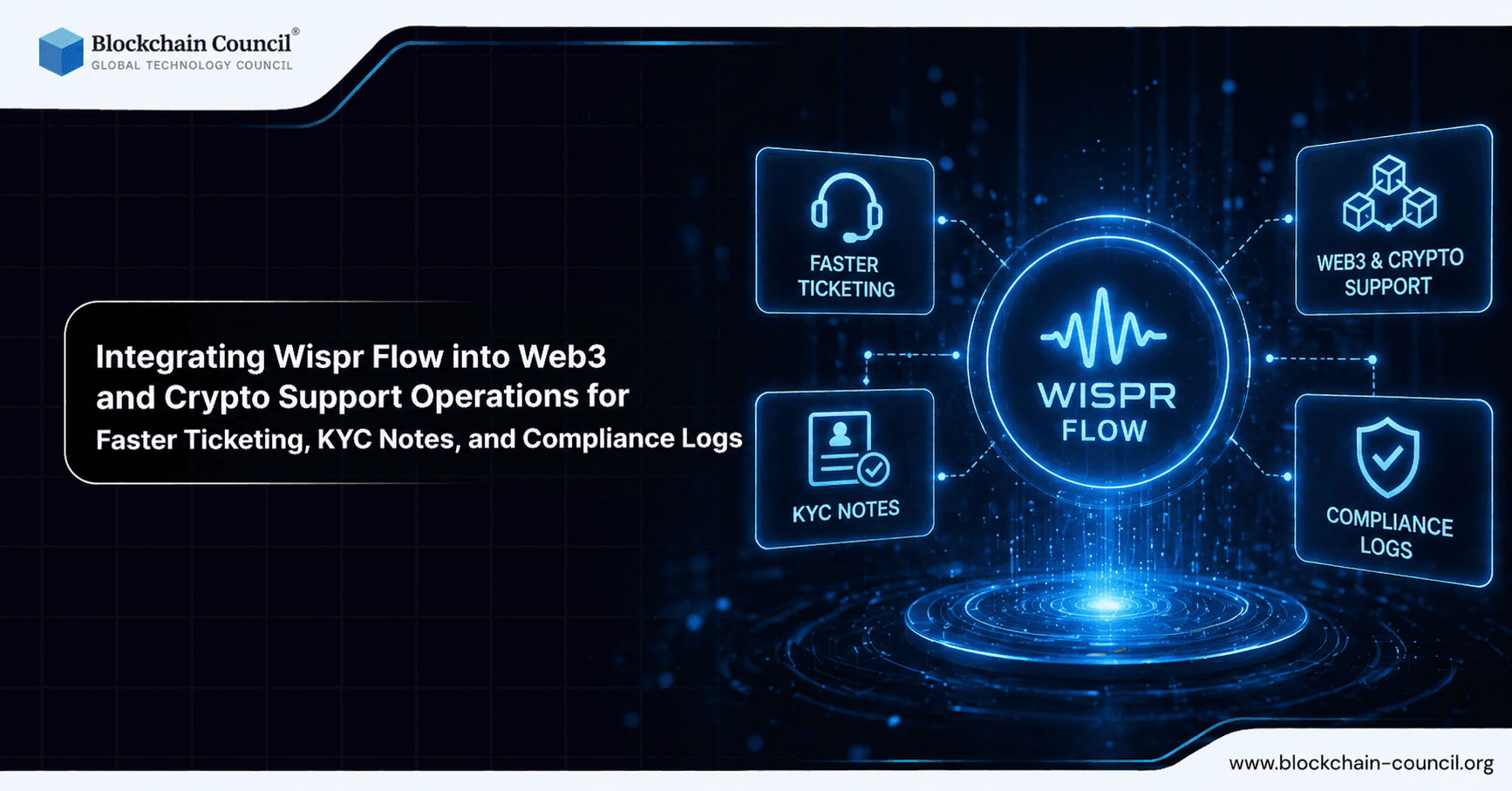
Integrating Wispr Flow into Web3 and crypto support operations is a practical way to speed up ticket creation, standardize KYC notes, and improve compliance logging in environments where documentation accuracy directly affects regulatory outcomes. Support teams in exchanges, wallets, DeFi applications, and NFT platforms routinely manage live chats, email threads, voice calls, and internal handoffs while maintaining strict audit trails. Real-time voice-to-text can reduce manual typing, shorten resolution times, and improve record quality, provided privacy and regulatory requirements are handled correctly.
Wispr Flow, developed by Wispr AI, has attracted attention in high-speed transcription benchmarks. In a February 2026 benchmark, it transcribed Eminem's "Rap God" at 4.28 words per second, outperforming several mainstream dictation tools in the same scenario. Wispr AI also reports accuracy above 95% at approximately 4 words per second in internal benchmarks, indicating the tool is designed for both speed and precision rather than only standard dictation conditions.

As AI-powered productivity tools continue to advance, professionals are increasingly pursuing an AI Certification to better understand modern AI systems, automation workflows, and practical deployment strategies, while the expertise associated with a WEB3 Expert can help bridge emerging technologies, decentralized ecosystems, and next-generation digital innovation.
Why Voice-to-Text Matters in Web3 and Crypto Support
Crypto support operations differ from traditional SaaS support in several important ways:
High urgency: account takeovers, phishing attempts, stuck withdrawals, and failed swaps require rapid triage and documentation.
Regulatory sensitivity: KYC, AML, sanctions screening, and incident response processes require consistent, defensible documentation.
Multi-channel evidence: calls, screenshots, on-chain transaction hashes, and identity artifacts must be consolidated into a single auditable narrative.
Global user base: accents, background noise, and code-switching can degrade transcription quality, particularly during escalations.
Real-time transcription allows support agents to capture details while actively listening, which reduces rework and omissions. Gartner has projected that by 2030, 70% of white-collar workers may use conversational voice platforms daily. In crypto support and compliance contexts, that shift can produce faster and more complete records, as long as data handling is designed with security as a baseline requirement.
What Makes Wispr Flow Relevant for Support Workflows
Wispr Flow uses transformer-based neural networks for low-latency, high-fidelity automatic speech recognition. The practical value for crypto operations lies not only in accuracy but in performance under pressure:
Low-latency transcription: supports live call scenarios where agents need near-real-time notes.
High-speed resilience: demonstrated by the 2026 benchmark result at 4.28 words per second.
Operational consistency: faster capture of exact phrasing reduces ambiguity in escalation notes and handoff summaries.
There are no widely documented native integrations between Wispr Flow and Web3 platforms in publicly available sources. However, developers have applied the tool within voice-first productivity workflows, including custom applications that combine dictation with AI-assisted features. For crypto support teams, this points to a feasible integration pattern: treat Wispr Flow as an input layer that feeds standardized ticket, KYC, and compliance templates.
Use Case 1: Faster Ticketing and Better Triage
Integrating Wispr Flow into Web3 and crypto support operations can streamline ticket intake across three common scenarios:
Live call intake: transcribe the user's issue into a structured ticket while the call is active.
Agent-to-agent handoffs: dictate escalation summaries to reduce time spent rewriting context across teams.
Incident response war rooms: capture rapid discussions during security events and convert them into timestamped incident timelines.
Practical Ticket Template Driven by Voice
To reduce variability, use a spoken template that maps transcription output directly to ticket fields:
Issue type: withdrawal, swap, login, KYC, chargeback, phishing, smart contract bug.
User identifiers: user ID, email hash reference, account tier. Avoid reading full sensitive identifiers aloud where possible.
On-chain context: network, transaction hash, block explorer link, destination address, timestamp.
Impact: funds at risk, user locked out, compliance hold, reputational incident.
Next steps: freeze actions, additional verification required, engineering escalation.
Because Wispr Flow is built for speed, it reduces the lag between what an agent hears and what becomes searchable internal knowledge. In regulated environments, that searchability supports consistent decisions and post-incident reviews.
Use Case 2: KYC Notes That Are Consistent and Auditable
KYC operations frequently break down in the details: inconsistent notes, missing rationale, or unclear timestamps. Voice-to-text helps KYC analysts document observations without interrupting the verification flow.
Where KYC Voice Notes Help Most
Document review summaries: for example, "passport appears valid, MRZ consistent, no visible tampering; address proof dated within 90 days."
Liveness and selfie checks: note lighting conditions, mismatch concerns, or retake instructions in real time.
Enhanced due diligence: quickly record rationale for requesting additional documents, supporting a clear decision trail.
Accuracy is critical because KYC notes can become evidence during audits, disputes, or law enforcement requests. Wispr AI's reported accuracy above 95% at high dictation speeds suggests a meaningful reduction in transcription errors when analysts speak quickly during peak queues.
Data Minimization Guidance
Even with strong transcription accuracy, teams should not dictate unnecessary personal data. Train analysts to reference internal IDs and store sensitive details in designated secure fields. This practice supports GDPR-aligned data minimization principles and reduces exposure if notes are exported or accessed outside their intended system.
Use Case 3: Compliance Logs for Auditability and Incident Timelines
Compliance in crypto is documentation-heavy: AML case management, sanctions checks, suspicious activity investigation narratives, and security incident logs all require structured, defensible records. A real-time transcription layer can convert analyst discussions into standardized documentation.
High-Value Compliance Scenarios
AML investigations: transcribe analyst discussions and convert them into case summaries with clear rationale and timestamps.
Regulatory exam preparation: capture policy walkthroughs and evidence mapping sessions for structured review.
Security incidents: produce a chronological record of decision-making, containment steps, and user communications.
Research from MarketsandMarkets indicates that real-time subtitling and transcription tooling can reduce operational costs by around 40% in media and entertainment contexts. While crypto compliance is a distinct domain, the underlying principle applies: reducing manual transcription and rework lowers the labor cost per case and improves turnaround times for investigations and audits.
A Marketing Certification can help professionals better understand how operational efficiency, customer communication, performance measurement, and process optimization contribute to broader business outcomes, enabling teams to connect technology investments with measurable organizational value.
Architecture Patterns for Integrating Wispr Flow into Support Stacks
Because public documentation does not describe native Web3 platform integrations for Wispr Flow, integration typically follows established enterprise patterns. Common approaches include:
1. Agent Desktop Dictation into Ticketing Systems
Agents use Wispr Flow as a dictation input while writing tickets in tools such as Zendesk, Salesforce Service Cloud, or Jira Service Management. This is the lowest-effort integration path and can deliver immediate time savings with minimal infrastructure changes.
2. Transcription to Structured Fields via Workflow Automation
A middleware workflow can:
Capture audio and transcription output from Wispr Flow.
Apply a field mapping prompt or rules engine to extract issue type, network, transaction hash, severity level, and required actions.
Write results into a ticket, KYC, or case management system automatically.
3. Compliance-Grade Storage and Retention
For compliance logs, treat transcripts as formal records that require:
Access controls: least-privilege permissions, role-based access, and case-level restrictions.
Retention policies: aligned with legal hold requirements and jurisdictional deletion obligations.
Immutable logging: tamper-evident storage or append-only audit logs, particularly for incident response documentation.
For teams building internal capability around these workflows, formal upskilling in AI, blockchain operations, and crypto compliance can help standardize implementation and governance practices. Certifications such as Certified AI Engineer, Certified Blockchain Expert, and Certified Cryptocurrency Auditor provide structured frameworks for teams deploying voice-based workflows in regulated environments.
Security, Privacy, and Regulatory Considerations
Crypto support teams operate under tight privacy and regulatory expectations. Two areas require particular attention: GDPR obligations and EU AI Act requirements for high-risk system classifications.
Key Controls to Implement
Consent and notice: inform users when calls are being recorded or transcribed, consistent with applicable data protection laws.
PII redaction: remove or mask wallet seed phrases, full identity document numbers, and sensitive biometric references from free-text notes.
Human review: treat transcripts as drafts for critical decisions, particularly for account freezes or fraud determinations.
Vendor and model risk management: document data flows, storage locations, and subprocessors as part of your data protection impact assessment.
Quality monitoring: track transcription error rates by language, accent, and environment to identify bias risks and operational gaps.
Voice-to-text can strengthen compliance posture when implemented thoughtfully, because it increases the completeness and timeliness of documentation. The risk emerges when transcripts become uncontrolled copies of sensitive data stored outside governed systems.
Implementation Checklist for Support Leaders
Define scope: begin with ticket summaries, then expand to KYC notes and compliance logging.
Standardize voice templates: establish spoken formats that map cleanly to structured fields in your systems of record.
Set data rules: specify what can and cannot be dictated, stored, or shared outside designated systems.
Measure impact: track time-to-first-response, handle time, re-open rate, and audit finding frequency before and after deployment.
Train teams: cover security hygiene, redaction practices, and escalation protocols as part of onboarding to the workflow.
Turning Fast Transcription into Operational Advantage
Integrating Wispr Flow into Web3 and crypto support operations offers a high-leverage opportunity for teams working to reduce ticket backlog, standardize KYC documentation, and maintain cleaner compliance logs. Wispr Flow's reported accuracy above 95% at high dictation speeds, combined with its benchmark performance under extreme transcription conditions, positions it as a tool built for real-time operational pressure rather than casual use.
The strongest results come from pairing voice-to-text with structured templates, strict data minimization, and compliance-grade storage. Organizations that also invest in formal upskilling - covering AI, blockchain operations, and crypto compliance - are better positioned to deploy voice workflows safely, consistently, and in alignment with regulatory expectations.
FAQs
1. What is Wispr Flow in Web3 support operations?
Wispr Flow is a voice-to-text productivity tool used to streamline documentation and communication. In Web3 support, it helps agents quickly create tickets, notes, and logs. This improves efficiency and accuracy.
2. How does Wispr Flow improve crypto support ticketing?
Wispr Flow allows agents to dictate tickets instead of typing. This speeds up ticket creation and reduces manual effort. Faster input leads to quicker response times.
3. What role does Wispr Flow play in KYC documentation?
It helps agents capture KYC notes quickly and accurately through voice input. This ensures detailed and consistent records. It also reduces the risk of missing information.
4. How can Wispr Flow assist with compliance logging?
Wispr Flow enables real-time documentation of compliance activities. Agents can record actions and decisions efficiently. This supports audit readiness and transparency.
5. Why is speed important in Web3 customer support?
Crypto users expect fast responses due to the time-sensitive nature of transactions. Delays can lead to user dissatisfaction or financial loss. Efficient tools improve service quality.
6. How does Wispr Flow reduce manual workload for support teams?
It automates note-taking and documentation through voice input. This reduces typing and repetitive tasks. Agents can focus more on problem-solving.
7. Can Wispr Flow integrate with existing support systems?
Yes, it can integrate with ticketing systems and CRM platforms. APIs enable seamless data flow between tools. This ensures smooth operations.
8. How does Wispr Flow improve accuracy in support logs?
Voice input captures detailed information quickly. It reduces errors caused by rushed typing. Clear records improve support quality and compliance.
9. What are the benefits of using Wispr Flow in crypto support?
Benefits include faster ticketing, improved documentation, and better compliance tracking. It enhances productivity and reduces errors. This leads to better customer experiences.
10. How does Wispr Flow support regulatory compliance in Web3?
It helps maintain accurate and complete logs required for audits. Proper documentation ensures adherence to regulations. This reduces compliance risks.
11. What challenges can arise when integrating Wispr Flow?
Challenges include system compatibility and user adoption. Training may be required for effective use. Proper setup ensures smooth integration.
12. How can teams ensure secure use of Wispr Flow?
They should implement encryption and access controls. Sensitive data must be handled carefully. Regular audits improve security.
13. How does Wispr Flow help with multilingual support?
It can capture voice input in multiple languages. This helps support global users. Accurate transcription improves communication.
14. What is the role of automation in Web3 support operations?
Automation reduces manual tasks and speeds up processes. It improves efficiency and consistency. This is critical in high-volume environments.
15. How can Wispr Flow improve team productivity?
By reducing time spent on documentation, agents can handle more tickets. Faster workflows increase efficiency. This improves overall team performance.
16. Can Wispr Flow be used for incident reporting in crypto platforms?
Yes, it helps quickly document incidents and actions taken. This ensures detailed records for analysis. It supports faster resolution and compliance.
17. How does Wispr Flow enhance customer experience?
Faster response times and accurate documentation improve service quality. Users receive quicker and more reliable support. This builds trust.
18. What tools can be combined with Wispr Flow for better results?
It works well with CRM systems, ticketing platforms, and compliance tools. Integration enhances workflow efficiency. Combining tools improves performance.
19. How can businesses measure the impact of Wispr Flow integration?
Metrics include response time, ticket resolution rate, and documentation accuracy. User feedback also provides insights. Monitoring helps optimize usage.
20. What are best practices for integrating Wispr Flow in Web3 support?
Ensure proper integration with existing systems and train staff effectively. Use secure data handling practices. Continuously monitor and सुधार workflows for better results.
Related Articles
View All
AI & ML
OpenAI Launches GPT-6.1 Terra: What’s New?
OpenAI has launched GPT-6.1 Terra, a faster and cheaper mid-tier model with stronger computer use, better image understanding and fewer errors. See what is new, what it costs, and who can use it.

AI & ML
Built to Catch AI Cheating: Rethinking Pre-Employment Assessments with HireValid
Explore how HireValid is rethinking pre-employment assessments with AI-resistant test design, integrity signals, candidate evidence, and human review to address AI-assisted cheating.

AI & ML
AI-Era Hiring Needs AI-Proof Tests: How HireValid Is Redefining Talent Assessment
Explore how HireValid is rethinking talent assessment for the AI era with job-relevant tests, anti-cheating design, integrity signals, and human-reviewed evidence of candidate ability.
Trending Articles
AWS Career Roadmap
A step-by-step guide to building a successful career in Amazon Web Services cloud computing.

Top 5 DeFi Platforms
Explore the leading decentralized finance platforms and what makes each one unique in the evolving DeFi landscape.
What is AWS? A Beginner's Guide to Cloud Computing
Everything you need to know about Amazon Web Services, cloud computing fundamentals, and career opportunities.