

Integrating Blockchain with AI Using AWS
 Michael Willson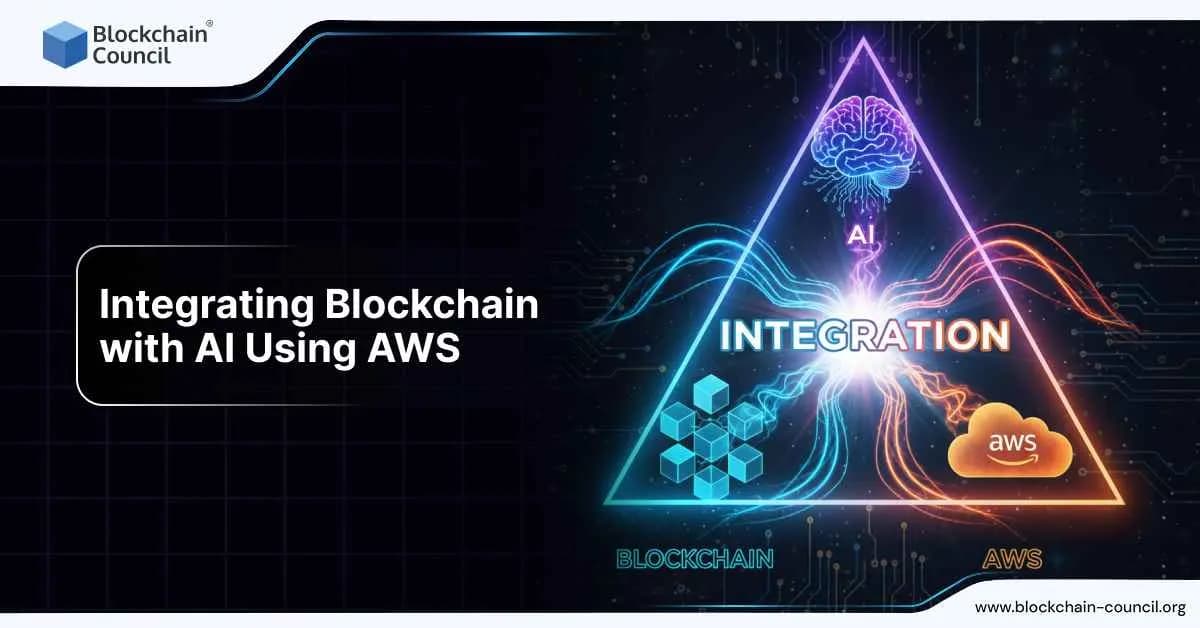
Artificial intelligence and blockchain were once seen as separate technological revolutions, each evolving at its own pace. AI focused on intelligence, prediction, and automation, while blockchain built trust, transparency, and cryptographic integrity. Today, these two forces are finally merging, not as competing technologies but as complementary building blocks for a new class of intelligent and trustworthy digital systems. This integration is no longer theoretical. It is already happening inside enterprises, startups, government programs, and high scale data ecosystems that rely on cloud infrastructure to power next generation applications.
AWS has emerged as the most important platform enabling this shift. With Amazon Managed Blockchain, massive AI compute power, and advanced data engineering services, developers and enterprises now have a complete environment where blockchain and AI can operate together. Many professionals first approach this field through fundamental learning pathways like a Blockchain Course, which gives them the conceptual clarity needed to understand why this integration is so powerful.

Integrating blockchain with AI on AWS is ultimately about solving one of the biggest problems in technology today. AI systems are only as trustworthy as the data they receive, and blockchain ensures that the provenance, transparency, and integrity of that data remain intact. On the other side, blockchain networks often need automation, intelligence, and adaptation, something AI delivers at scale. AWS becomes the shared foundation that gives both technologies reliability, global reach, and operational consistency.
AWS as the Bridge Between Blockchain and AI
AWS is not just a cloud provider for compute and storage. It is a complete ecosystem designed for distributed systems, automation, scale, and high performance AI workloads. Integrating blockchain and AI requires tools that can handle large volumes of transactions, verifiable data histories, decentralized consensus, and rapid model execution. AWS supports each of these with platform level services that work smoothly together.
Why AWS is the ideal environment for blockchain AI systems
Several reasons make AWS the natural home for these hybrid architectures:
Scalable infrastructure for AI workloads
AI models require massive compute power during training and ongoing optimization. AWS Inferentia, Trainium, and EC2 clusters provide this capacity without requiring companies to set up physical hardware.
Managed blockchain systems through Amazon Managed Blockchain
Amazon Managed Blockchain removes the complexity of running nodes, validating blocks, and maintaining uptime. It allows developers to focus on application logic instead of infrastructure maintenance.
Data orchestration tools for secure pipelines
AI and blockchain require clean, secure, and traceable data flows. AWS Glue, Kinesis, and Lambda help build these pipelines while maintaining data integrity.
Integration with identity and access systems
AWS IAM supports fine grained access control for blockchain networks and AI systems, ensuring that data remains protected at all times.
Enterprise grade compliance and governance
Hybrid AI blockchain solutions often operate in regulated industries. AWS supports frameworks such as HIPAA, SOC, and GDPR, easing compliance challenges.
This combination makes AWS the preferred environment for research institutions, fintech companies, supply chain platforms, and AI driven cybersecurity systems.
Core Benefits of Integrating Blockchain with AI
Once blockchain and AI are deployed together, they create new capabilities that neither technology can enable alone. The combination helps organizations build systems that are intelligent, trustworthy, transparent, and secure.
Verified data for training AI models
AI depends on accurate training data. If attackers manipulate or poison datasets, the resulting model becomes unreliable. Blockchain prevents these attacks by securing data pipelines with timestamps, signatures, and verifiable provenance. This ensures that AI models are always trained on authentic information.
Automated smart contract operations powered by AI
Smart contracts are powerful but static. They perform exactly as written, which limits adaptive behavior. AI introduces dynamic intelligence that can analyze conditions, detect anomalies, and trigger smart contract actions automatically. This opens pathways for intelligent supply chains, adaptive financial instruments, and autonomous digital ecosystems.
Auditability and transparency for AI decisions
Industries such as healthcare and finance require AI explanations and detailed decision trails. Blockchain stores these decision logs permanently, making AI systems more accountable. This is essential for regulatory transparency and governance.
Secure AI agent collaboration
As AI agents begin interacting autonomously, blockchain becomes the trust layer that validates each interaction. Identity, permissions, transaction history, and reputational data can all be stored on the ledger to secure communication between agents.
Decentralized data sharing for multi team AI projects
Organizations often struggle to share data securely across teams. Blockchain enables tamper proof, decentralized data sharing that supports collaborative AI development without exposing sensitive information.
These features create AI systems that are not only more intelligent but also more trustworthy and compliant.
Real World Use Cases of AI and Blockchain on AWS
Enterprises across sectors have begun exploring hybrid architectures on AWS to solve real problems. These examples show how blockchain and AI complement each other in high stakes environments.
Healthcare data integrity and diagnosis models
Hospitals store patient histories on blockchain to ensure accuracy and immutability. AI models then use this verified data to produce reliable diagnostic insights. AWS provides the infrastructure to host both datasets and AI pipelines securely.
Supply chain transparency with AI driven forecasting
Manufacturers store supply chain events on blockchain for traceability. AI uses this trusted data to predict delays, optimize inventory, and identify anomalies.
Insurance fraud detection
Blockchain stores claims and transaction histories, while AI reviews the data to detect unusual patterns. This reduces fraud and speeds up claim approvals.
Financial compliance and auditing
AI models analyze blockchain backed ledgers to automate compliance checks. AWS supports the large scale computing needed for continuous monitoring.
Decentralized identity verification for fintech apps
Blockchain stores identity metadata, and AI verifies patterns in user behavior to detect identity theft or account compromise.
These use cases highlight why AWS is the backbone for blockchain AI applications, offering compute power, data tools, and compliance frameworks in one environment.
Tools and Services on AWS That Support Blockchain AI Integration
To build blockchain AI solutions, developers rely on a blend of AWS services. These tools make integration simpler and more efficient.
Amazon Managed Blockchain
This fully managed service handles node provisioning, security patches, scaling, and network management. Developers can deploy Hyperledger Fabric or Ethereum networks without maintaining complex infrastructure.
AWS AI and ML stack
Services such as SageMaker, Bedrock, EC2 GPU clusters, and Trainium hardware support training and deploying AI models.
Data engineering services
AWS Glue, S3, Athena, Kinesis, and Redshift create seamless data pipelines for blockchain logs and AI datasets.
Security and access control
AWS IAM and Key Management Service help enforce identity, permission structures, and cryptographic control.
Serverless automation tools
Lambda, Step Functions, and EventBridge enable workflows that connect blockchain events to AI responses without manual intervention.
Many developers deepen their understanding of automation by exploring tools through a Python Course, which helps them build scripts and workflows for these integrated architectures.
The Role of AWS Keywords in the Architecture
Organizations often rely on specialized cloud partners to build and maintain these systems. This is where enterprise services come in.
Many companies work with AWS consulting services to design blockchain enabled data architectures that can scale and comply with regional regulations. After deployment, businesses depend on AWS managed services to ensure that blockchain nodes, AI models, and data pipelines remain secure and functional.
These cloud services play a critical role in enabling real world AI blockchain adoption, making the integration smoother and less risky.
Challenges Developers Face When Combining Blockchain and AI
Although AWS supports hybrid architectures well, developers face several challenges that must be managed carefully.
Data privacy and protection laws
Blockchain is immutable, while privacy laws often require the ability to delete or modify user data. AWS supports hybrid storage solutions, but developers must design systems with both requirements in mind.
Latency between blockchain and AI layers
Blockchain consensus processes can introduce delays, while AI models require fast inference. To solve this, teams use sidechains, cache layers, and asynchronous design patterns on AWS.
Complexity of multi system integration
Developers need expertise in data engineering, machine learning, cryptography, and distributed system design. Using AWS managed tools helps reduce this burden, but the architecture still requires careful planning.
Cost optimization
Large scale blockchains and AI models can be expensive. AWS offers auto scaling, efficient compute instances, and serverless workflows to manage these costs.
These challenges are not barriers. They simply require thoughtful approaches, especially for enterprises planning long term deployments. For companies transitioning from legacy systems into cloud based blockchain AI ecosystems, AWS migration services help them move safely without slowing down operations.
The Growing Future of Blockchain AI Systems on AWS
The convergence of blockchain and AI on AWS is becoming more common as organizations shift toward autonomous digital infrastructure. Several future trends are emerging.
AI agents powered by blockchain identity
AI agents will use blockchain to verify their identity, permissions, and reputational history before interacting with other systems.
Blockchain secured AI training datasets
Enterprises will store dataset metadata on blockchain, allowing regulators and users to verify how training data was collected.
Autonomous supply chain ecosystems
AI will optimize supply chains, while blockchain provides the transparency needed for global collaboration.
Smart contract automation with AI decision models
AI algorithms will trigger smart contract clauses based on verified data, making transactions intelligent and self governing.
AI powered marketing on blockchain verified data
Marketing teams will use blockchain verified behavioral insights to build campaigns with greater accuracy. Professionals exploring this area often study AI Marketing to understand how blockchain and AI together can shape future marketing ecosystems.
These developments indicate that blockchain and AI are not converging by accident. They represent the foundation of next generation digital infrastructure.
Final Takeaway
Integrating blockchain with AI using AWS is one of the most significant technological shifts happening today. Blockchain ensures tamper proof data integrity, while AI brings intelligence and automation. AWS unifies these strengths with scalable infrastructure, secure data pipelines, managed blockchain services, and world leading AI compute capacity. This integration is already transforming sectors from healthcare to finance, from smart cities to supply chains, and from identity verification to compliance systems.
As organizations plan for long term digital transformation, the combination of AI, blockchain, and AWS has become essential for building trustworthy, transparent, and resilient systems. The technologies are no longer independent. Together, they form a powerful foundation for tomorrow’s digital economy.
Frequently Asked Questions (FAQs)
How does AWS simplify blockchain and AI integration?
AWS provides a managed environment where developers can deploy blockchain networks and AI models without handling complex infrastructure. Services such as Amazon Managed Blockchain, SageMaker, and serverless workflows help teams build hybrid systems that are scalable, secure, and operationally efficient.
Can blockchain improve the trustworthiness of AI systems?
Yes. Blockchain records data provenance, timestamps, training sources, and decision logs in a tamper resistant way. This ensures AI systems operate on verified data and produce accountable results, which is essential for industries that depend on transparency and auditability.
What role does Amazon Managed Blockchain play in these solutions?
Amazon Managed Blockchain allows organizations to run secure blockchain networks without managing nodes or performing manual maintenance. It acts as the backbone for storing immutable records, smart contracts, and permission structures that AI systems reference during decision making.
Is integrating blockchain with AI expensive on AWS?
Costs depend on architecture and workload. AWS offers flexible compute options, auto scaling, serverless triggers, and efficient blockchain management that help reduce operational expenses. Proper design and cost monitoring tools make the integration affordable for both startups and enterprises.
Which industries benefit most from blockchain AI systems on AWS?
Healthcare, finance, supply chain, manufacturing, insurance, and digital identity programs gain the most value. These sectors require trustworthy data, secure collaboration, and accurate AI insights, making blockchain and AI a powerful combination when deployed on AWS.
Related Articles
View All
AI & ML
Built to Catch AI Cheating: Rethinking Pre-Employment Assessments with HireValid
Explore how HireValid is rethinking pre-employment assessments with AI-resistant test design, integrity signals, candidate evidence, and human review to address AI-assisted cheating.

AI & ML
AI-Era Hiring Needs AI-Proof Tests: How HireValid Is Redefining Talent Assessment
Explore how HireValid is rethinking talent assessment for the AI era with job-relevant tests, anti-cheating design, integrity signals, and human-reviewed evidence of candidate ability.
AI & ML
Google Launches Gemini 4 Argon: Features and Capabilities
Google has launched Gemini 4 Argon, its flagship AI model for coding, finance, law, cybersecurity and science. Learn its key features, availability, pricing and safety details.
Trending Articles
The Role of Blockchain in Ethical AI Development
How blockchain technology is being used to promote transparency and accountability in artificial intelligence systems.
How Blockchain Secures AI Data
Understand how blockchain technology is being applied to protect the integrity and security of AI training data.
How to Create Claude Skills?
Claude Skills are one of the most important features Anthropic has introduced for users who want automation that is structured, consistent and reusable. Instead of giving Claude long instructions ever