

How to Fine-Tune a Large Language Model: Step-by-Step Workflow, Tools, and Best Practices
 Suyash Raizada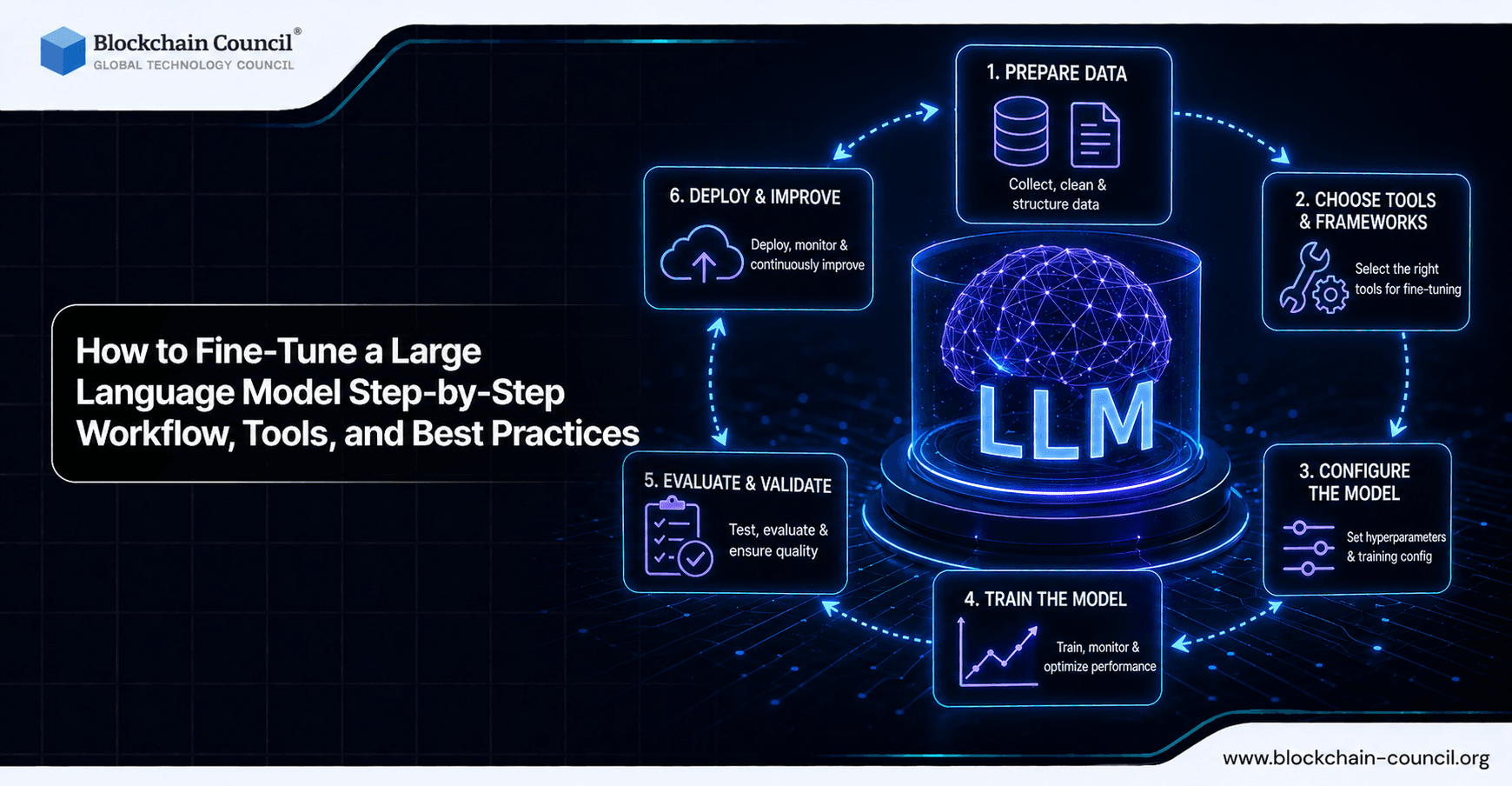
Fine-tuning a large language model in 2026 is less about massive budgets and more about disciplined data, efficient adapters like LoRA and QLoRA, and evaluation-driven iteration. Modern workflows focus on changing model behavior - format consistency, refusal policy, reasoning style - rather than updating facts, which is usually better handled with retrieval-augmented generation (RAG). With today's tooling, fine-tuning a 7B model can run on a single GPU in hours and cost under $5, making production-grade customization accessible to most teams.
As organizations increasingly customize and deploy foundation models, interest in LLM Developer Certification programs is growing among professionals who want to build expertise in fine-tuning, model evaluation, prompt engineering, RAG architectures, and production-scale LLM development.

This guide walks through a production-ready, step-by-step workflow, recommended tools, and best practices to reduce hallucinations, improve format compliance, and reliably align outputs with your domain.
What Fine-Tuning Does (and Does Not) Do
Before starting any training run, clarify the goal. Fine-tuning is most effective when you need consistent behavioral changes, such as:
Output format reliability - for example, strict JSON schemas for APIs. LoRA-based fine-tunes often reach 95%+ schema compliance compared to lower reliability from prompting alone.
Task style and tone - support agent voice, compliance language, or structured reasoning layout.
Refusal behavior and safety boundaries tailored to your application.
Domain reasoning patterns - debugging, proofs, policy interpretation - increasingly improved via GRPO and preference optimization methods rather than supervised fine-tuning (SFT) alone.
Fine-tuning is generally not the right choice when:
You have fewer than roughly 500 high-quality examples or cannot maintain consistent data quality.
Your requirements change frequently and retraining would become a bottleneck.
You primarily need the model to reference fresh or proprietary knowledge. Use RAG to keep answers current and auditable.
Step-by-Step Workflow to Fine-Tune an LLM
The workflow below is designed for teams that want repeatable results and measurable improvements, not just a one-off experiment.
Step 1: Assess Whether to Fine-Tune or Use RAG
Use this decision heuristic:
Need citations, freshness, or proprietary documents? Choose RAG or a hybrid approach.
Need strict formatting, stable tone, or consistent refusals? Choose fine-tuning.
Need better reasoning style for domain tasks? Consider GRPO or other preference optimization methods.
A practical hybrid pattern in 2026 is RAG combined with fine-tuning: use RAG to ground facts and fine-tuning to enforce style, structure, and safety boundaries.
Step 2: Data Preparation
Data quality is the single biggest driver of fine-tuning outcomes. A common target is 500 to 2,000 examples drawn from real usage. Many practitioners find that 500 carefully curated examples outperform 5,000 mediocre ones.
Checklist for high-quality datasets:
Collect real prompts and desired outputs from tickets, chats, internal workflows, or curated task sets.
Format as chat training data using ChatML-style JSONL with roles (system, user, assistant).
Split 80/20 into train and evaluation sets. Keep the eval set fixed for comparability across runs.
Manually review at least 100 samples for contradictions, missing context, sensitive data, and inconsistent labeling.
Audit for bias and diversity: ensure inclusive representation and avoid encoding harmful stereotypes.
Example use case patterns:
JSON formatting: include edge cases such as nulls, optional fields, and nested objects to harden schema compliance.
Summarization: pair source text with high-quality abstracts and add reviewer notes that define what a good summary looks like.
Finance calculations: include correct step-by-step outputs, boundary conditions, and common error traps such as discount math.
As these workflows become more sophisticated, many professionals also pursue a Programming Certification to strengthen their understanding of software logic, data structures, debugging practices, and the technical foundations needed to build and evaluate reliable AI-powered applications.
Step 3: Choose the Model and Tooling
Start with a platform that matches your constraints: data privacy requirements, cost, deployment environment, and the level of infrastructure control your team needs.
OpenAI API: a straightforward entry point for managed fine-tuning on proprietary models, with minimal infrastructure overhead.
Hugging Face: a broad ecosystem for LoRA and QLoRA workflows and open-source training stacks.
Axolotl or LLaMA-Factory: practical choices for local fine-tuning of open models such as Llama variants.
SiliconFlow: a cloud pipeline designed for fast iteration, offering an integrated upload-train-deploy experience.
Efficiency methods to consider:
LoRA (Low-Rank Adaptation): a strong cost-to-performance trade-off for most enterprise tasks.
QLoRA: quantization-aware adapter training that reduces memory requirements, useful when GPU resources are constrained.
GRPO (Group Relative Policy Optimization): increasingly adopted for reasoning-heavy tasks where preference optimization outperforms pure SFT.
Teams often pair hands-on implementation with structured learning to standardize evaluation, safety, and MLOps practices. Certifications such as a Certified AI Engineer, Certified Machine Learning Professional, or a focused LLM and GenAI program can help build consistent team-wide competency in these areas.
Step 4: Run the Fine-Tuning Job
Fine-tuning is now fast enough to support iterative development cycles. A 7B parameter model can often be fine-tuned on a single GPU in hours, with costs that may fall under $5 depending on platform and configuration.
Training configuration guidelines:
Batch size: use the largest batch your GPU memory allows, typically 16 to 64. Larger batches tend to stabilize gradient updates.
Gradient accumulation: apply when memory is limited to simulate larger effective batch sizes.
Method selection:
Use SFT when the primary goal is style, format, or task demonstration learning.
Use GRPO or related preference optimization when you need better reasoning patterns, such as code debugging or structured proofs.
Human reviewer loop: incorporate reviewer feedback for borderline cases, safety issues, and rubric-based scoring throughout the training process.
Step 5: Evaluation and Iteration
Evaluation-first workflows have become standard practice. Rather than waiting until training is complete to assess results, build automated evaluation loops that run after each epoch or at defined intervals.
Build a scorecard covering metrics such as:
Task accuracy - exact match, rubric score, or unit tests for code outputs.
Format compliance - valid JSON output, schema validation pass rate.
Hallucination rate - claims not supported by provided context in RAG workflows, or incorrect citations where applicable.
Refusal correctness - refuse when required, comply when safe.
Latency and cost - especially relevant when tuning for production efficiency.
Operational best practices:
Fixed eval set: keep it stable so improvements are comparable across training runs.
Quality gates: define pass thresholds such as 95% JSON validity or a maximum allowed hallucination rate.
Early stopping: stop training when eval quality plateaus or begins to regress.
Qualitative review: sample outputs and inspect failure clusters to guide targeted dataset improvements.
Proceed to online A/B testing with real traffic only after offline evaluation results meet your defined thresholds.
Step 6: Deploy, Monitor, and Retrain
Deployment is not the finish line. Models drift as user behavior shifts, policies evolve, and new edge cases emerge in production.
A/B testing: compare the fine-tuned model against a baseline across accuracy, safety, and user satisfaction metrics.
Monitoring: run the same evaluation suite on sampled production traffic to detect regressions early.
Quantization: for local or edge deployment, quantize models to reduce latency and memory footprint.
Dataset refresh: add new failure cases to your training set and repeat the cycle.
As AI systems become more integrated into customer-facing products and business processes, professionals are increasingly complementing technical AI skills with a Digital Marketing Certification to better understand user behavior, customer experience, performance measurement, and data-driven decision-making.
Tooling Overview: What to Use and When
Selecting the right stack reduces time-to-value and avoids rework later in the process.
Fast cloud pipelines: platforms like SiliconFlow simplify the workflow to upload data, configure training, and deploy.
Open ecosystem: Hugging Face combined with PEFT methods (LoRA, QLoRA) suits teams that need control, transparency, and flexibility.
Local training: Axolotl and LLaMA-Factory are practical for open models and private data environments.
Managed APIs: OpenAI API fine-tuning reduces infrastructure complexity when proprietary models meet your requirements.
Best Practices Checklist
Start with the smallest intervention: try prompt engineering and RAG improvements first, then fine-tune for stable behavioral changes.
Prioritize data quality: clear rubrics, consistent labels, and reviewer oversight matter more than dataset size alone.
Use LoRA or QLoRA by default: a strong cost-to-performance trade-off for most tasks.
Use GRPO for reasoning-heavy tasks: particularly when SFT leads to shallow pattern matching.
Automate evaluations: embed evaluation into the training pipeline and gate releases on defined metrics.
Monitor after deployment: production drift is expected, so track the same metrics continuously.
Conclusion
Fine-tuning a large language model is now a practical engineering discipline: curate 500 to 2,000 high-quality examples, choose efficient methods like LoRA or QLoRA, apply GRPO when reasoning quality matters, and treat evaluation as a first-class system component. Teams that succeed are those that iterate with tight feedback loops, enforce quality gates, and monitor behavior continuously in production. For most real-world deployments, the strongest outcomes come from a hybrid approach - RAG for factual grounding and fine-tuning for consistent behavior, format compliance, and domain-specific interaction patterns.
FAQs
1. What is fine-tuning a large language model (LLM)?
Fine-tuning is the process of training a pre-trained language model on a specific dataset. It adapts the model to a particular task or domain. This improves accuracy and relevance.
2. Why should you fine-tune an LLM?
Fine-tuning helps customize the model for specific use cases like customer support or domain-specific tasks. It improves performance compared to general models. It also reduces reliance on prompt engineering alone.
3. What are the key steps in fine-tuning an LLM?
The main steps include data collection, data preprocessing, model selection, training, and evaluation. Each step ensures the model learns effectively. A structured workflow improves results.
4. What type of data is needed for fine-tuning?
You need high-quality, labeled, and domain-specific data. The dataset should reflect the target task. Clean and relevant data is critical for good performance.
5. How do you prepare data for fine-tuning?
Data preparation involves cleaning, formatting, and labeling. It may include removing duplicates and normalizing text. Proper formatting ensures compatibility with the model.
6. What tools are used for fine-tuning LLMs?
Common tools include Hugging Face Transformers, PyTorch, TensorFlow, and OpenAI APIs. These frameworks support training and deployment. Tool selection depends on the use case.
7. What is supervised fine-tuning (SFT)?
Supervised fine-tuning uses labeled input-output pairs to train the model. It teaches the model to generate desired responses. This is the most common fine-tuning method.
8. What is parameter-efficient fine-tuning (PEFT)?
PEFT methods like LoRA reduce training costs by updating only a subset of parameters. They require less compute and memory. This makes fine-tuning more accessible.
9. How much data is required for fine-tuning?
The amount of data depends on the complexity of the task. Small datasets can work for simple tasks, while larger datasets improve performance. Quality is more important than quantity.
10. What hardware is needed for fine-tuning LLMs?
Fine-tuning typically requires GPUs or specialized hardware. Cloud platforms provide scalable resources. Smaller models can be trained on less powerful systems.
11. How do you evaluate a fine-tuned model?
Evaluation involves testing the model on validation datasets. Metrics like accuracy, relevance, and loss are used. Human evaluation may also be required.
12. What are common challenges in fine-tuning LLMs?
Challenges include data quality issues, overfitting, and high computational costs. Poor tuning can degrade performance. Careful monitoring is necessary.
13. How can you avoid overfitting during fine-tuning?
Use validation datasets and regularization techniques. Limit training epochs and monitor performance. Early stopping helps prevent overfitting.
14. What is instruction tuning in LLMs?
Instruction tuning trains the model to follow specific prompts or instructions. It improves usability and response quality. This is useful for conversational AI.
15. How does fine-tuning compare to prompt engineering?
Fine-tuning modifies the model itself, while prompt engineering adjusts inputs. Fine-tuning provides deeper customization. Prompting is faster but less precise.
16. What are best practices for fine-tuning LLMs?
Use clean, high-quality data and start with smaller experiments. Monitor metrics and iterate gradually. Proper documentation and testing are essential.
17. Can fine-tuned models be deployed in production?
Yes, fine-tuned models can be deployed using APIs or cloud services. Proper testing ensures reliability. Monitoring is required for ongoing performance.
18. How does cost impact fine-tuning decisions?
Fine-tuning can be expensive due to compute and storage needs. Parameter-efficient methods reduce costs. Budget planning is important.
19. What industries benefit from fine-tuned LLMs?
Industries such as healthcare, finance, customer support, and education benefit. Fine-tuned models provide domain-specific insights. This improves efficiency and accuracy.
20. What is the future of LLM fine-tuning?
Future trends include more efficient training methods and better tools. Fine-tuning will become more accessible and scalable. It will remain a key part of AI development.
Related Articles
View All
AI & ML
Meta Launches Muse Wonder: Its New AI Model Explained
Meta has launched Muse Wonder and Muse Wonder Full, new AI models built for personal and professional agents. Learn the features, pricing, access options and how they compare with rivals.

AI & ML
Jev AI: the complete guide to TypeSafe's System One Model
Explore Jev AI in this complete guide, including TypeSafe’s System One architecture, RLCD training, parallel sampling, typed decisions, calibrated confidence, performance, and automation use cases.

AI & ML
Jev Model Architecture
Explore the Jev model architecture, including TypeSafe AI’s System One design, parallel sampling, RLCD training, typed outputs, and calibrated probabilistic decisions.
Trending Articles
AWS Career Roadmap
A step-by-step guide to building a successful career in Amazon Web Services cloud computing.

Top 5 DeFi Platforms
Explore the leading decentralized finance platforms and what makes each one unique in the evolving DeFi landscape.
What is AWS? A Beginner's Guide to Cloud Computing
Everything you need to know about Amazon Web Services, cloud computing fundamentals, and career opportunities.