

China AI Tools: Free vs Paid Options for Builders, Creators, and Enterprises

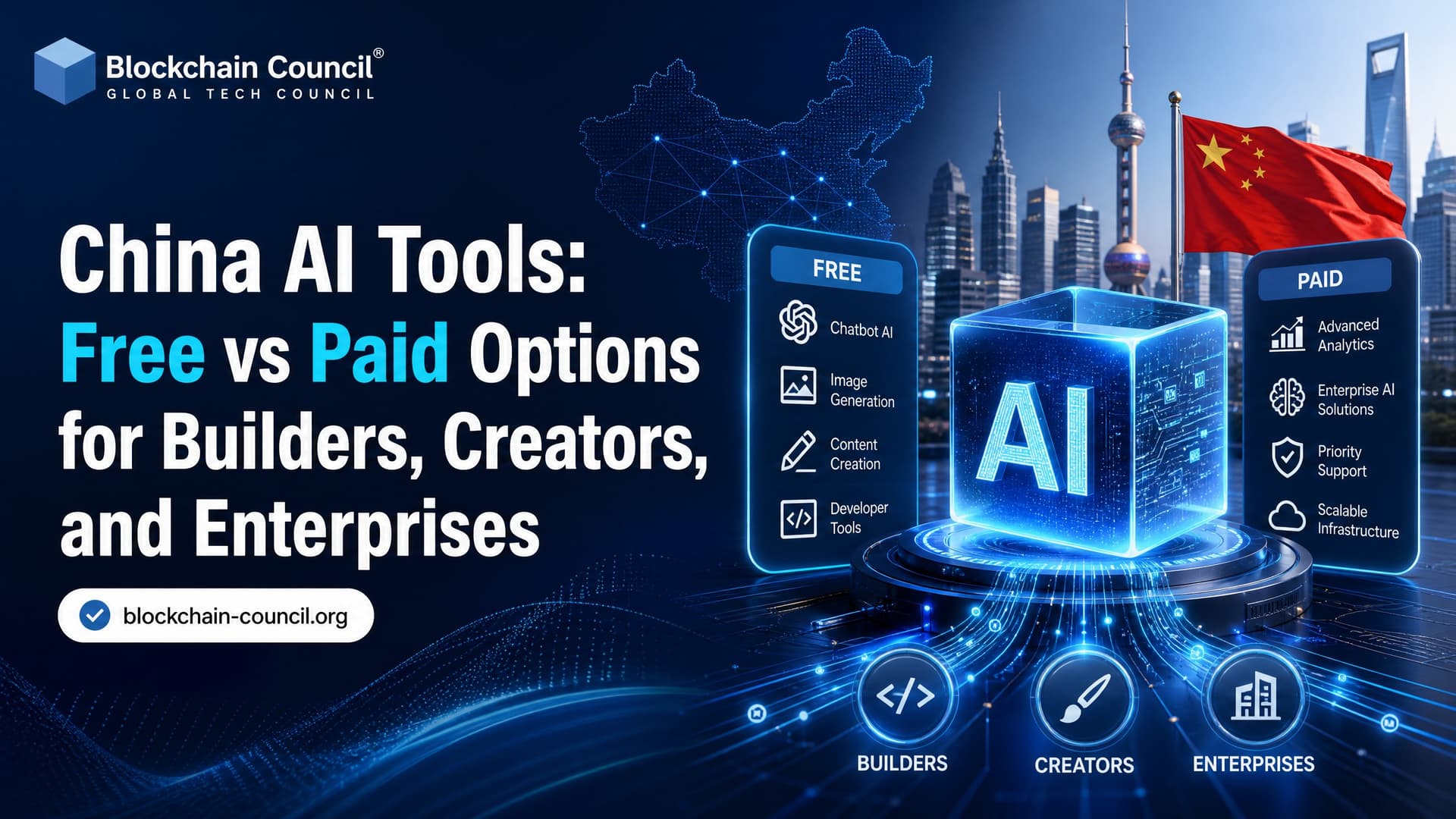
China AI tools have moved from interesting alternatives to practical choices for developers, marketers, founders, and enterprise teams. The short version: free Chinese AI models are now good enough for many coding, content, image, video, and agent workflows. Paid tools still matter when you need support, uptime promises, compliance reviews, and deep integration with business systems.
This split matters because the pricing pressure is real. Chinese open-source models such as DeepSeek, Qwen, GLM, and MiMo-style releases have changed what users expect. You can prototype with a capable model, generate marketing assets, test an agent workflow, or build a demo without paying for a Western subscription or burning API credits on every failed prompt.

What Makes China AI Tools Different Right Now?
The market is growing on two tracks. One track is free or open-source: models, video generators, image tools, and coding assistants that aim for fast adoption. The other is paid enterprise AI from major platforms such as Alibaba Cloud, Baidu, Tencent Cloud, Huawei Cloud, and Zhipu AI, where buyers pay for API scale, managed deployment, security controls, and service commitments.
That is not generosity. It is strategy. If developers build prototypes on your model, fine tune it, wrap it in applications, and train teams on its behavior, your ecosystem becomes hard to replace. Several China tech analysts describe this as an infrastructure play: make the foundation cheap or free, then monetize cloud, hardware, enterprise contracts, and platform dependence.
Open-source activity in China has expanded quickly over the past decade, with a large and growing base of active contributors across model and tooling projects. Andreessen Horowitz partner Martin Casado has also said that many US AI startups prototype with Chinese open-source models such as DeepSeek because the cost and iteration speed are hard to ignore.
Free China AI Tools: Where They Work Best
Free does not always mean weak. In this category, free usually means one of three things: open model weights, free web access, or a no-cost playground that encourages adoption. The trade-off is that you often handle setup, testing, privacy review, and failure recovery yourself.
1. LLMs and Coding Models
DeepSeek and Qwen are the names most developers already know. DeepSeek models gained attention for strong reasoning and coding performance at lower cost. Qwen, developed by Alibaba, has become a serious family for multilingual tasks, coding, math, and agent workflows. Many Qwen models are available through open model hubs, and some can run locally depending on size and hardware.
GLM models, from Zhipu AI, are also widely discussed as Chinese alternatives to premium Western chat models. Some reviewers describe newer GLM releases as useful for app prototypes, presentations, games, and code generation through public testing platforms. Treat benchmark claims carefully, though. A model that wins a leaderboard prompt may still fail your real codebase if it lacks project context.
Here is a small gotcha from actual developer use: AI coding assistants often mix ethers.js v5 and v6 syntax. If a model tells you to use contract.deployed() in an ethers v6 Hardhat project, you will hit TypeError: contract.deployed is not a function. The v6 method is waitForDeployment(). This is the kind of detail you must test before trusting any free model in a blockchain workflow.
2. Image and Video Generation
China's multimodal tools are putting pressure on paid image and video platforms. Alibaba's Wan video models, often discussed in AI creator communities, are part of a broader wave of Chinese video generation tools used for short clips, product visuals, avatars, and marketing experiments. Qwen-based tools are also appearing in video and multimodal workflows.
Some roundups mention tools such as OneAI, Wan-style generators, and free image playgrounds with no watermarks or login barriers. Be practical here. Test output rights, privacy terms, and commercial usage language before using generated assets in client work. No watermark does not automatically mean unrestricted commercial licensing.
Perchance is often grouped with free AI image tools because it allows quick image experiments without a heavy setup. Treat it as a free image playground rather than assume it is a China-origin model, unless the specific model provider is clearly listed.
3. Local and Agentic Models
Open-source Chinese models are especially useful for local deployment. Xiaomi's MiMo model releases have drawn attention for agent-style tasks and local experimentation under permissive licensing. If you run models through LM Studio, Ollama, or similar desktop tools, the boring details matter: quantization choice, context length, VRAM, and temperature settings change results more than most tutorials admit.
For example, a Q4 quantized model may be fine for summarizing meeting notes, but it can quietly damage code quality or tool-calling accuracy. For agent work, start with deterministic settings such as temperature near 0.2, log every tool call, and keep a human approval step before money, credentials, or production systems are touched.
Paid China AI Tools: When Paying Makes Sense
Paid Chinese AI tools are not going away. They solve a different problem. If you are a bank, manufacturer, healthcare provider, telecom operator, or public-sector vendor, the model price is only one line item. You also need data handling rules, access controls, audit logs, uptime terms, and someone accountable when the system fails at 2 a.m.
Paid AI services from Chinese cloud and AI companies usually charge for:
- Enterprise API usage at higher volume and predictable throughput.
- Managed deployment, including private cloud or on-premise configurations.
- Fine tuning and customization for company terminology, support scripts, or vertical data.
- Security and compliance support, especially for China's generative AI rules and industry-specific requirements.
- Formal support, onboarding, service-level agreements, and incident response.
To be blunt, paid is the better choice when downtime costs more than the subscription. A free model is attractive for a prototype. It is risky as the only support layer for customer service, trading operations, medical triage, or compliance-heavy document workflows.
Free vs Paid China AI Tools: Practical Comparison
| Factor | Free China AI tools | Paid China AI tools |
|---|---|---|
| Cost | No subscription or low-cost open model use, depending on hosting | Subscription, API, cloud, or enterprise contract pricing |
| Best use | Prototypes, content drafts, coding tests, internal experiments | Production systems, regulated workflows, large-team deployment |
| Support | Community forums, GitHub issues, docs, self-debugging | Vendor support, onboarding, SLAs, escalation paths |
| Customization | Strong if weights are open, but you need engineering skill | Managed fine tuning, integration, governance, monitoring |
| Privacy | Best when self-hosted, weaker if using unknown web tools | Contractual controls and enterprise data terms |
| Reliability | Depends on your setup and provider limits | Designed for uptime, scale, and operational reporting |
Which Users Should Choose Free Tools?
Choose free China AI tools if you are testing ideas, learning AI, or building early product demos. They are especially useful for:
- Developers building proof-of-concept apps, coding agents, or smart contract analysis tools.
- Content creators producing rough cuts, thumbnails, ad concepts, or avatar tests.
- Startups trying five product ideas before paying for a managed API stack.
- Students and professionals learning prompt design, model evaluation, and AI deployment basics.
- Web3 teams experimenting with wallet support bots, NFT creative assets, DAO research assistants, or smart contract review helpers.
If you work in blockchain, pair these experiments with structured learning. Blockchain Council's Certified Artificial Intelligence (AI) Expert™ can help you understand model behavior and deployment choices, while Certified Prompt Engineer™ is useful if your role involves designing repeatable AI workflows. For smart contract-heavy work, Certified Blockchain Developer™ fits well, because AI-generated Solidity still needs a developer who can catch dangerous mistakes.
Which Users Should Pay?
Pay when the AI system becomes part of a real business process. That includes customer-facing chatbots, fraud monitoring, enterprise search, document review, manufacturing analytics, and anything that touches regulated data. Paid tools are also better when your team lacks ML operations experience.
A simple rule works: if the AI output is advisory and low-risk, free tools are fine. If the AI output changes money movement, legal decisions, medical recommendations, access permissions, or production code, budget for paid infrastructure and human review.
Risks You Should Check Before Using China AI Tools
Do not evaluate only model quality. Check the operational details.
- License terms: Confirm whether commercial use, fine tuning, and redistribution are allowed.
- Data exposure: Avoid pasting private keys, customer records, unreleased financials, or proprietary source code into public tools.
- Model hosting: Self-hosting gives more control, but it adds patching, logging, GPU cost, and monitoring work.
- Output ownership: For images and video, read the terms before using assets in ads or client campaigns.
- Compliance: Enterprise use may require review under China's generative AI regulations or your own industry rules.
- Benchmark claims: Test on your own tasks. Public scores rarely predict messy production behavior.
Future Outlook for China AI Tools
The free-versus-paid gap will keep shrinking for common tasks. Coding help, first-draft content, basic image generation, document summarization, and agent prototypes are already well served by free or open-source Chinese models. Paid providers will need to justify their pricing with reliability, governance, specialized tooling, and integration depth.
Expect more edge-friendly releases as hardware companies push models onto phones, PCs, vehicles, and local devices. Also expect stronger Qwen, DeepSeek, GLM, and Wan-style releases to keep forcing price competition across the global AI market.
What You Should Do Next
Start with a small benchmark of your own. Pick three China AI tools, one paid platform, and ten real tasks from your work. Measure cost, latency, accuracy, privacy risk, and the time needed to fix bad outputs. If free tools pass, use them for experimentation and internal workflows. If the workflow affects customers or regulated data, move to a paid setup with contracts and monitoring.
If you want a structured path, study model evaluation, prompt engineering, and AI governance before selecting vendors. Blockchain Council's Certified Artificial Intelligence (AI) Expert™ and Certified Prompt Engineer™ are relevant next steps, especially if you are comparing AI tools for production use rather than casual testing.
Related Articles
View All
AI & ML
Built to Catch AI Cheating: Rethinking Pre-Employment Assessments with HireValid
Explore how HireValid is rethinking pre-employment assessments with AI-resistant test design, integrity signals, candidate evidence, and human review to address AI-assisted cheating.

AI & ML
AI-Era Hiring Needs AI-Proof Tests: How HireValid Is Redefining Talent Assessment
Explore how HireValid is rethinking talent assessment for the AI era with job-relevant tests, anti-cheating design, integrity signals, and human-reviewed evidence of candidate ability.

AI & ML
Google Launches Gemini 4 Argon: Features and Capabilities
Google has launched Gemini 4 Argon, its flagship AI model for coding, finance, law, cybersecurity and science. Learn its key features, availability, pricing and safety details.
Trending Articles

Top 5 DeFi Platforms
Explore the leading decentralized finance platforms and what makes each one unique in the evolving DeFi landscape.

Can DeFi 2.0 Bridge the Gap Between Traditional and Decentralized Finance?
The next generation of DeFi protocols aims to connect traditional banking with decentralized finance ecosystems.
Blockchain in Supply Chain Provenance Tracking
Supply chains are under pressure to prove not just efficiency, but also authenticity, sustainability, and fairness. Customers want to know if their coffee really is fair trade, if the diamonds are con