

Kimi K2.7 Code vs GLM 5.2 vs Claude vs ChatGPT vs Gemini: Best AI Coding Assistant Comparison
 Suyash Raizada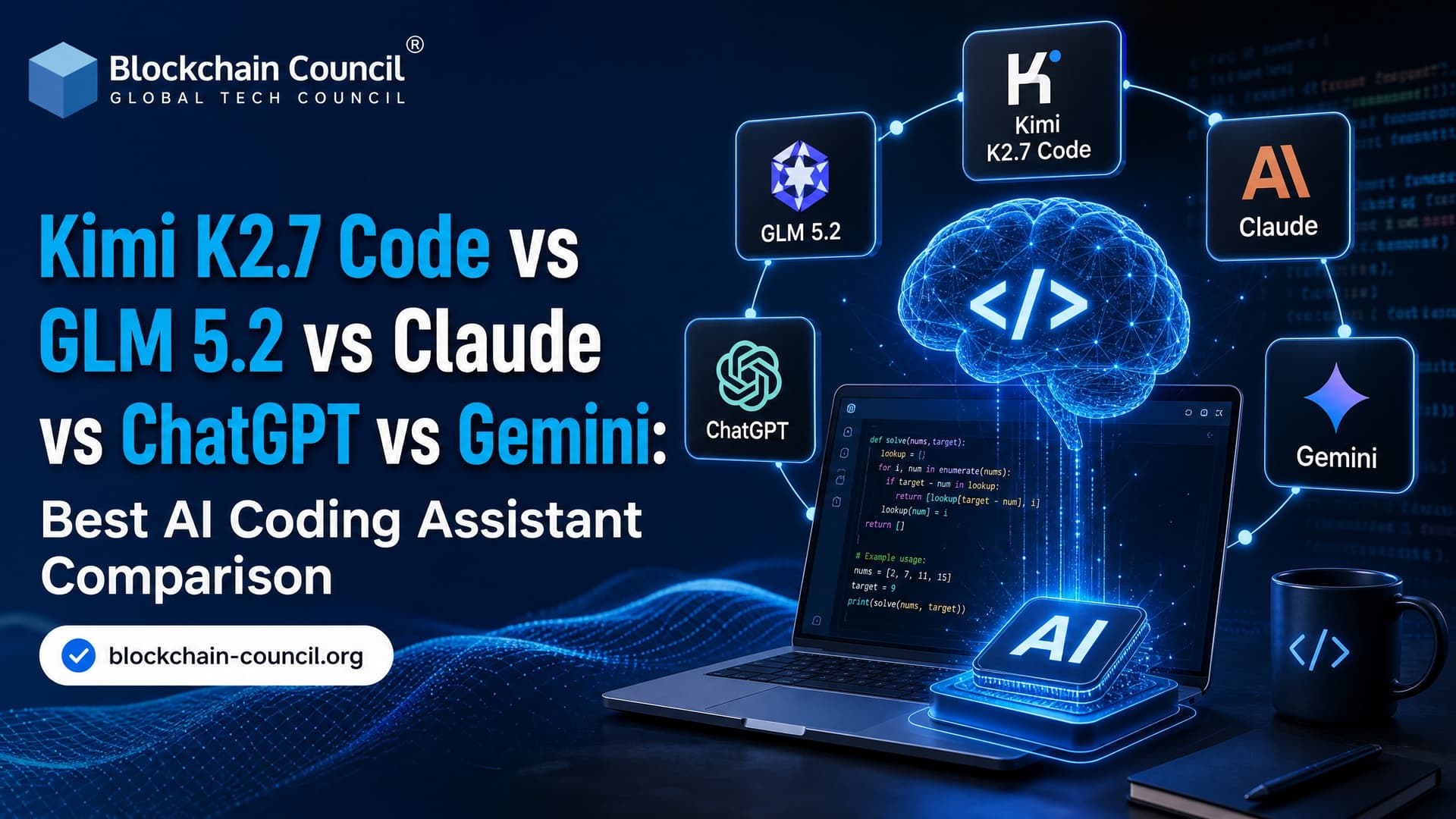
Picking the best AI coding assistant is no longer about which model writes the neatest Python function. By mid 2026, serious developers compare context windows, agent behavior, licensing, IDE support, data governance, and how often an assistant edits files it should not touch. The short version: GPT-4.1, Claude Sonnet, and Gemini Code Assist are the strongest closed options for most teams, while GLM 5.2 and Kimi K2.7 Code lead the open-weight segment for long-running coding agents.
If you write production code, do not pick from a leaderboard alone. Run the model against your own repository. A model that scores well on HumanEval can still make a messy pull request when it has to trace a failing test through five services and an old migration script.

For professionals looking to build these capabilities in a structured way, becoming an AI Powered Coding Expert can provide practical experience with AI-assisted software development, coding agents, repository-level workflows, debugging strategies, and responsible use of AI across the software development lifecycle.
How to Judge the Best AI Coding Assistant
Older benchmarks like HumanEval still matter because they test whether generated code passes unit tests. But they mostly cover short tasks. Real work is different. You need the assistant to read a repository, understand build commands, inspect stack traces, apply a patch, and avoid unrelated edits.
Use a mixed evaluation set:
Short code correctness: HumanEval-style tasks and language-specific unit tests.
Repository tasks: SWE-bench Verified, Terminal-Bench, and your own bug tickets.
Diff quality: Does the model change only the files you asked it to change?
Security: Does it expose secrets, add unsafe dependencies, or weaken validation?
Delivery impact: Track DORA-style metrics such as deployment frequency, change failure rate, and mean time to recovery.
One practical tip. Set a low temperature for real code edits. I usually start around 0.1 to 0.2 for patch generation. Higher settings can help when you want architecture options, but they tend to produce noisy diffs. I have also watched agents mishandle ethers.js v5 to v6 migrations by switching contract.address to await contract.getAddress() while forgetting that deployed() became waitForDeployment(). That kind of small break can eat an afternoon.
Kimi K2.7 Code: Best for Open Agentic Coding with Multimodal Context
Kimi K2.7 Code from Moonshot AI is built for long-horizon software engineering, not quick autocomplete. It uses a Mixture-of-Experts design with about 1 trillion total parameters and roughly 32 billion active per token. Its 256K-token context window is large enough for meaningful repository work, long plans, and repeated tool calls.
The model is open weight under a modified MIT-style license that allows commercial use with attribution. That matters for enterprises that want more control over hosting, regional deployment, or model inspection. Kimi also supports multimodal input through MoonViT, so UI screenshots and visual debugging can sit beside source code in the same workflow.
Where Kimi K2.7 Code Fits
Long-running coding agents that plan, edit, run tests, and revise.
Teams that need open weights but still want frontier-class coding behavior.
Large refactors where the assistant must hold context across many turns.
The trade-off is speed. Kimi K2.7 Code runs in thinking-only mode, which helps reasoning but is overkill for simple completions like a small SQL query or a docstring. If you mostly want inline suggestions, it can feel heavier than needed.
GLM 5.2: Best Open-Weight Choice for Huge Codebases
GLM 5.2 from Z.ai is the strongest open-weight option if scale is your first requirement. It offers a 1M-token context window, an MIT license, and reasoning effort controls that let you trade latency for deeper analysis. The architecture uses MoE-style routing with around 744 to 753 billion total parameters and about 40 billion active per token.
On coding benchmarks, GLM 5.2 sits near the top of the open model market. Reported scores include 81.0 on Terminal-Bench 2.1 and 62.1 on SWE-bench Pro, with large gains over GLM 5.1. Independent hosts and reviewers have described it as competitive with closed frontier systems on several coding suites.
Where GLM 5.2 Fits
Enterprises that need self-hosting and clean MIT licensing.
Monorepos where 1M tokens can hold code, tests, docs, and issue history.
Teams building custom coding agents on Ollama, Hugging Face, cloud inference, or internal platforms.
My view: if your legal or security team blocks proprietary model calls for sensitive repositories, start with GLM 5.2 before Kimi. The 1M context window gives it more room for full-project reasoning. Kimi still wins when multimodal agent workflows are central.
Claude Sonnet and Claude Code: Best for Agentic Debugging and Refactoring
Claude 3.5 Sonnet and the newer Sonnet 4.x models remain developer favorites for multi-step reasoning. Claude 3.5 Sonnet has a 200K-token context window, and Anthropic reported about 92 percent on HumanEval plus a 64 percent success rate on its internal agentic coding evaluation, compared with 38 percent for Claude 3 Opus.
The real value is Claude Code. It runs in the terminal, reads your local codebase, edits files, runs tests, and works through errors. That makes it more useful than a browser chat window when you are debugging a failing CI job or migrating a package.
Where Claude Fits
Legacy code migration and cross-language translation.
Terminal-based debugging with local files and test loops.
Frontend prototyping through Claude Artifacts.
Claude is proprietary, so you depend on Anthropic or supported clouds such as Amazon Bedrock and Google Cloud Vertex AI. For regulated teams, that may be acceptable under enterprise contracts. For air-gapped environments, it is not the right primary choice.
Professionals who plan to build enterprise applications with Anthropic's models can also benefit from becoming a Claude AI Expert, gaining structured knowledge of Claude-powered development, prompt engineering, long-context workflows, AI safety practices, and enterprise implementation patterns.
ChatGPT with GPT-4.1: Best Default for Code Diffs and Ecosystem
GPT-4.1 is OpenAI's developer-focused model family for coding, instruction following, and long context. It supports up to 1M tokens and up to 32,768 output tokens, which helps with large diffs and full-file rewrites. OpenAI reported that extraneous code edits dropped from about 9 percent with GPT-4o to about 2 percent with GPT-4.1.
Its benchmark profile is strong. GPT-4.1 reached 54.6 percent on SWE-bench Verified, a major jump over GPT-4o, and performed well on Aider's polyglot diff benchmark. For many teams, ChatGPT plus GPT-4.1 is the safest default because the ecosystem is mature: VS Code tooling, API wrappers, Azure access, documentation, and community patterns are easy to find.
Where GPT-4.1 Fits
Precise code review comments and scoped diffs.
Long-context analysis across many files.
Teams that want broad tooling support rather than a niche workflow.
The downside is governance. GPT-4.1 is proprietary, and high-volume usage can get expensive. Use the Mini or Nano variants for low-risk routine work, but keep the larger model for architecture, critical diffs, and hard debugging.
For professionals who want to get more value from OpenAI's ecosystem, becoming a ChatGPT Expert can help build practical skills in prompt engineering, AI-assisted coding, workflow automation, and the effective use of ChatGPT for software development and enterprise productivity.
Gemini 1.5 Pro and Gemini Code Assist: Best for Google Cloud Teams
Gemini 1.5 Pro is Google's long-context multimodal model, and Gemini Code Assist brings Gemini into IDEs and Google Cloud workflows. Standard context is commonly around 128K tokens, with expanded 1M and 2M-token modes available in selected environments. Google has shown Gemini reasoning over more than 100,000 lines of code in a single prompt.
Gemini Code Assist integrates with VS Code, JetBrains IDEs, Android Studio, Cloud Workstations, and Cloud Shell. It supports code completion, block generation, conversational help, debugging, and source citations. Its Google Cloud fit is the main reason to pick it.
Where Gemini Fits
Google Cloud, Firebase, BigQuery, Android, and API management workflows.
Multimodal debugging with screenshots, screencasts, text, and code.
Large monorepos where IDE context and cloud context both matter.
Be careful with data settings. Some individual tiers collect prompts, code, outputs, edits, and usage data for model improvement, while enterprise editions provide stronger controls. Check this before connecting a private repository.
Professionals who work extensively with Google's AI ecosystem can also benefit from becoming a Google Gemini Professional, developing practical expertise in Gemini-powered development, multimodal AI workflows, cloud-native applications, prompt design, and enterprise AI implementation across Google Cloud services.
Side-by-Side Comparison
Assistant | Best use | Context | License |
|---|---|---|---|
Kimi K2.7 Code | Open agentic coding with multimodal input | 256K tokens | Open weights, modified MIT-style |
GLM 5.2 | Self-hosted project-scale engineering | 1M tokens | MIT |
Claude Sonnet | Agentic debugging, refactors, migrations | 200K tokens for 3.5 Sonnet | Proprietary |
GPT-4.1 | Code diffs, reviews, long-context analysis | Up to 1M tokens | Proprietary |
Gemini Code Assist | Google Cloud and IDE-native workflows | 128K standard, higher in selected modes | Proprietary |
Which AI Coding Assistant Should You Choose?
Choose based on your operating constraints, not brand preference.
Pick GPT-4.1 if you want the best general-purpose default for diffs, code review, and mature integrations.
Pick Claude Sonnet if you spend a lot of time in agentic debugging, migrations, and terminal-based workflows with Claude Code.
Pick Gemini Code Assist if your engineering stack is already centered on Google Cloud, Firebase, BigQuery, or Android Studio.
Pick GLM 5.2 if you need open weights, MIT licensing, and a 1M-token context window for sensitive repositories.
Pick Kimi K2.7 Code if you want an open long-horizon coding agent with strong reasoning and multimodal input.
Governance, Security, and Training Matter More Than Teams Admit
AI coding assistants can raise output, but they also raise review burden when used carelessly. Generated code still needs security review, dependency scanning, test coverage, and a human owner. Do not let an agent merge changes without CI, especially in smart contracts, payment systems, authentication flows, or infrastructure-as-code.
For Blockchain Council readers, this is where structured learning helps. If you work with AI engineering teams, look at learning paths around the Certified Artificial Intelligence (AI) Expert, Certified Generative AI Expert, and Certified Prompt Engineer credentials. Developers building decentralized applications can pair AI coding workflows with the Certified Blockchain Developer program to sharpen Solidity, Web3 tooling, and secure contract fundamentals.
A broader Tech Certification can further complement these learning paths by expanding your knowledge of emerging technologies, cloud platforms, software engineering practices, and AI-driven development, helping you apply coding assistants effectively across modern enterprise environments.
Final Recommendation
This comparison has one practical answer: pilot two closed models and one open-weight model on your real backlog. Use GPT-4.1 or Claude as the closed baseline, Gemini if you are Google Cloud-heavy, and GLM 5.2 as the open-weight baseline. Add Kimi K2.7 Code when your team needs long-running agent sessions with multimodal context.
Start with five real tickets: one bug, one refactor, one test-writing task, one documentation task, and one security-sensitive change. Measure accepted diff percentage, review time, test pass rate, and escaped defects. Then standardize. If you want to build the skills behind these evaluations, begin with Blockchain Council's AI and developer certifications and use your own repository as the lab.
A Marketing Certification can also add value by helping professionals understand product positioning, developer adoption, user education, and go-to-market strategies for AI-powered software tools and enterprise technology solutions.
FAQs
1. What Is Kimi K2.7 Code?
Kimi K2.7 Code is an AI coding model from Moonshot AI that focuses on software development tasks such as code generation, debugging, code explanation, and programming assistance.
2. What Is GLM 5.2?
GLM 5.2 is a large language model developed by Zhipu AI. It is designed for reasoning, coding, multilingual understanding, agent workflows, and enterprise AI applications.
3. What Is Claude?
Claude is a family of AI models developed by Anthropic. It is known for strong reasoning, coding capabilities, long-context processing, document analysis, and enterprise-focused AI safety features.
4. What Is ChatGPT?
ChatGPT is OpenAI's AI assistant powered by GPT models. It supports coding, writing, reasoning, research, multimodal tasks, automation, and AI agent workflows across a wide range of applications.
5. What Is Gemini?
Gemini is Google's family of AI models designed for reasoning, coding, multimodal understanding, search integration, and productivity across Google services and enterprise applications.
6. Which Model Is Best for Code Generation?
All five models support code generation. Performance varies by language, framework, prompt quality, and task complexity. The best choice depends on your workflow rather than a universally superior model.
7. Which AI Model Is Better for Debugging?
Claude, ChatGPT, Gemini, GLM 5.2, and Kimi K2.7 Code all assist with debugging by explaining errors, identifying bugs, and suggesting fixes. Real-world debugging quality depends on the specific programming task and available context.
8. Which Model Supports the Most Programming Languages?
All major AI coding models support popular languages including Python, JavaScript, TypeScript, Java, C++, Go, Rust, SQL, HTML, and CSS, with varying levels of optimization.
9. Which Model Is Better for Large Codebases?
Models with larger context windows generally perform better when analyzing large repositories or multiple files. Actual effectiveness depends on context limits, tooling, and implementation.
10. Which AI Model Is Better for Documentation?
Claude, ChatGPT, Gemini, GLM 5.2, and Kimi K2.7 Code can all generate technical documentation, API references, README files, code comments, and developer guides.
11. Which Model Is Better for AI Agents?
ChatGPT, Claude, Gemini, GLM 5.2, and Kimi K2.7 Code can all be integrated into AI agent workflows. Agent performance depends on orchestration frameworks, tools, memory, and system design, not only the base model.
12. Which Model Is Better for Software Development?
Each model supports software development through code generation, debugging, testing, refactoring, and documentation. The best fit depends on project requirements, IDE integration, enterprise needs, and developer preferences.
13. Which AI Model Supports Enterprise Applications?
Claude, ChatGPT, Gemini, GLM 5.2, and Kimi K2.7 Code all offer enterprise-oriented capabilities through various platforms, though available security, deployment, compliance, and integration options differ by vendor.
14. Which AI Model Is Better for Multilingual Development?
All five models support multiple languages for both natural language and programming tasks. Actual multilingual performance varies by language pair and implementation.
15. What Factors Should Developers Compare?
Compare coding accuracy, reasoning ability, context window, latency, supported languages, debugging quality, API availability, pricing, enterprise features, integrations, security, and ecosystem support.
16. Which Model Is Best for Beginners?
ChatGPT, Claude, Gemini, GLM 5.2, and Kimi K2.7 Code can all explain programming concepts, generate examples, and assist new developers. The best choice depends on learning style, available features, and platform accessibility.
17. What Are the Limitations of AI Coding Models?
AI coding models can generate incorrect, insecure, or outdated code, misunderstand complex requirements, and make reasoning errors. Human review, testing, and security validation remain essential.
18. How Should Businesses Evaluate AI Coding Models?
Organizations should evaluate models using real-world development tasks, measuring code quality, reasoning accuracy, security practices, integration capabilities, scalability, cost, governance, and developer productivity.
19. What Common Mistakes Should Teams Avoid When Comparing AI Models?
Avoid relying only on benchmark scores, ignoring real-world workflows, overlooking security and compliance, comparing models using only simple coding tasks, or assuming the newest model is automatically the best. A useful evaluation measures performance across your own codebase, tooling, and engineering processes.
20. Which AI Coding Model Should You Choose?
There is no single best AI coding model for every use case. Kimi K2.7 Code, GLM 5.2, Claude, ChatGPT, and Gemini each have strengths in coding, reasoning, and productivity. The right choice depends on your programming languages, project complexity, ecosystem, deployment needs, security requirements, budget, and preferred development workflow. The practical approach is to benchmark shortlisted models on your own tasks before making a long-term decision.
Related Articles
View All
AI & ML
Google Launches Gemini 4 Argon: Features and Capabilities
Google has launched Gemini 4 Argon, its flagship AI model for coding, finance, law, cybersecurity and science. Learn its key features, availability, pricing and safety details.

AI & ML
Google Playground: Create AI Games Without Coding
Learn what Google Playground is, how it uses generative AI to turn text prompts into browser games, how to create your first game, what it costs, how it compares with other no-code tools, and what limits to expect.

AI & ML
Can Gemini Improve Itself? Google AI and Recursive Self-Improvement Explained
Can Gemini improve itself? Learn why Google AI does not self-rewrite its model today, but can power controlled recursive self-improvement loops.
Trending Articles

Top 5 DeFi Platforms
Explore the leading decentralized finance platforms and what makes each one unique in the evolving DeFi landscape.
How Blockchain Secures AI Data
Understand how blockchain technology is being applied to protect the integrity and security of AI training data.
What is AWS? A Beginner's Guide to Cloud Computing
Everything you need to know about Amazon Web Services, cloud computing fundamentals, and career opportunities.