

How Meta AI Works: Llama Models, Multimodal AI, and Generative Tools

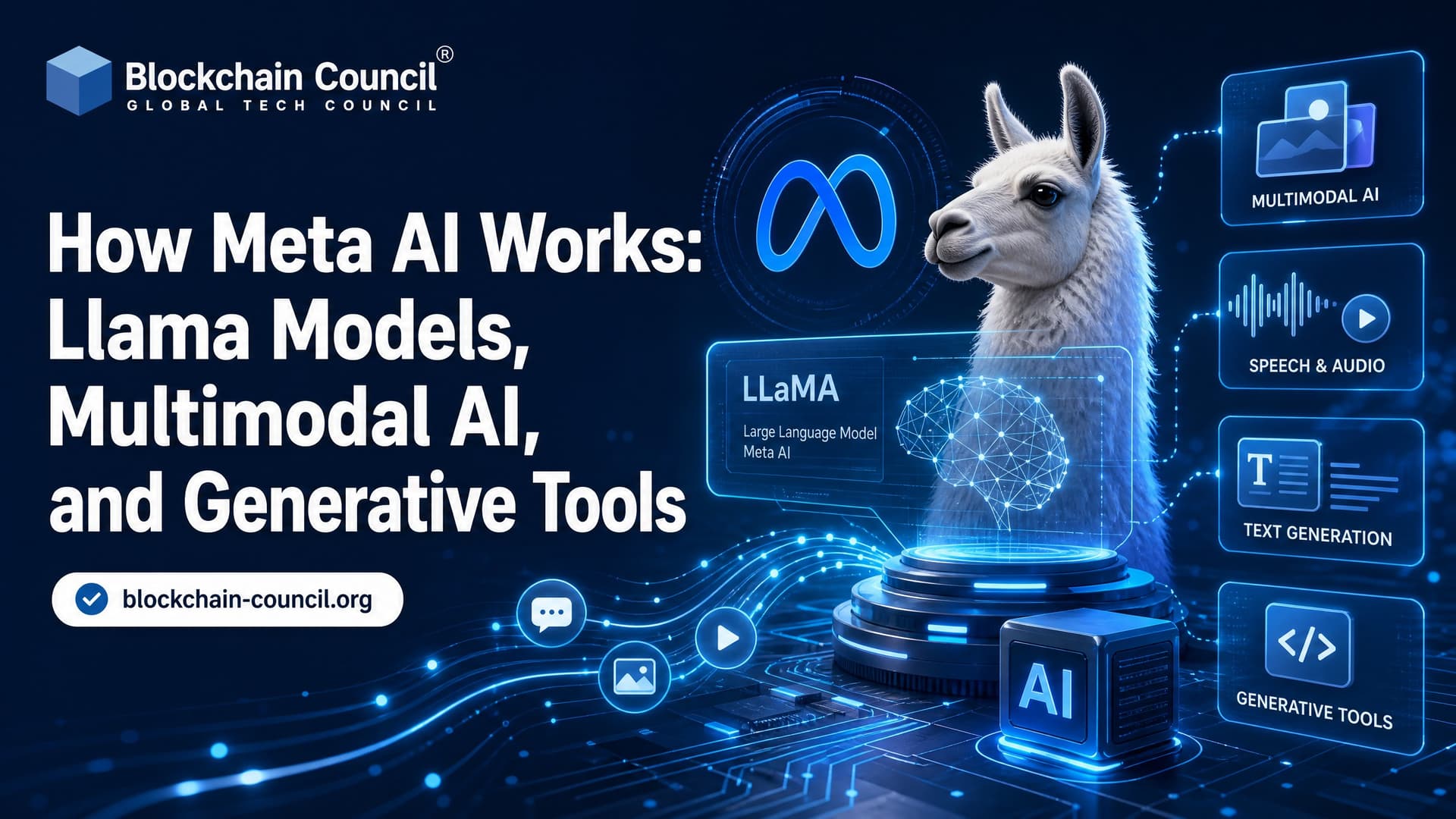
How Meta AI works comes down to three layers: the Llama model family, multimodal systems that connect text with images, and product tools that turn those models into assistants for chat, coding, search, and content generation. The interesting part is not model size. It is how Meta moved from research-only language models to open-weight systems that now run across Facebook, Instagram, WhatsApp, web apps, developer stacks, and edge devices.
If you are learning AI architecture, Llama is worth studying closely. It shows where large language models are heading: sparse expert models, long context windows, image reasoning, tool calling, and smaller on-device variants.

What Is Meta AI?
Meta AI is the assistant and product layer built on top of Meta's Llama models. You see it in Meta's consumer apps, including Facebook, Instagram, WhatsApp, and the dedicated Meta AI web interface. Under the hood, the assistant uses instruction-tuned Llama models, retrieval systems, safety filters, product integrations, and multimodal components.
Think of it this way. Llama is the engine. Meta AI is the vehicle. The same engine can also power third-party chatbots, code assistants, document search tools, visual Q&A apps, and enterprise agents.
The Llama ecosystem now includes:
- Base language models for research and fine-tuning
- Instruction-tuned models for chat and assistant behavior
- Code Llama, a code-specialized branch based on Llama 2
- Vision and multimodal models, including Llama 3.2 and Llama 4
- Developer tools such as prompt optimization and synthetic data kits
Inside Llama Models
From Llama 1 to Llama 4
Llama, short for Large Language Model Meta AI, first arrived in February 2023. Llama 1 was mainly a research release, with model sizes up to 65B parameters. Meta reported that its 13B model outperformed GPT-3 175B on many NLP benchmarks used in its evaluation, which made developers pay attention fast.
Llama 2 followed in 2023 with 7B, 13B, and 70B parameter variants. It was trained on about 2 trillion tokens and shipped with instruction-tuned versions. The bigger change was licensing. Llama 2 allowed broad commercial use, which helped it spread into startups, enterprise tools, and research labs.
Llama 3, released in 2024, raised the scale again. Meta reported 8B and 70B pretrained and instruction-tuned models, trained on roughly 15 trillion tokens. For instruction tuning, Meta used public instruction datasets plus more than 10 million human-annotated examples. Its April 2024 release notes also claimed that Llama 3 70B beat Gemini Pro 1.5 and Claude 3 Sonnet on many evaluated benchmark categories.
Llama 3.2 added smaller 1B and 3B models aimed at edge and mobile devices. That matters. A 1B model will not replace a frontier model for deep reasoning, but it can summarize, classify, call tools, or personalize workflows on-device with lower latency and better privacy.
Llama 4, released in 2025 according to Meta's Llama materials, introduced a bigger architectural shift: natively multimodal mixture-of-experts models such as Llama 4 Scout and Llama 4 Maverick.
The Transformer Design
Llama models are autoregressive, decoder-only transformers. They predict the next token based on previous tokens, then repeat the process until the answer is complete. That sounds simple. It is not.
Several design choices help Llama perform well:
- SwiGLU activation instead of the GeLU activation used in GPT-3 style architectures
- Rotary Position Embeddings, often called RoPE, for handling token positions and longer contexts
- RMSNorm instead of traditional LayerNorm for efficient training dynamics
- Instruction tuning to make the model follow user requests more reliably
A practical detail developers notice quickly: Llama chat models are sensitive to prompt formatting. If you use Hugging Face Transformers and forget the model's chat template, output quality drops. With some Llama tokenizers, batching can also throw the familiar error, Asking to pad but the tokenizer does not have a padding token. The fix is usually to set a pad token explicitly, often to the EOS token, before batching. Small setup choices change results.
Mixture-of-Experts in Llama 4
Llama 4 uses a mixture-of-experts architecture. Instead of activating the full model for every token, an MoE model routes each token to selected expert subnetworks. This lets a model carry a very large total parameter count while using far fewer active parameters during inference.
Meta's reported Llama 4 configuration shows the pattern clearly:
- Llama 4 Scout: 17B active parameters, 16 experts, 109B total parameters, and context length up to 10 million tokens
- Llama 4 Maverick: 17B active parameters, 128 experts, 400B total parameters, and context length up to 1 million tokens
This is a sensible trade-off. Dense models are simpler to serve and reason about. MoE models can be more cost-efficient at scale, but routing, memory placement, and batching get harder. If you are building a small internal assistant, you may not need MoE. If you are serving billions of requests or analyzing very long multimodal contexts, sparse activation starts to make sense.
How Multimodal AI Works in Meta's Stack
Multimodal AI means the model can process more than one type of input. In Meta's newer Llama systems, that means text and images, with text output. Llama 3.2 introduced open vision capabilities and edge-focused models. Llama 4 made multimodality native to the architecture.
Meta has not published every internal detail of its fusion pipeline, but the general pattern is familiar across modern multimodal systems:
- A vision encoder converts an image into embeddings.
- Those embeddings are projected into a token-like space the language model can use.
- The transformer attends across text tokens and image embeddings together.
- The model generates grounded text, such as an answer, description, or instruction.
This supports tasks such as image captioning, visual question answering, design critique, accessibility descriptions, and diagram explanation. Llama 4 also supports reasoning across multiple images and image grounding, where the model refers to specific visual elements rather than giving a vague caption.
Long context is the other major piece. A 1 million or 10 million token window changes how teams design retrieval systems. You still need retrieval for cost, ranking, and governance, but you can now pass far more source material directly to the model when the use case justifies it.
Meta AI Assistant and Generative Tools
Assistant Layer
The Meta AI assistant combines Llama with product context, tool calls, search, and safety systems. In a chat app, the assistant may answer a question directly. In a productivity setting, it may summarize a thread, draft a response, or pull current information through connected tools.
Tool calling is especially important. A model should not pretend to know a live account balance, a shipping update, or a calendar slot. It should call the right API, inspect the result, then respond. Llama 3.2 highlighted tool calling even in small models, which points to a future where local agents can trigger actions without sending every step to a cloud model.
Code Llama
Code Llama is a fine-tuned Llama 2 model family for programming tasks. Meta released 7B, 13B, and 34B versions in August 2023, with a 70B version added in January 2024. It can support code completion, bug explanation, test generation, and IDE integrations.
Be blunt about its limits. Code models are useful pair programmers, not senior reviewers. You still need tests, linting, dependency checks, and human review. A model can generate a plausible function with an off-by-one bug faster than you can spot it.
Prompt Optimization and Synthetic Data
The Llama 4 ecosystem also includes tools for building better applications. Meta's partner course materials describe a prompt optimization tool that improves system prompts and a synthetic data kit for generating domain-specific fine-tuning data.
This is where enterprise AI work is heading. Good prompts matter, but good evaluation data matters more. Synthetic data can help when real data is scarce or sensitive, but you must sample it, test it, and check for label drift. Do not fine-tune on synthetic examples blindly.
Real-World Use Cases
Llama models already appear in several practical settings. Zoom has reported using Meta Llama 2 as one model behind its AI Companion for meeting summaries, message drafting, and presentation help. Meta AI brings assistant features into social and messaging products. Developers use Llama models for internal Q&A, AI agents, coding assistants, and document workflows.
Strong use cases include:
- Customer support with retrieval from approved policy documents
- Meeting summarization with action item extraction
- Visual tutoring for charts, diagrams, and screenshots
- On-device assistants using smaller Llama 3.2 models
- Long-document review using Llama 4's extended context windows
What Professionals Should Learn Next
If you want to understand how Meta AI works at a professional level, study three areas: transformer fundamentals, multimodal model design, and deployment engineering. Prompting alone is not enough anymore.
For structured learning, Blockchain Council readers can explore learning paths such as Certified Artificial Intelligence (AI) Expert™, Certified Generative AI Expert™, and Certified Prompt Engineer™. Developers building agent workflows may also benefit from training that covers AI agents, API orchestration, model evaluation, and responsible AI governance.
Your next practical step: run a small Llama model locally, test the same prompt with and without the correct chat template, then build a simple retrieval or tool-calling workflow. You will learn more from that one working prototype than from reading another benchmark table.
Related Articles
View All
AI & ML
How LLMs Work in Openclaw: Models, Agents, Tools, and Local Setups
Learn how OpenClaw uses LLMs as pluggable reasoning engines for agents, tools, local models, cloud providers, and JSON-based workflows.

AI & ML
Meta AI Career Opportunities: Skills for Generative AI and Machine Learning Roles
Explore Meta AI career opportunities, required generative AI and machine learning skills, salary ranges, role types, and a practical learning path.

AI & ML
Can AI Models Train Themselves Without Human Intervention?
AI models can partially train themselves through self-supervision, self-critique, and AI feedback, but human oversight remains essential.
Trending Articles
How Blockchain Secures AI Data
Understand how blockchain technology is being applied to protect the integrity and security of AI training data.

Can DeFi 2.0 Bridge the Gap Between Traditional and Decentralized Finance?
The next generation of DeFi protocols aims to connect traditional banking with decentralized finance ecosystems.
Claude AI Tools for Productivity
Discover Claude AI tools for productivity to streamline tasks, manage workflows, and improve efficiency.