

LongCat AI Explained: How Meme Culture, Generative AI, and Web3 Communities Are Converging
 Suyash Raizada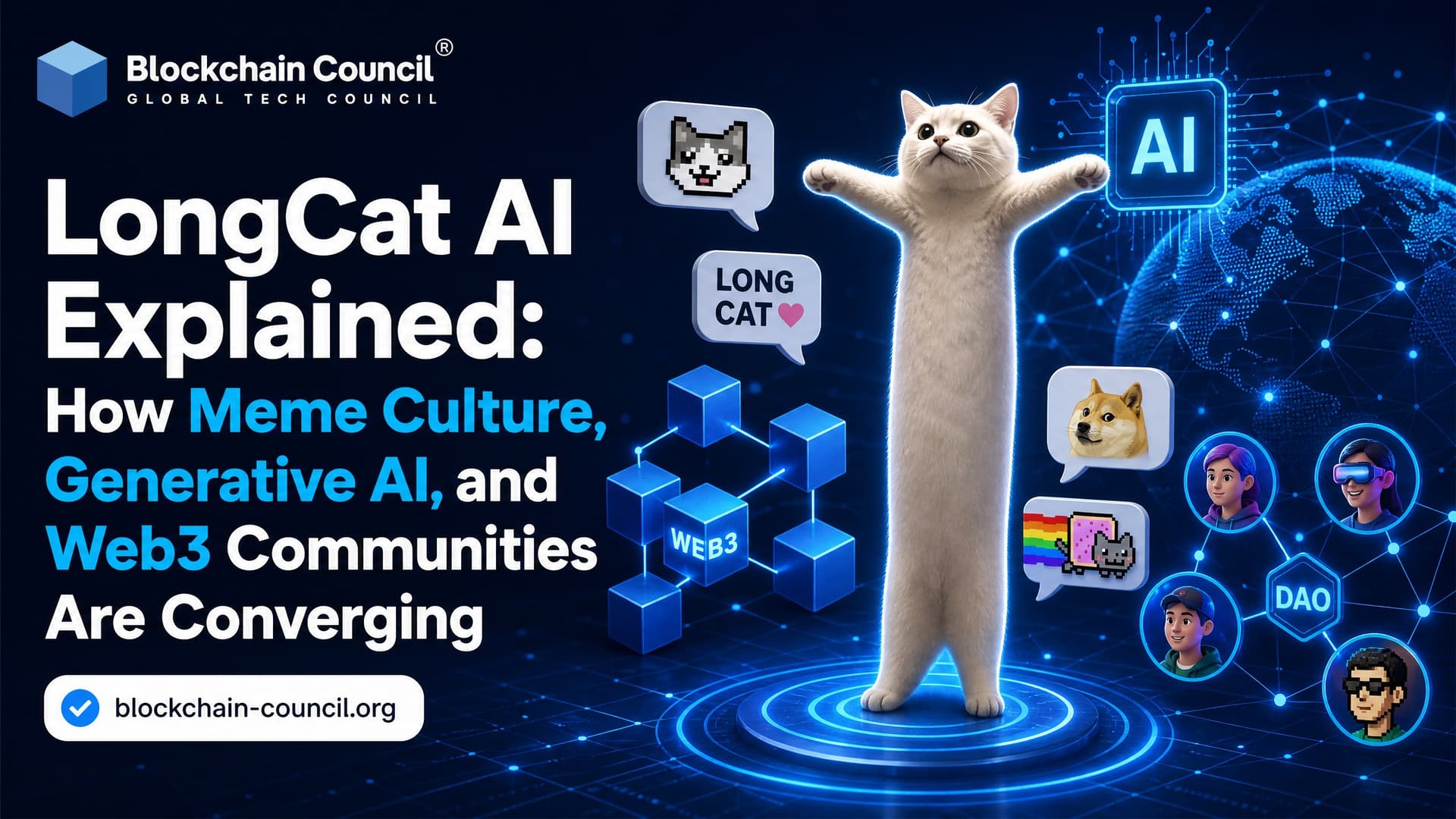
LongCat AI is not just another meme-branded model family. It is a serious open-source AI stack from Meituan covering large language models, coding agents, formal math, video generation, and audio-driven avatars. The interesting part is the mix: frontier-scale generative AI, the old internet Longcat meme, and community patterns that feel familiar to Web3 builders.
That combination matters. In crypto, memes often become coordination tools. In AI, open models become infrastructure. LongCat AI sits where those two habits meet.

What Is LongCat AI?
LongCat AI refers to a group of open-source models and tools developed by Meituan. The branding nods to the classic Longcat internet meme, an elongated cat image that became part of early imageboard culture. The technology underneath, though, is industrial-scale.
The current LongCat AI ecosystem includes:
LongCat-Flash: A 560B-parameter Mixture-of-Experts language model built for efficient inference, coding, tool use, and agentic tasks.
LongCat-2.0: A 1.6T-parameter MoE model focused on agentic coding, multimodal reasoning, and native 1 million token context.
LongCat-Flash-Prover: A formal mathematics model that produces Lean4 proofs for machine-verifiable reasoning.
LongCat-Video: A 13.6B-parameter video model for text-to-video, image-to-video, and video continuation.
LongCat-Video-Avatar: An audio-driven character animation model for expressive talking avatars and character motion.
The name is playful. The engineering is not.
Why LongCat AI Is Technically Important
LongCat-Flash: Efficiency Without Small-Model Compromise
LongCat-Flash uses a Mixture-of-Experts architecture with 560B total parameters, but only about 18.6B to 31.3B parameters are activated per token, with an average near 27B. That is the point of MoE. You keep a very large model capacity, but each token uses only a subset of the network.
Meituan's technical report says LongCat-Flash was pre-trained on about 20 trillion tokens in 30 days, with a reported 98.48% time availability and no manual fault intervention. It later extended context length to 128k tokens. Inference throughput reportedly exceeds 100 tokens per second on H800 GPUs, with an output cost near 0.7 USD per million tokens.
For builders, the useful detail is not the headline parameter count. It is the active parameter count. A trillion-scale dense model is often too expensive for normal product use. An MoE model with strong routing can be more practical, especially for agents that need long sessions and repeated tool calls.
LongCat-2.0: Agentic Coding at Trillion Scale
LongCat-2.0 raises the scale to 1.6T total parameters, with 33B to 56B parameters activated per token. It supports a native 1 million token context, which changes how you design coding assistants. Instead of chunking a repository into tiny fragments and hoping retrieval works, you can pass far more project history, issue context, documentation, and test output into one session.
Reported benchmark results include SWE-bench Pro 59.5, LCB 82.8, and OIBench EN 47.7. Benchmarks are not products, but SWE-bench-style tasks are closer to real development than toy coding questions because they involve fixing actual repository issues.
My view: long-context coding models are most useful when paired with strict tool boundaries. Do not let an agent directly push to main or execute privileged contract calls. Give it read access first, then require signed human approval for changes. Anyone who has watched a coding agent loop after a failing pnpm test run knows why.
LongCat-Flash-Prover: Formal Math and Smart Contract Safety
LongCat-Flash-Prover is built around Lean4, the formal proof language. Meituan reports a 97.1% pass rate on MiniF2F-Test with 72 inference attempts, plus strong scores on MathOlympiad-Bench, PutnamBench, AIME-25, and IMO-AnswerBench.
This matters to blockchain teams because formal verification is one of the few ways to reason about smart contract correctness beyond unit tests. A Solidity test can catch a known failure. A proof can show that an invariant holds across all valid states, if the specification is written correctly.
Be careful, though. A theorem prover does not magically understand your protocol economics. You still need the right specification. In smart contract audits, the hard part is often not proving the statement. It is choosing the statement that should have been true.
LongCat-Video and LongCat-Video-Avatar
LongCat-Video is a 13.6B-parameter model for text-to-video, image-to-video, and video continuation. It targets long video generation at 720p and 30 fps, while trying to reduce problems such as color drift over time. Meituan also frames it as a first step toward world models, meaning AI systems that simulate coherent environments rather than generate disconnected clips.
Early user reports suggest LongCat-Video works best for short B-roll, concept previews, social clips, and animatics. That matches what most video models are good at today. They can help you test ideas fast. They should not be treated as a drop-in replacement for a skilled editor, animator, or cinematographer.
LongCat-Video-Avatar extends this into audio-driven character animation. It can take speech or other audio signals and turn them into facial and body motion. That is where meme culture becomes more than branding. Character IP, VTuber-style identities, animated NFT personas, and community mascots all need cheap, repeatable animation pipelines.
How Meme Culture Shapes Serious AI Infrastructure
The Longcat meme is old internet culture. LongCat AI is modern compute infrastructure. The connection may look odd until you look at how online communities form around tools.
Meme-native branding does three useful things:
It lowers the entry barrier. A strange or funny name is easier to remember than a sterile model code.
It gives communities a shared symbol. Developers, creators, and researchers can rally around an identity, not just a GitHub repo.
It fits remix culture. Generative video and avatar tools are often used for parody, clips, mascots, and social-native content.
Web3 learned this earlier than AI. Memecoins, NFT characters, DAO mascots, and protocol memes have repeatedly shown that narrative can coordinate attention. Sometimes that attention funds serious engineering. Sometimes it funds nonsense. You need to know the difference.
Why LongCat AI Matters for Web3 Communities
LongCat AI is not officially positioned as a Web3 project in the technical reports. Still, its design lines up with several Web3 needs.
Open Models Fit Composable Development
Open-source AI is attractive to crypto builders because Web3 teams tend to prefer forkable and inspectable infrastructure. If a model can be hosted, modified, benchmarked, and integrated without relying only on a closed API, it fits the way many decentralized communities build.
Agentic Models Can Read and Act Across Web3 Tools
LongCat-Flash and LongCat-2.0 are designed for tool calling. In a Web3 setting, that could mean reading smart contract ABIs, querying block explorers, summarizing governance proposals, checking wallet activity, or preparing transaction data for human signing.
Here is the practitioner warning: never let an AI agent sign transactions unattended. Even basic Web3 defaults trip people up. If your script points MetaMask or a JSON-RPC provider at Ethereum mainnet, the chain ID is 1. Sepolia is 11155111. Mix them up and you can get failed transactions, wrong explorer links, or the classic wallet error: insufficient funds for gas * price + value. Models can help explain the error. They should not hold the keys.
AI Avatars and NFT Communities Are a Natural Match
LongCat-Video-Avatar could support dynamic NFT characters, DAO mascots, community explainers, or livestream avatars that react to user prompts and audio. This is likely to be one of the more practical intersections of generative AI and Web3 because it serves a clear need: communities constantly need content.
Real-World Use Cases
For professionals and teams, the most realistic LongCat AI use cases fall into four buckets:
Coding assistants: Repository-level debugging, refactoring support, test generation, and code review across large contexts.
Web3 research agents: Proposal summarization, smart contract documentation, governance history analysis, and transaction explanation.
Formal verification support: Lean4 proof generation, math reasoning, and eventually AI-assisted smart contract verification workflows.
Creator tools: Meme videos, avatar animation, B-roll, game concept previews, course visuals, and community content.
If you are an enterprise team, start with internal copilots and analysis workflows before letting any model touch production operations. If you are a Web3 founder, start with read-only agents. If you are a creator, use video models for drafts and social content, not final brand films.
Skills You Need to Work With LongCat AI
LongCat AI sits across AI engineering, blockchain, and community design. You do not need to master every layer at once, but you should build a working base.
For AI fundamentals and model deployment, consider Blockchain Council's Certified Artificial Intelligence (AI) Expert™.
For decentralized application context, connect this learning with the Certified Blockchain Expert™.
For smart contract and agent safety work, the Certified Smart Contract Developer™ is a useful next step.
For community, identity, and token-based product design, look at the Certified Web3 Expert™.
The best path depends on your job. Developers should learn tool calling, evals, and smart contract basics. Product leaders should focus on model risk, licensing, governance, and user workflows. Creators should test video and avatar tools with a simple content pipeline.
Generative AI is changing how businesses create content, analyse information, and automate workflows. This shift also makes it important for employers to distinguish genuine candidate capabilities from AI-assisted outputs. HireValid's candidate assessment platform is relevant to organisations exploring more effective ways to evaluate applicants.
What Comes Next
LongCat AI shows where open generative AI is heading: larger MoE models, longer context, stronger coding agents, formal reasoning, and video systems that can carry community narratives. The meme branding is not a side note. It is part of how technical communities now form.
Your next step should be practical. Pick one workflow: summarize a DAO proposal, review a Solidity contract, generate a short avatar explainer, or test a coding agent on a non-critical repository. Keep the model read-only at first. Then build the guardrails before you connect it to anything with funds, permissions, or production data.
Related Articles
View All
AI & ML
AI Explained: From Machine Learning to Generative AI
AI Explained in simple terms. Learn the differences between AI, machine learning, and deep learning, how neural networks and LLMs work, and how generative and multimodal AI create content.

AI & ML
Meta Launches Muse Wonder: Its New AI Model Explained
Meta has launched Muse Wonder and Muse Wonder Full, new AI models built for personal and professional agents. Learn the features, pricing, access options and how they compare with rivals.
AI & ML
NVIDIA Cosmos 3 Explained: The Next Generation of Physical AI
Explore NVIDIA Cosmos 3, an open foundation model for Physical AI that combines vision reasoning, world simulation, multimodal generation, and action prediction for robotics and autonomous systems.
Trending Articles
The Role of Blockchain in Ethical AI Development
How blockchain technology is being used to promote transparency and accountability in artificial intelligence systems.
How Blockchain Secures AI Data
Understand how blockchain technology is being applied to protect the integrity and security of AI training data.
How to Install Claude Code
Learn how to install Claude Code on macOS, Linux, and Windows using the native installer, plus verification, authentication, and troubleshooting tips.