

Meta AI for Developers: Tools, APIs, and Opportunities in AI App Development

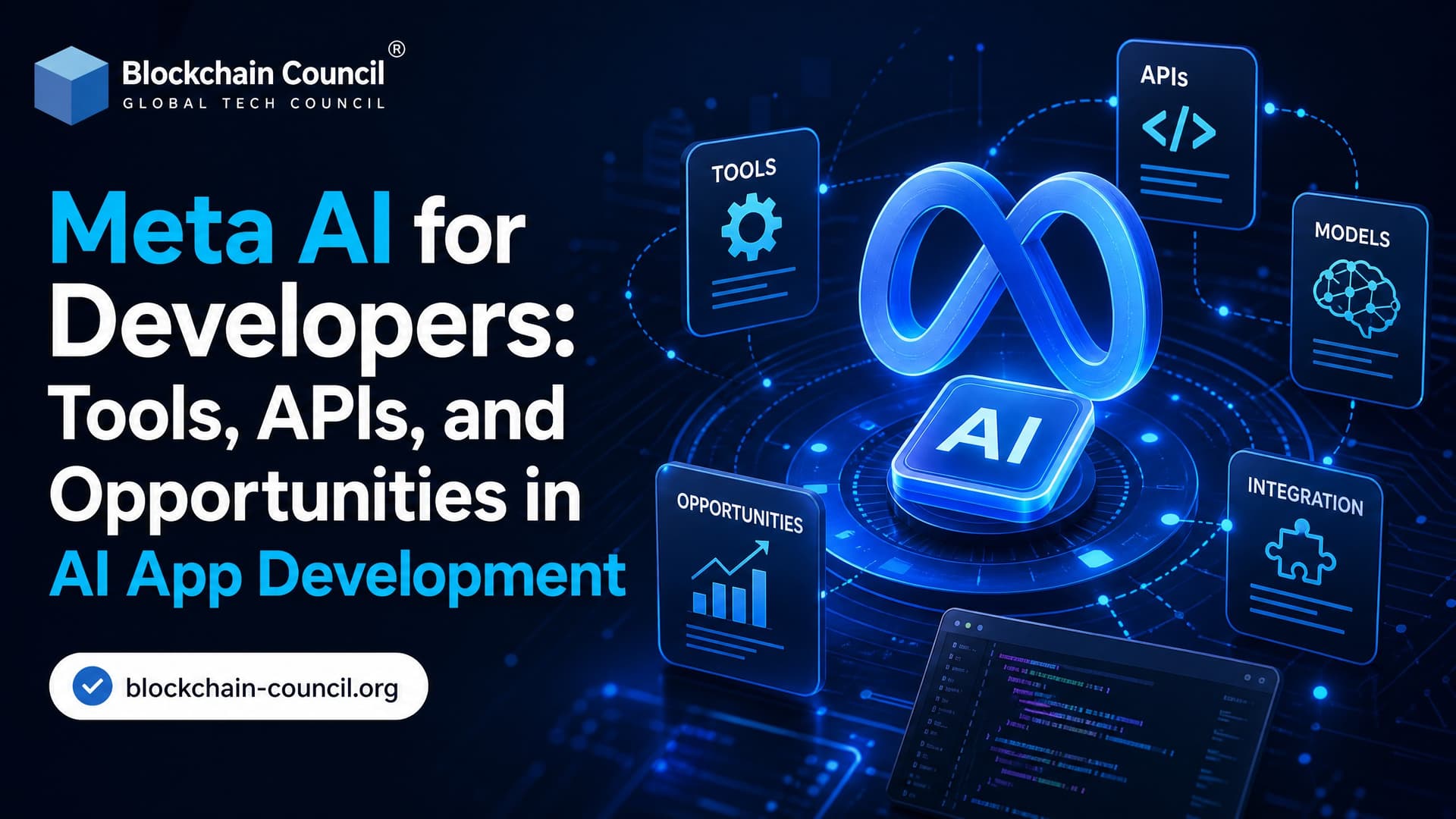
Meta AI for developers is no longer just about running an open model in a notebook. It now spans the Llama model family, hosted Llama API access, WhatsApp Cloud API integrations, Graph API updates, marketing tools, and AI-assisted development for Horizon OS. If you build AI apps, Meta gives you two things that matter: models you can deploy and channels where users already spend their time.
The trade-off is clear. Meta's ecosystem can be powerful for messaging, commerce, social analytics, and XR apps. It is not the right fit for every AI product. If your application has no need for Meta distribution or Llama compatibility, a simpler model API may ship faster. If your users live on WhatsApp, Instagram, Facebook, or Quest, pay attention.

What Meta AI for Developers Includes Today
Meta's developer AI stack is built around Llama, its open model family, plus hosted APIs and platform integrations. Meta's developer portal describes Llama as an open source AI model family, and the broader platform now leans toward production AI app development rather than research experiments alone.
Llama 4 Models and the Hosted Llama API
Meta's hosted Llama API exposes several Llama 4 model options, each tuned for a different balance of speed, context length, reasoning, and multimodal capability. Pricing and context figures below reflect platform reporting and can change, so confirm current numbers in Meta's pricing documentation before you commit to a budget.
- Llama 4 Turbo: a reported 256,000-token context window, aimed at fast general workloads, with pricing cited near $0.12 input and $0.36 output per 1 million tokens.
- Llama 4 Deep Think: a reported 512,000-token context window, aimed at long-document reasoning and multi-step analysis, with pricing cited near $0.22 input and $0.66 output per 1 million tokens.
- Llama 4 Maverick: a reported 128,000-token context window, aimed at multimodal vision and text generation, with pricing cited near $0.27 input and $0.85 output per 1 million tokens.
Those context sizes change how you design applications. A 512k window makes long contracts, technical manuals, audit trails, and customer histories practical to process in fewer chunks. Do not treat context length as a free lunch, though. Longer prompts raise latency, cost, and the surface area for failure. In production, retrieve only what the user actually needs.
Open Weights, Hosted APIs, and Multi-cloud Deployment
Meta's strategy combines downloadable Llama models with hosted API access. That matters. Open weights help when you need private inference, custom fine-tuning, or local evaluation. A hosted Llama API is better when your team wants speed, managed scaling, and easier integration.
Llama is also available through Amazon Bedrock and Google Vertex AI Model Garden. For enterprises, this is not a minor detail. Cloud choice affects data residency, procurement, access controls, audit processes, and existing MLOps pipelines. If your company already standardizes on AWS or Google Cloud, running Llama through those environments may be easier than adding another vendor endpoint.
Meta's roadmap also points to an Edge Kit for Llama 4 Scout models, reportedly aimed at offline, on-device inference. That would matter for privacy-sensitive mobile apps, embedded systems, and XR experiences where network latency breaks the experience.
Llama API Tool Calling: Where AI Apps Become Useful
The most useful AI apps do not just answer questions. They do things. Meta's Llama API tool-calling support reportedly follows an OpenAI-compatible schema, which cuts migration friction for teams already using structured function calling.
Reported capabilities include:
- Up to 128 structured functions per session
- Nested function calls up to three levels deep
- Parallel tool execution
- JSON Schema based connectors for third-party tools
- Better recovery when one step in a multi-call chain fails
This is where vertical AI products become realistic. A customer support agent can look up an order, verify account status, create a return label, and summarize the interaction for a human agent. An analytics copilot can query a warehouse, fetch campaign metrics, and explain the changes in plain language.
Practical advice: keep your first tool set small. Five well-tested tools beat fifty vague ones. Developers often let the model choose between overlapping functions like getCustomer, lookupCustomer, and fetchAccount. That ambiguity causes bad calls. Use strict schemas, clear descriptions, and server-side validation every time.
SDKs and Developer Experience
Meta has been improving the workflow around Llama. Reports mention lightweight Python and JavaScript SDKs, including @meta/llama, plus a VS Code extension called Llama Live.
Useful features reportedly include real-time API logs, token heat maps, starter templates, and automatic retries for transient failures. Token heat maps are more valuable than they sound. In real apps, one hidden system prompt or a repeated conversation-history block can quietly double your bill. Seeing where tokens go helps you cut waste before finance notices.
If you are building a team skill path, structured training helps. Blockchain Council's Certified Artificial Intelligence (AI) Expert™, Certified Generative AI Expert™, and Certified Prompt Engineer™ cover model behavior, prompt design, and production AI concepts for readers who want a deeper foundation.
Security, Compliance, and Governance
For enterprise AI app development, model quality is only half the job. You also need controls. Meta platform analysis highlights security features such as:
- No-train flag: sensitive paid-plan data is reportedly excluded from model training by default.
- Signed-URL secure fetch: time-limited, encrypted access to documents and blobs.
- Audit logging: request IDs, token usage, and response times for compliance review.
These features matter most in finance, healthcare, legal technology, and enterprise SaaS. A financial advisory assistant that retrieves client documents must leave an audit trail. A healthcare documentation tool must limit data exposure. A SaaS vendor embedding Llama into its product needs to prove what data was sent, when, and why.
To be blunt, do not build compliance on marketing copy. Test the actual data path. Log request IDs. Confirm retention settings. Review cloud region behavior. Ask how signed URLs expire and whether documents are cached downstream.
Meta Social and Messaging APIs for AI Apps
Meta's biggest advantage is distribution. Meta's developer portal states that more than 3.2 billion people use at least one Meta app daily, across Facebook, Instagram, Messenger, WhatsApp, and Threads. For AI builders, this means your interface might be a chat thread rather than a new app download.
Graph API v22.0 and Marketing API v22.0
Meta keeps updating its social developer platform, including Graph API v22.0 and Marketing API v22.0. These APIs are relevant for AI-powered analytics, campaign optimization, creator tools, social listening, and business workflows.
Use them carefully. Permissions, review requirements, and platform rules shape what you can build. A prototype that works with a test account may still fail app review if you request broad permissions without a clear user benefit.
WhatsApp Cloud API and AI Chatbots
The WhatsApp Cloud API is one of the most practical channels for Meta AI developers. The standard architecture looks simple on paper:
- Create an app in the Meta developer console.
- Add WhatsApp Cloud API as a product.
- Configure a phone number and access token.
- Expose an HTTPS webhook so Meta can send incoming messages to your server.
- Route messages to your Llama-powered backend, business rules, or human support tools.
One concrete issue trips up beginners: webhook verification. Meta sends parameters such as hub.mode, hub.challenge, and hub.verify_token. If your server does not echo the challenge when the verify token matches, the console shows a callback validation failure. If the token does not match, return 403. Use a valid HTTPS endpoint too. Localhost without a tunnel will not work.
During development, teams often start with temporary access tokens, then move to permanent tokens for production. Treat that migration as a release task, not an afterthought. Expired tokens create silent chatbot outages that look like AI failures but are really authentication failures.
WhatsApp Flows for Structured AI Workflows
WhatsApp Flows adds structured interaction inside WhatsApp. Instead of asking users to type every field into a chat, you can guide them through forms, bookings, onboarding, surveys, or support steps. Pairing Flows with Llama is a strong pattern: let the model explain, summarize, and route, while Flows captures validated data.
XR, Horizon OS, and On-device AI
Meta is also pushing AI into XR development. Meta Horizon OS materials describe AI-powered Quest development tools that help Android developers build, port, and test applications for Quest headsets. That opens space for virtual assistants, intelligent NPCs, adaptive training simulations, and context-aware interfaces.
Here is the trade-off: XR AI apps are harder than chatbots. You need low latency, spatial context, device constraints, and careful UX. If an AI response arrives two seconds late in a headset, users notice. For developers with Android or Unity experience, though, Horizon OS plus future edge inference could become a serious opportunity.
Best Opportunities in Meta AI App Development
If you are deciding where to build, start with these areas:
- Customer support on WhatsApp: high demand, clear ROI, and a familiar user channel.
- Commerce assistants: product lookup, order tracking, returns, and appointment booking.
- Enterprise copilots: tool-calling agents that connect CRMs, ERPs, databases, and ticketing systems.
- Marketing intelligence: AI analysis layered on Graph API and Marketing API data, where permissions allow.
- Document intelligence: long-context Llama models for contracts, policies, claims, or compliance files.
- XR assistants: Quest and Horizon OS apps with contextual help, training, and simulation features.
For developers who want to connect AI and blockchain skills, Blockchain Council's Certified Blockchain Expert™ pairs well with AI certifications when you are building identity, provenance, tokenized access, or audit systems around AI workflows.
How to Start Building with Meta AI
Do not begin with a giant agent. Start small.
- Choose one user channel: WhatsApp, web app, Instagram integration, or XR.
- Pick the model based on workload: fast chat, long-context reasoning, or multimodal input.
- Define three to five tools the model may call.
- Add logging for prompts, tool calls, token usage, latency, and errors.
- Test bad inputs, expired tokens, webhook retries, and partial tool failures.
- Review privacy, consent, data retention, and platform policy before launch.
Meta AI for developers works best when you combine Llama with real workflows and Meta's distribution channels. For a practical next step, build a WhatsApp Cloud API prototype that answers one support use case, then add one verified tool call. After that, deepen your foundation with Certified Generative AI Expert™ or Certified Prompt Engineer™ training before you move into regulated or enterprise deployments.
Related Articles
View All
AI & ML
Kimi K2.7 Code: A Beginner's Guide to Faster App Development and Debugging
Learn how beginners can use Kimi K2.7 Code for faster app development, debugging, repo analysis, testing, and safer AI-assisted coding workflows.
AI & ML
Best OpenAI Consultant Tools and APIs to Know in 2026
A practical guide to OpenAI consultant tools, covering APIs, function calling, RAG, cloud platforms, coding assistants, productivity tools, and governance.

AI & ML
Meta AI Career Opportunities: Skills for Generative AI and Machine Learning Roles
Explore Meta AI career opportunities, required generative AI and machine learning skills, salary ranges, role types, and a practical learning path.
Trending Articles

Top 5 DeFi Platforms
Explore the leading decentralized finance platforms and what makes each one unique in the evolving DeFi landscape.
What is AWS? A Beginner's Guide to Cloud Computing
Everything you need to know about Amazon Web Services, cloud computing fundamentals, and career opportunities.
Claude AI Tools for Productivity
Discover Claude AI tools for productivity to streamline tasks, manage workflows, and improve efficiency.