

Gemma 4 12B

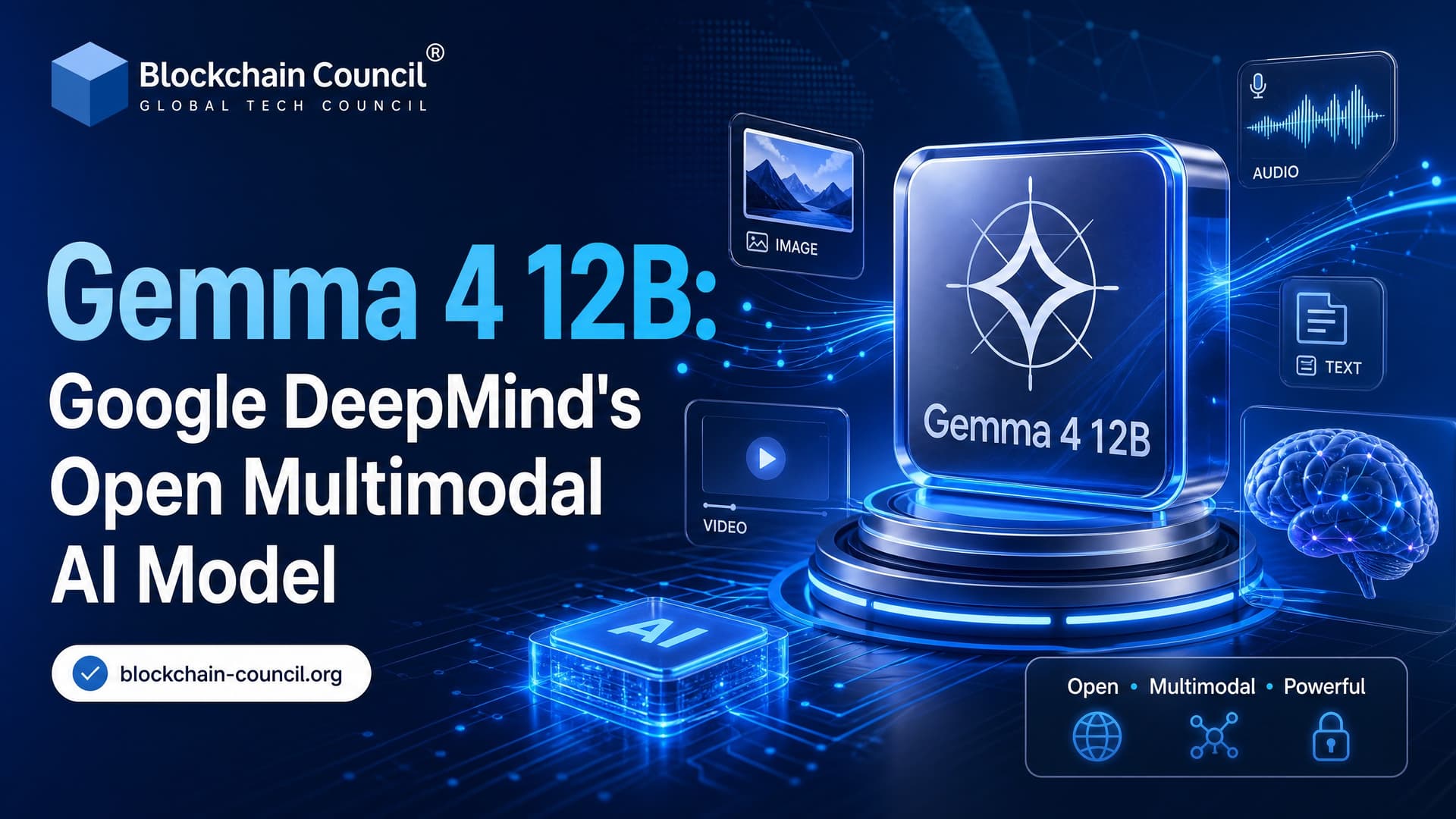
Gemma 4 12B is Google DeepMind's first medium-sized, encoder-free multimodal model, designed to process text, images, audio, and video through a unified architecture. Released as part of the open Gemma 4 family, it is positioned for advanced reasoning, coding, agentic workflows, and local deployment. For professionals, developers, and enterprises, Gemma 4 12B signals a shift toward practical, self-hosted multimodal AI that can operate beyond cloud-only environments.
The model fills a gap between smaller edge-focused models and larger workstation or server models. With 12 billion parameters, a context window of up to 256K tokens, multilingual training across more than 140 languages, and open-weight availability, Gemma 4 12B offers a flexible foundation for document intelligence, coding assistants, Web3 automation, enterprise knowledge workflows, and multimodal agents.

What Is Gemma 4 12B?
Gemma 4 12B is part of the broader Gemma 4 model family from Google DeepMind. The family includes smaller E2B and E4B models, the 12B unified multimodal model, a Mixture-of-Experts model, and a larger dense model. Google describes Gemma 4 as its most capable open model family to date, built for reasoning, coding, and agentic AI workflows.
The 12B variant is notable because it is the first medium-sized Gemma model to use an encoder-free multimodal design. Instead of relying on separate encoders for vision and audio, Gemma 4 12B projects raw image patches and audio waveforms directly into the language model's embedding space. This creates a more unified processing pipeline for multiple modalities.
Gemma 4 12B is available as open weights in pre-trained and instruction-tuned forms. It is listed on Hugging Face and supported by local AI tools such as LM Studio and Ollama. This ecosystem support makes the model accessible to developers who want to test, fine-tune, or deploy AI systems on local machines or private infrastructure.
Key Technical Features of Gemma 4 12B
1. Encoder-Free Multimodal Architecture
The defining feature of Gemma 4 12B is its unified, encoder-free architecture. Traditional multimodal models often use separate encoders to convert images, audio, or video into representations that the language model can understand. Gemma 4 12B simplifies this approach by mapping raw multimodal inputs directly into the language model's embedding space.
This architectural choice has practical implications. It reduces system complexity, supports tighter cross-modal reasoning, and can simplify deployment for developers building multimodal applications. For example, a single model can analyze a screenshot, interpret spoken input, and generate a text response within the same framework.
2. Text, Image, Audio, and Video Inputs
Gemma 4 12B is designed to process several input types:
Text: General language understanding, summarization, question answering, reasoning, and generation.
Images: Visual question answering, chart interpretation, screenshot analysis, OCR, and document parsing.
Audio: Speech recognition, transcription, and speech-to-text translation, according to Google and Hugging Face documentation.
Video: Native video ingestion for temporal and multimodal understanding, as described in Google developer materials.
Like other Gemma 4 models, the output remains text-based. The model can accept multimodal inputs but responds in natural language, making it suitable for assistants, copilots, workflow automation, and enterprise search interfaces.
3. Large 256K Context Window
Gemma 4 12B supports a context window of up to 256K tokens. This matters for enterprise and professional workloads because many real-world tasks require long-form reasoning over large documents, codebases, legal files, technical papers, or business reports.
For blockchain and Web3 teams, a long context window can support analysis of smart contract repositories, whitepapers, tokenomics documents, audit reports, and governance proposals. Professionals exploring AI for business transformation may also connect this capability with learning paths such as Blockchain Council's Certified Artificial Intelligence Expert or Certified Blockchain Expert programs.
4. Multilingual Support
Gemma 4 12B was pre-trained across more than 140 languages, with strong out-of-the-box support reported for over 35 languages. This makes it relevant for global enterprises, multilingual customer support, cross-border compliance teams, and international developer communities.
Multilingual AI is particularly valuable in Web3 ecosystems, where communities, documentation, and governance conversations often span countries and languages. Gemma 4 12B can help summarize, translate, and interpret technical and community-generated content more efficiently.
Capabilities: Reasoning, Coding, and Agents
Advanced Reasoning and Thinking Modes
Gemma 4 is positioned as a reasoning-first family. Ecosystem providers such as Ollama describe the models as capable reasoners with configurable thinking modes. Gemma 4 12B can be used in applications where the model needs to break down tasks, follow multi-step instructions, compare alternatives, or explain decisions.
Organizations should still evaluate outputs carefully, especially in regulated or high-risk settings. Even so, the model's long context and reasoning orientation make it a strong candidate for knowledge work and technical analysis.
Coding and Developer Workflows
Gemma 4 models are designed for code generation, completion, and correction. Gemma 4 12B can act as a local coding assistant for developers working in Python, JavaScript, Rust, Solidity, or other languages. It can explain errors, suggest refactors, generate tests, and assist with code documentation.
Its function-calling capabilities also make it relevant for tool-using agents. A developer could connect Gemma 4 12B to compilers, linters, test suites, blockchain nodes, or smart contract analysis tools. For learners, this aligns naturally with Blockchain Council resources such as Certified Smart Contract Developer, Certified Web3 Expert, and AI-focused certification programs.
Multimodal Agents
Gemma 4 12B can support agents that combine perception, reasoning, and action. For example, an AI agent could read a PDF, inspect a chart, process a meeting transcript, call an API, and draft a summary. In enterprise environments, this creates opportunities for semi-autonomous workflows in compliance, research, customer support, software development, and cybersecurity.
Practical Use Cases for Gemma 4 12B
Local Multimodal Assistant
Because Gemma 4 12B can run through local model tools and supports quantized deployment, it is suitable for privacy-aware environments. A local assistant powered by Gemma 4 12B could summarize PDFs, extract information from scanned documents, interpret screenshots, transcribe meetings, and answer questions without sending sensitive data to a third-party API.
Enterprise Knowledge Management
The 256K-token context window makes the model useful for processing long enterprise documents. Teams can use it to summarize policies, compare contracts, review technical documentation, analyze regulatory material, and support retrieval-augmented generation systems. When deployed on-premise, Gemma 4 12B can help organizations balance AI productivity with data governance requirements.
Blockchain and Web3 Development
For blockchain professionals, Gemma 4 12B can assist with smart contract review, code explanation, whitepaper summarization, governance proposal analysis, and developer documentation. It can also be integrated into DevOps pipelines for automated issue triage, test generation, and security checklist support.
AI-generated smart contract suggestions should not replace formal security audits. They are best treated as an acceleration layer for developers and auditors, not as a final authority.
Speech and Multilingual Applications
With audio and multilingual capabilities, Gemma 4 12B can support transcription, speech-to-translated-text workflows, multilingual search, and cross-lingual customer interactions. This is useful for global organizations that need AI tools capable of operating across languages and communication formats.
Why Gemma 4 12B Matters
Gemma 4 12B brings several advanced AI trends into a medium-sized open model:
Open-weight access: Developers can inspect, fine-tune, and deploy the model more flexibly than closed API-only systems.
Unified multimodality: Text, image, audio, and video inputs can be handled in a single architecture.
Local deployment potential: Quantization and ecosystem support make self-hosting more practical.
Long-context reasoning: The model can work with large documents and complex multi-step tasks.
Agent readiness: Function calling, reasoning modes, and system prompt support make it suitable for AI agents.
These characteristics are relevant as enterprises evaluate AI systems based on data control, cost, customization, and compliance. Open models such as Gemma 4 12B may not replace all proprietary systems, but they are becoming serious options for specialized, private, and domain-specific deployments.
Limitations and Considerations
Despite its strengths, Gemma 4 12B should be evaluated carefully before production use. Organizations should test accuracy, latency, hardware requirements, multilingual quality, safety behavior, and domain-specific performance. Multimodal models can still misinterpret visual or audio inputs, and coding outputs may contain errors or insecure patterns.
Enterprises should also establish governance policies around model monitoring, access control, human review, and data handling. Professionals looking to build these skills can explore Blockchain Council's AI, cybersecurity, blockchain, and Web3 certification tracks as part of a broader AI readiness strategy.
Future Outlook for Gemma 4
Gemma 4 12B points toward a future where medium-sized open models become more capable, more multimodal, and easier to deploy locally. Encoder-free design may influence future open AI architectures, especially as developers seek simpler stacks for multimodal reasoning.
As model tooling improves, Gemma 4 12B could become a common backbone for local assistants, coding copilots, enterprise RAG systems, and specialized agents in finance, healthcare, cybersecurity, and blockchain. Its open-weight release also creates opportunities for fine-tuned variants tailored to specific industries and languages.
Conclusion
Gemma 4 12B represents an important step in open multimodal AI. With a 12B-parameter unified architecture, encoder-free processing, support for text, image, audio, and video input, a 256K-token context window, and broad ecosystem availability, it offers a practical foundation for developers and enterprises exploring local and self-hosted AI.
For blockchain, Web3, and deeptech professionals, Gemma 4 12B is more than another language model. It reflects where applied AI is heading: multimodal, agentic, multilingual, and increasingly deployable on infrastructure that organizations control. Understanding models like Gemma 4 12B will be essential for professionals building the next generation of intelligent applications.
Related Articles
View All
AI & ML
Built to Catch AI Cheating: Rethinking Pre-Employment Assessments with HireValid
Explore how HireValid is rethinking pre-employment assessments with AI-resistant test design, integrity signals, candidate evidence, and human review to address AI-assisted cheating.

AI & ML
AI-Era Hiring Needs AI-Proof Tests: How HireValid Is Redefining Talent Assessment
Explore how HireValid is rethinking talent assessment for the AI era with job-relevant tests, anti-cheating design, integrity signals, and human-reviewed evidence of candidate ability.
AI & ML
Google Launches Gemini 4 Argon: Features and Capabilities
Google has launched Gemini 4 Argon, its flagship AI model for coding, finance, law, cybersecurity and science. Learn its key features, availability, pricing and safety details.
Trending Articles
The Role of Blockchain in Ethical AI Development
How blockchain technology is being used to promote transparency and accountability in artificial intelligence systems.
AWS Career Roadmap
A step-by-step guide to building a successful career in Amazon Web Services cloud computing.

Top 5 DeFi Platforms
Explore the leading decentralized finance platforms and what makes each one unique in the evolving DeFi landscape.