

Free Vibe Coding: Exploring Google Antigravity and Agent-First Development
 Suyash Raizada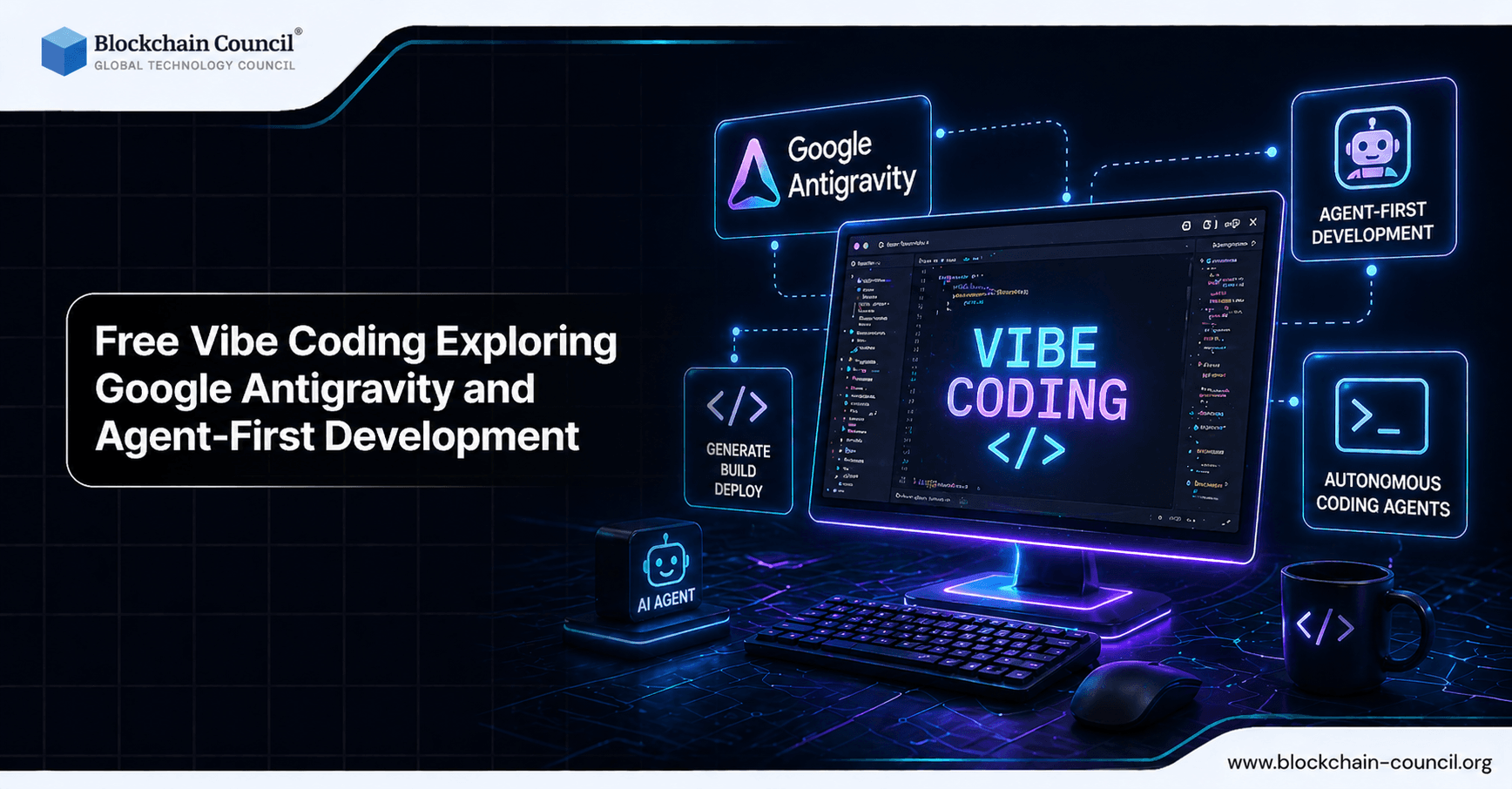
Free Vibe Coding is quickly becoming a practical approach for developers to prototype, refactor, and ship features using natural language prompts combined with AI agents that can plan, write code, validate, and browse the web. Among the newest entries in this space, Google Antigravity is positioned as Google's primary agent-first development environment, designed so that multiple agents collaborate inside a single workspace.
A Vibe Coder Certification can help professionals develop expertise in AI-assisted software development, prompt-driven coding workflows, agent orchestration, code validation, and the practical skills needed to build and deploy applications in modern AI-powered development environments.

This article breaks down what vibe coding means for developers, what makes Antigravity different from standard AI code completion, how the free preview works, and how to adopt it responsibly in real projects.
What Is Vibe Coding and Why Developers Care
Vibe coding refers to AI-powered development workflows where you describe outcomes in natural language and the tool orchestrates the steps required to produce working software. Instead of manually editing files and writing every line of code, you can delegate chunks of work to AI systems that:
Translate requirements into implementation plans
Generate and modify code across multiple files
Run validations and iterate on errors
Use a browser or terminal to fetch context and execute tasks
This shift is widely framed as a response to traditional development being too slow, fragmented, and expensive for many MVPs and internal tools. The key distinction is that vibe coding is not simply autocomplete. It is an outcome-focused workflow where the IDE becomes a coordination layer for agentic tasks.
Free Vibe Coding Tools by Google: Meet Google Antigravity
Google Antigravity is an agent-first development environment launched as a preview offering free personal access, with paid organizational paths for broader usage and governance. It is built around the idea that developers will increasingly manage a team of AI agents rather than prompt a single assistant.
What Makes Antigravity Agent-First
Antigravity is designed as a workspace where multiple autonomous agents can coordinate on different parts of the same goal. Instead of one model producing a single response, you can assign distinct roles such as:
Planner agent: breaks down a feature into steps, clarifies assumptions, and proposes acceptance criteria
Builder agent: writes or edits code across the repository
Validator agent: runs tests, checks build output, reviews errors, and proposes fixes
Research agent: uses web browsing to pull API documentation, examples, and compatibility notes
This multi-agent approach is why several reviewers and training platforms have identified Antigravity as a tool worth watching, particularly for developers who want their IDE to behave like an agent workspace rather than a suggestion engine.
Core Capabilities: Mission Control, Artifacts, and an Integrated Workspace
Antigravity's differentiators center on coordination and traceability:
Mission Control: a central panel for assigning tasks to agents, tracking progress, and managing parallel workstreams.
Integrated editor: edit files directly while agents propose changes you can accept or revise.
Terminal and browser: enables tool use such as running commands, validating builds, and checking external documentation.
Artifacts: captures plans, screenshots, outputs, and intermediate results so you can audit how agents reached an outcome.
Traceability is often the missing element in AI-assisted coding. Artifacts provide a structured trail from prompt to plan to implementation to validation, which matters considerably in real engineering workflows.
A Prompt Engineer Certification can help professionals develop expertise in designing effective AI instructions, workflow orchestration, and output validation, while a Marketing Certification can strengthen communication, stakeholder alignment, and the ability to translate technical outcomes into measurable business value.
Pricing and Access: What Free Means in Free Vibe Coding
Antigravity remains in preview and offers free personal access, with usage-based scaling and paid organizational paths. As of 2026, it is also reported to integrate with Google's AI model ecosystem and provides expanded coding tokens for Google One subscribers at around $20 per month. For many developers, this means exploring Antigravity at no cost and then increasing capacity through an existing subscription rather than purchasing a separate developer tool plan.
This mirrors common patterns among agentic tools such as Cursor and Replit, which also offer free tiers with paid upgrades, and Vercel v0, which uses free credits plus paid scaling.
How Antigravity Compares to Other Vibe Coding Tools
Antigravity is frequently compared with v0, Cursor, and Replit because all four represent the direction of agentic or AI-native development workflows. The differences come down to focus:
Google Antigravity: multi-agent coordination and mission management inside a single workspace.
Vercel v0: strong UI generation with a path toward production-ready frontends and increasing emphasis on security and deploy controls.
Cursor: an AI-native editor experience that many developers use for day-to-day coding.
Replit: browser-based building and quick iteration in a hosted environment.
Security provides a useful lens for assessing the maturity of this category. Vercel v0 has reportedly blocked over 100,000 insecure deployments since late 2024, which signals how vibe coding platforms are adding guardrails as adoption scales. Antigravity's Artifacts approach aligns with that trend by making changes and outputs easier to review and audit.
Practical Workflows for Coders Using Google Antigravity
To get real value from Free Vibe Coding, treat Antigravity as a structured development partner. The most effective pattern is to separate responsibilities across agents and enforce checkpoints throughout.
Workflow 1: Feature Build with Planning, Coding, and Validation Agents
Prompt the planner agent with the user story, constraints, and acceptance criteria.
Request a stepwise plan that includes file touchpoints, new modules, and required tests.
Assign the builder agent to implement each step, committing changes in small batches.
Run validation via the validator agent in the terminal: unit tests, linting, build, and type checks.
Review Artifacts to confirm what was changed, why it was changed, and what evidence supports correctness.
This pattern works well for full-stack features such as adding an API endpoint, wiring UI changes, and updating tests. The advantage is maintaining parallel streams while preserving a reviewable trail.
Workflow 2: Refactor with Guardrails
For refactors, structuring the task carefully reduces risk:
Have the planner agent propose a refactor plan and a rollback strategy
Require the builder agent to refactor behind feature flags or in small commits
Use the validator agent to run regression tests and measure performance or bundle size
Capture before-and-after evidence in Artifacts, including terminal output and test results
This is particularly helpful when modernizing legacy code, reorganizing modules, or migrating APIs.
Workflow 3: Research-Heavy Tasks Using Integrated Browsing
When integrating a new SDK or API, the web browsing capability supports a research agent that can locate official documentation, compatibility notes, and working examples. The key is enforcing source quality. Prioritize vendor documentation and well-maintained repositories, then ask the agent to summarize constraints and include exact snippets with context.
Best Practices: Using Free Vibe Coding Safely and Effectively
Agentic tools can accelerate output, but developers still own the results. Apply practices that prevent speed from accumulating as technical debt.
1) Make Acceptance Criteria Explicit
Define what done looks like: edge cases, performance constraints, and error handling requirements. The clearer the target, the less rework the agents generate.
2) Require Tests and Reproducible Validation
Always pair generation with verification. Request unit tests, integration tests, and a terminal-based validation sequence. Keep the commands in Artifacts so you can re-run them locally or in CI.
3) Treat Artifacts as an Audit Log
Use Artifacts for review: plans, diffs, test outputs, and screenshots of critical flows. This improves collaboration and makes pull request reviews more thorough.
4) Apply Security and Secrets Hygiene
Never paste secrets into prompts. Use environment variables and secret managers. Review dependencies and any generated authentication logic carefully. The vibe coding ecosystem is adding guardrails, but a secure SDLC mindset remains the developer's responsibility.
Where Free Vibe Coding Is Heading
Multi-agent IDE workflows are expected to become more common by late 2026, particularly for MVPs, internal tools, and fast iteration cycles. Antigravity's architecture signals this direction clearly: developers orchestrate agents that plan, build, validate, and research within one environment. As models improve in response speed and tool integration, the practical ceiling for complexity will rise, shifting more work from manual implementation toward supervision and review.
Challenges remain, however. Teams will still need strong code review practices, clear ownership, and policies covering compliance and data handling. Free preview tiers like Antigravity's can lower the barrier to entry, but production usage requires disciplined engineering habits regardless of the tooling.
Learning Path for Coders Adopting Agentic Development
To build a professional workflow around Free Vibe Coding, focus on the skills that make agent outputs reliable and maintainable:
Prompting for engineering: writing specs, defining constraints, and structuring stepwise execution
Secure coding and threat modeling: validating generated code and dependencies
AI fundamentals: understanding model limitations, evaluation methods, and failure modes
Web3 and cloud fundamentals (optional): relevant if your projects involve decentralized applications or scalable deployments
Relevant programs to explore on Blockchain Council include the Certified Artificial Intelligence (AI) Expert program, Certified Prompt Engineer training, and cybersecurity-focused certifications that support secure AI-assisted development practices.
Conclusion
Free Vibe Coding is evolving from simple AI assistance into agent-first development, and Google Antigravity represents a meaningful step in that direction. Its Mission Control panel, integrated editor and terminal, browsing support, and Artifact-based traceability make it well-suited for developers who want to coordinate planning, coding, and validation in one place. Used with clear acceptance criteria, strong testing practices, and security hygiene, Antigravity can accelerate real development work without compromising engineering discipline.
FAQs
1. What is free vibe coding in modern development?
Free vibe coding refers to an intuitive, exploratory coding approach using AI tools. Developers focus on ideas and outcomes rather than strict planning. It emphasizes rapid iteration and creativity.
2. What is Google Antigravity in the context of coding?
Google Antigravity is often used metaphorically to describe unconventional or experimental development approaches. It represents breaking traditional coding constraints. In practice, it aligns with flexible, AI-assisted workflows.
3. What is agent-first development?
Agent-first development focuses on building systems where AI agents handle tasks autonomously. Developers design workflows around agent capabilities. This approach reduces manual coding effort.
4. How does agent-first development differ from traditional development?
Traditional development relies on explicit instructions and manual coding. Agent-first development delegates tasks to AI agents. This enables automation and faster execution.
5. What are the benefits of free vibe coding?
It allows rapid prototyping and creative exploration. Developers can test ideas quickly without rigid structures. This improves innovation and speed.
6. What are the risks of vibe coding?
It can lead to unstructured code and technical debt. Lack of planning may cause scalability and maintenance issues. Proper review and discipline are required.
7. How do AI agents support vibe coding workflows?
AI agents generate code, debug issues, and automate repetitive tasks. They assist in decision-making and implementation. This enhances productivity and reduces manual effort.
8. What tools are used in agent-first development?
Tools include AI coding assistants, APIs, and automation frameworks. Platforms like Claude, GPT-based tools, and developer SDKs are common. These tools enable intelligent workflows.
9. Can beginners use vibe coding effectively?
Yes, beginners can use AI tools to learn and build projects quickly. However, understanding basic programming concepts is important. This ensures better control and learning.
10. How does vibe coding impact software quality?
It can improve speed but may reduce code quality if not managed properly. Regular testing and refactoring are essential. Balancing speed and structure is key.
11. What is the role of prompts in vibe coding?
Prompts guide AI tools to generate code and solutions. Clear and specific prompts improve output quality. Prompt engineering is a critical skill.
12. How can developers structure agent-first workflows?
Developers define tasks, assign them to agents, and monitor outputs. Breaking workflows into smaller steps improves efficiency. Clear boundaries ensure better control.
13. What are real-world use cases of agent-first development?
Use cases include automated coding, data processing, and customer support systems. AI agents handle repetitive and complex tasks. This improves efficiency across industries.
14. How does Google Antigravity relate to experimental coding approaches?
It symbolizes breaking conventional rules and exploring creative solutions. Developers experiment with AI-driven workflows. This encourages innovation in development practices.
15. Can vibe coding replace traditional software engineering?
No, it complements rather than replaces traditional methods. Structured engineering is still needed for scalability and reliability. Vibe coding is best for prototyping and exploration.
16. How can developers avoid technical debt in vibe coding?
They should review, refactor, and document code regularly. Adding structure after prototyping is important. This ensures maintainability and quality.
17. What skills are needed for agent-first development?
Key skills include prompt engineering, system design, and understanding AI tools. Basic programming knowledge is also important. These skills help manage agent workflows effectively.
18. How does collaboration work in vibe coding environments?
Teams use shared prompts, documentation, and version control. Clear communication ensures consistency. Collaboration tools help manage workflows.
19. What is the future of vibe coding and agent-first development?
These approaches will become more common with advanced AI tools. Developers will focus more on design and oversight. Automation will handle routine tasks.
20. How can developers start with free vibe coding today?
They can begin by using AI coding tools and experimenting with small projects. Learning prompt engineering is essential. Gradual practice helps build confidence and skills.
Related Articles
View All
AI & ML
Google Playground: Create AI Games Without Coding
Learn what Google Playground is, how it uses generative AI to turn text prompts into browser games, how to create your first game, what it costs, how it compares with other no-code tools, and what limits to expect.
AI & ML
Google Launches Gemini 4 Argon: Features and Capabilities
Google has launched Gemini 4 Argon, its flagship AI model for coding, finance, law, cybersecurity and science. Learn its key features, availability, pricing and safety details.
AI & ML
Why Recursive Self-Improvement Matters for AGI Development
Recursive self-improvement could shape AGI by accelerating capability growth, changing safety risks, and forcing new governance for self-updating AI systems.
Trending Articles
The Role of Blockchain in Ethical AI Development
How blockchain technology is being used to promote transparency and accountability in artificial intelligence systems.
AWS Career Roadmap
A step-by-step guide to building a successful career in Amazon Web Services cloud computing.

Can DeFi 2.0 Bridge the Gap Between Traditional and Decentralized Finance?
The next generation of DeFi protocols aims to connect traditional banking with decentralized finance ecosystems.