

Deploying an AI Shopping Assistant with RAG for Accurate Product, Review, and Policy Answers
 Suyash Raizada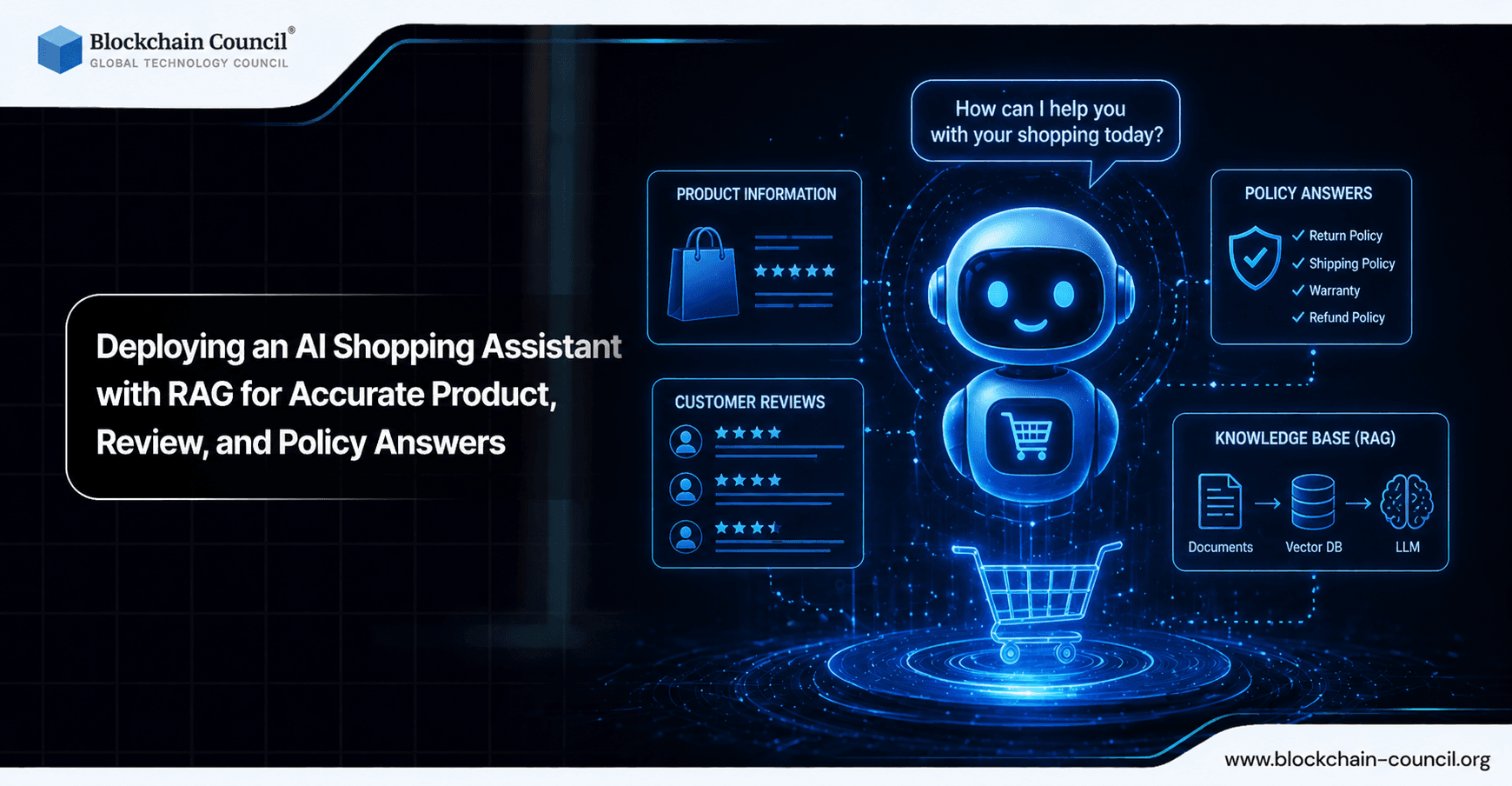
Deploying an AI shopping assistant with RAG has become a practical approach for retailers and marketplaces to deliver accurate, context-aware answers across product catalogs, customer reviews, shipping and returns policies, and support documentation. Instead of relying on a model to recall details from training data, Retrieval-Augmented Generation (RAG) retrieves the most relevant, up-to-date sources and grounds responses in your own data. This reduces hallucinations and builds user trust - which is critical when customers ask questions like "Will this jacket arrive before Friday?" or "Is this blender covered under warranty if it stops working?"
Through 2025 and into 2026, RAG has moved from experimental pilots to production baselines across many enterprises. Advanced patterns including Hybrid RAG, Adaptive RAG, Agentic RAG, and Graph RAG have become common architectural choices, selected based on workload characteristics, latency requirements, and risk tolerance. In parallel, agentic commerce protocols are emerging - OpenAI's Agentic Commerce Protocol (ACP), announced in September 2025, and Google's Universal Commerce Protocol (UCP), announced in January 2026 - both designed to enable natural language purchases using structured catalog signals and integrated checkout flows.

As conversational commerce systems become more autonomous, professionals are increasingly pursuing an AI Security Certification to better understand AI governance, transaction security, and risk management, while the expertise associated with a Chatbot Expert is becoming essential for designing reliable, customer-focused, and commercially effective AI shopping experiences.
What Deploying an AI Shopping Assistant with RAG Actually Means
At a high level, a RAG-based shopping assistant combines two systems:
Retrieval: Searches your knowledge sources - catalog, inventory, reviews, policy pages, order history, FAQs - to find the best evidence for a user's question.
Generation: Uses a large language model (LLM) to produce a conversational answer that cites and follows the retrieved evidence.
For e-commerce, the knowledge sources are more varied than typical enterprise documentation. You often need to merge:
Product catalog data: attributes, variants, compatibility, materials, sizing, images, and structured specifications
Customer reviews: pain points, fit feedback, durability signals, and real-world use cases
Policies: shipping cutoffs, returns and exchanges, warranty terms, price matching, and gift options
Support content: troubleshooting guides, product manuals, order status workflows, and billing FAQs
Operational data: real-time inventory, delivery promises, store pickup readiness, and fraud checks
Why RAG Has Become Strategic Infrastructure in E-Commerce
AI personalization in retail is measured through concrete business outcomes: conversion rate, average order value (AOV), lifetime value (LTV), and reduced support ticket volume. RAG enables these outcomes because it can:
Justify recommendations using evidence from reviews and product specifications, rather than opaque model intuition.
Handle objections around sizing uncertainty, delivery timing, and warranty coverage with policy-grounded answers.
Reduce support load by resolving issues before a ticket is opened, using accurate references to policies and order data.
Enable safe cross-sell and bundling by retrieving compatibility rules and established accessory relationships.
Industry forecasts reflect why teams are investing now: projections estimate agentic commerce could reach trillions of dollars globally by 2030, with a significant share of e-commerce volume attributed to agent-driven shopping experiences. These channels will reward retailers that can serve reliable product and policy answers at low latency, with governance and auditing built in from the start.
RAG Architecture Choices in 2026: From Baseline to Advanced
Choosing the right RAG pattern depends on query types, risk profile, and performance requirements. In shopping assistants, a single approach is rarely optimal across all scenarios.
Hybrid RAG (Production Baseline)
Hybrid RAG combines lexical retrieval (keyword or BM25-style search) with semantic retrieval (vector similarity). This matters for shopping because users mix exact terms ("Gore-Tex", "iPhone 16 case") with intent-driven queries ("something like the one I bought last year"). Hybrid retrieval improves robustness, especially when product names, SKUs, and attributes must match precisely.
Adaptive RAG (Routing by Query Complexity)
Adaptive RAG dynamically determines how much retrieval and reasoning a given query requires. For example:
Simple query: "When is my order ready for pickup?" can be answered directly from order event data.
Complex query: "Why was I double-charged and how do I get a refund?" requires billing history, policy retrieval, and carefully constrained response generation.
This routing approach reduces latency and inference cost while improving accuracy on higher-risk queries.
Agentic RAG (Multi-Step Tool Use)
Agentic RAG allows an assistant to plan multiple steps, call external tools, and perform multi-hop reasoning. In commerce, a typical flow might include: retrieve policy, check inventory, verify delivery promise by zip code, then propose alternatives if an item is out of stock. This pattern is powerful, but increases the need for guardrails, tool permissioning, and comprehensive audit logs.
Graph RAG (Relationships and Connected Knowledge)
Graph RAG is most useful when relationships matter as much as content - such as product compatibility, bundles, user purchase history, and category hierarchies. A graph can connect "camera body" to "lens mount type" to "compatible lenses" and to "frequently bought together" rules. This approach is particularly effective for complex catalogs and high-consideration purchases.
As Agentic RAG and Graph RAG become more common in production environments, many professionals are pursuing a Machine Learning Certification to strengthen their understanding of retrieval systems, knowledge graphs, model evaluation, reasoning workflows, and the techniques required to build reliable AI applications that operate effectively at scale.
How Agentic Commerce Protocols Change the Deployment Target
RAG improves answer quality, but agentic commerce protocols aim to complete transactions within conversational interfaces. Notable developments include:
OpenAI ACP: Announced September 29, 2025, enabling Instant Checkout access across a large weekly user base, initially in the US with international expansion expected through 2026. The protocol is backed by payment infrastructure partnerships and released as open-source under the Apache 2.0 license.
Google UCP: Announced January 2026, partnering with major retailers and platforms with an emphasis on rich structured product signals, including support for an extensive set of product attributes.
For teams deploying an AI shopping assistant with RAG, these protocols introduce two immediate requirements:
Catalog readiness: clean product feeds, consistent attribute naming, and schema markup including Product, Offer, and AggregateRating.
Operational readiness: dynamic availability, accurate pricing, and reliable fulfillment promises to avoid broken experiences at checkout.
Reference Architecture: Connecting Catalogs, Reviews, and Policies
A practical production architecture typically includes the following layers:
Data ingestion layer: connectors for PIM and ERP systems, Merchant Center feeds, review platforms, CMS policy pages, support knowledge bases, and order management systems.
Indexing layer: a hybrid search index combining lexical and vector search, with domain-specific chunking rules for commerce content.
RAG orchestration: query understanding, Adaptive RAG routing, retrieval, reranking, and response generation.
Guardrails: policy constraints, refusal logic for sensitive actions, and source-based quoting for critical claims.
Observability: logs capturing retrieved sources, answer quality metrics, latency, and conversion or deflection outcomes.
Caching: semantic and result caching to meet sub-second latency targets in high-frequency query flows.
Data Modeling and Chunking Guidance for Commerce
Split by intent: maintain separate indexes for product specifications, reviews, and policies. This improves ranking precision and reduces irrelevant retrieval.
Keep policy chunks small: return windows, exclusions, and shipping cutoffs should be retrieved precisely rather than as full pages.
Normalize attributes: standardize sizes, colors, materials, and compatibility fields to reduce retrieval ambiguity.
Review summarization with traceability: extracted themes can be stored for efficiency, but links to original review text should be retained so the assistant can ground its claims.
Deployment Steps: From Pilot to Production
A disciplined rollout helps close the gap between "RAG is possible" and "RAG is working reliably in production." A typical path looks like this:
Map customer journeys and question types
Discovery: "Recommend waterproof boots under $200 that run true to size."
Decision: "Does this item qualify for free returns?"
Post-purchase: "Where is my package and can I change the delivery address?"
Start with one high-impact use case
A common starting point is a product detail page assistant that answers sizing, materials, and shipping questions using catalog data, policies, and reviews.
Select the RAG pattern and technology stack
Hybrid RAG for robust retrieval, combined with Adaptive RAG routing for cost and latency control.
Integrate CRM or CDP signals for personalization where appropriate and privacy-compliant.
Define governance
Assign ownership of prompts, retrieval indexes, and policy updates.
Establish update cadence for product feeds, policy documents, and review ingestion.
Set human review thresholds for high-risk topics such as billing disputes and chargebacks.
Test and iterate with measurable KPIs
Track answer accuracy, citation coverage, response latency, containment rate (support deflection), and conversion impact.
Use A/B testing loops to validate improvements and catch regressions early.
As conversational AI becomes more closely tied to customer acquisition and retention, a Digital Marketing Certification can help professionals strengthen their understanding of customer journeys, conversion optimization, performance measurement, and data-driven strategies for improving business outcomes.
Trust, Privacy, and Quality: Non-Negotiable Requirements
Shopping assistants face heightened trust requirements because errors have direct revenue and customer satisfaction consequences. To manage risk effectively:
Prioritize data freshness: inventory levels, delivery promises, and policy updates must be reflected in the retrieval index without significant delay.
Log retrieved sources: store which documents and attributes were used to generate each answer for auditability and debugging.
Minimize data exposure: apply role-based access controls and redact personal data within retrieval pipelines.
Constrain high-risk outputs: responses about returns, refunds, and billing should follow retrieved policy text exactly, with escalation to human support when the assistant is uncertain.
Skills and Training to Build RAG Shopping Assistants
Deploying an AI shopping assistant with RAG requires competence across LLM application design, search engineering, data pipelines, and security. For teams building these systems, structured learning paths can accelerate skill development. Blockchain Council's Generative AI and AI certification programs provide job-relevant grounding in these areas, with related tracks in AI application development and cybersecurity for teams responsible for secure deployment and governance.
Conclusion: RAG as the Foundation for Accurate Commerce AI
Deploying an AI shopping assistant with RAG is no longer just about making a chatbot sound helpful. In 2026, it is about building a governed, observable, low-latency system that reliably connects product catalogs, reviews, and policies to answer real customer questions with verifiable evidence. Hybrid RAG is the production baseline for most teams. Adaptive RAG improves efficiency by routing queries according to complexity. Agentic and Graph RAG unlock multi-step reasoning across complex, interconnected commerce data.
As agentic commerce protocols expand, the organizations that benefit most will be those that treat RAG as a living asset: continuously updated feeds, measurable quality loops, and disciplined controls for privacy and trust. Done well, RAG-powered assistants reduce support burden, improve conversion rates, and make shopping experiences more transparent and decision-friendly for customers.
FAQs
1. What is an AI shopping assistant with RAG?
An AI shopping assistant with RAG combines a language model with a retrieval system. It pulls product, review, and policy data to generate accurate responses. This improves reliability and reduces hallucinations.
2. How does RAG improve shopping assistant accuracy?
RAG retrieves relevant data from trusted sources before generating answers. This grounds responses in real information. It reduces incorrect or outdated outputs.
3. What data sources are used in a RAG-based shopping assistant?
Common sources include product catalogs, customer reviews, FAQs, and store policies. These are indexed in a vector database. High-quality data improves response accuracy.
4. How do you ingest product and review data for RAG?
Data is collected, cleaned, and structured before indexing. It is then converted into embeddings for storage in a vector database. Proper ingestion ensures effective retrieval.
5. What is chunking in a shopping RAG system?
Chunking splits product descriptions, reviews, and policies into smaller sections. This improves retrieval precision. Proper chunking helps the assistant provide relevant answers.
6. How does metadata improve RAG performance in e-commerce?
Metadata such as product category, price, and ratings helps filter results. It enables more targeted retrieval. This improves relevance and user experience.
7. What vector databases are suitable for shopping assistants?
Popular options include Pinecone, Weaviate, and Milvus. They support fast similarity search and scalability. The choice depends on performance and infrastructure needs.
8. How can developers ensure accurate policy responses?
Policies should be clearly structured and regularly updated. Retrieval pipelines must prioritize official sources. Validation checks help ensure correctness.
9. What role does prompt design play in RAG systems?
Prompt design guides how retrieved data is used in responses. Clear instructions improve accuracy and coherence. It ensures the model uses relevant context effectively.
10. How can hallucinations be reduced in AI shopping assistants?
Using RAG with trusted data sources reduces hallucinations. Adding guardrails and validation improves reliability. Continuous monitoring is also important.
11. How do you evaluate a RAG-based shopping assistant?
Evaluation includes testing response accuracy, relevance, and latency. Real user queries help assess performance. Feedback loops improve system quality.
12. What are common challenges in deploying RAG systems?
Challenges include data quality, retrieval accuracy, and system latency. Integration complexity can also be an issue. Proper design and testing are required.
13. How does RAG handle real-time product updates?
New data is ingested and indexed regularly. Incremental updates keep the system current. This ensures accurate and up-to-date responses.
14. What security considerations are important for shopping assistants?
Security includes protecting user data and securing APIs. Access controls and encryption are essential. Monitoring helps detect potential threats.
15. How can RAG improve customer experience in e-commerce?
RAG provides accurate and context-aware answers to user queries. It helps customers make informed decisions. This increases satisfaction and conversions.
16. Can RAG systems support multilingual shopping assistants?
Yes, multilingual embeddings and models enable support for multiple languages. This improves accessibility for global users. Proper training data is required.
17. How do you scale a RAG-based shopping assistant?
Scaling involves distributed vector databases and efficient indexing. Load balancing and caching improve performance. Cloud infrastructure supports scalability.
18. What tools are used to build RAG shopping assistants?
Tools include language models, vector databases, and frameworks like LangChain or LlamaIndex. APIs connect system components. These tools enable efficient development.
19. How can businesses integrate RAG assistants into their platforms?
They can integrate through APIs or embed assistants into websites and apps. Backend systems connect data sources and models. Seamless integration improves usability.
20. What are best practices for deploying AI shopping assistants with RAG?
Use high-quality data, optimize retrieval, and design clear prompts. Monitor performance and update data regularly. Focus on accuracy, security, and scalability.
Related Articles
View All
AI & ML
OpenAI Launches GPT-6.1 Terra: What’s New?
OpenAI has launched GPT-6.1 Terra, a faster and cheaper mid-tier model with stronger computer use, better image understanding and fewer errors. See what is new, what it costs, and who can use it.

AI & ML
Built to Catch AI Cheating: Rethinking Pre-Employment Assessments with HireValid
Explore how HireValid is rethinking pre-employment assessments with AI-resistant test design, integrity signals, candidate evidence, and human review to address AI-assisted cheating.
AI & ML
AI-Era Hiring Needs AI-Proof Tests: How HireValid Is Redefining Talent Assessment
Explore how HireValid is rethinking talent assessment for the AI era with job-relevant tests, anti-cheating design, integrity signals, and human-reviewed evidence of candidate ability.
Trending Articles
The Role of Blockchain in Ethical AI Development
How blockchain technology is being used to promote transparency and accountability in artificial intelligence systems.
How Blockchain Secures AI Data
Understand how blockchain technology is being applied to protect the integrity and security of AI training data.
What is AWS? A Beginner's Guide to Cloud Computing
Everything you need to know about Amazon Web Services, cloud computing fundamentals, and career opportunities.