

Chinese AI
 Suyash Raizada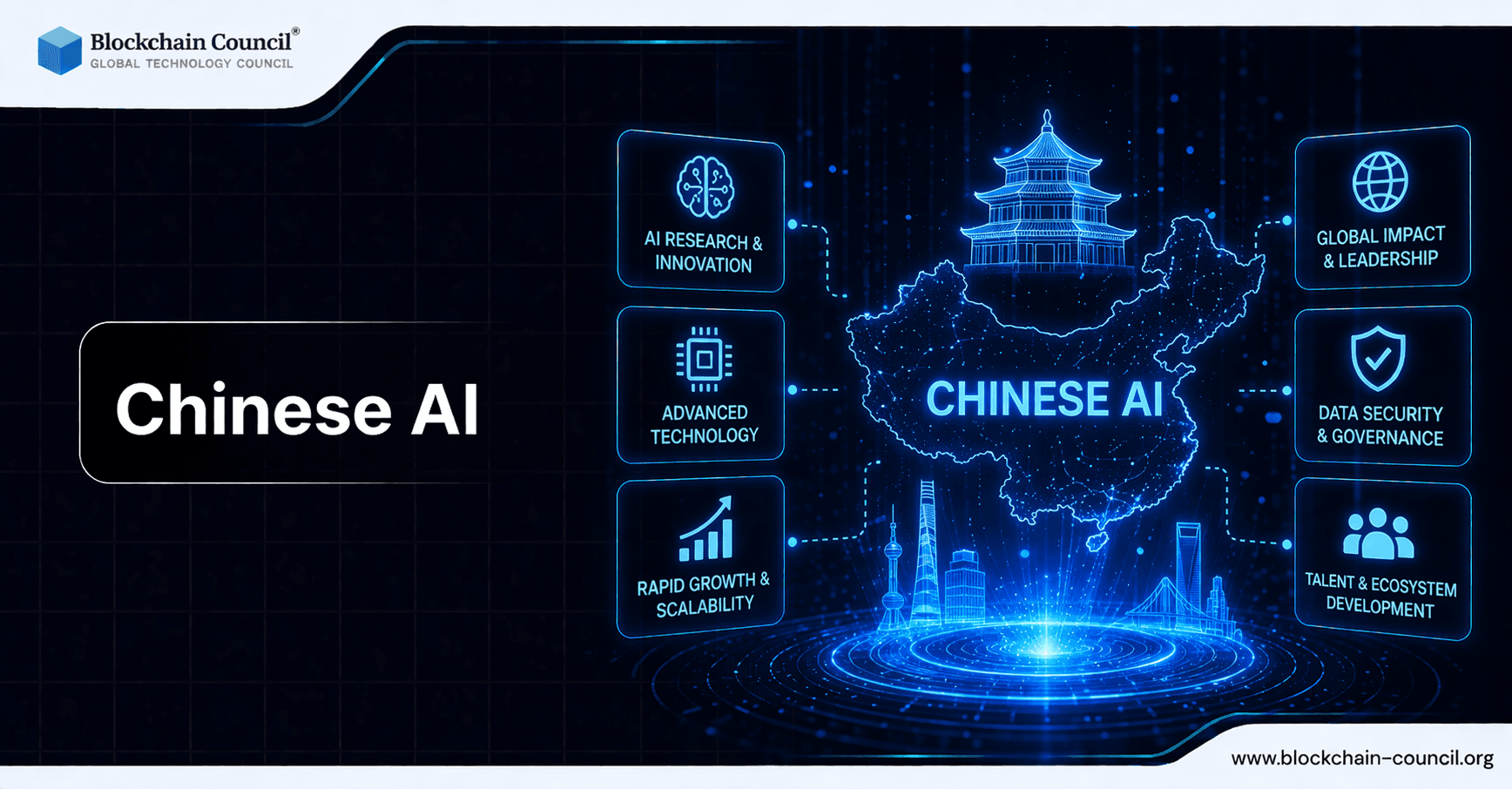
China has emerged as one of the most influential players in the global artificial intelligence landscape. With strong government support, massive data availability, and a rapidly growing technology ecosystem, Chinese AI development has accelerated at an impressive pace. From facial recognition systems to large language models and smart cities, China’s AI capabilities are shaping industries both domestically and internationally.
This article explores the evolution of Chinese AI, its latest developments, real world applications, governance frameworks, and global implications. It also highlights how professionals can build expertise to navigate this rapidly evolving field.

For those seeking structured knowledge in artificial intelligence, certifications such as the Claude Code Certification and the AI expert certification provide valuable learning pathways.
Overview of Chinese AI Development
China’s AI journey began with a focus on applied technologies, but it has quickly expanded into advanced research and innovation. Over time, the country has built a comprehensive ecosystem that includes academic institutions, private enterprises, and government initiatives working together to drive progress.
Key Drivers of Growth
Government investment and strategic planning
Large scale data availability
Rapid digital adoption among citizens
Strong private sector participation
These factors have allowed China to rapidly scale AI solutions and integrate them into everyday life.
Government Role in AI Advancement
National AI Strategy
The Chinese government has introduced long term strategies aimed at making China a global leader in AI. These plans include funding research, building infrastructure, and developing talent pipelines to sustain growth over time.
Policy Support
Policies are designed to encourage innovation while maintaining oversight. This dual approach allows rapid development while ensuring alignment with national priorities and security considerations.
Public Private Collaboration
Close collaboration between government and technology companies ensures that innovations are quickly implemented and aligned with broader economic and social goals.
Leading Chinese AI Companies
China is home to several major companies driving AI innovation across multiple sectors.
Baidu
Baidu focuses on autonomous driving, natural language processing, and AI research, playing a major role in advancing intelligent transportation systems.
Alibaba
Alibaba leverages AI for e-commerce optimization, cloud computing, and logistics, improving efficiency and customer experience.
Tencent
Tencent applies AI in gaming, social platforms, and healthcare, integrating intelligent systems into widely used consumer services.
Huawei
Huawei develops AI hardware and enterprise solutions, contributing to infrastructure and global technology deployment.
These companies collectively shape the direction of Chinese AI development and innovation.
Real World Applications of Chinese AI
Smart Cities
AI is used to manage traffic, energy consumption, and public services in urban areas, improving efficiency and sustainability.
Facial Recognition
Widely deployed for security, payments, and identity verification, this technology demonstrates the scale of AI adoption in China.
Healthcare
AI assists in diagnostics, medical imaging, and patient management, enhancing healthcare delivery and outcomes.
E Commerce
Platforms use AI to personalize recommendations, optimize supply chains, and improve customer satisfaction.
Example
A large Chinese metropolitan area uses AI powered traffic systems to analyze real time data from cameras and sensors. This allows authorities to adjust traffic signals dynamically, reduce congestion, and improve overall transportation efficiency, showcasing the practical benefits of AI integration.
Chinese AI in Global Competition
United States vs China
The United States leads in foundational AI research and innovation, while China excels in large scale implementation and rapid deployment of technologies.
Europe
Europe focuses on ethical frameworks and regulatory standards, emphasizing responsible AI development.
China’s Position
China combines strong government direction with industry innovation, creating a unique model that prioritizes scale and efficiency.
AI Regulation in China
Strict Governance
China enforces comprehensive regulations governing AI development, particularly in areas such as data usage, content generation, and platform behavior.
Generative AI Policies
Recent policies address risks associated with generative AI, including misinformation, deepfakes, and intellectual property concerns.
Data Security
Strong data protection measures ensure that information is controlled and used in accordance with national policies.
Ethical Considerations
Privacy Concerns
Extensive data collection raises important questions about individual privacy and data protection.
Surveillance
The use of AI for monitoring purposes has sparked debates about civil liberties and ethical boundaries.
Bias and Fairness
Ensuring that AI systems produce fair and unbiased outcomes remains an ongoing challenge.
Chinese AI in Business
Automation
AI enables businesses to automate repetitive tasks, increasing efficiency and reducing operational costs.
Decision Making
Data driven insights allow organizations to make informed strategic decisions.
Customer Experience
Personalized services improve user satisfaction and engagement.
Professionals interested in developing AI systems can explore the AI Powered coding expert Course.
AI in Marketing and Digital Platforms
Chinese companies use AI extensively in marketing to analyze consumer behavior, predict trends, and deliver targeted campaigns. This enhances engagement and improves overall effectiveness.
For deeper understanding, the AI powered marketing course offers practical insights.
Recent Developments in Chinese AI
Large Language Models
Chinese firms have developed advanced language models capable of competing with global systems, improving capabilities in natural language processing and communication.
AI Chips
Investment in domestic semiconductor production aims to reduce reliance on foreign technology and strengthen national capabilities.
Autonomous Vehicles
Significant progress has been made in self driving technologies, with pilot programs and real world testing underway.
Robotics
AI powered robots are increasingly used in manufacturing, logistics, and service industries.
Challenges Facing Chinese AI
International Restrictions
Trade limitations and export controls affect access to advanced hardware and technologies.
Talent Competition
Global demand for skilled AI professionals creates competition for talent.
Ethical Concerns
Balancing innovation with ethical considerations remains complex.
Regulation Complexity
Strict policies can both enable and limit growth, requiring careful balance.
Future of Chinese AI
Continued Innovation
China is expected to maintain strong momentum in AI development and deployment.
Global Influence
Chinese AI technologies will continue to expand into international markets.
Integration Across Industries
AI will become more deeply embedded in sectors such as healthcare, transportation, and finance.
Preparing for the AI Landscape
Skill Development
Understanding AI technologies is essential for professionals across industries.
Continuous Learning
Keeping up with advancements ensures relevance in a rapidly evolving field.
Practical Application
Hands on experience helps build expertise and confidence.
Conclusion
Chinese AI represents a powerful combination of innovation, scale, and governance. Its rapid development has positioned China as a global leader in artificial intelligence, influencing industries and shaping the future of technology.
While challenges remain, including ethical concerns and international competition, China’s AI ecosystem continues to evolve and expand. Understanding its dynamics is essential for professionals, businesses, and policymakers navigating the global AI landscape.
FAQs
1. What is Chinese AI?
Chinese AI refers to the development, deployment, and governance of artificial intelligence technologies within China’s technological and regulatory ecosystem. It includes innovations from private companies, research institutions, and government backed initiatives. The term encompasses everything from consumer applications like recommendation engines to advanced systems such as autonomous vehicles and large language models, all shaped by China’s unique approach to scale and centralized planning.
2. Why is China a leader in AI?
China has become a leader in AI due to a combination of strong government support, access to vast amounts of data, and a highly competitive technology sector. The country’s ability to rapidly implement and scale AI solutions across industries gives it a distinct advantage. Additionally, strategic investments in research, infrastructure, and talent development have accelerated progress.
3. What industries use AI in China?
AI is widely used across industries such as healthcare, finance, manufacturing, transportation, and e commerce. Each sector benefits from automation, predictive analytics, and improved decision making capabilities, making AI an integral part of China’s economic growth.
4. How does China regulate AI?
China regulates AI through a combination of laws, guidelines, and strict oversight mechanisms. These regulations focus on data security, content control, and ethical considerations, ensuring that AI development aligns with national priorities while managing risks effectively.
5. What are the benefits of Chinese AI?
The benefits include increased efficiency, improved services, economic growth, and technological innovation. AI enhances productivity and enables new capabilities across industries, contributing to overall development.
6. What are the risks of Chinese AI?
Risks include privacy concerns, surveillance implications, algorithmic bias, and ethical challenges. These issues require careful governance and ongoing evaluation to ensure responsible use.
7. How does China compare to the US in AI?
The United States leads in foundational research and innovation, while China excels in rapid deployment and large scale application. Both countries are key players shaping the global AI landscape.
8. What is China’s AI strategy?
China’s strategy focuses on becoming a global leader in AI through investment, innovation, and policy support. It emphasizes integration across industries and long term development.
9. How is AI used in Chinese cities?
AI is used to manage traffic, optimize energy use, and improve public services, making cities more efficient and sustainable.
10. What is the role of data in Chinese AI?
Data is a critical resource that enables AI systems to learn, adapt, and improve. China’s large population and digital infrastructure provide extensive datasets for training models.
11. How does AI impact Chinese businesses?
AI improves efficiency, enhances decision making, and enables personalized customer experiences, giving businesses a competitive advantage.
12. What are AI chips?
AI chips are specialized processors designed to handle AI workloads efficiently, supporting faster computation and improved performance.
13. How is China addressing AI ethics?
China is developing policies and guidelines to address ethical concerns, though balancing innovation and ethics remains an ongoing challenge.
14. What is the future of Chinese AI?
The future includes continued growth, technological advancement, and increasing global influence, with AI becoming more integrated into everyday life.
15. How can professionals learn Chinese AI trends?
Professionals can stay informed by studying AI technologies, following industry developments, and gaining practical experience.
16. What is AI in Chinese healthcare?
AI is used for diagnostics, treatment planning, and patient management, improving healthcare outcomes and efficiency.
17. How does AI affect privacy in China?
AI raises privacy concerns due to extensive data collection and surveillance applications, making governance and regulation critical.
18. What is China’s approach to AI innovation?
China combines government support with private sector initiatives to drive rapid innovation and large scale deployment.
19. How does AI influence Chinese marketing?
AI enables highly targeted and personalized marketing strategies based on consumer data and behavior analysis.
20. Why is Chinese AI important globally?
Chinese AI is important because it influences global technology trends, competition, and policy development, shaping the future of artificial intelligence worldwide.
Related Articles
View All
AI & ML
OpenAI Launches GPT-6.1 Terra: What’s New?
OpenAI has launched GPT-6.1 Terra, a faster and cheaper mid-tier model with stronger computer use, better image understanding and fewer errors. See what is new, what it costs, and who can use it.

AI & ML
Built to Catch AI Cheating: Rethinking Pre-Employment Assessments with HireValid
Explore how HireValid is rethinking pre-employment assessments with AI-resistant test design, integrity signals, candidate evidence, and human review to address AI-assisted cheating.

AI & ML
AI-Era Hiring Needs AI-Proof Tests: How HireValid Is Redefining Talent Assessment
Explore how HireValid is rethinking talent assessment for the AI era with job-relevant tests, anti-cheating design, integrity signals, and human-reviewed evidence of candidate ability.
Trending Articles
The Role of Blockchain in Ethical AI Development
How blockchain technology is being used to promote transparency and accountability in artificial intelligence systems.

Top 5 DeFi Platforms
Explore the leading decentralized finance platforms and what makes each one unique in the evolving DeFi landscape.
How Blockchain Secures AI Data
Understand how blockchain technology is being applied to protect the integrity and security of AI training data.